Barn Doors vs Solid Doors for Privacy: Which Is Better? (Guide)

I once made a significant error in a home renovation by prioritizing a specific visual trend over the functional requirements of the space. I selected a beautiful, reclaimed wood sliding slab for a primary bedroom entrance, admiring its rustic texture and the way it saved floor space. Within a week, the lack of acoustic separation and the light bleeding through the sides made the room feel less like a sanctuary and more like a hallway. This experience taught me that in the world of high-end home materials, a choice that looks excellent in a showroom can fail miserably if it does not meet the technical performance standards required for daily living.
Understanding Sound Transmission Class (STC) in Home Material Comparison
Sound Transmission Class, or STC, is an integer rating that quantifies how well a building partition reduces airborne sound. In the context of interior portals, it measures the decibel reduction provided by the barrier. A higher STC rating indicates better noise isolation, which is a critical metric when evaluating how different closure styles perform in private living areas.
When I analyze supply chains for interior materials, I look at the ASTM E90 and E413 standards. These tests determine how much sound passes through a material at various frequencies. A traditional hinged unit with a solid core typically achieves an STC rating between 30 and 35. In contrast, a surface-mounted sliding system often struggles to reach an STC of 20. This is not necessarily due to the material of the door itself, but because sound behaves like water; it moves through the easiest path. The gaps required for a sliding mechanism to clear the wall act as massive “leaks” for noise.
- STC 20: Speech is clearly audible through the barrier.
- STC 30: Loud speech can be heard but not understood.
- STC 35: Loud speech is audible only as a murmur.
- STC 40: Great for privacy; loud speech is mostly inaudible.
Interestingly, even a high-density slab will perform poorly if the perimeter is not sealed. Building on this, homeowners must decide if the visual appeal of a sliding system is worth the 10 to 15-point drop in decibel reduction compared to a standard hinged setup.
Material Density and Technical Material Specifications for Interior Openings
Material density refers to the mass of the door slab relative to its volume, usually measured in pounds per cubic foot. In material science, a denser object provides a more formidable barrier to both sound waves and physical force. Technical specifications often distinguish between hollow-core, solid-core, and solid wood constructions, each offering different levels of thermal and acoustic resistance.
In my 13 years of evaluating materials, I have found that solid-core doors—typically made of a composite wood fiber or a mineral core—offer the best balance of performance and cost. These units usually weigh between 80 and 120 pounds for a standard 30-inch width. A hollow-core door, by comparison, weighs about 30 to 40 pounds. The added mass of the solid core significantly improves the “thud” factor and the feeling of permanence in a home.
The Janka Hardness Scale and Surface Durability
The Janka hardness test measures the resistance of a wood sample to denting and wear. It involves measuring the force required to embed an 11.28-millimeter steel ball halfway into the wood. This metric is essential for homeowners with high-traffic households or pets.
- White Oak: 1,360 lbf (Excellent for high-traffic areas)
- Hard Maple: 1,450 lbf (Very durable, resists denting)
- Pine: 380–420 lbf (Soft, prone to scratches and dings)
- MDF (Medium Density Fiberboard): N/A (Uniform density, excellent for paint, but lacks grain)
As a result of these specs, if you choose a sliding system made of soft pine, the bottom edges are likely to show wear quickly if the floor guide is not perfectly aligned. Conversely, a solid oak hinged door is a “set it and forget it” investment in terms of structural durability.
Durability vs Maintenance Cost: Analyzing the Lifecycle of Door Hardware
Durability vs maintenance cost is a comparison of the upfront investment in high-quality components against the long-term expenses of repairs and adjustments. High-quality hardware should operate smoothly for decades with minimal intervention. Inexpensive systems often require frequent recalibration, lubrication, or part replacement, which increases the total cost of ownership over time.
From a supply chain perspective, the hardware for a sliding system is far more complex than a standard hinge. A sliding track involves rollers, ball bearings, anti-jump blocks, and floor guides. If the track is made of thin-gauge steel, it may bow under the weight of a heavy solid-wood slab. I have seen tracks fail after only three years of use because the bearings were not sealed, leading to a “grinding” noise during operation.
- Hinged Hardware: Usually consists of three 3.5-inch or 4-inch steel hinges. Maintenance involves tightening a screw once every few years.
- Sliding Hardware: Requires a heavy-duty rail, usually 6 to 8 feet long. Maintenance includes cleaning the track of dust and ensuring the floor guide hasn’t shifted, which could cause the door to scratch the baseboard.
| Feature | Traditional Hinged (Solid Core) | Sliding Surface-Mount (Solid Core) |
|---|---|---|
| Upfront Hardware Cost | Low ($20 – $50) | Moderate to High ($150 – $600) |
| Installation Time | 1 – 2 Hours | 3 – 5 Hours |
| 15-Year Maintenance | Near Zero | Periodic Lubrication/Alignment |
| Acoustic Seal | High (4-sided contact) | Low (Significant air gaps) |
| Light Blockage | Excellent | Poor (Halo effect around edges) |
Trade-off Analysis: Space Efficiency vs Acoustic Sealing
A trade-off analysis is the process of weighing one desirable feature against another to find the best fit for a specific environment. In home design, this often involves choosing between the floor space saved by a sliding door and the superior privacy offered by a swinging door. Understanding these technical trade-offs prevents buyer’s remorse after the installation is complete.
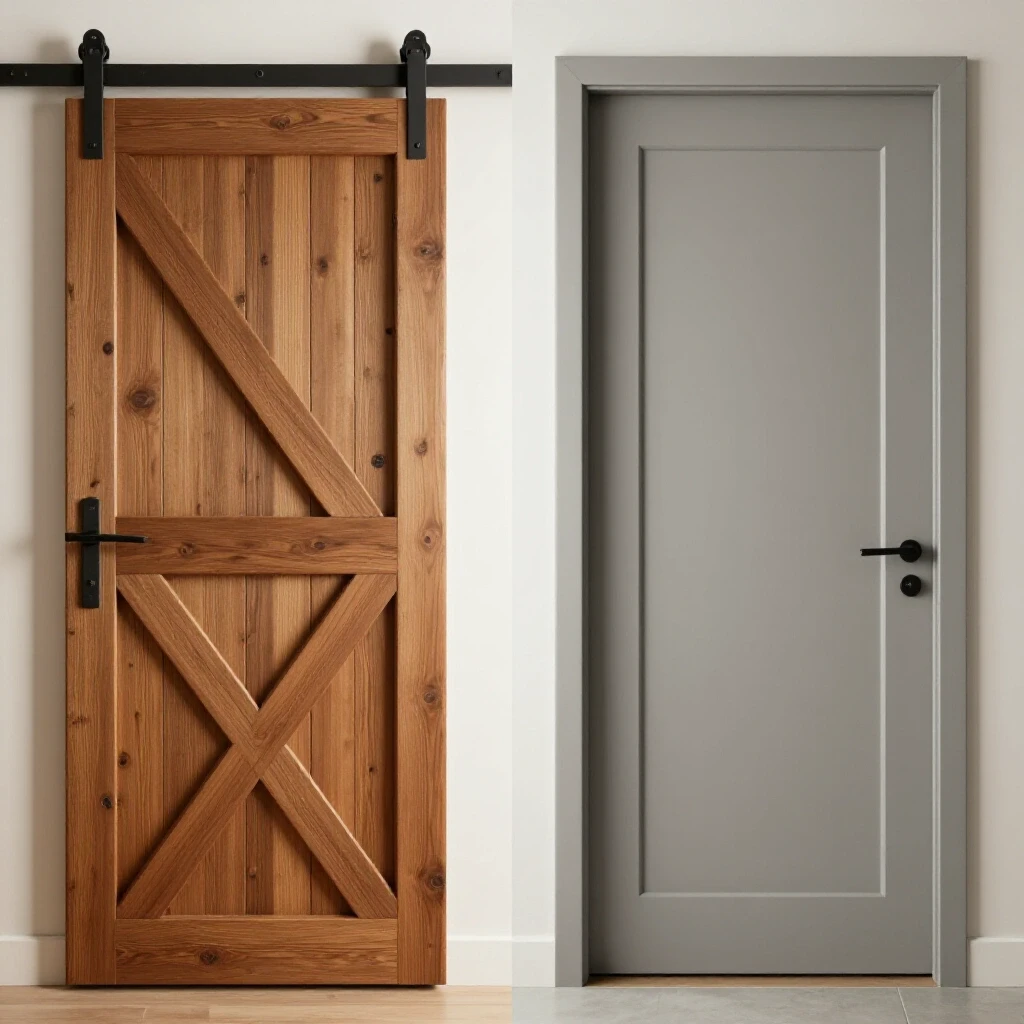
The biggest advantage of a sliding track system is the “swing-clear” benefit. In a small bathroom or a narrow hallway, a door that swings inward can consume up to 10 square feet of usable space. By mounting the door on a track, you reclaim that floor area. However, the technical trade-off is the “privacy gap.” To prevent the door from rubbing against the wall or the casing, it must sit approximately 0.5 to 0.75 inches away from the wall.
This gap is where the privacy lesson becomes real. Light from a hallway will spill into a dark bedroom through this perimeter gap. Similarly, odors and sounds from a bathroom will escape easily. If you are evaluating high-end home materials for a primary suite, I recommend a hinged door for the bathroom and a sliding door only for a walk-in closet where privacy is not a concern.
Selecting High-End Home Materials Based on Privacy Performance
Selecting materials based on privacy performance involves evaluating how a product manages light, sound, and sightlines. This goes beyond the aesthetic of the material and looks at the engineering of the entire system. High-end materials should provide a sense of seclusion and security, which are the hallmarks of a well-designed private space.
During my comparative evaluations, I used a simple light-meter test. With a standard 60-watt bulb on in a hallway, I measured the light leakage into a pitch-black room. The hinged door, when equipped with a standard stop and casing, allowed virtually zero light into the room. The sliding door created a “halo” of light around all four sides. For a light-sensitive sleeper, this is a technical failure that no amount of expensive reclaimed timber can fix.
- Check the Slab Thickness: Standard interior doors are 1 3/8 inches thick. For better privacy, look for 1 3/4 inch “architectural grade” slabs.
- Inspect the Core: Knock on the center. A hollow sound indicates a cardboard honeycomb interior, which offers poor acoustic insulation.
- Evaluate the Seal: For hinged doors, look for integrated weather stripping or “smoke seals” if you want recording-studio levels of quiet.
- Verify the Track Rating: Ensure the sliding hardware is rated for at least 20% more weight than the door slab to prevent sagging.
An Appliance Buying Guide Approach to Door Hardware Sourcing
Applying an appliance buying guide approach means looking at the technical specifications, warranty terms, and mechanical reliability of the hardware. Just as you would check the decibel rating on a dishwasher, you should check the cycle-test rating on door rollers. This systematic approach ensures that the “moving parts” of your home do not become the weak link in your renovation.
When I source hardware for large-scale projects, I look for “Grade 1” or “Grade 2” ratings from the Builders Hardware Manufacturers Association (BHMA). A Grade 1 hinge or roller is tested for hundreds of thousands of cycles. For a sliding door, the quality of the wheels is paramount. Nylon-coated wheels with ball bearings offer the quietest operation, whereas solid steel wheels on a steel track can be quite noisy—a detail often missed in the initial purchase phase.
Installation Complexity and Structural Demands
Building on the hardware discussion, the installation of these two systems is vastly different. A hinged door requires a plumb and square frame. If the house settles, you might need to plane the door. A sliding door requires a perfectly level track. If the track is even 1/16th of an inch out of level, a heavy door will “ghost roll,” meaning it will slide open or closed on its own.
Furthermore, a sliding system requires structural blocking. You cannot simply screw a 150-pound door and track into drywall. You must have a solid wood header (usually a 2×6 or 2×8) installed behind the drywall to catch the track screws. This is a hidden cost that many homeowners overlook during their initial trade-off analysis.
Practical Buying Worksheet: Privacy and Performance Matrix
To help you make a confident decision, use this scoring matrix. Rate each category from 1 (Poor) to 5 (Excellent) based on your specific room needs.
- Acoustic Privacy Needed: (Bedroom/Office = 5, Closet = 1)
- Light Control Needed: (Nursery/Bedroom = 5, Pantry = 1)
- Floor Space Availability: (Tight Hallway = 1, Large Room = 5)
- Budget for Hardware: (High-end rollers = 5, Standard hinges = 1)
- DIY Skill Level: (High = 5, Low = 1)
Results Analysis: * Total Score 15-25: A traditional solid-core hinged door is your best technical fit. It provides the privacy and light control you require. * Total Score 5-14: A sliding system is a viable option. The space savings likely outweigh the loss of acoustic privacy.
Final Supply-Chain and Cost Recommendations
When you are ready to purchase, avoid the “kit” options found at big-box retailers if you are looking for long-term durability. These kits often use thinner tracks and plastic components that degrade. Instead, source your slab and your hardware separately. This allows you to pair a high-quality solid-core slab with industrial-grade rollers.
In my experience, the total cost for a high-quality hinged solid-core setup (including slab, frame, and hardware) ranges from $300 to $600. A comparable sliding setup with a high-end track and a solid-core slab will range from $600 to $1,200. The higher upfront price of the sliding system does not translate to better privacy; it translates to specialized hardware and aesthetic appeal.
By focusing on the technical material specifications and understanding the physics of sound and light, you can avoid the mistakes I made. A door is more than a visual element; it is a functional valve for your home’s environment. Choose the one that matches the lifestyle you actually lead, not just the one that looks best in a photograph.
FAQ: Technical Performance of Interior Portals
How can I improve the soundproofing of an existing sliding door? You can install “brush seals” or weather stripping along the edges of the door to close the air gaps. Additionally, ensuring the door overlaps the wall opening by at least two inches on each side will help reduce sound and light leaks.
Does a solid wood door warp more than a solid-core composite door? Yes. Solid wood is a natural material that expands and contracts with humidity. In environments with high moisture, like a bathroom, a solid-core composite (MDF or particle core) is actually more stable and less likely to warp over time.
What is the “halo effect” in interior lighting? The halo effect refers to the ring of light that escapes around the perimeter of a surface-mounted sliding door. Because the door does not sit flush against a jamb, light from the adjacent room reflects off the wall and into the dark room.
Is there a way to lock a sliding door for privacy? Yes, but the mechanisms are often less robust than a standard deadbolt or privacy latch. Most sliding doors use a “teardrop” latch or a floor-mounted bolt. These are functional but can be more difficult to align and operate than a standard door handle.
How much weight can a standard interior wall support for a sliding track? A standard wall can support a heavy door only if the track is screwed directly into the wall studs or a structural header. Never rely on drywall anchors for a sliding door; the constant movement and weight will eventually cause the anchors to pull through the gypsum.
What is the difference between a “barn door” and a “pocket door”? A barn door slides on the outside of the wall, leaving the hardware visible and creating a gap. A pocket door slides into a recessed cavity inside the wall. Pocket doors offer better space savings and slightly better privacy than barn doors, but they are much more expensive to install in an existing wall.
Why do some sliding doors make a loud clicking sound? This usually indicates that the rollers have “flat spots” from sitting in one position too long or that the bearings are failing. High-quality, precision-bearing rollers will stay silent for years, whereas cheap plastic wheels will develop noise quickly.
Can I use a hollow-core door for a sliding track system? It is not recommended. Hollow-core doors lack the internal structural “stiles” (the wood frame inside the door) to securely hold the heavy bolts required for sliding hardware. The bolts may eventually pull out of the thin veneer.
What is the best Janka rating for a family home with large dogs? Look for woods with a Janka rating above 1,200 lbf, such as White Oak or Hard Maple. These materials are much more resistant to claw scratches and impact damage than softer woods like Pine or Cedar.
How often should I lubricate my door hardware? Hinges rarely need lubrication unless they squeak. Sliding tracks should be wiped clean of dust every six months. If the rollers are not sealed, a small amount of silicone-based lubricant can be applied annually to keep the movement fluid.
(This article was written by one of our staff writers, Andrew Morrison. Visit our Meet the Team page to learn more about the author and their expertise.)