Deck Repair Cost Breakdown: 5-Year Real Data & Savings (Guide)

Maintaining what we already own is the ultimate form of sustainability. In a world that often pushes for complete replacements and brand-new construction, choosing to restore and preserve an existing outdoor structure is both environmentally responsible and financially savvy. By extending the life of a wooden deck through disciplined maintenance, we reduce waste and keep thousands of dollars in our interest-bearing accounts rather than handing them over to a demolition crew.
Over the last decade, I have tracked every cent of my home improvement spending. My spreadsheets show that the most successful projects aren’t the ones with the biggest budgets, but the ones with the most consistent care. When I looked at my five-year ledger for my own backyard deck, the data revealed a clear story about how small, planned investments prevent massive, unplanned failures.
Establishing a Financial Framework for Outdoor Maintenance
A financial framework for home maintenance is a structured plan that treats your house like an asset with a predictable depreciation schedule. Instead of waiting for a board to rot, you allocate a “sinking fund” or a dedicated savings category for recurring upkeep. This proactive approach turns a potential $15,000 replacement into a manageable series of small, intentional expenses.
In my experience, homeowners often struggle because they view home maintenance as an “if” rather than a “when.” When I first began tracking my outdoor restoration project, I set a strict budget boundary of $2,800 over five years. I knew that if I exceeded this, I was likely over-improving for my neighborhood’s market ceiling.
To stay on track, I used a simple formula: the 1% rule. This suggests setting aside 1% of your home’s total value annually for all maintenance. For a $400,000 home, that is $4,000 a year. My deck restoration was a subset of this fund. By breaking this down into monthly increments, I avoided the “sticker shock” that usually comes when you realize you need forty gallons of high-quality sealant and a rented floor sander.
- Establish a dedicated savings bucket for exterior projects.
- Review your local housing market reports to ensure your total investment doesn’t exceed 2% of your home’s value.
- Track every hardware store run, no matter how small.
Why Initial Restoration Estimates Often Underestimate Long-Term Expenses
Initial estimates fail because they focus only on the “Day One” costs. A realistic expense forecast must include the “tail” of the project—the secondary materials and tools required to keep the wood from degrading after the first year. Most DIYers forget to account for the price of consumables like sanding pads, brushes, and specialized cleaners.
When I started my five-year tracking period, I estimated I would spend $1,200. My actual spreadsheet showed a final total closer to $2,100. Why the $900 variance? It wasn’t one big mistake; it was the “creep” of inflation on wood products and the realization that my deck required a mid-cycle touch-up in year three that I hadn’t originally planned for.
The Role of Material Price Volatility
Material price volatility refers to the unpredictable swings in the cost of raw goods like lumber, stains, and hardware. In the home renovation world, these shifts can happen monthly based on global supply chains or seasonal demand. Understanding this helps you time your purchases when prices are historically lower, such as late autumn.
During my five-year window, I noticed that the price of high-quality oil-based stains fluctuated by as much as 25%. By tracking these prices on my spreadsheet, I learned to buy my materials in the “off-season.” This small adjustment saved me nearly $150 over the life of the project.
Accounting for Tool Depreciation and Rental Fees
Tool depreciation is the loss of value in your equipment over time, while rental fees are the costs paid to use professional-grade machinery for short periods. For a deck project, you must decide if buying a power washer is more cost-effective than renting one three times over five years.
I chose to rent a commercial-grade sander for the initial heavy lifting. My ledger showed that renting for two days cost $140, whereas buying a lower-quality version would have cost $300 and taken up valuable garage space. However, I purchased a mid-range power washer because the math showed it would pay for itself by the third year of seasonal cleaning.
| Item Type | Projected Cost (Year 1) | Actual 5-Year Total | Variance |
|---|---|---|---|
| Wood Cleaners/Strippers | $80 | $220 | +$140 |
| Sanding Supplies | $60 | $115 | +$55 |
| High-End Sealant/Stain | $450 | $980 | +$530 |
| Fasteners/Small Hardware | $40 | $85 | +$45 |
| Tool Rentals/Purchases | $300 | $700 | +$400 |
| Total | $930 | $2,100 | +$1,170 |
A Line-Item Audit of DIY Restoration Materials
A line-item audit is a granular breakdown of every single component required for a project. Instead of a broad “materials” category, you list every brush, every gallon of solvent, and every box of screws. This prevents the “death by a thousand cuts” where small, unrecorded purchases eventually blow your budget.
When you are working within a $400 to $2,800 range, every $20 matters. In year one, I focused on the heavy restoration. In years two through five, the costs shifted toward “maintenance materials.” This transition is where many homeowners stop tracking, leading to a deck that looks great for two years and then fails by year six.
- Year 1: The Foundation. This is your most expensive year. Focus on high-quality wood brighteners and deep-penetrating stains.
- Year 3: The Refresh. Budget for a light cleaning and a single “maintenance coat” of sealer to protect the high-traffic areas.
- Year 5: The Evaluation. Assess if the wood needs another round of light sanding or if the current protective layer is holding.
The Financial Reality of Sweat Equity
Sweat equity is the non-monetary contribution a homeowner makes to a project through their own labor. While it “saves” money on the balance sheet, it has a real cost in terms of your time and physical effort. Calculating the value of your labor helps you decide if a DIY approach is truly the most efficient use of your resources.
I spent approximately 60 hours over five years on my deck. If I value my time at a modest $30 per hour, that is $1,800 in labor value. When added to my $2,100 material cost, the “true” cost of the project was $3,900. For a cost-conscious planner, this calculation is vital. If the DIY approach takes you away from your primary job or family time, the “savings” might be an illusion.
However, for most homeowners in the 28–55 age bracket, the DIY route is a way to ensure the job is done to their specific standards without the markup of a service provider. I found that doing the work myself allowed me to be much more selective with materials, choosing a premium stain that a professional might have upcharged by 50%.
Avoiding the “Over-Improvement” Trap
Over-improvement occurs when the money spent on a home project exceeds the amount of value it adds to the property relative to the neighborhood. In the context of a deck, this means using exotic materials or overly complex finishes that won’t see a return when you eventually sell the home.
I live in a mid-market neighborhood. If I had spent $10,000 on high-end composite boards for a simple repair, I would never see that money again. By sticking to a restoration budget of $2,100, I maintained the home’s value without crossing the threshold of diminishing returns. According to Remodeling Magazine’s Cost vs. Value reports, wood deck projects typically see a higher percentage of cost recovery than more expensive composite alternatives.
- Check local “comps” (comparable home sales) to see what kind of outdoor spaces are standard in your area.
- Prioritize structural integrity and cleanliness over “luxury” finishes.
- Keep a folder of your maintenance receipts; showing a buyer a five-year history of care adds more value than a “fresh coat of paint” applied right before the open house.
5-Year Outcome: The Data-Backed Results
The goal of my five-year experiment was to see if a disciplined, low-cost maintenance schedule could rival the look of a brand-new deck. The results were clear: the deck looked better in year five than it did in year one. This was due to the cumulative effect of the wood fibers being saturated with protective oils over several seasons.
My spreadsheet showed that my annual cost averaged out to $420 per year. This is significantly less than the interest payments on a loan for a new deck. By staying within my $400–$2,800 material range, I avoided debt and kept my home’s exterior looking sharp.
- Year 1: Deep clean, sand, and two coats of oil-based stain. (Cost: $950)
- Year 2: Simple wash with a garden hose and mild soap. (Cost: $20)
- Year 3: Light wash and one maintenance coat on floorboards. (Cost: $310)
- Year 4: Spot treatment of high-sun areas. (Cost: $45)
- Year 5: Full wash and re-application of sealer. (Cost: $775)
Essential Tools for Tracking Your Home Finances
To manage a project like this, you need more than just a hammer; you need a financial toolkit. I recommend using a combination of digital and physical tracking methods to ensure no expense slips through the cracks.
- Dedicated Spreadsheet: Use columns for “Date,” “Vendor,” “Item,” “Projected Cost,” and “Actual Cost.”
- Receipt Scanning App: Apps like Expensify or even a simple folder in Google Drive help keep paper receipts from fading or getting lost.
- Home Inventory Software: Tools like HomeZada can help track the age of your deck and remind you when it’s time for the next cleaning.
- Local Price Index: Keep a small note on your phone of the current price of a gallon of your preferred stain at local hardware stores.
Conclusion: The Long-Term Payoff of Financial Discipline
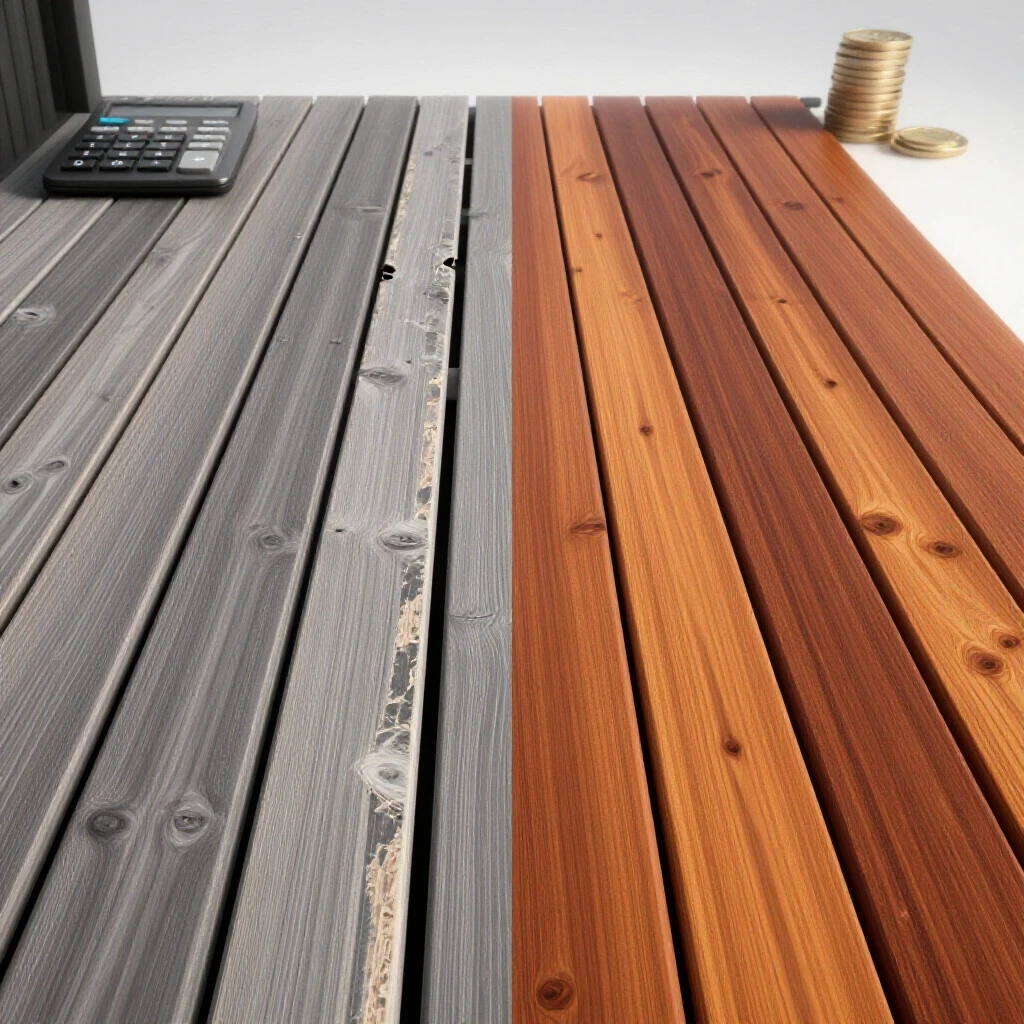
Managing the costs of an outdoor wooden structure over five years is a marathon, not a sprint. By applying the principles of construction accounting—like line-item audits and tracking material price volatility—you protect your largest investment. My own journey from a weathered, graying deck to a rich, preserved outdoor space proved that consistency beats a massive one-time budget every time.
For those looking to start their own restoration, begin by auditing your current structure. Create your spreadsheet today, set your budget ceiling at $2,800, and commit to the seasonal “wash and watch” method. Your future self, and your bank account, will thank you.
Frequently Asked Questions
How much should I realistically budget for a DIY deck restoration?
For most standard residential decks, a budget between $400 and $2,800 is realistic for a five-year cycle. The lower end covers basic cleaning and sealing, while the higher end allows for sanding rentals and premium oil-based stains.
Does restoring an old deck actually add value to my home?
Yes, but the value is primarily in “curb appeal” and preventing “value loss.” A well-maintained deck helps a home sell faster and prevents buyers from asking for price credits to replace a “rotting” structure.
Why did my stain fail after only one year?
Most DIY stain failures are due to poor preparation or applying product to wood that is too damp. If you don’t factor the cost of proper cleaning and drying time into your plan, you will end up spending double to fix it later.
Is it cheaper to use water-based or oil-based products?
Water-based products often have a lower initial price point, but oil-based stains generally last longer and are easier to “refresh” without full sanding. Over five years, oil-based products often prove to be more cost-effective.
How do I track “hidden” costs like sandpaper and brushes?
Create a “Consumables” line item in your spreadsheet. Allocate 10-15% of your total material budget specifically for these items so they don’t surprise you at the checkout counter.
Should I buy or rent a power washer for annual cleaning?
If you plan to clean your deck, siding, and driveway annually, buying a mid-range unit ($200-$300) is more economical over five years than renting a professional unit ($60/day) every time.
What is the biggest financial trap in deck maintenance?
The biggest trap is the “wait and see” approach. Ignoring a deck for three years can lead to wood rot that requires replacing boards, which is significantly more expensive than a $50 bottle of cleaner and a weekend of work.
How does weather affect my restoration budget?
Unexpected rain can ruin a fresh coat of stain, forcing you to buy more material and spend more time on labor. Always check a 10-day forecast and have a “contingency” of 10% in your budget for wasted materials.
Can I save money by using “cheap” sealant?
In my experience, no. Cheap sealants often sit on top of the wood and peel within 12 months. This requires expensive stripping and sanding. Investing in a $60-per-gallon professional-grade product saves money in the long run.
How do I know if I’m over-improving my deck?
Compare your deck’s size and features to other homes in your neighborhood. If everyone has simple 10×10 wood decks and you are spending thousands on custom railings and exotic finishes, you likely won’t recoup those costs.
(This article was written by one of our staff writers, Steven Fletcher. Visit our Meet the Team page to learn more about the author and their expertise.)