How to Declutter with the Timer Method (Step-by-Step Guide)

It is 6:30 PM on a Tuesday. You just walked through the door after a long shift, and the visual noise is deafening. Mail is piled on the counter like a precarious tower, three pairs of shoes are scattered across the entryway, and a basket of “clean” laundry has sat on the sofa for three days. You spent five hours last Saturday organizing every drawer, yet here you are again, wading through the same mess. It feels like the house is fighting back. As someone who manages supply chains and logistics for a living, I realized my home wasn’t a mess because I was lazy; it was a mess because my “operating system” was designed for a museum, not a living, breathing family.
Why Home Systems Fail: A Logistical Perspective
Household organization fails when the rate of incoming items exceeds the speed of your sorting and storage systems. In logistics, we call this a bottleneck, where a slow process causes a massive backup in the entire chain.
When we approach home organization as a one-time event, we ignore the reality of daily item flow. Most families struggle because their storage solutions require too many steps to maintain. If it takes five steps to put a pair of scissors away—opening a closet, pulling out a bin, unlatching a lid, placing the item, and reversing the process—the item will likely stay on the counter. This is known as retrieval friction. To build a sustainable home, we must shift from “perfect” aesthetics to high-flow efficiency that accounts for the human tendency to take the path of least resistance.
Understanding Retrieval Friction and Spatial Capacity
Retrieval friction is the measurable amount of effort required to put an item away or take it out of its designated spot. Spatial capacity refers to the physical limit of a storage area before it becomes impossible to navigate without moving other objects.
In my own home, I noticed that our “junk drawer” wasn’t the problem; it was the “high-friction” bins I bought to fix it. These bins had beautiful bamboo lids that looked great on Instagram but added two extra seconds to every interaction. Over a week, those seconds turned into a mental barrier. Research in environmental psychology suggests that visual processing overload occurs when we are surrounded by too many distinct objects, leading to increased cortisol levels. By reducing the steps needed to interact with our belongings, we lower the cognitive load required to keep a space functional.
The Psychological Cost of Clutter Reversion
Clutter reversion happens when a system is so complex that the brain views “putting things away” as a high-energy task rather than a background habit. This leads to decision fatigue, where you are too tired to choose where an item belongs.
When a home quickly returns to a state of disarray after a deep clean, it creates a psychological “failure loop.” You begin to believe that organization is impossible for your family. However, the issue is usually a lack of feedback loops. In industrial settings, we use visual cues to tell us when a system is failing. In a home, the cue is often a surface—like a dining table—becoming a “catch-all.” By implementing short, timed bursts of activity, we can reset these surfaces before the mental fatigue of a “big clean” sets in.
| Metric | High-Friction System | Low-Friction System |
|---|---|---|
| Retrieval Steps | 5+ (Lid, Bin, Shelf, Latches) | 1-2 (Open bin, Drop in) |
| Daily Sorting Time | 45-60 Minutes | 10-15 Minutes |
| Reversion Rate | High (3-5 days) | Low (Ongoing maintenance) |
| Cognitive Load | High (Decision-heavy) | Low (Intuitive placement) |
The Mechanics of Interval-Based Sorting Sprints
Timed organizational intervals involve setting a strict, short duration—usually 10 to 15 minutes—to focus on a specific zone or category of items. This method prevents the “marathon cleaning” burnout and allows you to see immediate, measurable progress without exhausting your mental reserves.
The beauty of using a timer is that it creates a definitive end point. In my house, we started using 15-minute “spatial resets” before dinner. This isn’t about deep cleaning; it’s about moving items from “transit” (the floor or counters) back to “storage.” By focusing on what can be done in a short window, you bypass the perfectionism that often stalls decluttering efforts. You aren’t trying to fix the whole house; you are just managing the flow for a quarter of an hour.
Why Short Bursts Beat Marathon Sessions
Short intervals work because they respect the human attention span and the reality of a busy schedule. When you commit to only 15 minutes, the barrier to entry is low, making it easier to start even when you are tired.
Studies in organizational behavior show that “micro-goals” lead to higher completion rates than large, abstract projects. If I tell my kids we are “cleaning the playroom,” they shut down. If I set a timer for 10 minutes and say we are “sorting the LEGO bin,” they can see the finish line. This approach treats organization as a series of small, manageable logistics tasks rather than a moral failing or an insurmountable mountain.
The 15-Minute Sorting Log
A sorting log is a simple way to track which areas of your home are “high-traffic” and require the most frequent resets. By documenting your progress, you can identify where your systems are failing and where they are succeeding.
- Zone: The specific area (e.g., Kitchen Island, Entryway Mudroom).
- Items Processed: A rough count of items returned to their homes.
- Bottlenecks Identified: Why were these items out? (e.g., “No hook for backpacks”).
- Time Elapsed: Always 10-15 minutes to maintain consistency.
Designing Low-Friction Storage Zones
A storage zone is a designated area where items are grouped by their frequency of use and the specific activities they support. Zoning reduces the time spent searching for items and ensures that high-use objects are the easiest to reach.
In my logistics work, we place the most frequently shipped items closest to the loading dock. I applied this to our kitchen. The coffee pods, mugs, and spoons are all within a 2-foot radius of the machine. This is “Zone 1” (Daily Use). Items used once a month go to “Zone 2” (High Cabinets), and seasonal items go to “Zone 3” (Garage or Attic). Most home clutter is just “Zone 1” items that don’t have a “Zone 1” home, so they sit on the counter.
Categorizing by Frequency of Use
To build a functional home, you must categorize items based on how often they are touched. This prevents “storage competition,” where a rarely used bread maker takes up the prime real estate needed for daily lunchboxes.
- Daily (Zone 1): Items used every 24 hours. Must be accessible with zero or one “step” (e.g., open shelf or hook).
- Weekly (Zone 2): Items used 1-3 times a week. Can be in a drawer or a lidded bin.
- Monthly/Seasonal (Zone 3): Items used once a month or less. Can be in deep storage, requiring a ladder or a trip to another room.
Reducing Bin Friction for Families
The type of container you choose determines whether your family will actually use it. For children and busy adults, “open-top” containers are almost always superior to lidded boxes because they remove the “unlatching” step.
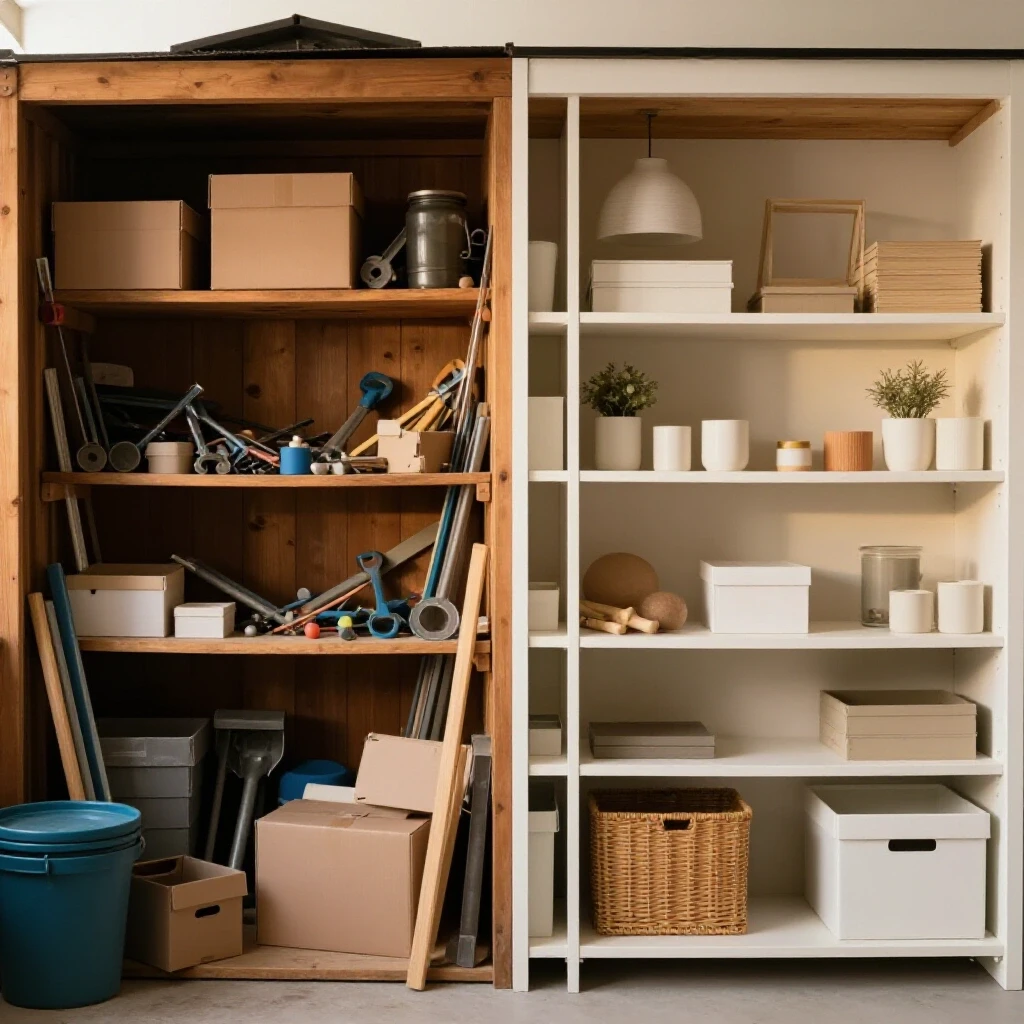
In our home, we replaced my wife’s beautiful, labeled shoe boxes with large, open wicker baskets. The result? The shoes actually ended up in the baskets instead of in a pile next to them. This is a “low-friction” win. We also use clear bins for pantry items so we can see the “inventory level” at a glance. This prevents overbuying, which is a major source of household inflow.
| Storage Type | Retrieval Friction Score (1-10) | Best Use Case |
|---|---|---|
| Open Basket | 1 (Lowest) | Toys, Shoes, Daily Blankets |
| Clear Bin (No Lid) | 2 | Pantry Staples, Cleaning Supplies |
| Lidded Tote | 6 | Seasonal Clothes, Holiday Decor |
| Vacuum Bag | 9 (Highest) | Long-term Archive, Guest Bedding |
Measuring the Success of Your Sorting Cycles
Success in a lived-in home isn’t measured by a lack of mess, but by the speed at which that mess can be resolved. We track this through “reset time”—the number of minutes it takes to return a room to its functional baseline.
When we first started our timed intervals, our living room took 40 minutes to reset. After six months of refining our zones and reducing bin friction, that same room now takes 8 minutes. We didn’t get rid of everything we owned; we simply made it easier to move items from “active” to “rest.” By timing these cycles, you get objective data that your system is working, which is a powerful antidote to the mental fatigue of feeling like you are “always cleaning.”
Standard Item-Density Guidelines
Item density refers to how many objects are packed into a specific cubic foot of storage. Overcrowding a shelf leads to “avalanche” effects, where taking one thing out causes three others to fall.
- The 80% Rule: Never fill a shelf or bin more than 80% full. That 20% “air gap” allows you to see and grab items without shuffling others.
- Vertical Utilization: Use stackable, clear drawers instead of deep bins to ensure every item has a “front-row” seat.
- Visual Weight: If a shelf looks “heavy” or cluttered, it will contribute to your mental load. Aim for one clear “visual break” on every surface.
Identifying and Fixing Logistics Bottlenecks
A bottleneck is a single point in your home where items accumulate because the “outflow” process is too difficult or non-existent. Common bottlenecks include the mail pile, the “half-worn” clothes chair, and the entryway floor.
In my family, the kitchen island was our primary bottleneck. It was where school papers, keys, and grocery bags went to die. We analyzed the “logistics” and realized there was no “outflow” for paper. We installed a simple three-slot wall file: “To Action,” “To File,” and “To Shred.” By giving the paper a destination that was as easy to reach as the counter, the bottleneck cleared. We didn’t need more discipline; we needed a better sorting map.
Sustaining Flow with Family-Friendly Habit Loops
A habit loop consists of a trigger, an action, and a reward. In a home, the trigger is often a transition—like coming home from work or finishing a meal. The action is a short, timed interval of sorting.
To get the whole family involved, the “reward” must be immediate and tangible. For us, it’s the “visual peace” of a clear counter before we sit down for a movie. We don’t frame it as a chore; we frame it as a “system reset” that makes our lives easier tomorrow morning. By keeping the intervals short and the storage low-friction, the “cost” of the habit remains lower than the “benefit” of the tidy space.
The “One-Touch” Rule in Practice
The one-touch rule states that you should aim to handle an item only once before it reaches its final destination. This is a core principle in industrial logistics to reduce labor costs, and it works wonders in a home.
- Mail: Don’t put it on the counter to “look at later.” Walk it directly to the recycling bin or the “Action” file.
- Laundry: Don’t move it from the dryer to a basket to the sofa. Move it from the dryer to the hanger.
- Groceries: Don’t leave bags on the floor. Group items by zone (Pantry, Fridge) and put them away immediately.
Smart Tools for Modern Maintenance
While analog systems are the foundation, certain modern tools can help track your inventory and reduce the “where is it?” friction that leads to messy drawers.
- QR Code Labels: For “Zone 3” boxes in the garage, we use simple QR stickers linked to a digital list. I can scan the box with my phone and see exactly what’s inside without opening it.
- Modular Drawer Dividers: These allow you to adjust your “spatial mapping” as your family’s needs change (e.g., as kids grow out of certain toy categories).
- Motion-Sensor Lights: Putting these in dark closets or pantries makes it easier to see your “inventory,” which naturally encourages people to keep the area organized.
Conclusion: Your Path to a Functional Home
Designing a home that stays organized isn’t about finding the perfect bin or having a minimalist aesthetic. It is about understanding the logistics of your daily life and creating systems that work with your natural behaviors rather than against them. By implementing short, timed sorting intervals, you break the cycle of clutter reversion and regain control over your environment.
Start small. Choose one bottleneck area—the one that causes you the most stress—and commit to a 10-minute sorting sprint tonight. Don’t worry about making it look “perfect.” Focus on reducing the friction for the items that live there. When you stop fighting the flow and start managing it, the mental fatigue begins to lift, replaced by a sense of spatial clarity that actually lasts.
Frequently Asked Questions
How do I start if my whole house is overwhelmed?
Pick the “highest-impact” surface, usually the kitchen counter or the entryway. Set a timer for 10 minutes and focus only on moving items back to their “zones.” Do not try to organize the whole room; just clear the transit items.
What if my family won’t participate in the timed intervals?
Start by yourself to demonstrate the “reset time” improvement. When they see that the house stays functional with only 10 minutes of effort, they are more likely to join. Use “low-friction” storage like open baskets to make it easy for them to succeed without trying.
How often should I do these sorting sprints?
Once a day is ideal, usually during a natural transition like “after work” or “before bed.” Consistency is more important than duration. A daily 10-minute reset is far more effective than a monthly 5-hour deep clean.
What is the biggest mistake people make with storage bins?
Buying bins with lids and opaque sides for high-use items. If you can’t see what’s inside and you have to use two hands to open it, the system will fail. Stick to clear, open-top containers for anything used daily.
How do I handle items that don’t have a “home”?
These are your “logistics outliers.” If an item doesn’t have a home, it means you haven’t defined a zone for it. Create a “Transit Bin” for these items during your 15-minute sprint, then spend one specific interval later in the week deciding on permanent homes for them.
Why does my house get messy again so fast?
You likely have a “high-friction” system or a “capacity” issue. Either it’s too hard to put things away, or you have more items than your storage zones can hold. Focus on reducing retrieval steps and decluttering until you reach the 80% capacity rule.
Can I use this method for digital clutter?
Yes. Set a 10-minute timer to clear your email inbox or organize your desktop files. The same principles of “retrieval friction” and “zoning” apply to your digital environment.
What should I do with items I’m not ready to get rid of?
Move them to “Zone 3” (deep storage). If you don’t miss them or need them within six months, they are candidates for outflow (donation or disposal). This keeps your “Zone 1” and “Zone 2” areas clear for daily living.
How do I stay motivated when I’m tired?
Remember that the 10-minute sprint is an investment in your “future self.” Spending 10 minutes tonight saves you 30 minutes of searching and stress tomorrow morning. The goal is “functional,” not “perfect.”
What if 15 minutes isn’t enough?
Stop anyway. The goal of the timer is to prevent burnout. If the timer goes off and you want to keep going, you can, but you’ve already won by completing the first 15 minutes. Consistent “wins” build the habit.
(This article was written by one of our staff writers, Christopher Bennett. Visit our Meet the Team page to learn more about the author and their expertise.)