How to Build a DIY Closet System for Small Rooms (Step-by-Step)

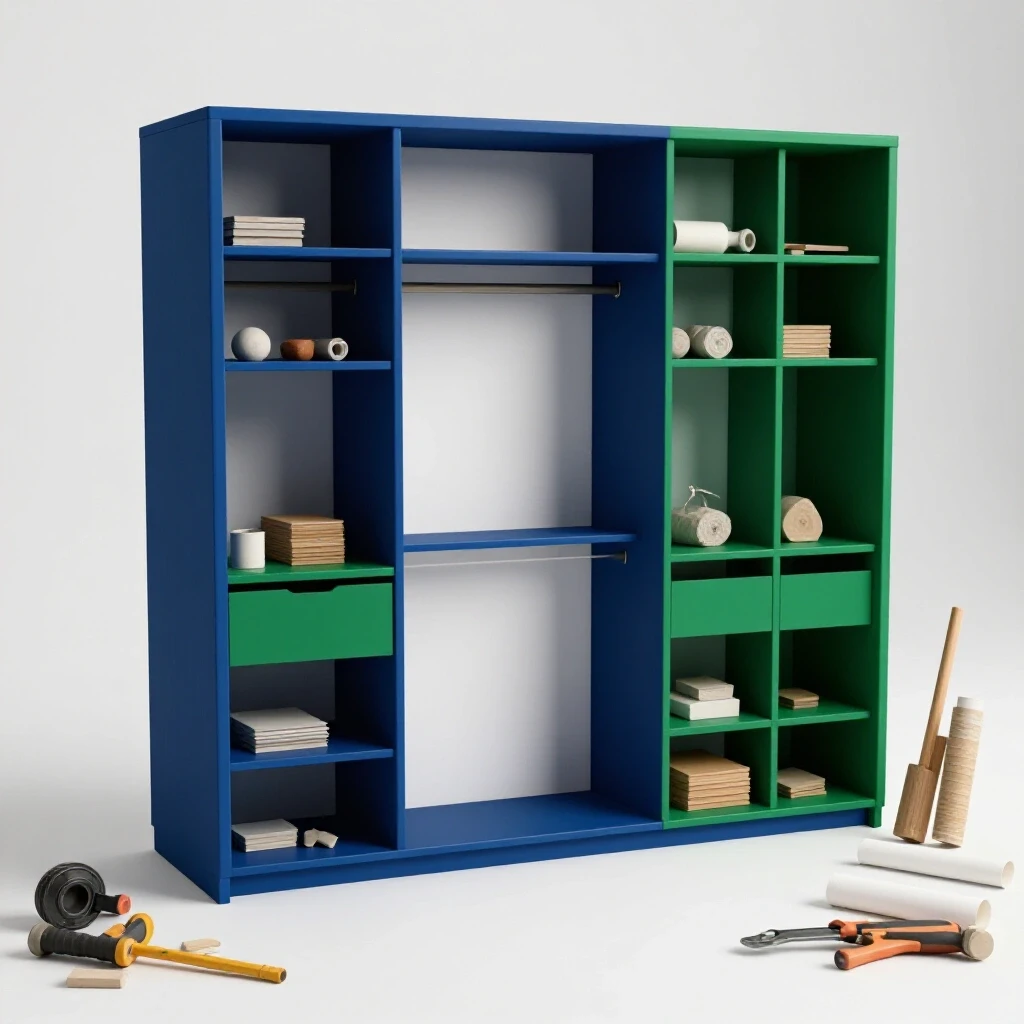
I stood in my hallway at 2:00 AM, staring at a pile of clothes, splintered wood, and crumbled drywall. The single wire shelf that came with my house had finally surrendered to the weight of a professional wardrobe, tearing clean out of the wall. In my day job as a facilities manager, I oversee the structural integrity of large buildings, yet here I was, defeated by a four-foot reach-in closet. That moment of frustration sparked a weekend mission to replace the failed hardware with a custom-built, wood-based vertical storage solution designed for rooms under 100 square feet.
Building a custom storage unit from scratch is not about aesthetic perfection; it is about engineering a system that respects the physics of a small space. When you are working in a tight footprint, every inch of vertical real estate is a premium asset. My goal was to create a high-capacity, code-compliant structure using raw materials that would never sag or pull away from the wall again. This guide details the exact steps I took to transform a cramped, failing closet into a functional powerhouse of organization.
Assessing Your Compact Storage Potential
Evaluating the physical dimensions and structural integrity of a small bedroom closet involves determining the maximum vertical and horizontal load capacity of the existing walls. Before you buy a single board, you must understand what is happening behind your drywall.
In my first home, I made the mistake of assuming all studs were perfectly spaced at 16 inches on center. I was wrong. Small closets are often framed with odd spacing to accommodate corner junctions. I use a high-quality stud finder with AC detection to map out the framing and ensure I am not about to drill into a vent pipe or a live electrical line. For a build like this, you need to know exactly where your solid wood supports are located, as a shelf loaded with shoes and coats can easily exceed 100 pounds of static tension.
| Project Phase | Active Labor Hours | Effort Level (1-10) | Skill Requirement |
|---|---|---|---|
| Site Prep & Demolition | 2 Hours | 4 | Basic |
| Measuring & Layout | 1.5 Hours | 6 | Intermediate |
| Material Cutting | 3 Hours | 7 | Intermediate |
| Structural Assembly | 5 Hours | 8 | Advanced |
| Finishing & Painting | 4 Hours | 3 | Basic |
Total Estimated Time: 15.5 Hours (Spread over two weekends)
Essential Tools for Precision Vertical Builds
A curated list of hand and power tools is necessary for measuring, cutting, and securing structural components in confined environments where traditional long boards may not fit. You cannot complete this project safely with just a screwdriver and a prayer.
- Circular Saw or Miter Saw: Used for cross-cutting your 3/4-inch plywood or solid pine boards to length.
- Impact Driver and Drill: Essential for driving 3-inch wood screws into studs without stripping the heads.
- 4-Foot Level: Crucial for ensuring your horizontal cleats are perfectly flat; even a 1/8-inch slope can cause drawers or bins to slide.
- Stud Finder: Must include deep-scan and AC wire detection to avoid catastrophic utility hits.
- Kreg Jig (Pocket Hole System): This tool allows you to join wood pieces at an angle, creating strong, hidden joints that are perfect for tight closet corners.
- Speed Square: A triangular marking tool used to ensure every cut is a perfect 90-degree angle.
- Personal Protective Equipment (PPE): N95 mask for sawdust, safety glasses, and ear protection when using power saws.
Structural Safety and Code Compliance in Small Spaces
Adhering to residential building standards regarding shelf weight limits and fastener selection ensures the system remains safe for years. While there is no specific “closet code” for shelving, the National Electrical Code (NEC) and general framing standards apply.
According to NEC 410.16, you must maintain specific clearances between storage items and light fixtures. For example, incandescent fixtures must be at least 12 inches away from the nearest point of storage space. If you are building high shelves, you must ensure you aren’t creating a fire hazard. Furthermore, I always follow the “Rule of Three” for fasteners: at least three inches of screw length to ensure 1.5 inches of penetration into the center of the stud, accounting for 1/2-inch drywall and 3/4-inch lumber.
Key Safety Metrics: – Shelf Span: Do not exceed 32 inches between vertical supports for 3/4-inch plywood to prevent sagging. – Fastener Depth: 3-inch #8 or #10 wood screws are the standard for securing cleats to wall framing. – Load Capacity: A properly anchored 12-inch deep wood shelf can typically support 40-50 lbs per linear foot.
Phase 1: The Blueprint and Dry-Fit Stage
The process of mapping out shelf heights and support locations on the wall before making permanent cuts prevents costly material waste. I start by using blue painter’s tape to “draw” the system directly onto the closet walls.
I realized during my build that my floor was not level—a common issue in older homes. If I had built the unit based on measurements from the floor up, the entire system would have looked crooked. Instead, I found the highest point of the floor and used my 4-foot level to establish a “level line” around the entire perimeter. This ensures that every shelf is parallel to the horizon, regardless of the house’s settling. Dry-fitting involves holding your cut pieces up to the wall to check for gaps caused by “bowed” drywall. Walls are rarely perfectly flat, and you may need to scribe or sand the edges of your shelves to get a snug fit.
Phase 2: Anchoring and Frame Construction
Installing the primary vertical supports and horizontal cleats into wall studs is the most critical step for long-term stability. This is where the “heavy lifting” of the project occurs.
I began by installing 1×2 pine cleats along the back and side walls. These cleats act as the “ledger” that the shelves sit on. I pre-drill pilot holes into the cleats to prevent the wood from splitting. A pilot hole is a small hole drilled into the wood that is slightly narrower than the screw itself. Building on this, I used a countersink bit so the screw heads sit flush with the wood surface. In my experience, skipping pilot holes is the number one cause of failed DIY wood projects. When I hit a stud, the resistance on the impact driver changes; if the screw spins freely, I’ve missed the wood and must relocate the fastener.
Phase 3: Custom Shelving and Finishing Touches
Cutting individual shelves to size and securing them to the frame requires patience and a steady hand. For small rooms, I prefer using 3/4-inch birch plywood because it is dimensionally stable and resists warping better than solid pine.
Once the shelves are cut and dry-fitted, I apply edge banding to the exposed plywood fronts. Edge banding is a thin strip of real wood veneer with heat-activated glue on the back. I use a standard household iron to melt the glue and a sharp utility knife to trim the excess. This gives the “raw” plywood the appearance of expensive solid lumber. After installation, I sand everything with 120-grit followed by 220-grit sandpaper. Interestingly, the quality of your finish is 90% preparation. If you feel a bump while sanding, it will be magnified ten times once the paint or stain is applied.
Troubleshooting Common Installation Errors
Identifying and correcting issues like out-of-plumb walls or missed studs is part of the DIY process. No project goes exactly according to the initial plan.
During my installation, I encountered a “proud” corner where the drywall mud was applied too thickly, making the corner less than 90 degrees. My shelf wouldn’t slide into place. Instead of forcing it and damaging the wall, I used a hand plane to shave a few millimeters off the back corner of the shelf. This “scribing” technique is a lifesaver. Another common failure is over-tightening screws into soft wood, which strips the hole. If this happens, I jam a couple of toothpicks coated in wood glue into the hole, let them dry, and then re-drive the screw. It creates a fresh “bite” for the threads.
Long-Term Maintenance and Load Testing
Regularly inspecting fasteners and shelf integrity prevents sagging or failure over years of active use. Every six months, I do a “stress check” on my systems.
I look for any gaps forming between the wall and the cleats. If a gap appears, it means the fasteners are pulling out or the house is shifting. In a small room, we tend to overstuff storage areas, which puts constant “creep” pressure on the wood. As a facilities manager, I recommend a maximum deflection limit of 1/270th of the span. For a 3-foot shelf, that means if the center bows more than 1/8th of an inch, it needs an additional vertical support or a stiffener (a piece of wood turned on its edge and glued to the bottom of the shelf).
Final Quality Control Checklist
Before you consider the project complete and start loading your gear, run through this safety and functional checklist.
- Level Check: Place the level on every shelf, front-to-back and side-to-side.
- Fastener Check: Ensure no screw heads are protruding, which could snag clothing.
- Snag Test: Run a microfiber cloth over all sanded surfaces; if it catches, you need more sanding.
- Clearance Check: Ensure you have at least 24 inches of “walk-in” or “reach-in” space to access the items.
- Lighting Safety: Verify that no items are within 12 inches of a non-LED light fixture.
By taking the time to build a structural frame rather than relying on thin metal brackets, you create a system that adds actual value to the home. It feels solid because it is anchored into the “bones” of the house. The satisfaction of sliding a drawer or placing a heavy bin on a shelf you built yourself—and knowing it won’t budge—is the ultimate reward for a weekend of hard labor.
FAQ
What is the best wood to use for high-capacity shelving in a small space? I recommend 3/4-inch birch or maple plywood. It is significantly stronger than particle board or MDF and won’t sag as easily under heavy loads. Avoid “common board” pine for long spans, as it tends to cup and twist over time as the moisture content changes in your home.
How do I handle walls that aren’t square? Almost no wall is perfectly 90 degrees. Use a tool called a “sliding T-bevel” to find the actual angle of your corner, then transfer that angle to your saw. If the gap is small (under 1/8 inch), you can use paintable caulk to hide the seam between the shelf and the wall.
Can I use drywall anchors if I can’t find a stud? For structural storage, I strongly advise against it. While “toggle bolts” can hold significant weight, they rely on the integrity of the drywall, which can crumble under the vibration of daily use. Always bridge two studs with a horizontal cleat, then mount your shelving to that cleat.
What is the ideal height for a hanging rod? Standard “short hang” for shirts and folded pants is 42 inches from the floor. “Long hang” for dresses or coats should be 68 to 72 inches. In a small closet, I often install two rods—one at 80 inches and one at 40 inches—to double the hanging capacity.
Do I need to paint or seal the wood? Yes. Raw wood absorbs moisture and can hold onto odors from clothing. At a minimum, apply two coats of a water-based polyurethane or a high-quality interior latex paint. This makes the shelves easier to dust and protects the wood from humidity.
How do I avoid hitting electrical wires? Wires are typically stapled to the center of studs. When drilling, if you feel the drill bit “drop” into an empty space after passing through the drywall, stop immediately. Never force a drill if you feel unusual resistance. Use a stud finder with a dedicated “Voltage” or “AC” warning light.
What is the most common mistake beginners make? Measuring only once. I always measure the width of the closet at the back, the middle, and the front. Walls often “taper,” meaning the closet might be 48 inches wide at the back but 47.5 inches wide at the door frame. If you cut all your shelves to 48 inches, they won’t fit.
How much weight can a custom wood system really hold? If you have anchored 1×2 cleats into at least two studs using 3-inch screws and used 3/4-inch plywood, a 3-foot shelf can easily handle 100-150 lbs of distributed weight. However, always place the heaviest items (like bins of books or tools) on the lowest shelves to keep the center of gravity low.
Is a circular saw enough, or do I need a table saw? A circular saw is sufficient if you use a “straight edge guide” or a “track.” This allows you to make perfectly straight, long rips in plywood sheets. A table saw is great but often too bulky for a DIYer working in a small garage or driveway.
How do I finish the edges of the plywood? The most professional method is heat-activated edge banding. You iron it on, let it cool for a minute, and then trim it with a dedicated edge-trimming tool or a very sharp chisel. It completely hides the plywood layers and makes the shelf look like a solid piece of wood.
(This article was written by one of our staff writers, Robert Callahan. Visit our Meet the Team page to learn more about the author and their expertise.)