How to Create a Family Paperwork System That Lasts (Guide)

Have you ever cleared off your kitchen island only to find it buried under a mountain of school flyers, bills, and coupons by Tuesday afternoon? This cycle of temporary tidiness followed by rapid clutter reversion is the primary source of mental fatigue for most busy parents. After 11 years in operations and logistics, I realized that my home was failing not because we weren’t cleaning, but because our document management lacked a sustainable flow.
In a professional warehouse, items are tracked from the moment they enter the building until they leave. In a busy home, paper enters through the front door and often stays indefinitely, occupying high-value “real estate” like counters and dining tables. To fix this, we have to look at the household as a logistical hub where every piece of mail and every school drawing is a unit of inventory that requires a designated path.
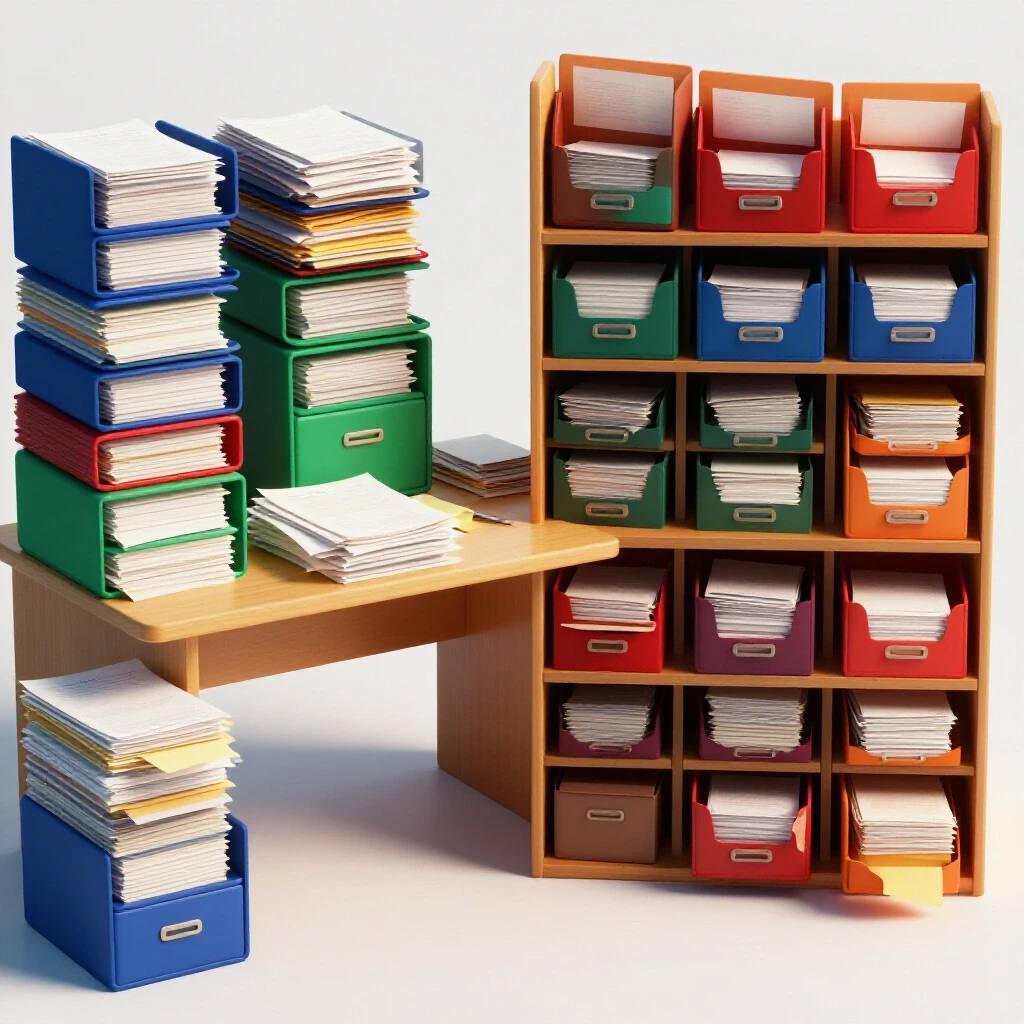
Environmental psychology research suggests that visual clutter acts as a constant low-level stressor, signaling to our brains that work is never finished. When a system is too complex—like a multi-tiered filing cabinet hidden in a dark closet—the “friction” of using it becomes higher than the energy we have at the end of a workday. My family’s journey toward sustainable decluttering began when I stopped looking for “pretty” bins and started measuring how many steps it took to put a single bill away.
The Logistics of Paper Inflow and Spatial Capacity
Effective household document management requires understanding that every surface has a finite spatial capacity. When the volume of incoming paper exceeds the speed at which we process and remove it, the system “bottlenecks,” leading to the piles we see on our counters.
In my early years of managing a household while working in logistics, I treated every piece of paper as equally important. This was my first mistake. In a warehouse, we use “ABC analysis” to categorize inventory: “A” items are high-priority and need quick access, while “C” items are rarely touched. Most household paper clutter consists of “C” items that we treat like “A” items, leaving them on the counter for “visibility.”
The psychological cost of this is significant. A study in the Journal of Neuroscience indicates that multiple visual stimuli compete for neural representation. Essentially, that pile of mail is fighting for your attention while you are trying to cook dinner or help with homework. To reduce this cognitive load, we must establish a clear “Inflow Control” point.
Defining Retrieval Friction in Home Organization Systems
Retrieval friction is the measurable effort required to find or store an item, often calculated by the number of physical steps or “touches” involved. High-friction systems, like deep drawers or locked boxes, often lead to “surface dumping” where items are left out because storing them is too difficult.
I measured our family’s “sorting friction” and found that if a filing system required more than three steps (open door, find key, open drawer, find folder), the paper would stay on the counter 90% of the time. We needed a low-friction, functional home storage solution that aligned with our natural movements.
- Step 1: Identifying the “Drop Zone” where mail naturally lands.
- Step 2: Measuring the average daily volume of incoming paper (usually 5-10 pieces).
- Step 3: Creating a “One-Touch” rule for immediate recycling or sorting.
| Storage Type | Retrieval Steps | Friction Level | Success Rate |
|---|---|---|---|
| Closed Filing Cabinet | 5-7 | High | 15% |
| Accordion Folder | 4-5 | Medium | 40% |
| Open Desktop Tiered Tray | 1-2 | Low | 85% |
| Wall-Mounted DIY Bins | 1 | Very Low | 95% |
Reducing Sorting Friction with Durable Command Centers
A command center is a centralized hub designed to capture and categorize incoming information before it spreads to other rooms. By using wall-mounted organizers or repurposed decorative bins, families can move paper off horizontal surfaces and into a vertical, visible sorting framework.
When my family first tried to organize our paperwork, we used a heavy metal filing cabinet in the home office. It was a total failure. Because the office was at the back of the house, the “logistical distance” was too great. We ended up with “transit piles” on the kitchen table. We eventually moved to a DIY wall-mounted system right by the entry door.
This system survived because it matched our behavioral flow. We used three simple, handmade wooden bins labeled: “Action,” “Review,” and “Archive.” This categorized the paper by the type of energy required rather than the subject. “Action” items (bills, permission slips) were handled immediately, while “Review” items (newsletters, magazines) were for the weekend.
Why High-Friction Bins Lead to Rapid Clutter Reversion
Many storage solutions for families fail because they prioritize aesthetics over ergonomics. A beautiful basket with a tight-fitting lid looks great in a photo, but it adds an extra “touch” to the process. In a busy home, every extra touch is a point of failure.
Spatial ergonomics studies show that we are more likely to maintain systems that are within our “primary reach zone”—the area between our waist and shoulders. If you have to bend down or reach high to file a document, you won’t do it. Our sustainable decluttering journey succeeded only when we placed our primary sorting tools at eye level in the highest-traffic area of the home.
- Visual Processing: Use clear or open-topped containers so the contents are visible but contained.
- Spatial Mapping: Assign one specific “zone” for paper; if it’s not in that zone, it doesn’t belong in the house.
- Capacity Limits: Once a bin is full, it triggers a mandatory “outflow” session.
The Architecture of Sustainable Binder Systems
Binder-based systems offer a modular, portable way to manage long-term household records without the bulk of traditional filing. By using decorative binders and clear sleeves, families can create a “living library” of information that is easy to update and move between rooms.
I transitioned our “Archive” bin into a series of themed binders. We have one for “Home Maintenance,” one for “Medical Records,” and one for “School Memories.” This works because binders are “low-friction” for retrieval. You can pull a binder off a shelf and sit on the couch to flip through it, rather than standing over a drawer.
Interestingly, this method mirrors industrial “Standard Operating Procedures” (SOPs). In logistics, we keep manuals in binders for quick reference on the floor. Applying this to a home means that if a pipe leaks, I don’t hunt through a drawer; I grab the “Home” binder and find the plumber’s number in seconds.
Designing a DIY Document Portfolio
Creating a custom portfolio involves more than just buying a folder; it requires a layout that reflects your family’s specific needs. We found that using color-coded tabs significantly reduced the time spent searching for documents.
- Select a 1.5-inch D-ring binder: These allow pages to lay flat and prevent tearing.
- Use heavy-duty sheet protectors: These eliminate the need for a hole punch, which is a major friction point.
- Create a “Table of Contents”: A simple list at the front of the binder prevents “digging” and keeps the density of items manageable.
- Label the spine clearly: Use a bold font that is readable from five feet away.
| Metric | Binder System | Filing Cabinet |
|---|---|---|
| Average Sorting Time | 2 minutes | 8 minutes |
| Search Time (per item) | 30 seconds | 3 minutes |
| Space Utilization | High (Vertical) | Low (Floor Space) |
| Portability | 100% | 0% |
Aligning Household Behavior with Low-Maintenance Habits
A system is only as good as the people using it. To maintain a tidy, functional living space, the habits of the family must be integrated into the design of the storage solutions themselves, ensuring that the “cost” of being organized is lower than the “cost” of being messy.
In my house, we noticed that my children would leave school papers everywhere because they didn’t know what was “trash” and what was “treasure.” We created a “Memory Box” for each child—a simple, decorative wooden crate. Their only job was to put their favorite drawings in the box. At the end of the month, we would spend 10 minutes together deciding which five items to keep in their permanent binder.
This taught them the concept of “Spatial Capacity.” They learned that the box has a limit, and once it is full, something must leave for something new to enter. This is a fundamental principle of inventory management that prevents household clutter from becoming overwhelming.
The 2-Minute Sort: A Daily Maintenance Routine
The most successful home organization systems rely on small, frequent actions rather than massive weekend overhauls. We implemented a “Daily Sorting Interval” that takes exactly two minutes when we walk through the door with the mail.
- Sort at the Trash Can: 60% of mail is usually junk. Don’t even let it hit the counter.
- Immediate Action: If a paper requires a signature or a quick payment, do it now.
- The “Holding Pattern”: Place items that need more thought into the “Review” wall bin.
- Weekly Purge: Every Sunday, the “Review” bin is emptied. This prevents “backlog” which is the primary cause of mental fatigue.
Measuring the Success of Your Storage Solutions
To know if a system is working, you have to track its performance over time. A truly sustainable system doesn’t require a “re-org” every month; it should remain functional with minimal effort, even during busy seasons like the holidays or the start of the school year.
We use a “System Feedback Loop” in our house. If I see a pile of paper forming on the stairs, it’s a signal that the current system has too much friction. Instead of nagging my family, I look at the logistics. Is the bin too far away? Is it too full? We then adjust the “zoning” to fix the flow.
Household Organization Performance Metrics
By tracking a few simple numbers, you can objectively see how your home is performing. This removes the emotional frustration and replaces it with logical problem-solving.
- Surface Clearance Rate: Percentage of flat surfaces clear at bedtime (Goal: 90%).
- Sorting Velocity: Time spent processing daily mail (Goal: < 2 minutes).
- Retrieval Rate: Time to find a specific document (Goal: < 60 seconds).
- Inflow/Outflow Balance: Are you removing as much as you are bringing in?
Common Pitfalls in Family Paperwork Management
Many families fall into the trap of “over-categorizing.” They create 50 different folders for every possible topic. This creates “decision fatigue.” When you are tired, you don’t want to decide if a receipt belongs in “Home Improvement” or “Hardware Store.” You just want to put it away.
Another mistake is buying “micro-storage”—tiny bins and small labels. These are difficult to maintain. Large, “macro-level” categories are much more sustainable. “Financial,” “Personal,” and “Household” are often enough for a daily system. You can always get more specific inside a binder later, but the initial sort must be fast.
- Avoid “Invisible” Storage: If you put it in a box, in a closet, in the basement, you will forget it exists.
- Don’t Skip Labeling: Even if you think you’ll remember, a label acts as a visual “boundary” that tells your brain exactly where an item lives.
- Stop the “I’ll Do It Later” Pile: This is the “death spiral” of organization. If it takes less than two minutes, do it now.
Building a Resilient Future for Your Home
The goal of these systems is not to achieve a magazine-perfect house. The goal is to reduce the “background noise” of your life. When you know where your papers are, you have more mental energy for your children, your career, and your hobbies.
Our family’s paperwork system survived because we treated it like a living thing. We adjusted the bins as the kids grew and our needs changed. We focused on “flow” rather than “stow.” By applying these logistics principles, you can transform your home from a place of stress into a high-functioning sanctuary.
Next Steps for Your Decluttering Journey
- Identify your “Bottle-neck”: Where does paper pile up today?
- Clear the “Primary Zone”: Remove everything from that surface and don’t let anything return without a “home.”
- Build one DIY bin or binder this weekend: Start small and test the friction level.
- Set a “Two-Minute Timer”: Practice the immediate sort for one week and observe the difference in your counter space.
Frequently Asked Questions
How do I handle school papers that my kids want to keep? Use a “one-in, one-out” rule with a dedicated memory box. Allow the box to have a physical limit. When it’s full, sit with your child to choose the best items to move into a permanent binder. This teaches them how to value their work rather than hoarding every scrap.
What if my spouse refuses to use the system? Design the system around their existing “natural” behavior. If they always drop mail on the end of the counter, place a decorative open bin exactly there. Reducing the physical distance to the “correct” spot is more effective than trying to change their habits through conversation.
Are binders better than filing cabinets for everyone? For daily and active documents, yes. Binders offer better portability and visibility. Filing cabinets are best reserved for “deep storage” items that you only need once a year, such as long-term records or historical documents.
How often should I “purge” my binders? A seasonal approach works best. Every three months, do a quick flip-through. If a document is no longer relevant (like an expired coupon or an old school calendar), remove it immediately. This keeps the “density” of the binder low and the retrieval speed high.
What is the best way to label DIY bins? Use large, clear text. For children, icons or colors are even better than words. The goal is for the brain to recognize the “zone” in less than a second without having to “read” and process the information.
How do I manage receipts without them taking over? Designate one small envelope or pouch in your “Action” binder. At the end of the month, only move receipts for high-value items or potential returns to the permanent “Household” binder. Toss the rest.
Can I use this system for magazines and catalogs? Yes. Use a vertical “Review” bin. The key is to limit the bin’s size. Once the bin is full, the oldest magazine must be recycled before a new one is added. This prevents the “stacking” effect on coffee tables.
What should I do with “sentimental” paper like old cards? Treat these as “C” items. They don’t belong in your daily command center. Store them in a decorative “Legacy Box” on a high shelf. They should be accessible for enjoyment but out of the way of your daily functional flow.
How do I start if I already have years of paper piles? Don’t try to sort the old piles first. Setup your “New Inflow” system today. Once the new mail is under control, spend 15 minutes a day working backward through the old piles. This prevents the “new” clutter from sabotaging your progress on the “old” clutter.
Why does my system always fail after a few weeks? It likely has too much “friction.” Check if you have to open too many lids, walk too far, or make too many complex decisions. Simplify the categories and move the bins closer to where the paper naturally lands.
(This article was written by one of our staff writers, Christopher Bennett. Visit our Meet the Team page to learn more about the author and their expertise.)