Hardwood Floor Installation Cost Comparison Guide (Budget Tips)

Imagine walking into your home and seeing the warm, natural grain of a freshly laid oak floor stretching from the entryway to the kitchen. It is a classic look that many homeowners dream of, but as a financial planner, I see more than just aesthetics. I see a series of carefully tracked line items on a spreadsheet. When I tackled my first major flooring project in a 1920s craftsman, I learned quickly that the price tag on the sample board is only a small fraction of the final bill.
My background involves over a decade of analyzing housing market data and managing my own renovation ledgers. I have seen how a lack of financial structure can turn a simple home improvement into a source of significant stress. To avoid this, we must look at the numbers with a cold, analytical eye. We need to separate the “sticker price” of the materials from the total capital outlay required to finish the job correctly.
Assessing Your Financial Readiness for New Timber Flooring
Financial readiness is the process of auditing your liquid assets and home equity to ensure you can fund a project without relying on high-interest credit. It involves setting a hard ceiling on spending based on your current savings and the projected value of your home within its specific neighborhood.
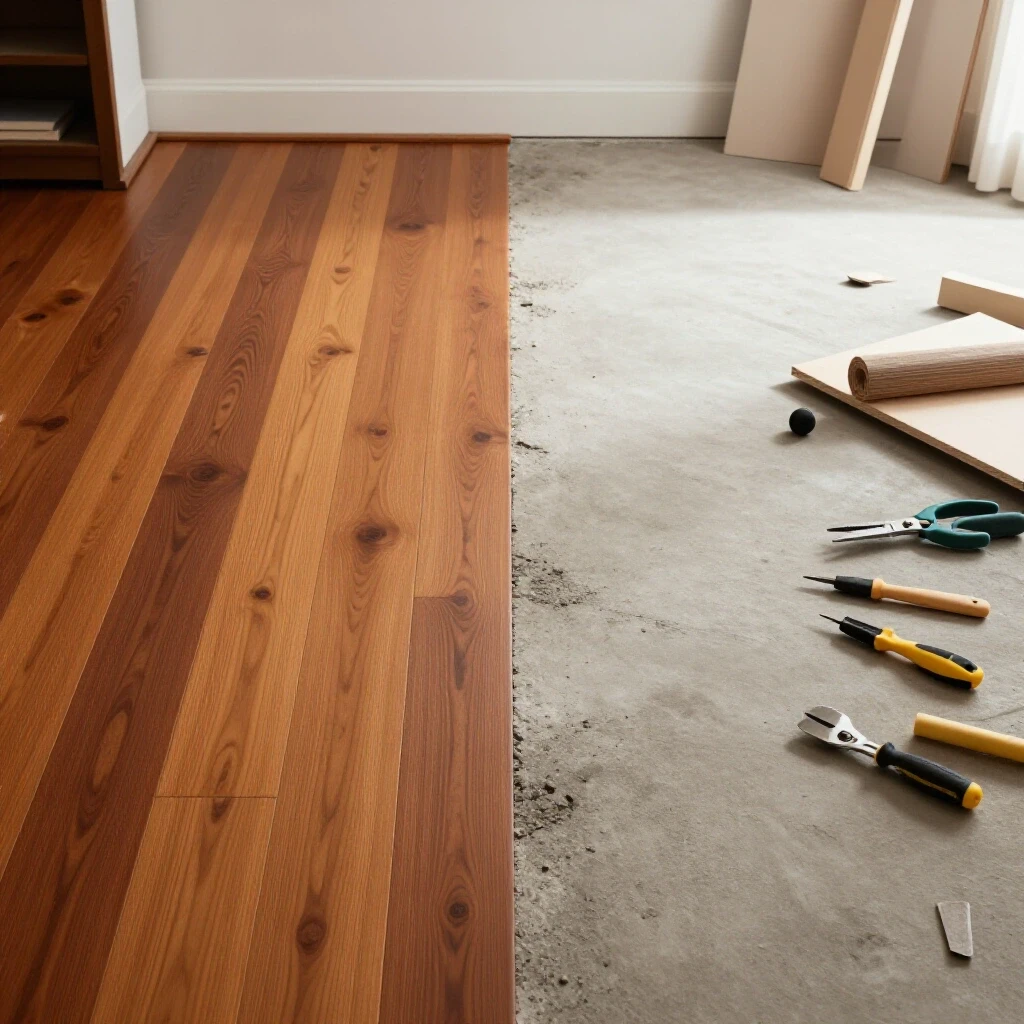
Before you pull up a single carpet staple, you must establish your funding boundaries. I recommend a “Tiered Budgeting Model” for any major home renovation. This means you have a primary budget for the ideal materials, a secondary budget for labor, and a mandatory 15% to 20% cash reserve for “unseen variables.” In my own experience, I once found a layer of rotted particle board under some old linoleum that added $1,200 to my subfloor prep costs instantly.
A common mistake is over-improving a home beyond what the local market can support. If the highest-selling home in your area has high-quality laminate, installing premium wide-plank walnut might not provide a return on investment. I use a “Market Ceiling Multiplier” to check this. Take the average price per square foot of recently sold homes in your zip code and ensure your total project cost doesn’t push your home’s “cost basis” more than 10% above that average.
- Review your emergency fund to ensure it remains untouched by the project.
- Calculate your debt-to-income ratio if you are considering a home equity line of credit.
- Analyze local “comps” to see if hardwood is a standard feature in your neighborhood.
Analyzing Material Expenses: Solid Wood versus Engineered Options
Material expenses represent the direct cost of the wood planks, which are the primary variable in your financial plan. This category includes the price per square foot of the wood itself, along with the necessary waste factor for cuts and damaged boards.
When I look at my historical cost logs, I see a clear divide between solid and engineered products. Solid wood is a single piece of timber, while engineered wood consists of a real wood veneer over layers of plywood. Solid wood often costs more upfront and requires more labor for acclimation and finishing. Engineered wood is more stable in humid environments and can sometimes be installed as a “floating” floor, which saves on labor.
You should always factor in a 10% waste allowance for standard layouts and 15% for complex patterns like herringbone. In a 1,000-square-foot space, you are actually buying 1,100 square feet of wood. This “hidden” 100 square feet can add hundreds or thousands of dollars to your cost breakdown guide depending on the species you choose.
| Feature | Solid Hardwood | Engineered Wood |
|---|---|---|
| Average Material Cost (per sq. ft.) | $8.00 – $15.00 | $6.00 – $12.00 |
| Lifespan | 100+ years | 25 – 50 years |
| Refinishing Potential | Multiple times | 1 – 2 times |
| Moisture Resistance | Low | Moderate |
Regional Labor Rates and Installation Fees
Labor rates are the fees paid to professionals to install, sand, and finish the floor. These costs are highly sensitive to your geographic location and are often calculated as a flat rate per square foot or an hourly wage for specialized custom work.
According to data from the U.S. Bureau of Labor Statistics, construction labor costs can vary by as much as 30% between the Midwest and the Northeast. In my own tracking, I found that hiring a specialist who only does floors is often more cost-effective than a general handyman. The specialist works faster and has the specific tools required to minimize material waste.
Labor for a “nail-down” installation of solid wood is typically the most expensive because it involves individual fastening and, often, on-site finishing. A “pre-finished” floor, where the boards arrive already stained and sealed, can reduce labor time significantly. I always suggest getting at least three detailed quotes that break down the cost per square foot for every phase of the job.
- Ask for a “scope of work” that includes furniture moving and appliance disconnection.
- Check if the quote includes the installation of baseboards and transition strips.
- Verify the contractor’s insurance and bonding to protect your financial liability.
Accounting for Subfloor Preparation and Hidden Project Fees
Hidden fees are the expenses that do not appear on the initial quote but are necessary for a high-quality result. This includes subfloor leveling, moisture barriers, and the removal and disposal of old flooring materials.
In my second renovation, I budgeted for the wood and the labor but forgot about the “disposal fee” for 800 square feet of old, heavy tile. That cost me an extra $450 in dump fees and labor. You must also consider the “flatness” of your subfloor. If the floor is not level within 3/16 of an inch over a 10-foot span, you will need self-leveling compound or new plywood underlayment.
Another often-overlooked item is the “acclimation period.” Real wood needs to sit in your home for 3 to 7 days to adjust to the humidity. If your contractor wants to install it the day it arrives, they are risking a floor that will buckle or gap later. Fixing a buckled floor is a massive financial drain that can double your initial investment.
- Subfloor Leveling: $0.50 – $1.50 per square foot.
- Moisture Barrier (Underlayment): $0.30 – $0.80 per square foot.
- Old Floor Removal: $1.00 – $3.00 per square foot.
- Baseboard/Trim Replacement: $2.00 – $5.00 per linear foot.
Evaluating the Long-Term Financial Impact of Wood Flooring
The long-term impact refers to the “Cost vs. Value” of the improvement. This involves looking at the depreciation schedule of the floor and how much of the initial cost you can expect to recover when you sell the property.
Remodeling Magazine’s Cost vs. Value reports consistently show that hardwood flooring offers one of the highest returns on investment for interior projects. In many markets, you can recover 70% to 100% of the cost at resale. However, this only applies if the installation is done to professional standards. A “DIY” job with visible gaps or poor finish can actually hurt your home’s value.
I also look at the “Life Cycle Cost.” A solid oak floor that lasts 100 years and can be refinished five times is much cheaper over several decades than a carpet that needs replacement every seven years. When you analyze the numbers, the “per year” cost of high-quality wood is often lower than almost any other flooring material.
Case Study: A 1,200 Square Foot Living Area Ledger
To illustrate how these numbers come together, let’s look at a real-world scenario from my files. This project involved replacing old carpet with solid white oak in a suburban home. The homeowner was a “cost-conscious planner” who tracked every cent.
| Expense Category | Projected Budget | Actual Expenditure | Variance |
|---|---|---|---|
| Materials (Oak + 10% Waste) | $9,600 | $9,850 | +$250 |
| Professional Labor | $4,800 | $5,100 | +$300 |
| Subfloor Repair | $500 | $1,200 | +$700 |
| Trim and Transitions | $400 | $550 | +$150 |
| Disposal Fees | $300 | $300 | $0 |
| Total Project Cost | $15,600 | $17,000 | +$1,400 |
The “Variance” column is the most important part of this ledger. This homeowner had a 10% contingency buffer ($1,560), which covered the $1,400 in overages perfectly. Without that buffer, they would have had to cut corners on the trim or delay the project mid-way through. The biggest surprise was the subfloor repair, which was only discovered after the carpet was removed.
Practical Tools for Managing Your Renovation Expense Tracker
Managing a project of this scale requires more than just a notebook. You need a structured way to track bids, receipts, and change orders. I use a combination of simple spreadsheets and specialized software to keep my projects on track.
First, create a “Bidding Template.” When you call contractors, ask them to fill out your form rather than giving you their own. This ensures you are comparing “apples to apples.” For example, make sure every bid includes the cost of moving the refrigerator or pulling up the old tack strips.
Second, use a “Change Order Log.” If you decide to change the stain color or add a decorative border during the project, record it immediately. These small changes are where most budgets fall apart. I have seen “minor” adjustments add up to 15% of the total cost by the end of the month.
- Excel or Google Sheets: Build a tab for Materials, Labor, and Contingency.
- Mobile Scanning Apps: Use these to digitize every receipt for tax and warranty purposes.
- Moisture Meter: A $40 tool that can save you thousands by ensuring your subfloor is dry before installation.
- Regional Cost Calculators: Use sites like ProMatcher or Homewyse to verify if your local quotes are within the standard range for your zip code.
Strategies to Protect Your Budget from Unexpected Strain
To keep your finances secure, you must act as your own project manager. This means being disciplined about what you spend and knowing when to say no to “scope creep.” Scope creep happens when you decide to paint the walls, change the lighting, and buy a new rug just because the new floors look so good.
I recommend a “Staged Funding” approach. Never pay more than 10% to 33% upfront. Pay the remaining balance in milestones: 33% when materials are delivered and 33% upon a successful final inspection. This keeps the contractor motivated and protects your cash.
Also, consider the “off-season.” Flooring contractors are often busiest in the spring and fall. Scheduling your project for January or February can sometimes lead to lower labor rates as companies look to fill their calendars. I have seen discounts of up to 10% just for being flexible with the start date.
- Always get a written contract that specifies the start and end dates.
- Include a “clean-up clause” so you aren’t left with piles of sawdust and scrap wood.
- Keep a “Project Journal” to document daily progress and any issues that arise.
Final Financial Framework for Your Flooring Project
Before you sign any contracts, run your final numbers through a “Stress Test.” If the project ends up costing 20% more than your highest estimate, do you have the cash to cover it? If the answer is no, you should consider a more affordable material or wait until you have saved more.
A successful home renovation budget isn’t about finding the absolute lowest price. It is about eliminating surprises. By using data-driven breakdowns and maintaining a healthy contingency fund, you can ensure that your new floors are a source of pride rather than a financial burden.
Start by measuring your space twice and creating your first spreadsheet today. Categorize your costs into “Fixed” (materials) and “Variable” (labor and prep). Once you have those numbers, you can move forward with the confidence that you are making a sound investment in your home’s future.
Frequently Asked Questions
How much should I realistically set aside for a contingency fund? I always recommend a minimum of 15%. For older homes built before 1970, I suggest 20% to 25%. These homes often have uneven joists or multiple layers of old flooring that are expensive to remove and level.
Is it cheaper to buy the wood myself and just hire labor? Not always. Contractors often get “pro discounts” at wholesalers that are not available to the public. If you buy the material yourself, you are also responsible for the logistics and any damaged boards. If the contractor buys it, they own the risk of the material being correct.
Does the width of the planks affect the total cost? Yes. Wider planks (over 5 inches) are often more expensive per square foot because they require higher-quality timber to prevent warping. They also take slightly longer to install because they often require both glue and nails to stay stable.
How do I know if I am over-improving for my neighborhood? Look at the “Real Estate Comps” for your specific street. If most homes have luxury vinyl plank (LVP) and are selling for $300,000, installing $20,000 worth of exotic hardwood might not be recovered at sale. Stay within one “tier” of your neighbors’ finishes.
What is the most common hidden cost in flooring? Subfloor remediation is the number one budget killer. You cannot see the condition of the subfloor until the old carpet or tile is gone. Budgeting for at least some plywood replacement or leveling compound is a smart financial move.
Should I choose pre-finished or site-finished wood for my budget? Pre-finished is usually better for strict budgets. The labor is cheaper because there is no sanding or staining on-site, and you don’t have to pay for a hotel while the finish dries and the fumes clear out.
How does humidity affect the financial planning of the project? If you don’t account for acclimation, the wood can expand or contract, causing permanent damage. Replacing a ruined floor costs 200% of the original project. Always factor in the time and cost of running a dehumidifier or HVAC system during the process.
Can I save money by doing the demolition myself? Yes, “sweat equity” in demolition can save you $1 to $3 per square foot. However, you must factor in the cost of a dumpster rental and the value of your own time. Ensure you don’t damage the subfloor or baseboards during the process, or you will negate your savings.
What is the ROI on hardwood flooring compared to other types? Hardwood typically has the highest ROI, often exceeding 80%. Laminate and LVP have lower ROIs but also lower initial costs. From a financial planning perspective, hardwood is a “long-term asset” whereas carpet is a “consumable expense.”
Do I need a permit for a flooring project? In most jurisdictions, simple flooring replacement does not require a permit. However, if you are repairing structural joists or changing the height of the floor in a way that affects stairs or door clearances, you might need one. Always check with your local building department to avoid fines.
(This article was written by one of our staff writers, Steven Fletcher. Visit our Meet the Team page to learn more about the author and their expertise.)