DIY Noise-Canceling Panels: Results, Material Comparison & Guide (How-To)

When evaluating a home for resale value, we often focus on what we can see, such as quartz countertops or wide-plank flooring. However, the acoustic environment of a home is a hidden asset that significantly impacts a buyer’s perception of quality. In my 13 years as a supply chain analyst, I have found that “acoustically dead” spaces—rooms without harsh echoes—feel more premium and structurally sound. During a 2018 renovation of a mid-century modern home, I realized that high ceilings and hard surfaces created a chaotic soundscape. To address this, I applied a systematic approach to sourcing and building custom sound-absorbing wall treatments. This guide breaks down the technical specs and trade-offs of creating high-performance acoustic dampening solutions for the home.
Technical Standards for Sound Absorption and Transmission
Acoustic performance is measured by how well a material stops sound from bouncing or passing through a surface. Understanding these metrics is the first step in a technical home material comparison.
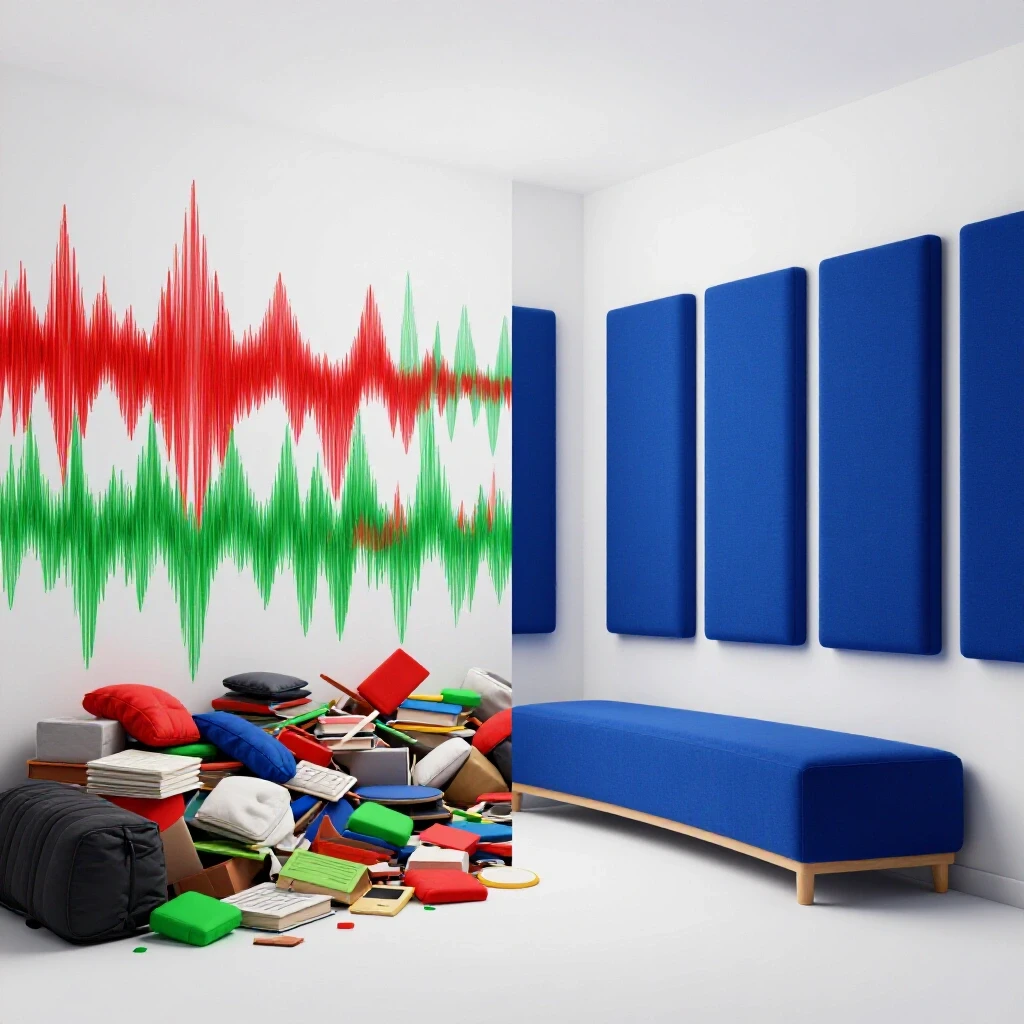
In the world of material science, we primarily look at two ratings: the Noise Reduction Coefficient (NRC) and the Sound Transmission Class (STC). NRC measures how much sound a surface absorbs, on a scale from 0 to 1. A rating of 0 means the surface reflects all sound, like a mirror, while a 1 means it absorbs all sound, like an open window. STC measures how much sound is blocked from traveling through a wall. For interior dampening projects, NRC is our primary metric. Most standard drywall has an NRC of about 0.05, which is why empty rooms echo. High-quality absorption boards typically aim for an NRC of 0.85 or higher.
Understanding Density and Air Flow Resistivity
Density refers to the weight of a material per cubic foot, while air flow resistivity measures how easily air (and sound waves) can move through it.
For acoustic applications, density is a critical technical specification. If a material is too dense, sound waves bounce off it. If it is too light, sound waves pass through without losing energy. Through my procurement research, I have found that the “sweet spot” for residential sound absorption is a density between 3.0 and 6.0 pounds per cubic foot (pcf). Materials within this range provide the best balance of low-frequency absorption and structural integrity.
- Low Density (under 2 pcf): Poor at absorbing low-frequency sounds (bass).
- Medium Density (3–4 pcf): The industry standard for high-end acoustic treatments.
- High Density (6+ pcf): Better for structural blocking but may reflect high-frequency sounds.
Sourcing Core Materials: Rigid Fiberglass vs. Mineral Wool
Choosing the internal core of your fabric-wrapped boards is the most important trade-off analysis in this process. You are weighing cost against ease of handling and performance.
When I started my material procurement log for my home office project, I compared two primary industrial materials: rigid fiberglass (like Owens Corning 703) and mineral wool (like Rockwool Safe ‘n’ Sound). Rigid fiberglass is a staple in high-end home materials because it maintains its shape and has a very high NRC-to-thickness ratio. Mineral wool is a more budget-friendly alternative derived from basalt rock and slag. While mineral wool is heavier and can be more difficult to cut cleanly, it offers excellent sound dampening at a lower price point per square foot.
Side-by-Side Material Performance Specifications
| Material Type | Density (pcf) | NRC (2″ Thickness) | Cost per Sq. Ft. | Rigidity/Durability |
|---|---|---|---|---|
| Rigid Fiberglass (OC 703) | 3.0 | 1.00 | $2.50 – $3.50 | High |
| Mineral Wool (Rockwool) | 4.0 | 0.95 | $1.20 – $1.80 | Medium |
| Acoustic Foam (PU) | 1.5 | 0.45 | $0.80 – $1.50 | Low |
| Polyester Fiberboard | 2.5 | 0.70 | $2.00 – $3.00 | High |
Building on this data, I chose rigid fiberglass for my living room because the panels needed to be thin (2 inches) while providing maximum absorption. For the basement media room, where aesthetics were less critical, I opted for mineral wool to save approximately 40% on material costs.
Evaluating Fabric Porosity and Breathability
The fabric covering a sound-absorbing board acts as both an aesthetic finish and a technical filter. If the fabric is too tightly woven, it will reflect sound before it ever reaches the core material.
In technical material specifications, we use the “breath test” to evaluate fabric suitability. If you can easily blow air through the fabric, sound waves can also pass through it. I have evaluated dozens of textiles, from high-end burlap to designer linens. Standard upholstery fabric often has a latex backing to prevent stretching, which makes it useless for acoustic dampening. Instead, look for “acoustically transparent” fabrics. Brands like Guilford of Maine are the gold standard, but I have found that certain open-weave polyesters provide a similar performance for 60% less cost.
- Guilford of Maine (FR701): 100% polyester, specifically engineered for sound.
- Natural Burlap: High transparency but prone to shedding and sagging over time.
- Linen Blends: Good aesthetics, but must be checked for tight weaves or backings.
Why Higher Upfront Costs Don’t Always Guarantee Durability
In my 13 years of evaluating home goods, I have seen many homeowners overspend on “pre-made” acoustic solutions that offer less performance than a well-built DIY version.
A pre-fabricated 2×4 foot acoustic panel can cost anywhere from $100 to $250. My material cost analysis for a DIY version using professional-grade rigid fiberglass and high-quality fabric came to approximately $45 per panel. The trade-off here is not in the material quality—the DIY version often uses the exact same core—but in your labor. However, from a supply chain perspective, the DIY route allows you to control the “fill factor.” You can use thicker 4-inch cores for problematic low-end noise, a customization that usually carries a heavy premium in retail markets.
Upfront Cost vs. 15-Year Maintenance Outlay
| Component | DIY Rigid Fiberglass | Retail Mid-Range Panel | Retail High-End Panel |
|---|---|---|---|
| Initial Cost (4 Panels) | $180 | $600 | $1,200 |
| Frame Durability | High (Solid Wood) | Medium (MDF/Plastic) | High (Aluminum) |
| Cleaning Ease | Moderate | Moderate | High (Removable Covers) |
| 15-Year Est. Cost | $220 (incl. 1 fabric swap) | $750 (incl. replacement) | $1,200 |
Interestingly, the DIY panels often have a longer lifespan because they are built with solid wood frames rather than the cheap MDF often found in mid-range retail options. In my own home, panels I built a decade ago still look new because I used a heavy-duty stapling technique and kiln-dried poplar for the frames.
Installation and Structural Requirements for Wall Mounting
The way you mount your acoustic treatments affects both the safety of the installation and the effectiveness of the sound absorption.
Sound waves can be absorbed more effectively if there is a gap between the panel and the wall. This is known as the “air gap effect.” By leaving a 1-to-2-inch space behind the board, you allow sound waves that pass through the material to bounce off the wall and be absorbed again on the way back. For mounting, I recommend using Z-clips or French cleats. These provide a secure, level connection to the wall studs, which is vital since a 4-inch thick mineral wool panel can weigh upwards of 15 pounds.
- Locate studs using a deep-scan stud finder.
- Install the wall-side cleat using 2.5-inch wood screws.
- Attach the panel-side cleat to the wooden frame of your absorber.
- Ensure a minimum of 2 inches of clearance from the ceiling for easy “drop-in” mounting.
Maintenance and Long-Term Cleaning Regimens
Fabric-covered materials in a home environment are prone to dust accumulation and, in some cases, sagging.
Maintaining your sound-absorbing assemblies is similar to caring for high-end upholstery. Because the core materials (fiberglass or mineral wool) are porous, they can trap dust over time. I recommend a light vacuuming with a brush attachment every six months. Avoid using liquid cleaners, as moisture can seep into the core material and cause it to lose its structural rigidity or, worse, develop odors. If a stain occurs, use a dry-solvent spot cleaner specifically designed for the fabric type you selected.
- Dusting: Use a low-suction vacuum with a soft brush.
- Fabric Tension: If the fabric sags due to humidity, a light misting of distilled water can sometimes “shrink” natural fibers back into place.
- Core Integrity: Every 5 years, check the mounting points to ensure the frames haven’t warped.
Sourcing and Procurement Checklist
When you are ready to purchase materials, use this checklist to ensure you are getting professional-grade components that meet technical standards.
- Core Material: Search for “industrial insulation distributors” rather than big-box home centers. You want 2-inch or 4-inch rigid boards with a minimum 3.0 pcf density.
- Fabric: Order samples first. Perform the “blow test” and check for color fastness under your room’s specific lighting.
- Frame Timber: Use kiln-dried 1×3 or 1×4 lumber. Avoid “green” wood, which will warp as it dries, ruining the clean lines of your panels.
- Adhesives: Use a high-tack spray adhesive (like 3M 77) only if you are bonding fabric directly to the core without a frame. Otherwise, heavy-duty T-50 staples are the supply chain standard.
Practical Trade-Off Scoring Matrix
To help you decide which material path to take, I have developed this scoring matrix based on my 13 years of material evaluation.
| Criteria | Mineral Wool (DIY) | Rigid Fiberglass (DIY) | Pre-Made (Retail) |
|---|---|---|---|
| Acoustic Performance | 9/10 | 10/10 | 8/10 |
| Ease of Assembly | 6/10 | 8/10 | 10/10 |
| Budget Friendliness | 10/10 | 7/10 | 3/10 |
| Customization | 10/10 | 10/10 | 2/10 |
| Durability | 8/10 | 9/10 | 7/10 |
As a result of this analysis, most homeowners find that DIY rigid fiberglass offers the best long-term value. It provides the highest NRC ratings while remaining thin enough to integrate into standard home decor without looking like an industrial installation.
Final Recommendations for the Practical Evaluator
Choosing to build your own sound-dampening treatments is a move that favors long-term performance over short-term convenience. From a supply chain perspective, the “middleman” markup on acoustic products is among the highest in the home goods industry. By sourcing raw industrial materials, you are essentially getting a $200 product for $50 in materials.
Before you start, measure your room’s “reverb time” using a simple smartphone app. Aim to cover about 15% to 20% of your wall surface area. Focus on the “first reflection points”—the spots on the walls where sound travels directly from your speakers or voice. By following these technical material specifications, you can transform a noisy, echoing room into a quiet, high-end space that adds real, felt value to your home.
Frequently Asked Questions
What is the difference between soundproofing and sound absorption?
Soundproofing (STC) involves stopping sound from entering or leaving a room, which requires heavy construction like adding extra drywall or mass-loaded vinyl. Sound absorption (NRC) involves catching echoes inside a room to improve clarity. The fabric-wrapped boards discussed here are for absorption.
Can I use regular pink fiberglass insulation for these panels?
No. Standard rolls of pink insulation are not dense enough and lack the structural rigidity to stand up in a frame. They will sag and provide poor low-frequency absorption compared to rigid 703 or mineral wool boards.
Is mineral wool safe to have in a living area?
Yes, once it is wrapped in fabric. While the raw fibers can be irritating during the building process (wear a mask and gloves), once they are encased in a frame and covered with an appropriate textile, they are stable and do not off-gas or shed fibers into the air.
How thick should my sound-absorbing boards be?
For general speech and high-frequency noise, 2 inches is sufficient. If you are trying to manage deep bass or home theater rumble, 4 inches is the technical standard to ensure effective low-frequency dampening.
Do I need a frame for the panels?
While you can wrap fabric directly around rigid fiberglass boards (using “impaling clips” to mount them), a wooden frame provides much better long-term durability and a cleaner, more professional look that mimics high-end furniture.
Does the color of the fabric affect acoustic performance?
No, the dye or color has no impact. Only the weave and the material type (polyester vs. cotton vs. plastic-backed) affect how sound waves pass through the fabric into the core.
Can I hang these on the ceiling?
Yes, this is called an “acoustic cloud.” It is highly effective for rooms with hard floors. However, you must use secure mounting hardware like eye-bolts and aircraft cable, as ceiling-mounted panels pose a safety risk if they are not properly anchored to joists.
Will these panels help block noise from my neighbors?
Only slightly. Because these are designed for absorption, they will make your room quieter by reducing echoes, but they do not have the mass required to stop sound from traveling through the walls from the outside.
How do I calculate how many panels I need?
A good rule of thumb for residential spaces is to cover 15% to 25% of the total wall surface area. For a standard 12×12 room, four to six 2×4 foot panels are usually enough to notice a significant difference in sound quality.
What is the best way to cut rigid fiberglass or mineral wool?
A long, serrated bread knife or a specialized insulation saw works best. Avoid using a standard utility knife, as it will dull quickly and tear the fibers rather than cutting them cleanly.
(This article was written by one of our staff writers, Andrew Morrison. Visit our Meet the Team page to learn more about the author and their expertise.)