How to Fix Roof Vent Problems in Your Attic (Step-by-Step Guide)

I once made the mistake of assuming that a few dark spots on my attic rafters were just “old house character.” During my early years as a facilities technician, I overlooked these small signals of poor air exchange, believing that as long as the roof wasn’t actively leaking, the system was performing its job. This oversight eventually led to localized wood rot that could have been prevented with a simple afternoon of diagnostic work. Maintaining an older property requires a shift in mindset: you aren’t just looking for holes in the roof; you are managing a complex environment where temperature and humidity must remain in a delicate balance.
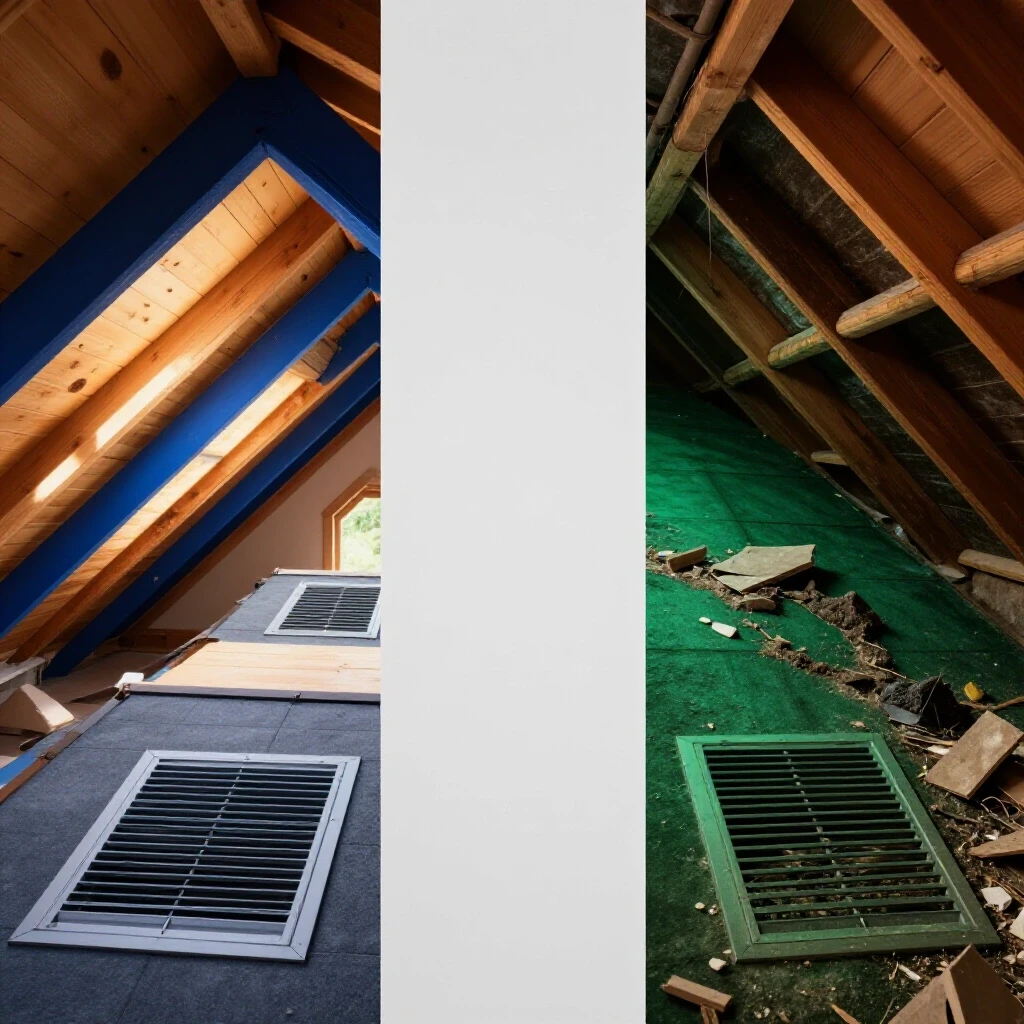
Over 17 years of maintaining legacy structures, I have learned that the attic is the most honest part of a home. It reveals exactly how the building envelope is failing. When we talk about the “building envelope,” we are referring to the physical separator between the conditioned interior of your home and the unconditioned exterior. In an attic, this envelope must be breathable yet secure. If the air trapped under your roof deck cannot circulate, it becomes a reservoir for moisture, leading to structural degradation that often goes unnoticed until it becomes an expensive crisis.
Understanding the Fundamentals of Attic Air Exchange
Attic ventilation is the intentional system of intake and exhaust ports designed to maintain a consistent temperature and moisture level within the upper reaches of a home. This process relies on the “stack effect,” a building science principle where warm air rises and creates a pressure differential.
The stack effect occurs because warm air is less dense than cold air. In a properly functioning attic, cool air enters through the lower intake vents (usually at the soffits) and rises naturally toward the peak of the roof. As it rises, it picks up heat and moisture, eventually exiting through exhaust vents like ridge vents or gable vents. If this pathway is obstructed, the air stagnates. Stagnant air allows moisture to condense on cold surfaces, which is the primary cause of roof deck deterioration.
The Role of Passive Ventilation Ratios
The standard guideline for residential air exchange is the 1/300 rule. This means for every 300 square feet of attic floor space, you should have at least 1 square foot of net free ventilating area (NFVA).
This ratio is split 50/50 between intake and exhaust. If you have 1,500 square feet of attic space, you need 5 square feet of total ventilation. Half of that (2.5 square feet) must be at the bottom near the eaves, and the other half should be at the top. This balance is critical because an imbalance can create a vacuum that pulls conditioned air out of your living space through “attic bypasses,” such as gaps around light fixtures or access hatches.
Essential Diagnostic Tools for Upper-Level Inspections
To accurately assess the health of your attic, you cannot rely on sight alone. You need a baseline of data to determine if the moisture levels in your lumber are within a safe range.
- Pin-Type Moisture Meter: This tool measures the electrical resistance between two pins pushed into the wood. For structural lumber, you want to see a moisture content (MC) between 8% and 14%. Anything consistently above 16% to 19% is a red flag for potential fungal growth.
- Infrared Thermal Camera: This allows you to see “thermal bridging,” where heat escapes through the ceiling and warms specific spots on the roof deck. These warm spots are often where condensation will first occur in winter.
- Hygrometer: A digital device that measures relative humidity (RH). Ideally, your attic’s RH should track closely with the outdoor humidity. If it is significantly higher, you have an airflow or moisture intrusion issue.
- Anemometer: This small handheld fan measures wind speed. You can hold it up to your intake vents on a breezy day to verify that air is actually moving into the attic space.
Identifying Moisture Failures in the Upper Envelope
Moisture detection in an attic is a systematic process of looking for the results of condensation and capillary action. Capillary action is the ability of a liquid to flow in narrow spaces without the assistance of, or even in opposition to, external forces like gravity.
When warm, moist air from your bathroom or kitchen leaks into a cold attic, it reaches its “dew point”—the temperature at which air can no longer hold its water vapor. That vapor turns into liquid water on the underside of your roof sheathing. If this happens repeatedly, the wood absorbs the water, leading to “delamination,” where the layers of plywood or OSB begin to separate.
Symptom-to-Root-Cause Diagnostic Tree
| Observed Symptom | Potential Root Cause | Diagnostic Step |
|---|---|---|
| Rusted nails on the roof deck | High humidity/condensation | Check RH levels with a hygrometer |
| Dark staining on rafters | Localized moisture/mold growth | Test wood with a moisture meter |
| Compressed or wet insulation | Air bypass or roof leak | Inspect for gaps in the ceiling plane |
| Ice dams on the roof edge | Poor intake airflow/heat loss | Check soffit vents for obstructions |
| Peeling paint on exterior trim | Trapped moisture in the soffits | Verify NFVA of intake vents |
Tracing Airflow Obstructions and Thermal Bridging
Thermal bridging occurs when a material that is more conductive than the surrounding insulation allows heat to bypass the thermal barrier. In many older homes, the wooden rafters themselves act as bridges, conducting heat from the house to the roof deck.
I have found that the most common cause of poor air exchange isn’t a lack of vents, but rather the accidental blockage of existing ones. During my inspections, I often find that previous owners or contractors have pushed fiberglass batts or blown-in cellulose insulation directly into the “eaves” or the edges of the attic. This completely seals off the soffit vents, preventing cool air from entering.
The Importance of Attic Baffles
To prevent insulation from migrating and blocking airflow, you must use baffles. These are plastic or foam channels stapled directly to the underside of the roof deck between the rafters. They ensure a clear, 2-inch gap between the insulation and the roof sheathing, allowing air to flow freely from the soffit into the main attic cavity. If your attic lacks these, your ventilation system is effectively paralyzed.
Physical Troubleshooting Sequences for the Homeowner
When you enter your attic for a diagnostic check, you should follow a specific sequence to ensure you don’t miss subtle signs of failure. Always wear a N95 respirator and eye protection to guard against insulation fibers and dust.
- Check the Perimeter: Start at the lowest point of the roof. Look for light coming through the soffits. If you see no light, your intake is blocked.
- Inspect the Sheathing: Look for “frosting” in winter or water stains in summer. Pay close attention to the North-facing side of the roof, as it stays colder and is more prone to condensation.
- Verify Exhaust Integrity: If you have a ridge vent, look up. You should see a clear gap in the wood at the very peak. If the wood was never cut back, the ridge vent is purely decorative and non-functional.
- Monitor Attic Bypasses: Look for “dirty” insulation. Fiberglass acts as a filter; if you see dark, grayish patches in your pink insulation, it means air is leaking from your living space, carrying dust and moisture into the attic.
Systematic Repairs and Airflow Improvements
If your diagnostics reveal poor airflow, the repair focus should be on restoring the intake-exhaust balance without introducing mechanical fans, which can often cause more harm than good by depressurizing the house.
Clearing the Intake Pathway
If insulation is blocking your soffits, you must pull it back. Use a long-handled rake or a specialized vacuum to clear the space. Once cleared, install baffles. Ensure the baffles extend at least 6 inches above the top of your insulation layer. This prevents wind-washing, where fast-moving air blows through the insulation and reduces its R-value (thermal resistance).
Managing the Thermal Boundary
Your goal is to keep the attic temperature within 10 to 15 degrees Fahrenheit of the outside air. To achieve this, you may need to increase your insulation levels. Modern standards suggest an R-49 to R-60 for most northern climates, which is roughly 16 to 20 inches of blown-in cellulose. However, more insulation requires even better ventilation to manage the moisture that will inevitably find its way up there.
DIY vs. Professional Scope Limits
Knowing when to stop is a critical part of structural protection. While most airflow improvements are within the realm of a dedicated homeowner, some issues indicate deeper problems.
| Task | DIY Scope | Stop and Evaluate |
|---|---|---|
| Installing Baffles | Safe for most; requires crawling in tight spaces | If rafters show structural cracks |
| Adding Insulation | Renting a blower is straightforward | If existing insulation is moldy or wet |
| Cleaning Soffit Vents | Use a brush or compressed air | If the soffit wood is rotted or crumbling |
| Sealing Air Bypasses | Use fire-rated canned foam around wires | If you find knob-and-tube wiring |
| Measuring Moisture | Use a \$30-\$50 moisture meter | If readings stay above 20% consistently |
A Multi-Year Prevention Program for Attic Health
Maintaining a legacy home is not a one-time event. It is a cycle of seasonal observations. By creating a residential diagnostics schedule, you can catch a minor airflow restriction before it turns into a roof deck replacement.
- Spring: Check for signs of winter condensation. Look for water spots on the floor and rust on any mechanical fasteners.
- Summer: Measure the temperature differential. On a 90-degree day, your attic shouldn’t be 150 degrees. If it is, your exhaust is insufficient.
- Fall: Ensure no leaves or debris have clogged your external vent covers. Check gable vent screens for bird or squirrel damage.
- Winter: Look for “attic rain” (frost) on the underside of the roof during the coldest weeks. This is the ultimate test of your moisture management.
Conclusion: Taking the Next Steps
The health of your home’s structure depends on your ability to manage what you cannot see. By understanding the building science of the stack effect and utilizing basic tools like moisture meters, you move from a reactive homeowner to a proactive caretaker. Your next step should be a simple visual audit. Grab a flashlight, head into the attic, and look at the perimeter. If you cannot see light coming from your eaves, your house isn’t breathing. Addressing that single issue can extend the life of your roof by a decade and protect the interior decor of your home from the silent threat of trapped moisture.
Frequently Asked Questions
How do I know if my attic has enough vents without doing complex math? A quick way to check is the temperature test. On a sunny day, the attic should not feel like a furnace compared to the outside. If you feel a significant “wall of heat” when you open the hatch, your exhaust is likely restricted. Also, look at the underside of the roof for “rust weeping” from nails; this is a clear sign that moisture is trapped and the ventilation is failing.
Can I just install a powered attic fan to fix airflow issues? I generally advise against this for older homes. Powered fans can create a negative pressure zone that pulls conditioned air (the air you paid to heat or cool) out of your house through small gaps in the ceiling. This increases your energy bills and can even pull carbon monoxide from gas appliances back into the home. Passive ventilation is safer and more reliable.
What is the “dew point” and why does it matter in my attic? The dew point is the temperature where air becomes saturated with water vapor. If your attic is cold and you have warm air leaking from your bathroom, that air hits the cold roof wood, reaches its dew point, and turns into liquid water. This is why air sealing the “bypasses” (gaps around pipes and lights) is just as important as ventilation.
Why are my soffit vents not working even though I can see them from outside? It is very common for painters to accidentally paint over the small holes in soffit vents, or for insulation to be blown over them from the inside. You should inspect them from both the outside (to ensure they aren’t painted shut) and the inside (to ensure they aren’t covered by fiberglass).
Does a ridge vent work better than gable vents? A ridge vent is generally more efficient because it is at the highest possible point of the roof, taking full advantage of the stack effect. However, they should not be used together. If you have both, the ridge vent might pull air from the gable vent instead of the soffits, leaving the lower parts of the roof stagnant.
What should I do if I find mold on my rafters? First, don’t panic. Small amounts of surface mold can often be cleaned, but the mold is just a symptom. You must fix the moisture source—either a leak or poor ventilation—or the mold will return. Use your moisture meter to see if the wood is currently wet (above 16%).
Is it okay to have different types of exhaust vents? It is best to stick to one type of exhaust. Mixing ridge vents with “turtle” vents or gable vents can disrupt the airflow pattern. The air will take the path of least resistance, which often means short-circuiting the system and leaving some areas of the attic unventilated.
How much does it cost to add baffles myself? Baffles are very inexpensive, usually costing between \$2 and \$5 per rafter bay. The real cost is the labor and the discomfort of working in a tight, dusty space. It is one of the highest-return DIY projects you can do for the longevity of your roof.
Can poor attic airflow cause my shingles to fail early? Yes. If the roof deck gets too hot, it can literally “cook” the shingles from the underside, causing them to curl, lose granules, and become brittle. Proper airflow keeps the shingles at a lower temperature, preserving the asphalt oils.
What is “wind-washing” in an attic? Wind-washing occurs when air enters the soffit vents at high speeds and blows through the insulation. This can push the insulation away from the edges of the house, creating cold spots on your ceiling and potentially clogging other vents. Baffles help prevent this by directing the air over the insulation.
(This article was written by one of our staff writers, Daniel Whitaker. Visit our Meet the Team page to learn more about the author and their expertise.)