Smart Bulbs vs Dimmers: Which Is Better for Your Home? (Guide)

It is a strange quirk of home design that we will spend six months obsessing over the exact vein pattern in a slab of Calacatta marble, only to flip a plastic switch and wash the entire room in a harsh, clinical glare. We treat the surfaces of our homes as permanent investments, yet we often treat the way we illuminate them as an afterthought.
Over the last 13 years, I have managed supply chains for high-end building materials and renovated three of my own properties. I have learned that the technical performance of your lighting control system is just as vital as the Janka hardness of your flooring. If the light quality is poor, even the most expensive materials look cheap.
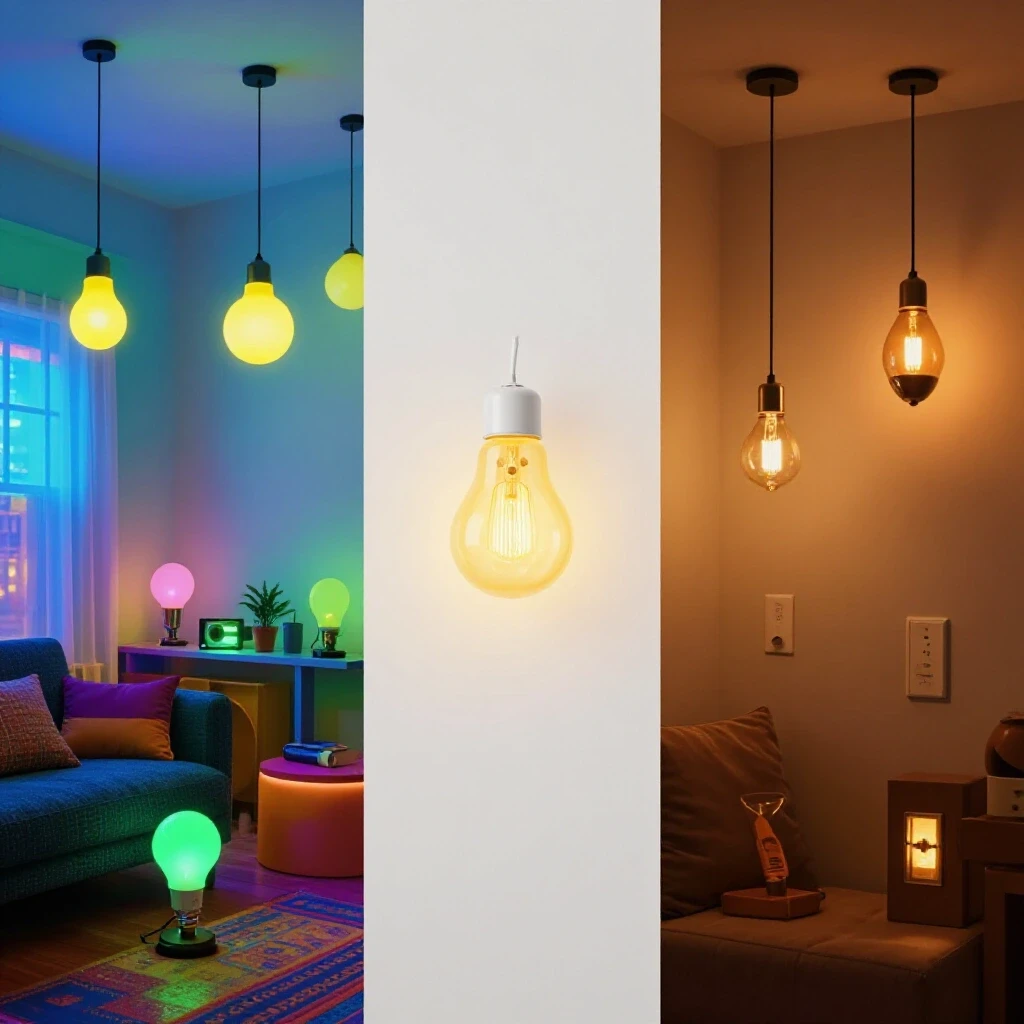
When evaluating how to manage light, homeowners usually face a choice between software-integrated light sources and hardware-based wall controllers. One offers infinite color flexibility through an app, while the other provides a tactile, consistent interface at the wall. My professional background in material specifications has taught me to look past the marketing and focus on the technical trade-offs of these two approaches.
Understanding Technical Performance Standards for Home Illumination
Technical standards in lighting focus on how a light source renders color and how reliably it responds to user input. These metrics help homeowners determine if a product will maintain its visual quality over several years or if it will degrade quickly under heavy use.
In the world of material science, we look at the Color Rendering Index (CRI). This is a scale from 0 to 100 that measures how accurately a light source reveals the true colors of objects. For a kitchen with high-end stone or wood, a CRI of 90 or higher is the industry standard. Software-defined bulbs often vary in CRI depending on the color temperature you choose, whereas dedicated wall controllers allow you to select high-CRI fixed bulbs that stay consistent.
Another key metric is “luminous flux,” measured in lumens, which tells you the total amount of visible light emitted. When comparing different control methods, you must consider “dimming range.” Many integrated bulbs can only drop to 5% or 10% brightness before they flicker or cut out. High-quality wall-mounted controllers can often achieve a “glow” as low as 1%, which is essential for evening ambiance.
Evaluating Hardware Longevity and Material Fatigue
Longevity in home materials refers to the ability of a component to withstand repeated cycles of use without a loss in performance. For lighting, this involves the life-cycle of the internal circuitry and the physical interface used to activate the light.
Integrated bulbs contain complex miniature circuit boards inside the base of the lamp. These components are sensitive to heat, which is the primary cause of premature failure in LED products. In my experience, a bulb rated for 25,000 hours may only last half that time if it is enclosed in a fixture where heat cannot escape. When the software or the hardware inside the bulb fails, the entire unit must be replaced.
Wall-mounted control units, by contrast, move the complexity out of the heat-prone fixture and into a stable environment. These devices use solid-state components designed to last 10 to 15 years. Because the bulb and the controller are separate, a failure in one does not require the replacement of the other. This separation of concerns is a core principle in supply chain risk management.
Side-by-Side Performance Specifications
| Feature | Software-Defined Bulbs | Integrated Wall Controllers |
|---|---|---|
| Average Lifespan | 3 – 7 Years | 10 – 15 Years |
| Color Rendering (CRI) | Variable (80 – 95) | Fixed (90+ depending on bulb) |
| Dimming Floor | 5% to 10% | 1% to 5% |
| Control Latency | 100ms – 2 seconds | Near-instant ( < 50ms) |
| Maintenance Unit | Individual Bulb | Wall Component |
Why Upfront Costs Don’t Always Guarantee Durability
In supply chain analysis, we distinguish between the “acquisition cost” and the “total cost of ownership.” A higher price tag at the store does not always mean a product will be cheaper to maintain over a decade of residential use.
Integrated bulbs often have a lower entry price for a single room. However, if you have a chandelier with 12 bulbs, the cost to make that fixture “smart” becomes significant. Furthermore, because these bulbs are part of a fast-moving tech ecosystem, finding an exact matching replacement three years later can be difficult. If one bulb fails and the manufacturer has changed the color profile of the new version, you may end up replacing all 12 to maintain visual harmony.
Wall controllers require a higher initial investment for the hardware. However, they allow you to use standard, high-performance bulbs that are commodity items. If a bulb burns out, you spend a few dollars on a replacement from any hardware store. The expensive part of the system—the controller—remains in the wall, providing a much more stable financial profile over time.
Practical Installation and Aesthetic Integration
Aesthetic integration is the measure of how well a technical component blends with the architectural intent of a home. For many homeowners, the visual “clutter” of technology can detract from the clean lines of a well-designed space.
Integrated bulbs offer the cleanest look at the wall because they often rely on existing switches or voice commands. However, this creates a usability paradox. If someone flips the physical wall switch to “off,” the software-defined bulb loses power and can no longer be controlled by an app or a schedule. This often leads to “taping” switches in the on position, which is a significant aesthetic failure in a high-end home.
Wall-mounted dimming systems solve this by replacing the standard switch with a dedicated interface. These units are always powered, meaning the light is always “ready” for a command, whether from a finger, a phone, or a timer. From a design perspective, these controllers come in various finishes—brushed brass, matte black, or stainless steel—to match your cabinet hardware and plumbing fixtures.
- Tactile Feedback: Physical controllers provide instant confirmation of use.
- Visual Uniformity: All switches in the home can match in style.
- Guest Usability: Visitors do not need an app to turn on the bathroom light.
- Response Time: Local hardware control eliminates the “lag” often seen with cloud-based bulbs.
Real-World Case Study: Lessons from a Decade of Use
In 2014, I outfitted a primary suite with a full set of color-changing integrated bulbs. I was excited by the prospect of “circadian lighting” that changed from cool white to warm amber throughout the day. However, the reality of daily usage over four years revealed several technical shortcomings that a spec sheet wouldn’t show.
The first issue was “node failure.” In a system of eight bulbs, one would occasionally lose its connection to the network. This resulted in a “popcorn effect” where seven lights would dim, but one would stay at 100% brightness. In a room designed for relaxation, this was a constant source of friction.
By 2018, I transitioned the main living areas of my next home to high-end wall controllers paired with “warm-dim” LED bulbs. These bulbs are engineered to mimic the behavior of incandescent filament; as they dim, the color temperature naturally shifts from 3000K to a cozy 2200K. This setup provided the aesthetic warmth I wanted with the 100% reliability of a hardwired system. I haven’t had to troubleshoot a “connection error” in five years.
15-Year Maintenance Outlay Comparison
-
Integrated Bulb System (10 bulbs):
- Initial Purchase: $350 – $500
- Replacement Cycle (Every 5 years): $1,050 – $1,500
- Software Troubleshooting: 10 – 20 hours
- Total: ~$1,800 + Time
-
Wall Controller System (1 Switch + 10 Bulbs):
- Initial Purchase: $150 (Controller) + $100 (Bulbs) = $250
- Replacement Bulbs (Every 7 years): $200
- Controller Replacement (None expected): $0
- Total: ~$450
Technical Material Specifications to Look For
When you are comparing products, ignore the marketing claims of “millions of colors” and look at the engineering data. These specifications will tell you how the material will actually perform in your specific environment.
- L70 Rating: This is the number of hours a bulb will run before its light output drops to 70% of its original brightness. Look for L70 ratings of at least 25,000 hours for integrated bulbs.
- Total Harmonic Distortion (THD): For wall controllers, a lower THD means the device produces less electrical noise, which results in less buzzing from the bulbs.
- Step-less Dimming: Check if the control is “continuous” or “stepped.” Stepped dimming looks jerky, like a computer screen, while continuous dimming feels smooth and high-end.
- Standby Power Draw: Integrated bulbs consume electricity even when “off” to stay connected to your network. In a large home, 50 “smart” bulbs can draw as much idle power as a small refrigerator.
Decision-Making Matrix for Homeowners
To choose the right system, you must weigh your lifestyle needs against the technical constraints of your home’s infrastructure. Use the following scoring system to evaluate which path fits your renovation goals.
-
Choose Integrated Bulbs if:
- You are in a temporary living situation (rental).
- You require vibrant color (pinks, blues, greens) for a media room.
- You have very few light fixtures per room.
- You prefer a “set it and forget it” automated schedule over manual control.
-
Choose Wall-Mounted Controllers if:
- You are performing a long-term renovation (5+ years).
- You have multi-bulb fixtures like chandeliers or recessed cans.
- You value high-quality, consistent light (CRI 90+).
- You want a system that guests and children can use intuitively.
- You want to minimize long-term electronic waste.
Practical Steps for Evaluating Samples
Before committing to an entire floor of your home, I recommend a “pilot test” in a single high-traffic room, such as the kitchen or living room. This allows you to observe the material performance under real conditions.
- Buy a Single Unit: Purchase one wall controller or one set of bulbs.
- Test the “Dimming Floor”: Turn the light to its lowest setting at night. Is it low enough for a “movie mode,” or is it still distractingly bright?
- Check for Flicker: Use your phone camera in “Slo-Mo” mode to record the light at low brightness. If you see heavy strobing on the screen, the pulse-width modulation (PWM) is low quality and may cause eye strain.
- Verify Color Match: Place a sample of your countertop or flooring under the light. Does the color look rich and true, or does it look “muddy” or grey?
Conclusion
The choice between software-driven illumination and hardware-based control is not just about convenience; it is a choice about the “infrastructure” of your home’s atmosphere. Integrated bulbs offer a high-tech, flexible solution that is excellent for specific use cases like accent lighting or entertainment. However, for the primary areas of a home where durability, light quality, and ease of use are the priorities, the evidence points toward wall-mounted controllers.
By separating the control interface from the light source, you create a system that is easier to maintain, more visually consistent, and significantly more cost-effective over a 15-year horizon. As a supply chain analyst, I look for systems that minimize failure points. In my own home, I have kept the wall-mounted controllers in every major room, reserving the software-integrated bulbs for a few decorative lamps where color flexibility adds a bit of fun without compromising the home’s core functionality.
FAQ
Which option is better for overall home resale value?
Wall-mounted controllers are generally better for resale value. They are considered “fixtures” that stay with the home and provide a permanent, high-end feel. Integrated bulbs are often viewed as “personal property” and may be removed by the seller, leaving the buyer with a home that has no smart functionality.
Do wall controllers work with all types of bulbs?
Most modern wall controllers are designed for “CFL/LED” loads, but you must ensure the bulbs you buy are explicitly labeled as “dimmable.” Using a non-dimmable LED with a wall controller can cause the bulb to overheat or the controller to fail.
Can I mix both systems in the same room?
It is technically possible but not recommended for the same circuit. You can have a wall controller managing your recessed ceiling lights and use software-defined bulbs in your bedside lamps. Mixing them on the same switch, however, leads to power conflicts and “flicker” issues.
How much does “idle power” cost for integrated bulbs?
A single integrated bulb uses about 0.5 to 1.0 watt in standby mode. While this seems small, 40 bulbs across a house can consume 350 kilowatt-hours per year. Depending on your local utility rates, this can add $50 to $100 to your annual power bill just to keep the lights “off.”
What happens if my internet goes down?
Wall-mounted controllers continue to work perfectly without an internet connection because they use local electrical signals. Many integrated bulbs will still turn on and off with a switch, but you will lose all dimming, scheduling, and color control until the connection is restored.
Do integrated bulbs really last 20 years?
Rarely. While the LED diode itself might last that long, the capacitors and wireless chips inside the bulb’s base are often the first to fail. In a residential setting, expect 3 to 7 years of reliable service from an integrated bulb, compared to 10+ years for a wall controller.
Is the light quality different between the two?
It can be. High-end wall controllers allow you to choose “Pro” grade bulbs with very high CRI and specific beam angles. Integrated bulbs are “all-in-one” units, meaning you are stuck with whatever light quality the manufacturer decided to package with the wireless chip.
Why do some lights buzz when they are dimmed?
Buzzing is usually caused by an incompatibility between the controller’s dimming method (forward-phase vs. reverse-phase) and the bulb’s internal driver. High-quality wall controllers often allow you to toggle between these modes to eliminate the noise, a feature rarely found in integrated bulbs.
(This article was written by one of our staff writers, Andrew Morrison. Visit our Meet the Team page to learn more about the author and their expertise.)