String Lights vs Lanterns: Cost, Efficiency & Durability Guide (Comparison)

How to determine the true cost of illuminating your patio or living room involves more than just looking at a price tag. Over the last 13 years, I have managed material procurement for three different properties, ranging from a 1920s bungalow to a modern build. In each project, I had to decide between overhead strand lighting and localized decorative fixtures. While one might seem like a simple aesthetic choice, the technical material specifications and energy draw significantly impact your monthly utility expenses and long-term maintenance schedule.
When evaluating high-end home materials, I look at the data first. Whether you are choosing between quartz and granite or deciding on a lighting layout, the methodology remains the same. You must weigh the upfront cost against the life-cycle costing calculations. In this guide, I will break down the technical trade-offs between continuous strand lights and individual plug-in lanterns, focusing on how these choices affect your home’s energy profile and your wallet.
Understanding Technical Lighting Standards for Residential Decor
Technical standards in residential lighting focus on luminous efficacy and material resilience. This involves evaluating how much energy is converted into light versus heat and how housing materials withstand environmental factors like humidity or physical impact over several years of regular household use. These metrics are vital for any appliance buying guide.
In my professional experience, homeowners often overlook the “wattage per foot” or “wattage per unit” metric. For example, a standard incandescent strand might pull 5 watts per bulb. If you have a 50-foot strand with 50 bulbs, that is 250 watts. In contrast, a single decorative plug-in lantern with a high-efficiency LED bulb might only pull 8 to 12 watts while providing a similar localized glow. This difference in energy draw is the primary driver of your monthly utility fluctuations.
Material Composition: Glass, Polycarbonate, and Metal Housings
The outer shell of a lighting fixture determines its durability and safety rating. While glass offers clarity and heat resistance, polycarbonate plastics provide impact resistance, and metal housings offer structural integrity. Choosing between these affects the product’s lifespan and the frequency of necessary replacements.
- Glass: Offers high UV resistance and does not yellow over time. However, it is prone to thermal shock—cracking when temperatures shift rapidly.
- Polycarbonate: This is a high-impact material often used in high-end home materials for its shatterproof qualities. It is excellent for active households with children or pets.
- Powder-Coated Steel: Commonly found in lantern frames, this material resists corrosion but requires periodic inspection for chips that could lead to rust.
Energy Consumption and Efficiency: Calculating the Impact on Monthly Utility Expenses
Energy consumption is measured in kilowatt-hours (kWh) based on the total wattage of the bulbs used. In a home material comparison, understanding the draw of a 50-foot strand versus a cluster of plug-in fixtures is essential for predicting long-term operational costs and overall household budget impact.
To perform a proper trade-off analysis, you need to calculate the daily usage. If you run your lights for 5 hours every evening, a 250-watt setup consumes 1.25 kWh per day. At an average rate of $0.15 per kWh, that costs about $5.60 per month. While that seems low, replacing those with low-wattage alternatives can drop that cost to under $0.50 per month. Over ten years, this represents a significant delta in ownership costs.
Side-by-Side Material Performance Specifications
| Feature | LED Strand Lights (High-End) | Decorative Plug-In Lanterns |
|---|---|---|
| Material | Polycarbonate / Heavy-duty Rubber | Metal / Tempered Glass |
| Wattage (Total) | 15W – 30W (for 50ft) | 8W – 12W (per unit) |
| Lifespan | 15,000 – 25,000 hours | 20,000 – 30,000 hours |
| Maintenance | Bulb replacement / Cord cleaning | Glass wiping / Metal polishing |
| Durability | High (Shatterproof) | Medium (Glass breakage risk) |
| Luminous Efficacy | 80-100 lumens/watt | 90-110 lumens/watt |
Comparing Long-Term Durability and Maintenance Requirements
Durability vs. maintenance cost is a critical pillar of any material evaluation. In my 13 years of analyzing supply chains, I have found that products with higher upfront costs often use superior seals and thicker gauge wiring, which prevents the internal corrosion that leads to premature failure.
String lights are often subject to “tension stress.” If they are draped over long distances, the copper wiring inside the rubber housing can stretch or fray. Lanterns, being stationary and often placed on solid surfaces, do not face this physical strain. However, lanterns have more surface area for dust and grime to accumulate, requiring a more frequent cleaning regimen to maintain their light output.
Material Degradation: UV Exposure and Thermal Stress
Thermal stress occurs when a material expands and contracts due to temperature changes. For outdoor-rated string lights, the rubber or PVC coating must remain flexible. Cheaper materials will become brittle and crack within 24 months, leading to moisture ingress.
- ASTM G154: This is a standard test for UV resistance. High-quality lighting materials should meet or exceed these ratings to ensure they don’t fade or crack.
- IP Ratings: Look for IP65 or higher for any lighting used in damp or outdoor areas. This ensures the housing is protected against dust and water splashes.
Financial Evaluation: Upfront Investment vs. Operating Expenses
A common mistake in home material comparison is focusing solely on the purchase price. A “cheap” set of lights that consumes more power and needs replacement every two years is far more expensive than a premium set that lasts a decade.
When I evaluated the lighting for my second property, I compared a $40 budget strand against a $120 commercial-grade set. The budget set used 125 watts and lasted 18 months. The commercial-grade set used 15 watts (LED) and is still functioning seven years later. The “expensive” choice saved me over $200 in energy and replacement costs during that period.
10-Year Life-Cycle Costing Calculation
- Initial Purchase: $120 (Premium) vs. $40 (Budget).
- Energy Use (5 hrs/day): $0.40/mo (Premium) vs. $3.50/mo (Budget).
- Replacement Cycle: 0 replacements (Premium) vs. 4 replacements (Budget).
- Total 10-Year Cost: ~$168 (Premium) vs. ~$580 (Budget).
Practical Installation and DIY Styling for Longevity
Installation demands vary greatly between these two options. String lights require structural anchor points—such as screw eyes or guide wires—to prevent sagging. Lanterns are “plug-and-play” but require stable, level surfaces to prevent tipping and glass breakage.
In my bungalow renovation, I found that using a stainless steel guide wire for string lights was a necessary “extra” material cost. Without it, the weight of the lights caused the rubber housing to stretch, eventually leading to a short circuit. For the lanterns I placed on the hearth, I opted for heavy wrought iron bases to ensure they wouldn’t be knocked over by my dogs.
Tool Kit for Lighting Evaluation
- Wattage Meter: A simple plug-in device to measure actual energy draw.
- Calipers: To check the thickness of the wire insulation (look for 14-16 gauge for heavy-duty use).
- Microfiber Cloths: For non-abrasive cleaning of glass and polycarbonate.
- Non-Acidic Metal Polish: To maintain the finish on decorative lanterns.
Real-World Case Study: The 13-Year Performance Log
During my tenure as a supply chain analyst, I kept a detailed log of every major home purchase. In 2015, I installed two different lighting styles in a covered patio area to test their resilience.
The first was a series of three large metal lanterns with LED Edison bulbs. The second was a 25-foot strand of heavy-duty LED globes. After five years, the lanterns required three cleanings per year to remove spider webs and dust from the glass. The string lights required almost zero maintenance, but the rubber housing had slightly faded from the heat. Interestingly, the energy impact of both was nearly identical because I used the same wattage bulbs in the lanterns as were present in the string. The trade-off was purely aesthetic versus cleaning labor.
Technical Spec Tracker for Your Home
- Total Wattage: Sum of all bulbs in the circuit.
- Lumens: Total light output (aim for 15-20 lumens per square foot for ambient areas).
- Color Temperature: Measured in Kelvin (2700K is warm/yellow, 5000K is daylight/blue).
- Warranty Limits: Most premium residential lighting offers a 3 to 5-year limited warranty.
Actionable Buying Worksheet
Before you make a purchase, use this scoring matrix to evaluate your options. Score each category from 1 to 5.
- Energy Efficiency: Does it pull less than 20 watts total?
- Material Quality: Is the housing metal or high-grade polycarbonate?
- Maintenance: Can it be cleaned in under 10 minutes?
- Durability: Is it rated for at least 20,000 hours?
- Cost-to-Value: Is the 10-year operating cost lower than the budget alternative?
If your chosen product scores below a 15, it may not be the best long-term investment for your home.
Conclusion
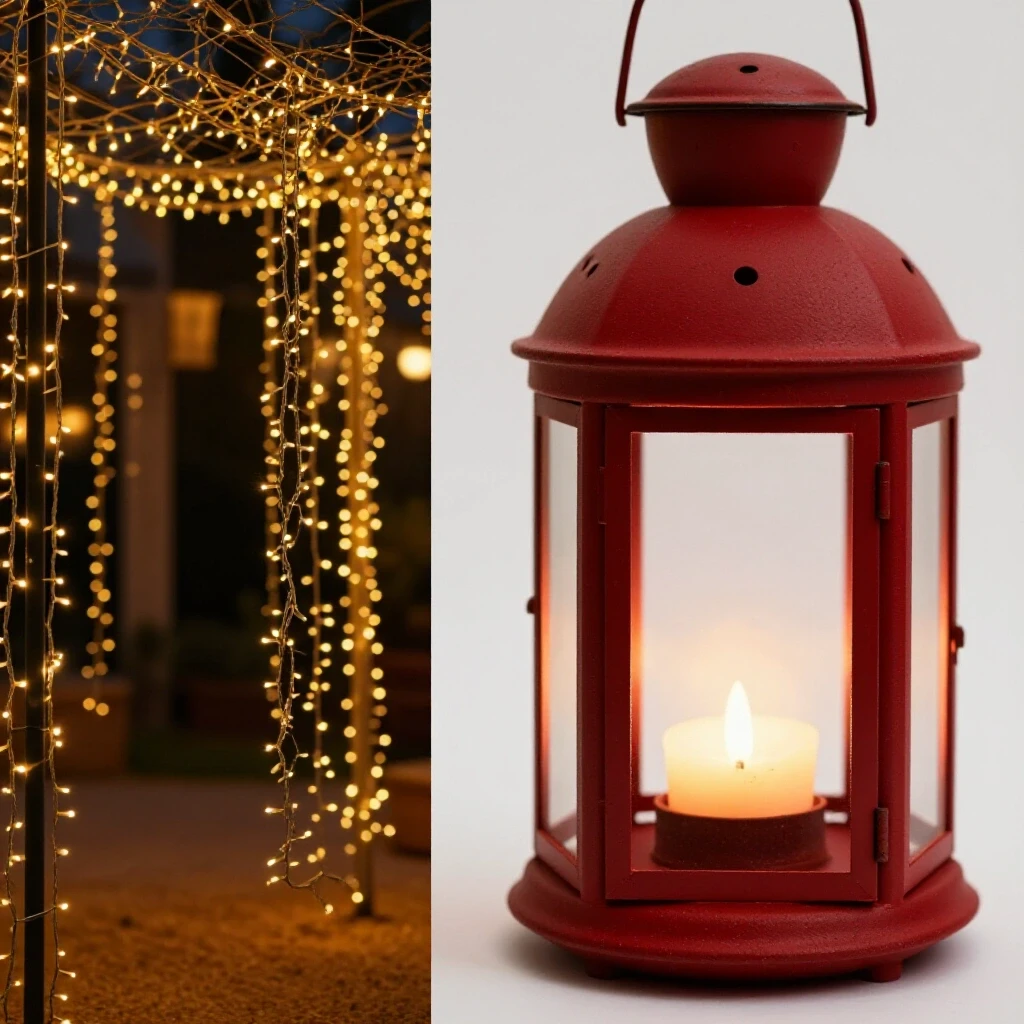
Choosing the right lighting for your home is a balance of technical specs and lifestyle fit. While string lights offer a broad, festive glow with very little maintenance, they require careful installation to avoid wire fatigue. Individual lanterns provide a classic look and high durability but demand more frequent cleaning to keep the glass clear. From a utility perspective, the most important factor is the bulb technology—LED is non-negotiable for anyone looking to keep their monthly expenses low. By focusing on material science and lifecycle costs, you can move past the overwhelm and make a confident, evidence-based decision for your renovation.
Frequently Asked Questions
How much does it actually cost to run decorative lighting every night?
For a typical LED setup pulling 20 watts, running it for five hours a night will cost approximately $0.09 per month based on a $0.15/kWh rate. Incandescent versions of the same lights can cost ten times that amount, roughly $0.90 to $1.50 per month.
Which material lasts longer outdoors: plastic or glass bulbs?
Polycarbonate (plastic) bulbs are generally superior for outdoor residential use because they are shatterproof and can withstand being blown against a house or fence by the wind. However, high-quality glass bulbs offer better clarity and do not scratch as easily during cleaning.
Do string lights use more power than a standard floor lamp?
Generally, no. A modern LED string light set uses between 15 and 30 watts, which is comparable to or even less than a standard floor lamp using a traditional 60-watt equivalent LED bulb (which actually pulls about 9-12 watts).
What is the most common cause of failure for these lighting types?
For string lights, moisture entering the bulb sockets is the primary cause of failure. For lanterns, it is typically the degradation of the internal wiring or the corrosion of the metal base if it sits in standing water on a patio.
How can I tell if a product is “commercial grade”?
Look at the wire gauge and the socket seal. Commercial-grade string lights usually feature 14 or 16-gauge wire and have a rubber “lip” that seals tightly around the base of the bulb to prevent water ingress.
Is there a difference in light quality between these two options?
The light quality depends on the bulb’s Color Rendering Index (CRI) and color temperature (Kelvin). Both styles can use the same bulbs, but lanterns often diffuse light through glass panels, creating a softer, more localized glow compared to the “point-source” light of exposed string bulbs.
How often should I clean my decorative lighting?
In an indoor environment, a quick dusting every three months is sufficient. For outdoor areas, you should wipe down glass panels or bulbs twice a year—once in the spring and once in the fall—to ensure maximum light output and to inspect for any material wear.
Can I replace individual bulbs in all string light sets?
Not all sets are created equal. Some budget-friendly options have integrated LEDs that cannot be replaced. Always look for sets with “E26” or “E12” base sockets, which allow you to replace individual bulbs as they burn out, extending the life of the entire strand.
Does the length of the cord affect the power draw?
The length of the cord itself has a negligible impact on power draw in a residential setting. The primary driver of energy consumption is the total number of bulbs and their individual wattage.
What should I look for in a warranty for high-end lighting?
A solid warranty should cover the “integrated components” for at least three years. Be wary of warranties that only cover the bulbs, as the bulbs are considered consumables. The housing, sockets, and wiring are the components you want protected.
(This article was written by one of our staff writers, Andrew Morrison. Visit our Meet the Team page to learn more about the author and their expertise.)