Best Baseboard Styles for Easy Cleaning (Comparison Guide)

When you are knee-deep in a home renovation, the smallest details often cause the biggest headaches. I have spent 13 years analyzing supply chains and material performance, and I have seen how a simple choice like floor trim can change your daily life. Most homeowners pick a profile based on a small sample at the store without considering how that shape will interact with dust, pet hair, and moisture over the next decade.
The problem is that many high-end designs feature intricate ledges and deep grooves that act as collection points for airborne particles. While these look beautiful in a showroom, they often require significantly more physical labor to keep clean compared to simpler alternatives. By understanding the technical specifications of materials and the physics of profile geometry, you can choose a trim that balances aesthetic appeal with a realistic maintenance schedule.
Understanding Technical Material Specifications for Interior Trim
Material science in home goods focuses on how different substances react to environmental stressors like humidity, impact, and abrasion. For interior trim, we primarily look at density, which is the mass of the material per unit volume, and dimensional stability, which measures how much a material expands or contracts. These factors dictate how well a finish adheres and how easily the surface can be wiped down.
Comparing MDF and Finger-Jointed Pine Performance
Medium Density Fiberboard (MDF) is an engineered wood product made by breaking down hardwood or softwood residuals into wood fibers. Finger-jointed pine consists of short pieces of solid wood joined together with glue. Both are industry standards, but they behave very differently when exposed to the mechanical stress of a vacuum cleaner or the moisture of a damp cloth.
In my experience evaluating materials across multiple properties, MDF offers a superior surface for paint because it lacks a natural grain. This creates a smoother finish that resists dust better than the slightly textured surface of natural wood. However, if you live in a high-humidity area, MDF can swell if the bottom edge is not sealed, leading to a permanent change in the profile’s shape that makes cleaning difficult.
The Role of PVC and Composites in High-Moisture Areas
Polyvinyl Chloride (PVC) and other high-tech composites are non-porous materials that do not absorb water. These materials are often used in bathrooms or laundry rooms where traditional wood products might rot or grow mold. From a maintenance perspective, these are the easiest to manage because they can withstand heavy moisture without warping or losing their finish.
Interestingly, the supply chain for these composites has improved significantly, making them a viable alternative to high-end wood. While the upfront cost can be 20% to 30% higher than MDF, the long-term value is found in their immunity to water damage. If a pipe leaks, a PVC trim remains unchanged, whereas wood or MDF would likely need a full replacement.
How Profile Geometry Influences Dust Accumulation
The geometry of a trim profile refers to the specific curves, steps, and flat surfaces that make up its visible face. In material engineering, we look at how these shapes create “shelves” where dust can settle. A complex profile with multiple horizontal surfaces will naturally collect more debris than a vertical, flat surface due to gravity and airflow patterns.
Evaluating the Maintenance Trade-offs of Ornate vs. Minimalist Shapes
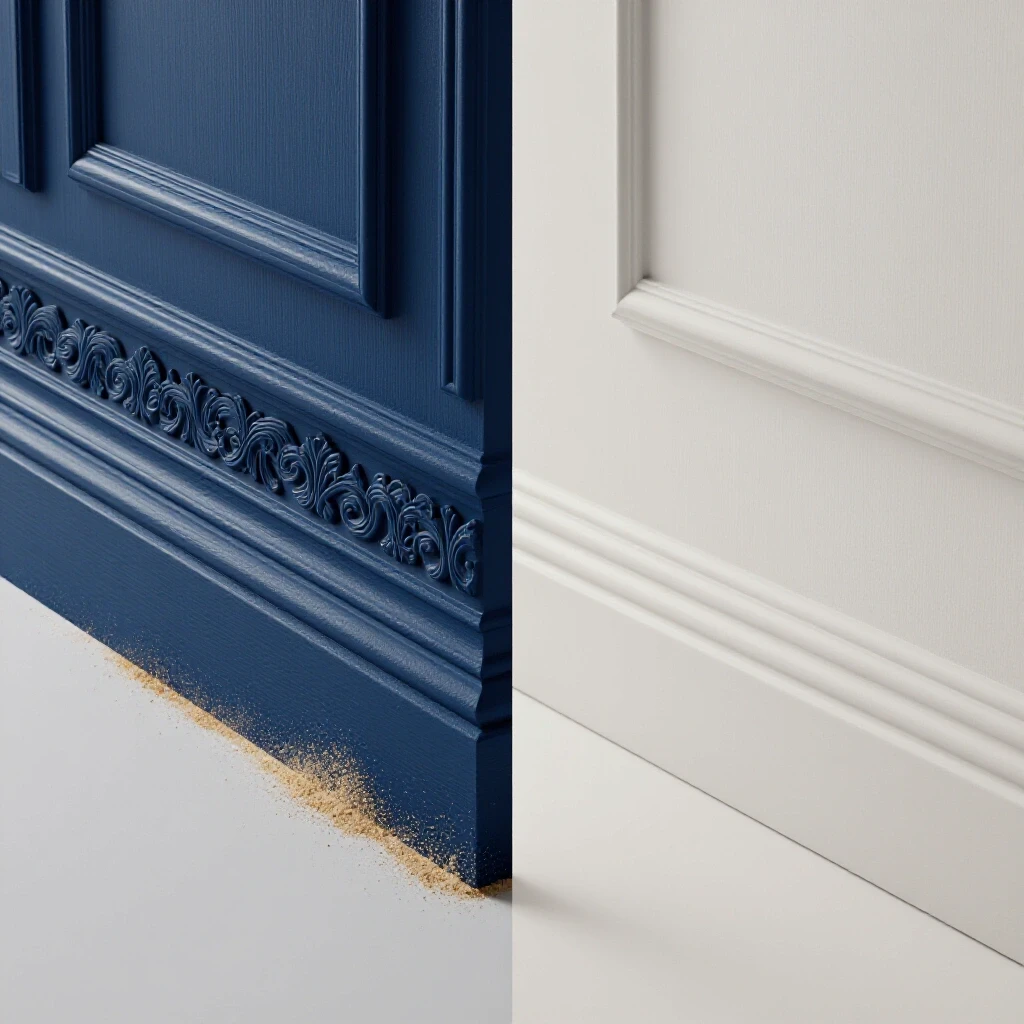
Ornate profiles, such as those found in Victorian or Colonial styles, feature deep coves and rounded beads. These designs create visual depth but also provide multiple landing zones for dust. In my own home, I found that profiles with a “beaded” edge required a more detailed cleaning approach compared to a simple “eased edge” design.
Minimalist shapes, like a square-edge or a craftsman-style trim, have fewer horizontal surfaces. This reduces the area where dust can accumulate. Building on this, the angle of the top edge is a critical technical detail. A sharp 90-degree angle at the top of a baseboard is a perfect shelf for dust, while a “sloped” or “chamfered” top encourages particles to slide off or makes them easier to remove with a quick pass of a cloth.
The Impact of Height and Thickness on Cleaning Accessibility
Standard baseboard heights range from 3 inches to over 7 inches, with thicknesses typically between 1/2 inch and 3/4 inch. A taller baseboard covers more of the wall and can protect it from scuffs, but it also presents a larger surface area to maintain. Thicker trim creates a more prominent ledge at the top, which is the primary site for dust buildup.
- Standard 3.5-inch trim: Lower surface area, less visible dust.
- High-profile 7-inch trim: High visual impact, requires more frequent wiping.
- Thin 1/2-inch profiles: Minimal ledge, easier to clean around furniture.
- Thick 3/4-inch profiles: Large top ledge, requires consistent attention.
Side-by-Side Material Performance Specifications
When choosing between materials, I look at the technical data provided by organizations like ASTM International. These ratings help determine how a material will stand up to the “real world” of a busy household. Below is a comparison of common materials based on my technical evaluations.
| Material Type | Density (lb/ft³) | Moisture Resistance (ASTM D1037) | Impact Resistance | Surface Smoothness |
|---|---|---|---|---|
| MDF | 40-50 | Low (Swells) | Moderate | Excellent |
| Finger-Jointed Pine | 25-30 | Moderate | Moderate | Good |
| Solid Oak | 45-50 | High | High | Fair (Grainy) |
| PVC / Composite | 30-40 | Waterproof | High | Excellent |
Why Higher Upfront Costs Don’t Always Guarantee Durability
In the world of supply chain analysis, we often see a “diminishing return” on investment. A high-end solid walnut baseboard costs significantly more than MDF, but it may actually be harder to maintain. Solid wood expands and contracts with the seasons, which can cause gaps at the joints (miters) where dust and hair can become trapped.
Evaluating the Real Trade-Offs of Premium Materials
Premium materials like solid hardwoods offer incredible durability against physical impacts, such as a rogue vacuum cleaner or a child’s toy. However, they require a clear coat or a specific stain that might need refreshing every few years. If the goal is a low-maintenance lifestyle, a high-quality painted MDF or a PVC composite often outperforms expensive wood.
I have found that the “sweet spot” for many homeowners is a high-density MDF with a factory-applied primer. This provides a very smooth surface that is easy to wipe down and resists the minor dings of daily life. By avoiding the natural imperfections of wood, you eliminate the small pits and grain lines where microscopic dirt likes to hide.
Life-Cycle Costing: Upfront Price vs. 15-Year Maintenance
To truly understand the value of your choice, you must look at the total cost of ownership. This includes the initial purchase, the cost of professional installation, and the estimated labor or material costs for repainting and cleaning over 15 years.
- MDF: Low upfront cost ($1.00/LF), high risk of water damage, requires repainting every 5-7 years.
- Solid Wood: High upfront cost ($4.00+/LF), durable, requires periodic refinishing.
- PVC: Moderate upfront cost ($2.50/LF), zero water damage risk, rarely needs repainting.
Practical Steps for Evaluating Samples Before You Buy
Before committing to a whole house of trim, I recommend a systematic evaluation process. You should treat this like any other major material purchase, such as flooring or countertops. Getting samples is the first step in seeing how the material and shape will perform in your specific environment.
- Obtain 12-inch samples of at least three different profiles and materials.
- Place the samples on the floor in a high-traffic area for one week.
- Observe how much dust accumulates on the top ledge and within any grooves.
- Wipe each sample with a dry cloth and a damp cloth to check for “drag” or snagging.
- Check for “telegraphing,” where the wood grain or imperfections show through the paint.
- Test the impact resistance by lightly tapping the sample with a heavy object to simulate a vacuum.
Supply Chain Realities and Sourcing Quality Materials
The quality of trim can vary wildly depending on the manufacturer and the sourcing of the raw materials. For example, some low-end MDF is made with urea-formaldehyde resins that can off-gas, while higher-end versions use moisture-resistant resins. As a supply chain analyst, I always look for products that meet CARB Phase 2 compliance for air quality.
When sourcing, check the “straightness” of the boards. Lower-quality finger-jointed pine often has “crooks” or “bows” that make installation difficult. If the trim isn’t perfectly flush against the wall, it creates gaps that are impossible to clean and eventually fill with debris. Always inspect your delivery before the installers begin their work.
Final Recommendations for a Low-Maintenance Home
Choosing the right trim is about matching the material’s technical specs to your lifestyle. If you have pets that shed or live in a dusty environment, avoiding ornate profiles with deep coves is the most practical decision you can make. A simple profile with a smooth, semi-gloss finish will always be easier to maintain than a complex, textured wood design.
Building on my years of property evaluation, I suggest prioritizing the “eased edge” or “bullnose” profiles. These provide a clean look without the horizontal shelves that characterize more traditional styles. By focusing on density and surface smoothness, you can ensure that your home remains beautiful with a fraction of the effort.
Frequently Asked Questions
Does the height of the trim affect how much dust it collects? The height itself doesn’t attract more dust, but a taller baseboard has more vertical surface area. Most dust settles on the horizontal top ledge. A 7-inch baseboard with a 3/4-inch thickness has the same “dust shelf” as a 3-inch baseboard of the same thickness. However, the taller board is more visible, so any scuffs or dust on the face will be more noticeable.
Is a semi-gloss finish better than a satin finish for cleaning? Yes, from a technical standpoint. Semi-gloss and high-gloss paints have a higher resin-to-pigment ratio. This creates a smoother, harder, and less porous surface. Dust and grime have a harder time “sticking” to a glossier surface, and it can withstand more vigorous wiping without the paint wearing thin.
Why do my baseboard joints keep cracking? This is usually due to the dimensional instability of the material. Natural wood and finger-jointed pine expand and contract with changes in humidity. If the material wasn’t acclimated to the room before installation, the joints will pull apart. MDF is more stable in this regard, though it is more sensitive to direct liquid water.
What is the most durable material for a home with kids and pets? Solid hardwood or high-quality PVC are the most durable against impacts. MDF is prone to chipping if hit hard by a heavy vacuum or toy. If you want a painted look with maximum durability, look for “Hardwood finger-jointed” trim, which combines the smoothness of a manufactured product with the impact resistance of real wood.
Can I use PVC trim throughout the whole house? You certainly can, though it is more expensive than MDF. PVC is excellent for durability and ease of cleaning. The main drawback is that it can be harder to get a “perfect” miter joint because the material is slightly more flexible than wood. It also requires specific adhesives and paints designed for cellular PVC.
Does “shoe moulding” make cleaning harder? Yes, adding shoe moulding or quarter round adds another horizontal ledge and another “seam” where dust can collect. While it is often necessary to cover gaps in flooring, it increases the maintenance surface area. If possible, a “flat” installation where the baseboard sits directly on the floor is easier to maintain.
How does the “Janka Hardness” rating apply to trim? The Janka scale measures the resistance of wood to denting. While usually used for flooring, it is relevant for trim in high-traffic areas. For example, Oak has a high Janka rating and won’t dent easily, whereas Pine is very soft and will show every bump and scrape.
What is the best way to handle “dust traps” in existing ornate trim? If you already have complex trim, the best approach is ensuring the finish is in good condition. A fresh coat of high-quality, smooth enamel paint can fill in micro-pores and make the surface slicker. This doesn’t remove the “shelves,” but it makes the debris easier to wipe away.
Is factory-primed trim worth the extra cost? In my experience, yes. Factory primers are applied in a controlled environment and are often much smoother than what can be achieved with a brush or roller on-site. This smooth foundation is key to a low-maintenance final finish.
Does the “sheen” of the paint affect the durability? Higher sheen levels generally correlate with higher durability and “scrubbability.” Flat or matte paints are more porous and can trap oils from skin or pet fur, making them very difficult to clean without removing the paint itself. Always use at least a satin, but preferably a semi-gloss, for trim.
(This article was written by one of our staff writers, Andrew Morrison. Visit our Meet the Team page to learn more about the author and their expertise.)