How to Fix a Broken Door Latch: Quick Repair vs Replacement (Guide)

Restoring a vintage piece of furniture or a century-old workbench often teaches you more about physics than any textbook. In my 17 years as a facilities technician, I found that the same principles of mechanical alignment and material fatigue apply to the smallest components of a home. There is a specific satisfaction in the crisp “click” of an interior door securing properly, a sound that signals a system in perfect equilibrium. When that sound changes to a metallic scrape or a dull thud, it is the house’s way of communicating a mechanical failure that requires systematic investigation.
Understanding Mechanical Tolerances in Interior Hardware
Mechanical tolerance refers to the permissible limit of variation in a physical dimension or a measured value of a machined part. In the context of interior door hardware, these tolerances ensure that the latch bolt interacts with the strike plate without excessive friction or resistance.
Building science teaches us that interior environments are dynamic. Wood doors expand and contract based on relative humidity, which usually fluctuates between 30% and 50% in a well-regulated home. When a door latch fails to engage, it is often because the mechanical tolerance has been exceeded due to either component wear or slight shifts in the door’s position. The internal mechanism of a standard tubular latch relies on a compression spring. Over thousands of cycles, this spring can suffer from metal fatigue, losing its ability to extend the bolt fully into the strike plate.
Essential Diagnostic Tools for Residential Hardware
A systematic approach to home maintenance requires a specific set of tools designed to measure and adjust mechanical components without causing secondary damage. Using the wrong tool can strip screw heads or mar the finish of legacy hardware, leading to more complex repairs.
- Phillips and Flathead Screwdrivers: High-quality drivers with hardened tips are essential for removing faceplates without slipping.
- Dry Graphite Lubricant: Unlike oil-based lubricants, dry graphite does not attract dust or pet hair, which can gum up internal springs over time.
- Needle-Nose Pliers: These are used for adjusting internal springs or removing debris caught within the bore hole.
- Metal File: A small mill file is necessary for minor adjustments to the strike plate opening if the alignment is off by less than 1.5 millimeters.
- Calipers or a Metric Ruler: Used to measure the backset—the distance from the edge of the door to the center of the knob hole—which is typically 60mm or 70mm.
- Flashlight: High-lumen illumination is required to inspect the internal “hub” where the spindle passes through the latch.
Identifying Symptoms of Internal Mechanism Failure
Residential diagnostics begin with a visual and tactile assessment of how the hardware behaves during operation. By categorizing the symptoms, you can determine if the issue is a simple lack of lubrication or a catastrophic failure of the internal cast metal components.
| Symptom | Probable Root Cause | Recommended Action |
|---|---|---|
| Latch bolt stays retracted | Broken compression spring | Full Component Substitution |
| Knob turns but bolt does not move | Sheared spindle or broken hub | Full Component Substitution |
| Bolt hits strike plate but won’t “click” | Vertical or horizontal misalignment | Quick Fix (Adjustment) |
| Mechanism feels “gritty” or stiff | Accumulation of debris or lack of lube | Quick Fix (Cleaning/Lube) |
| Handle sags or feels loose | Loose mounting screws or worn bushing | Quick Fix (Tightening) |
Building on this diagnostic tree, I recall a project in a 1920s craftsman home where the owner complained of “ghost doors” that would drift open. The issue wasn’t the house settling; rather, the latch bolts had become so worn from decades of friction that they had developed a rounded profile, allowing them to slip out of the strike plate under the slightest air pressure changes.
Systematic Troubleshooting for Sticking Latch Bolts
A quick fix involves restoring the functional parameters of the existing hardware without replacing the core components. This process focuses on reducing friction and ensuring that the kinetic energy of the internal spring is sufficient to overcome the resistance of the strike plate.
The first step in any residential repair guide is cleaning. Remove the handle and the latch unit to inspect for “zinc rot” or dust buildup. If the metal appears intact, apply a small amount of dry lubricant to the pivot points. Interestingly, many homeowners over-tighten the mounting screws, which can compress the tubular housing and bind the internal slide. Backing off the screws by a quarter-turn often restores smooth movement.
If the bolt is hitting the strike plate rather than entering the hole, check for “strike rub.” You can identify the exact point of contact by applying a small amount of lipstick or chalk to the latch bolt and closing the door. The mark left on the plate indicates where you need to use your metal file to widen the opening. As a rule of thumb, if you have to file away more than 3mm of metal, the issue is likely structural rather than mechanical.
When to Perform a Complete Hardware Substitution
Full component substitution becomes necessary when the structural integrity of the internal cast metal is compromised. In older properties, the “spindle”—the square metal bar that connects the knobs—can become rounded or sheared, making the door impossible to open from one side.
Mechanical systems have a finite lifespan, often rated by “cycles.” A standard residential latch might be rated for 100,000 to 200,000 cycles. Once the internal hub—the part the spindle turns—cracks, no amount of lubricant will fix the issue. When replacing the unit, precision is key. You must match the “backset” measurement exactly. If you install a 60mm latch in a hole drilled for a 70mm backset, the spindle will not align, and you risk stripping the new hardware immediately.
- Measure the door thickness: Standard interior doors are usually 35mm.
- Verify the latch faceplate shape: Some are “drive-in” (round), while others are rectangular with square or rounded corners.
- Check the spindle diameter: Older legacy hardware may use a different thread count or thickness than modern replacements.
Preventive Care and Long-Term Durability Strategies
Preventative home care involves a multi-year strategy to minimize wear on mechanical systems. By reducing the force required to operate a door, you extend the life of the internal springs and prevent the “rattle” that often precedes a total failure.
Building science suggests that maintaining a stable indoor climate reduces the expansion of wood door slabs, which in turn keeps the latch and strike plate aligned. I recommend a bi-annual inspection as part of your home maintenance checklist. During these checks, verify that the “deadlatch”—the small pin next to the main bolt—is not falling into the strike plate hole. Its job is to stay depressed against the plate to prevent “shimming” or forced entry, but in interior doors, it often serves as a secondary alignment guide.
Diagnostic Checklist for Seasonal Maintenance
- Spring Tension Test: Pull the latch bolt out with your fingers and release it. It should snap back instantly. If it moves slowly, it needs cleaning.
- Screw Torque Check: Ensure the rose (the plate against the door) is flush. If it wobbles, it will cause the spindle to wear unevenly.
- Strike Plate Alignment: Close the door slowly and watch the bolt enter the plate. There should be 1mm to 2mm of clearance on all sides.
- Lubrication Cycle: Apply dry graphite to the latch tongue every 12 months in high-traffic areas like bathrooms or kitchens.
Case Study: The Impact of Humidity on Legacy Hardware
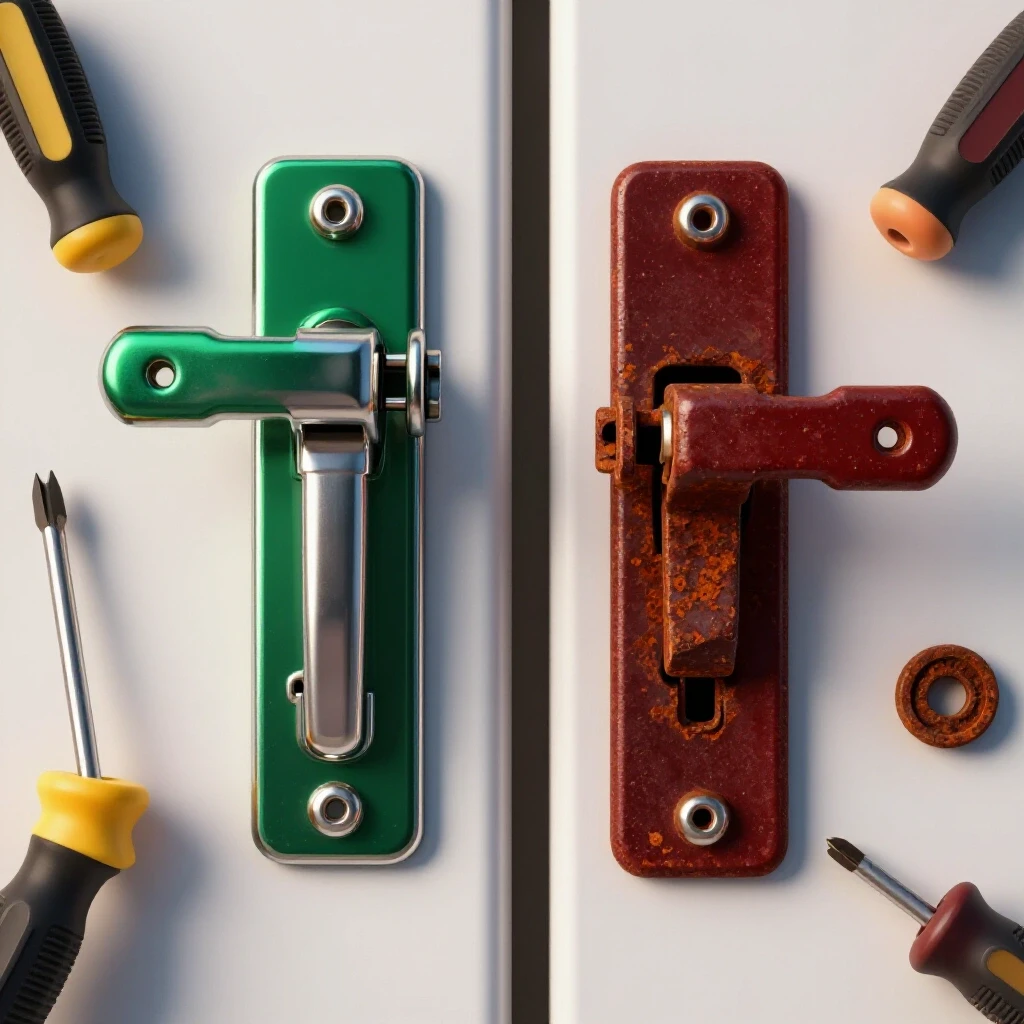
In my facility logs, I tracked a series of latch failures in a property located near a coastal area. The high salt content and humidity caused “galvanic corrosion” between the brass handles and the steel internal spindles. The resulting oxidation expanded the metal, causing the latches to seize.
The solution wasn’t just replacing the parts; it was applying a thin layer of non-reactive grease to the spindle to act as a barrier. This simple preventive step saved the homeowner from replacing the entire hardware set every three years. For homeowners of older properties, understanding these small environmental interactions is the key to preventing costly structural damage or hardware replacement.
Frequently Asked Questions
Why does my door latch only work when I lift the handle? This usually indicates a vertical misalignment between the latch bolt and the strike plate. Over time, the weight of the door can cause it to sag slightly. While the latch itself isn’t broken, the bolt is hitting the bottom of the strike plate. You can often fix this by filing the bottom of the strike plate opening or tightening the top hinge screws to pull the door back into alignment.
Can I use WD-40 to fix a sticking latch? Standard WD-40 is a solvent and a degreaser, not a long-term lubricant. While it may provide temporary relief by breaking down old grease, it eventually evaporates and leaves the metal surfaces prone to increased friction and rust. It is better to use a dedicated dry graphite spray or a silicone-based lubricant specifically designed for mechanical hardware.
How do I know if the internal spring is broken? If the latch bolt stays retracted inside the door even when the handle is not being turned, the compression spring has likely snapped or slipped out of its housing. In this scenario, a quick fix is rarely possible because most modern residential latches are “pressed” or “riveted” shut at the factory. A full component substitution is the safest and most efficient path.
What is a “backset” and why does it matter? The backset is the horizontal distance from the edge of the door to the center of the pre-drilled hole for the handle. In the United States, the two standard backsets are 2-3/8 inches (60mm) and 2-3/4 inches (70mm). If you purchase a replacement latch with the wrong backset, the handle will not line up with the latch mechanism, and you will be unable to assemble the hardware.
Why is my door handle sagging? A sagging handle is typically caused by a worn-out return spring within the handle assembly itself or a loose mounting plate. If tightening the screws doesn’t resolve the sag, the internal torsion spring has likely lost its “rate” (the force it exerts). This is common in high-traffic areas and usually requires replacing the handle set.
Is it safe to file down a strike plate? Yes, as long as you only remove small amounts of metal. Use a fine-tooth metal file and work slowly. Your goal is to remove just enough material so the latch bolt can extend fully into the hole. If you remove too much, the door may rattle when closed because it is no longer held tightly against the doorstop.
How often should I lubricate my interior door hardware? For most residential properties, a yearly application of dry lubricant is sufficient. However, in homes with high dust levels or coastal humidity, a six-month interval is more effective for preventing “gritty” movement and internal wear.
What should I do if the screws are spinning and won’t tighten? This is a common issue in older wood doors where the screw holes have become “stripped.” A reliable fix is to remove the screw, insert a few wooden toothpicks or a small wood dowel coated in wood glue into the hole, let it dry, and then trim it flush. This provides “new” wood for the screw threads to bite into, ensuring a secure fit for the hardware.
(This article was written by one of our staff writers, Daniel Whitaker. Visit our Meet the Team page to learn more about the author and their expertise.)