How to Organize Winter Gear: Coats, Boots & Gloves Storage (Guide)

Have you ever walked through your front door on a cold evening, only to feel your stress levels spike before you even take off your coat? You are met with a mountain of tangled scarves, boots leaking melted snow across the floor, and a closet so packed that adding one more jacket feels like a game of high-stakes Tetris. Many families spend their Saturdays tidying these entryways, only to find the chaos returns by Monday afternoon. This cycle happens because most home organization systems are designed for how we wish we lived, not for the reality of a Tuesday morning rush.
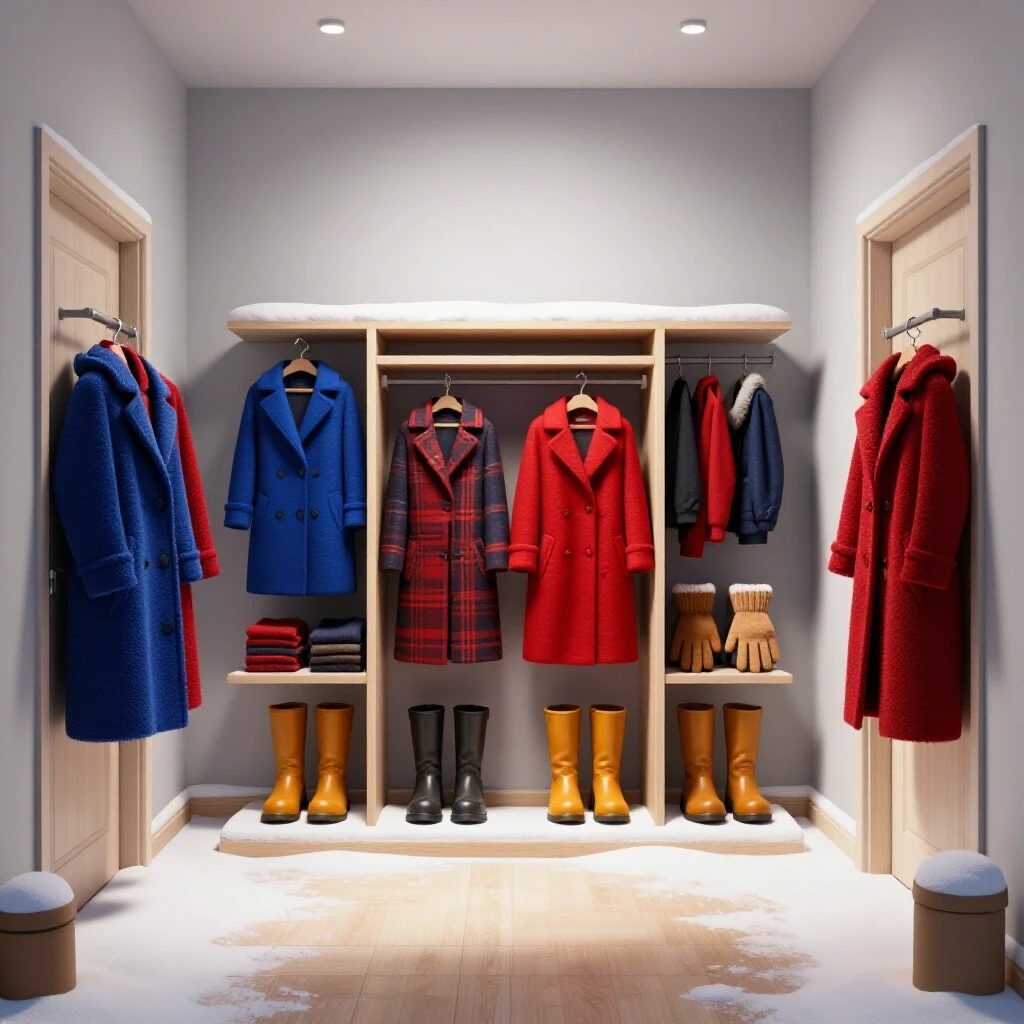
In my eleven years managing logistics and operations, I have learned that a system only works if it accounts for the “path of least resistance.” In my own home, we used to struggle with what I call the “mitten migration”—the way small winter accessories seem to travel from the front door to every corner of the house. We tried beautiful matching bins with lids, but they failed within forty-eight hours. Why? Because lifting a lid is a “high-friction” action. For a tired child or a busy professional, that one extra step is often the difference between a tidy shelf and a cluttered floor.
By applying spatial management principles, we can transform these high-traffic zones into low-stress environments. We do this by focusing on flow rates and retrieval friction rather than just buying more containers. When we align our storage solutions for families with actual human behavior, we create a sustainable decluttering habit that lasts through the coldest months.
Analyzing the Spatial Logistics of Winter Entryways
Spatial logistics is the study of how people and objects move through a defined area to maximize efficiency. In a home, this means looking at the physical path from the entrance to the main living space to identify where items naturally accumulate. By mapping these “drop zones,” we can place storage exactly where the family already wants to put their gear.
When a family of four enters a home, they are essentially a delivery truck unloading inventory. If that inventory—coats, heavy boots, and hats—has no designated “docking station,” it stays in the aisle. This creates a bottleneck. To fix this, we must look at the spatial capacity limits of our entryways. Most closets are designed for static storage, like suits or dresses, not for the high-flow volume of winter garments.
I recommend conducting a five-minute “flow audit.” Stand by your door and watch where your family members naturally drop their items. Is there a pile of boots three feet from the door? That is your natural zone. Instead of fighting that behavior by asking them to walk to a distant closet, we should place a heavy-duty boot tray exactly on that spot. This reduces the “retrieval step count,” which is the number of steps required to put an item away properly.
Reducing Retrieval Friction for Heavy Outerwear
Retrieval friction is the amount of physical and mental effort required to access or store an item. In the world of logistics, high friction leads to system failure and “unprocessed inventory,” which in a home manifests as piles of clothes on chairs. Low-friction systems prioritize “one-touch” storage, where an item can be put away with a single movement.
In my home, we replaced all the hangers in our main entryway with sturdy wall hooks. Research in environmental psychology suggests that “visual complexity” contributes to mental fatigue. A row of coats on hooks might look less “perfect” than a closed closet, but it is a functional home storage solution that actually gets used. A hanger requires two hands and several seconds of precision; a hook requires one hand and half a second.
| Storage Method | Steps to Store | Friction Score (1-10) | Best Use Case |
|---|---|---|---|
| Wall-Mounted Hooks | 1 step | 1 | Daily use heavy coats |
| Open Baskets | 1 step | 2 | Gloves, hats, and scarves |
| Hangers in Closet | 3-4 steps | 6 | Formal or guest coats |
| Bins with Lids | 5 steps | 9 | Out-of-season storage |
As shown in the table, hooks and open baskets have the lowest friction. For a busy parent, reducing household clutter is often as simple as removing the lids from your storage bins. This small change shifts the mental load from “organizing” to simply “dropping,” which is much easier to maintain during a long winter.
Implementing Functional Zoning for Boots and Accessories
Functional zoning is the practice of dividing a space into specific areas based on the frequency of use and the type of activity. For winter gear, this involves creating a “wet zone” for snowy items and a “dry zone” for clean accessories. This prevents the spread of salt and slush, which protects your home and reduces cleaning time.
When I redesigned our family’s mudroom area, I used a “Vertical Zoning” strategy. Items used by children are placed between two and four feet from the floor. Items for adults are placed between five and six feet. This ensures that everyone can reach their own gear without assistance. If a child cannot reach a hook, their coat will inevitably end up on the floor, regardless of how many times you ask them to hang it up.
- Zone 1: The Landing Pad (0-1 feet). This is for heavy boots. Use a tray with a raised edge to catch moisture.
- Zone 2: The Action Zone (2-5 feet). This is for daily coats and bags. Use hooks spaced at least eight inches apart to account for coat bulk.
- Zone 3: The Grab-and-Go (4-6 feet). This is for hats, gloves, and scarves. Open baskets on a shelf work best here.
By following these zones, you reduce the “decision fatigue” of where things go. Every family member knows exactly which height belongs to them. This creates a predictable environment that lowers the cognitive load of coming home after a long day.
Why High-Friction Bins Lead to Rapid Clutter Reversion
Visual processing overload occurs when our brains are forced to sort through too much visual information at once. When we see a tangled pile of gloves, our brain has to work harder to find a matching pair. This leads to frustration and the “clutter creep” that many parents experience just days after a big cleaning session.
Many people buy deep, opaque bins to hide the mess. However, these often become “black holes” where items at the bottom are forgotten. In logistics, we call this “dead inventory.” To avoid this, use shallow, transparent containers or wire baskets. These allow you to see the contents without having to dig through them. This visibility reduces the time spent searching, which is a major source of morning stress.
- Visibility: Can you see the item without moving anything else?
- Accessibility: Can you reach the item with one hand?
- Simplicity: Could a five-year-old understand where this goes?
If the answer to any of these is “no,” the system will likely fail. Sustainable decluttering is about building a framework that survives your worst, most exhausted day, not just your most productive one.
Using Industrial Sorting Metrics for Residential Order
To maintain a tidy space, we can use “flow rates” to manage the volume of items in our entryways. A space has a fixed capacity. When the number of items exceeds that capacity, the system breaks. For winter gear, this often happens because we keep too many options in the high-traffic “Action Zone.”
I recommend a “one-in, two-out” rule for seasonal accessories. If you buy a new pair of heavy gloves, two older or less-used pairs should be moved to a secondary storage area, like a bedroom closet or a high shelf. This keeps the “item density” low. In professional warehouses, we aim for 80% shelf utilization. Once a shelf is more than 80% full, it becomes difficult to move items in and out, leading to friction and mess.
- Count your hooks: If you have 6 hooks, you can effectively store 6-8 coats.
- Measure your basket volume: Hats and gloves should take up no more than 75% of the basket’s space.
- Set a “Reset” timer: Spend 120 seconds every evening returning items to their designated zones.
These metrics turn the vague goal of “being organized” into a measurable process. When you focus on the numbers—like retrieval steps and item density—you remove the emotional frustration of clutter and replace it with a logical system.
Establishing Sustainable Habit Loops for the Whole Family
A habit loop consists of a cue, a routine, and a reward. In a home organization system, the “cue” is walking through the door. The “routine” is placing the gear in its functional zone. The “reward” is a clear, calm entryway and a faster exit the next morning. To make this work, the routine must be incredibly easy.
In our house, we found that labeling was the secret to maintaining the system. We don’t just label the baskets; we use “smart labels” or simple picture icons for younger children. This provides a clear visual prompt that removes the need for “sorting” decisions. When a child sees their own photo or name on a basket, the “where does this go?” question is answered instantly.
- Consistency: Keep the zones the same all season.
- Feedback: If a pile starts to form, ask “What made this hard to put away?” instead of “Why didn’t you put this away?”
- Automation: Use a boot dryer or a dedicated mat to define the boundaries of the “wet zone” clearly.
By focusing on the “why” behind the mess, you can adjust the system to fit your family’s needs. If the gloves are always on the floor, perhaps the basket is too high or too small. Adjusting the hardware is often more effective than trying to change human nature.
Practical Tools and Layout Planning for Small Spaces
You do not need a massive mudroom to have an efficient winter storage system. Even a small hallway can be optimized using “vertical expansion.” By using the full height of your walls, you can increase your storage capacity without taking up valuable floor space.
I often suggest using a “grid system” for small entryways. This involves a wall-mounted panel with interchangeable hooks and baskets. This allows you to reconfigure the space as your needs change. For example, you might need more boot space in January than you do in November.
- Heavy-duty wall rails: These can hold the weight of multiple wet parkas.
- Stackable wire drawers: These provide visibility and airflow for damp items.
- Slim-profile boot racks: These utilize vertical space for footwear.
- Digital Inventory: For items stored in bins on high shelves, a simple photo taped to the outside of the box acts as a “digital” shortcut for your brain.
These tools focus on durability and function. When choosing gear, prioritize “over-engineered” items. Winter coats are heavy, and boots are dirty. Your storage must be able to withstand the physical demands of the season without sagging or breaking.
Conclusion: Moving Toward a Low-Stress Winter Home
Creating a functional home storage system for winter gear is not about achieving a magazine-perfect look. It is about building a logistical framework that supports your daily life. By reducing retrieval friction, defining clear zones, and monitoring your item density, you can stop the cycle of constant tidying and rapid clutter reversion.
Start small. Choose one area—perhaps just the boot tray or the glove basket—and apply these principles. Observe how your family interacts with the new setup. If it feels easy, you have found a sustainable solution. If it feels like a chore, look for the friction point and simplify it. Your home should be a place of refuge from the cold, not a source of additional mental fatigue.
Frequently Asked Questions
How do I stop my kids from dropping their coats on the floor? The most common reason children drop coats is high retrieval friction. Check the height of your hooks; they should be at chest level for the child. Also, ensure the hooks are large and easy to use. If a child has to struggle to get a coat loop over a small hook, they will likely give up and drop it.
What is the best way to store wet gloves and hats so they actually dry? Airflow is the key to drying. Avoid deep, solid plastic bins. Instead, use wire mesh baskets or “slotted” bins that allow air to circulate. Placing these baskets near a heat vent (but at a safe distance) can also speed up the drying process, making the gear ready for the next outing.
How many coats should I keep in the main entryway? In logistics, we call this “active inventory.” You should only keep one or two frequently used coats per person in the main entry. Any extra jackets or “special occasion” outerwear should be moved to a secondary closet to prevent overcrowding and visual overwhelm.
My entryway is tiny. How can I fit everything? Think vertically. Use a “double row” of hooks—one at adult height and one at child height. You can also use over-the-door organizers with clear pockets for small accessories like gloves and beanies. This keeps the floor clear and utilizes space that is often wasted.
How often should I “reset” the winter storage area? A daily two-minute reset is more effective than a weekly one-hour cleaning. At the end of each day, quickly check that boots are on the tray and hats are in their baskets. This prevents “clutter momentum,” where one misplaced item leads to a pile of many.
What should I do with “orphaned” mittens that have no match? Create a “Lost Soul” basket. If a match doesn’t appear within two weeks, it is time to let it go. Keeping unmatched items creates “decision drag,” where you have to look at and process useless items every time you reach for your gear.
Why do my storage bins always end up messy inside? This usually happens because the bins are too large. When a container is too big, items shift and pile up. Use smaller, specialized “sub-bins” to keep categories separate. For example, have one small bin for toddler mittens and another for adult scarves within a larger shelf unit.
Is it better to use a closet or an open rack? For daily use, an open rack or hooks are almost always better. Closets create a “visual barrier” that often leads to items being shoved inside haphazardly. Open storage provides immediate visual feedback, which encourages people to place items back in their correct spots.
How can I manage the salt and dirt that comes with winter boots? Use a two-stage system. A heavy-duty “scrubber” mat outside the door removes the bulk of the debris. Inside, a lipped boot tray catches the remaining melting snow and salt. This contains the mess to a single, easy-to-clean surface rather than letting it spread across your floors.
What is the most common mistake people make with winter organization? The biggest mistake is buying the containers before analyzing the behavior. People often buy a set of bins because they look nice, only to find they don’t fit their specific gear or their family’s habits. Always track your “spatial flow” for a few days before investing in new hardware.
(This article was written by one of our staff writers, Christopher Bennett. Visit our Meet the Team page to learn more about the author and their expertise.)