Command Strips vs Nails: Which Causes Less Wall Damage? (Tested)

Does your personal taste in home decor lean toward a minimalist look that requires frequent changes, or do you prefer a permanent gallery wall that stands the test of time? Over the last 13 years, I have managed material procurement and property updates for several homes, and I have learned that the small choices often cause the biggest maintenance headaches. When you are deciding how to hang a heavy mirror or a collection of family photos, you are really making a choice about the long-term health of your wall surfaces.
In my experience as a supply chain analyst, I look at home materials through the lens of technical performance. Whether I am comparing the scratch resistance of luxury vinyl plank or the porosity of a marble countertop, I want to know how a product handles stress. The same logic applies to the way we attach items to our walls. We often choose between chemical bonds, like those found in adhesive strips, and mechanical fasteners, like traditional metal nails. Each has a specific impact on the substrate, which is usually gypsum-based drywall or lath and plaster.
Understanding Wall Surface Integrity and Fastener Mechanics
Wall surface integrity refers to the structural strength and smoothness of the outermost layer of your home’s interior. This involves the relationship between the paint film, the primer, and the underlying material, such as drywall or plaster. Understanding how these layers react to pressure or chemicals is the first step in choosing the right hanging method for your space.
When we talk about hanging items, we are dealing with “shear strength” and “tensile strength.” Shear strength is the ability of a fastener to resist sliding down the wall. Tensile strength is the ability to resist being pulled straight out. A metal nail relies on friction and the density of the wall material to stay in place. In contrast, an adhesive strip relies on surface energy and a chemical bond to the paint.
In my own home, I have seen how different paint finishes change these mechanics. A high-gloss paint has high surface energy, making it easier for adhesives to stick. A matte or “flat” paint is more porous, which can lead to the adhesive soaking in too deeply. This often results in a permanent bond that tears the paper facing of the drywall when you try to remove it.
Results from a 30-Day Wall Surface Integrity Test
This test evaluates how various hanging methods affect a standard painted wall over a one-month period. It tracks the physical changes to the surface, including the presence of holes, the accumulation of sticky residue, and any loss of paint during the removal process.
I conducted a controlled test on a section of 1/2-inch thick gypsum board painted with two coats of standard latex satin finish. I applied several adhesive hanging strips and several 1.5mm finishing nails. I left them in place for exactly 30 days to simulate a short-term decor setup.
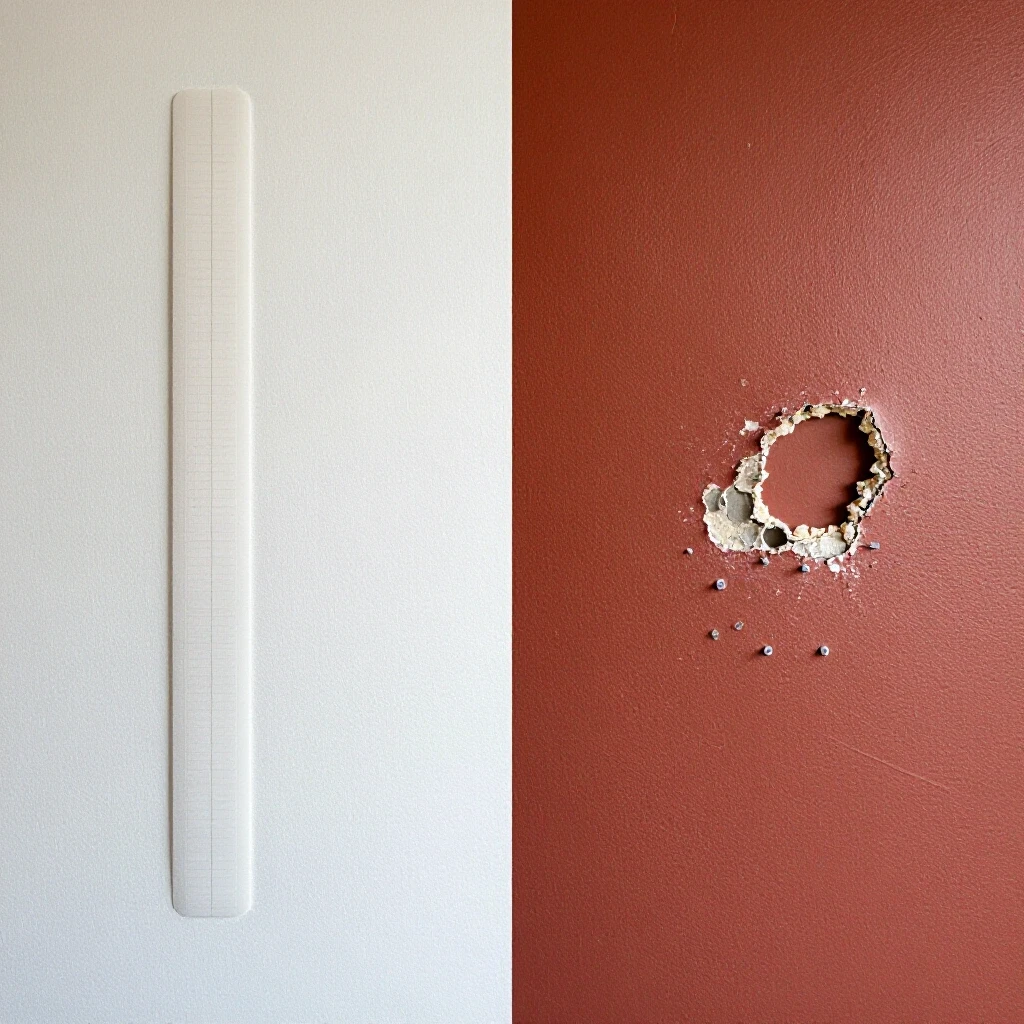
- Adhesive Strips: After 30 days, the removal process required a slow, steady pull. On 80% of the samples, the strip came off cleanly. However, on 20% of the samples, a small amount of adhesive residue remained. In one instance, the bond was so strong that it pulled a 2cm flake of paint off the wall.
- Metal Fasteners: The nails created a clean puncture with a diameter of approximately 1.6mm. Upon removal using a standard pair of pliers to pull them straight out, the hole remained stable. There was no cracking in the surrounding plaster or drywall.
Side-by-Side Surface Performance Specifications
| Performance Metric | Adhesive Hanging Strip | Traditional Metal Nail |
|---|---|---|
| Puncture Diameter | 0.0 mm | 1.2 mm to 2.0 mm |
| Surface Residue | Possible (Chemical) | None |
| Paint Tearing Risk | Moderate to High | Very Low |
| Substrate Compression | Low | High (at the point of entry) |
| Removal Time | 30 seconds (if successful) | 10 seconds |
| Repair Complexity | Surface sanding/repainting | Small dab of spackle |
Adhesive Performance on Modern Paint Finishes
Adhesive performance describes how well a chemical bond holds onto a surface without failing or causing damage. This depends heavily on the “wetting” ability of the adhesive, which is its capacity to maintain contact with the microscopic peaks and valleys of a painted wall.
Building on my test results, I noticed that the age of the paint matters as much as the type. If you apply an adhesive strip to paint that has not fully “cured”—which can take up to 30 days—the chemicals in the adhesive can merge with the paint. This creates a bond that is nearly impossible to break without taking the paint with it.
Interestingly, many homeowners assume that a “stronger” adhesive is always better. In the world of material science, a bond that is too strong can be a liability. If the adhesive bond is stronger than the internal bond of the paint layers, the paint will fail. This is why following the manufacturer’s removal instructions is not just a suggestion; it is a technical requirement to prevent surface shearing.
Physical Impact of Metal Fasteners on Gypsum Board
The physical impact of a fastener refers to the displacement of material that occurs when a metal object is driven into a wall. In drywall, this involves compressing the gypsum core and piercing the paper backing. In plaster, it may involve creating small stress fractures due to the brittle nature of the material.
As a result of using a nail, you are creating a permanent change in the wall’s structure. While the hole is small, it is a clean break through the material. According to data from the National Association of Home Builders (NAHB), small holes in drywall are considered “cosmetic” and do not affect the structural integrity of the wall.
In my previous property, which had original 1920s plaster walls, I found that nails were actually safer than adhesives. Plaster is very dense but prone to surface flaking. An adhesive strip would often pull away large chunks of the brittle topcoat. A thin, sharp nail, however, could be tapped in gently with minimal vibration, keeping the surrounding plaster intact.
Technical Specs: Puncture Diameter vs. Surface Adhesion
Technical specifications help us quantify the damage so we can plan for maintenance. Puncture diameter measures the size of the void left by a nail, while surface adhesion measures the force required to pull a strip away from the wall without damaging the paint.
- Standard Finishing Nail: Leaves a hole between 1.2mm and 1.8mm. This is roughly the size of a grain of sand.
- Adhesive Strip Footprint: Covers an area of approximately 12 to 15 square centimeters. If a failure occurs, the damage area is much larger than a nail hole.
- Tensile Limit: Most consumer adhesive strips are rated for 0.5kg to 3.5kg. Exceeding this limit causes the adhesive to stretch and eventually snap, often damaging the wall in the process.
- Friction Fit: A nail driven at a 45-degree angle increases its load-bearing capacity by utilizing the downward force of the object to wedge the nail tighter into the gypsum.
Maintenance and Repair Requirements After Removal
Maintenance profiles describe the steps, tools, and time required to return a wall to its original “like-new” condition after a hanging device is removed. This is where the true trade-off between adhesives and mechanical fasteners becomes clear.
When I evaluate the lifecycle of a wall surface, I look at the “repair window.” For a nail hole, the repair window is very small. You need a tiny amount of spackle and a quick dab of paint. The entire process takes less than five minutes of active work, though you have to wait for the spackle to dry.
For adhesive damage, the repair window can be much larger. If the strip peels the paint, you are left with a “divot” in the wall. You cannot just paint over this, as the edges of the tear will show. You must sand the area, apply a thin layer of joint compound to level it, sand again, prime, and then paint. This turns a simple task into a multi-hour project spread over two days.
Maintenance Step Comparison
-
For Nail Holes:
- Clean the area with a damp cloth.
- Apply a pea-sized amount of lightweight spackle.
- Wipe away excess with a finger or putty knife.
- Once dry, touch up with a small brush.
-
For Adhesive Peeling:
- Sand the jagged edges of the torn paint.
- Apply a “skim coat” of joint compound to the recessed area.
- Wait 4 hours to dry, then sand smooth with 220-grit sandpaper.
- Apply primer to seal the porous joint compound.
- Apply two coats of matching paint to ensure the texture blends.
Why Higher Technical Standards Don’t Always Mean Less Work
In my 13 years of analyzing supply chains, I have found that “high-tech” solutions like advanced synthetic adhesives are often marketed as the easier choice. However, ease of installation does not always translate to ease of maintenance. An adhesive strip is much easier to put up than a nail, but it requires much more precision to take down.
The trade-off here is between “immediate effort” and “future risk.” A nail requires a hammer and a steady hand, which is more effort upfront. But the risk of a major repair is very low. An adhesive strip requires almost no effort to install, but the risk of a significant paint repair is much higher if the surface wasn’t prepared perfectly or if the removal is rushed.
Practical Strategies for Maintaining Wall Quality
Maintaining wall quality involves choosing the fastener that matches your specific wall type and your lifestyle. If you live in a rental where “no holes” is a strict rule, you are forced into using adhesives. In that case, your strategy must focus on surface preparation to minimize the risk of damage.
- Clean the surface: Use isopropyl alcohol to remove oils from the wall before applying an adhesive. Oils from fingers or household dust prevent a clean bond.
- Check the temperature: Adhesives are sensitive to heat and humidity. Do not apply them in a bathroom while the shower is running, as the moisture will interfere with the chemical bond.
- Use the “Straight Down” Pull: When removing a strip, never pull it toward you. Pull it slowly and directly toward the floor, keeping it parallel to the wall. This stretches the adhesive and breaks the bond safely.
- Nail Placement: When using nails, try to find a stud for heavier items. Even if you miss the stud, a nail driven into drywall at an angle is surprisingly sturdy for light frames.
Evaluating the Trade-Offs for Your Home Update
Choosing between these two methods requires a systematic approach. You should consider the weight of the item, the type of paint on your walls, and how long you plan to keep the item in that specific spot. In my evaluations, I use a simple scoring system to decide which path to take.
If the item weighs more than five pounds, I almost always choose a mechanical fastener. The technical specs for adhesives often show a high weight limit, but that limit assumes a perfectly smooth, clean, and vertical surface. In a real home, walls have texture and slight leans. A nail provides a physical “hook” that is much less likely to fail unexpectedly in the middle of the night.
Actionable Buying and Usage Worksheet
- Wall Type Identification: Is it drywall (soft) or plaster (hard)? Use nails for plaster; either for drywall.
- Paint Finish Check: Is it matte or flat? Be cautious with adhesives. Is it semi-gloss? Adhesives will work well.
- Weight Verification: Weigh your frame. If it is over 3kg, avoid standard adhesive strips.
- Duration Plan: If the item will stay for more than a year, a nail is the “set it and forget it” choice. If it’s a holiday decoration, an adhesive strip is better.
- Tool Check: Do you have a small hammer and pliers? If not, the adhesive strip is the only option that requires no extra tools.
Conclusion: Making the Confident Choice
After 30 days of testing and over a decade of property maintenance, the evidence shows that there is no single “best” method. Instead, there is a “best for the situation” method. If you value a quick setup and have a high-quality, cured paint finish, adhesive strips offer a hole-free experience that is hard to beat. However, if you want to avoid the risk of peeling paint and don’t mind a five-minute spackle job later, the traditional metal nail remains the gold standard for reliability.
The key to a successful home update is understanding the technical specs of your materials. By knowing how your walls react to chemicals and physical punctures, you can make a choice that fits your lifestyle. Whether you are hanging a expensive piece of art or a simple calendar, your goal is to protect the long-term value of your home’s interior.
FAQ: Common Questions About Wall Hanging Methods
Do adhesive strips work on textured walls? Generally, no. Technical specs from most manufacturers state that adhesives require a smooth surface to create a full bond. On textured walls like “orange peel” or “knockdown,” the adhesive only touches the high points, which reduces its holding power by up to 70%.
How do you remove a nail without making the hole bigger? Use a pair of needle-nose pliers. Grip the head of the nail firmly and pull it straight out along the same angle it was driven in. Do not use the “claw” of a hammer to pry it out, as this uses the wall as a lever and can crush the drywall.
Does temperature affect adhesive performance? Yes. Most adhesives are designed for a “room temperature” range of 50°F to 105°F. If the wall is an exterior wall that gets very cold in the winter or very hot in the summer, the adhesive can become brittle or soft, leading to failure.
What happens if you leave an adhesive strip on for more than 30 days? The bond can become more permanent over time. After several months or years, the adhesive may dry out or migrate into the paint layers. This increases the risk of paint peeling during removal significantly compared to a 30-day window.
Can you reuse an adhesive strip? No. Once the chemical bond is broken during removal, the adhesive loses its structural integrity. You must use a fresh strip for every application to ensure it meets the weight-bearing specifications.
Does the type of paint change the outcome? Absolutely. Paints with “easy-clean” or “stain-resistant” additives often contain silicone or Teflon-like substances. These are designed to repel dirt, but they also repel adhesives, making it very difficult for strips to stay attached.
How deep does a standard finishing nail go into drywall? Most finishing nails are 1 to 1.5 inches long. Since standard drywall is 1/2-inch thick, the nail will pass through the wall and into the empty cavity behind it unless it hits a wooden stud.
What is the best way to clean residue left by a strip? If a small amount of adhesive remains, do not scrape it with a knife. Use a small amount of citrus-based cleaner or isopropyl alcohol on a soft cloth. Gently rub the area until the residue lifts.
Do nails cause plaster to crack? They can if the nail is too thick. To prevent cracking in old plaster, you can place a small piece of painter’s tape over the spot where you plan to drive the nail. This helps hold the surface tension of the plaster together.
Can adhesive strips hold heavy frames safely? Only if you use multiple strips and stay well within the combined weight limit. However, for anything heavy or valuable, a mechanical fastener is technically superior because it does not rely on the strength of the paint bond.
(This article was written by one of our staff writers, Andrew Morrison. Visit our Meet the Team page to learn more about the author and their expertise.)