How to Fix Home Flooring Problems Effectively (Step-by-Step Guide)

The fastest way to complete a home improvement project is often to do it twice. This sounds like a contradiction, but in my 17 years of maintaining older properties, I have found that the lessons learned from an initial, insufficient repair often provide the exact data needed for a permanent solution. When we rush into a fix using only surface-level information, we frequently overlook the underlying mechanics of the house. By comparing an initial failed attempt with a refined, systemic approach, we can see exactly how a deeper understanding of material science leads to a result that is significantly more durable and aesthetically pleasing.
The Fundamentals of Interior Material Science
Material science in a residential context involves understanding how different substances—like wood, adhesive, and stone—interact with the environment. It is the study of why finishes fail, why joints open up, and how humidity affects the dimensions of your home.
In older homes, materials are rarely static. Understanding “hygroscopic movement” is essential for any homeowner. This is the process where porous materials, especially wood, absorb and release moisture from the air, causing them to expand and contract. If you apply a rigid finish over a moving substrate without accounting for this movement, the finish will eventually crack or delaminate. My experience has shown that the difference between a repair that lasts two years and one that lasts twenty is almost always found in how well the installer managed these environmental variables.
The Role of Substrate Stability
Substrate stability refers to the firmness and flatness of the surface underneath your final finish, such as the plywood under your tile or the plaster behind your wallpaper. A stable substrate prevents the “telegraphing” of imperfections through to the surface.
When I first began working on legacy properties, I underestimated the power of the substrate. I assumed that a thick enough layer of paint or a heavy flooring material could hide a shaky foundation. However, the substrate is the “skeleton” of your project. If it moves even 1/16 of an inch, it can cause grout to crumble or seams to pop. Achieving a superior result requires measuring the deflection (the amount of “bounce” in a floor) and the moisture content of the material before any decorative work begins.
Case Study: The Evolution of a High-Traffic Floor
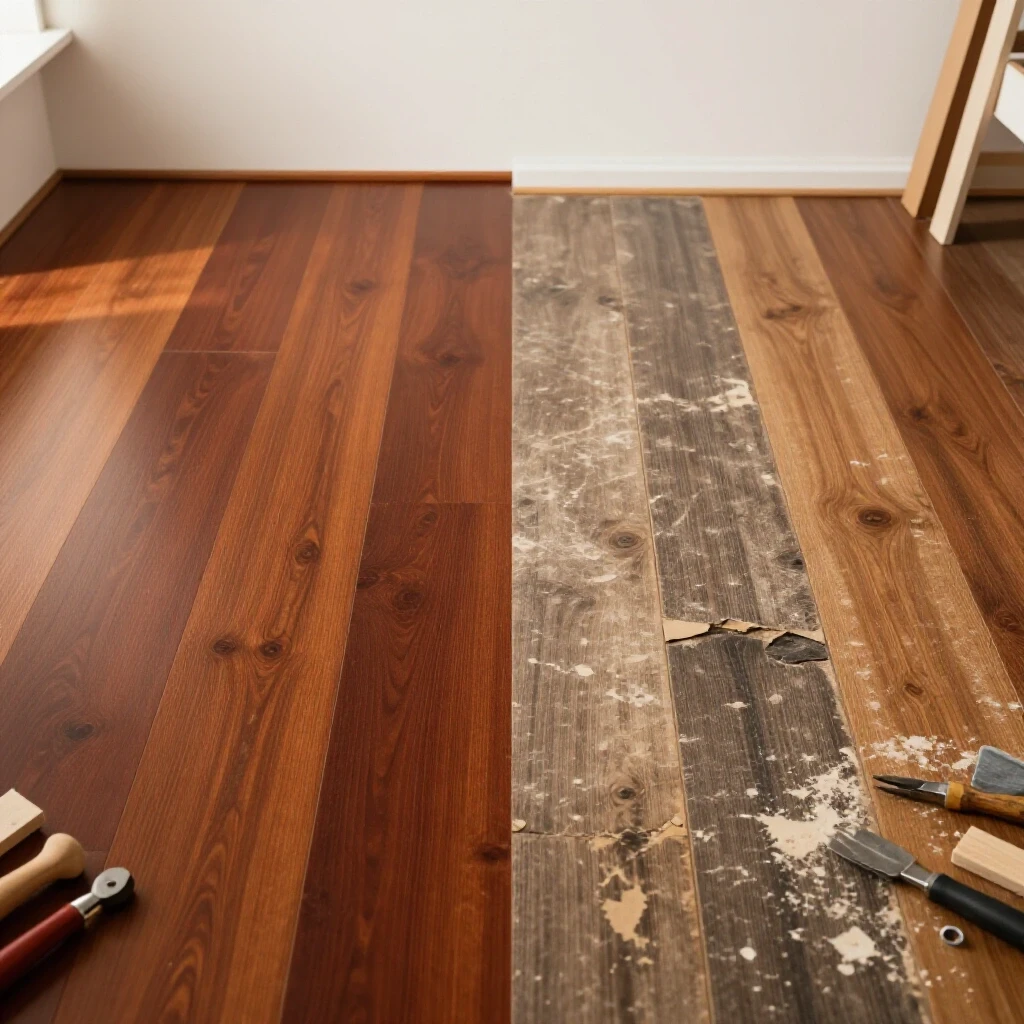
In my own 1920s bungalow, the laundry room floor served as a perfect laboratory for comparing a quick fix against a technical, long-term solution. The original wood was scarred and uneven, leading to a project that I eventually had to execute twice to get right.
The Initial Iteration: A Surface-Level Aesthetic Fix
My first attempt focused almost entirely on aesthetics and immediate cost savings. I used “peel-and-stick” vinyl tiles directly over the old wood. I cleaned the surface, but I did not account for the high humidity levels typical of a laundry area or the unevenness of the century-old planks.
The result was a floor that looked acceptable for exactly four months. Because I had not addressed the moisture levels or the substrate’s texture, the adhesive began to fail. The tiles “gapped” as the house shifted with the seasons, leaving sticky residue in the cracks that collected dirt. This was a classic example of a repair that addressed the symptom (an ugly floor) without diagnosing the cause (moisture and movement).
The Refined Methodology: A Systemic Material Upgrade
The second time I approached this floor, I treated it as a multi-layered system rather than a single surface. I began by using a pinless moisture meter to check the wooden subfloor, ensuring it was below 12% moisture content. I then installed a 1/4-inch cement backer board, which provided a rigid, moisture-resistant surface that decoupled the finish from the moving wood underneath.
Instead of cheap vinyl, I selected a high-quality luxury vinyl plank (LVP) with a cork underlayment. I also left a 1/4-inch expansion gap around the perimeter, hidden by baseboards, to allow the entire floor “island” to move independently of the walls. This second approach cost more upfront in both time and materials, but four years later, it remains as tight and level as the day it was installed.
| Feature | Initial Surface Fix | Refined Systemic Fix |
|---|---|---|
| Preparation Time | 1 Hour | 8 Hours |
| Substrate Treatment | None (Cleaned only) | Cement backer board & Leveling |
| Moisture Management | None | Vapor barrier & Moisture testing |
| Expansion Allowance | Zero | 1/4-inch perimeter gap |
| Longevity (Measured) | 4 Months until failure | 4+ Years (Ongoing) |
| Aesthetic Retention | Rapidly declined | Remains 100% intact |
Essential Diagnostic Tools for Interior Success
To achieve a result that is measurably better than a standard repair, you must move beyond visual inspections. Using specialized tools allows you to gather data that your eyes cannot see, such as hidden dampness or microscopic slopes.
- Pinless Moisture Meter: This tool uses electromagnetic signals to detect moisture up to 3/4 of an inch below the surface without marring the finish. It is vital for checking wood and drywall before painting or flooring.
- Digital Laser Level: A 360-degree laser level allows you to see exactly how much a room has “settled.” In older homes, knowing that a floor drops 1/2 inch from one corner to another is critical for proper cabinetry installation.
- Infrared Thermometer: While often used for HVAC, this is excellent for interior design to find “cold spots” behind walls where condensation might form, potentially ruining a new wallpaper or paint job.
- Feeler Gauges: These are used to measure the width of cracks in wood or gaps in joinery. Tracking these over a year tells you if a gap is “active” (moving) or “dormant” (stable).
- Calipers: Useful for measuring the thickness of materials to ensure they will flush up against existing transitions, like where a new tile floor meets an old hallway carpet.
Comparative Analysis of Material Longevity
When we compare a standard repair to a superior one, we are really comparing the “life-cycle cost” of the materials. A “cheap” fix that fails every two years is significantly more expensive than a “premium” fix that lasts twenty.
Building science teaches us that material compatibility is the key to longevity. For example, using a standard latex caulk in a high-moisture shower area is a common mistake. While it is easy to apply, it lacks the elasticity and mold resistance of a 100% silicone sealant. In my facility logs, I have noted that silicone applications in bathrooms outlast latex-based “tub and tile” caulks by a ratio of 4 to 1. This is the essence of doing the job twice as good: you select the material based on its chemical properties and the environmental stressors it will face.
Understanding Thermal Bridging and Condensation
In interior maintenance, we often see “ghosting” or dark streaks on walls. This is frequently caused by thermal bridging, where the wooden studs or metal fasteners are colder than the rest of the wall. This temperature difference causes microscopic moisture to condense, which then traps dust.
A standard fix is to simply paint over the streaks. A superior fix involves using a thermal break or an insulating primer that reduces the temperature differential on the wall surface. By addressing the physics of the wall, you prevent the aesthetic issue from ever returning.
Building a Multi-Year Prevention Program
Prevention is the highest form of home maintenance. Instead of waiting for a failure, a systematic homeowner monitors the “health markers” of their property. This involves a seasonal home maintenance checklist that focuses on the envelope of the interior spaces.
- Quarterly: Check the seals around all “wet” areas (sinks, tubs, toilets). Look for any softening of the material or discoloration.
- Bi-Annually: Inspect the “clearance” of interior doors. If a door begins to rub against the frame, it is a sign of humidity changes or subtle settling in the floor.
- Annually: Use a moisture meter on any exterior-facing walls, especially in closets or behind large furniture, to ensure no vapor is being trapped.
By keeping a log of these metrics, you can catch a minor shift in your home’s “behavior” before it results in a cracked tile or a warped floorboard. This data-driven approach is what separates a frustrated homeowner from one who has mastered the care of a legacy property.
Practical Steps Toward a Superior Interior Upgrade
If you are facing a recurring issue in your home, stop searching for a better brand of the same product. Instead, change your diagnostic process.
First, identify the “failure mode.” Did the paint peel? Did the wood warp? Did the tile crack? Once you know how it failed, you can look for the environmental cause. Usually, it is either moisture, movement, or poor adhesion. Second, test your substrate. Use your level and your moisture meter to see if the surface is actually ready for a finish. If the moisture is above 12% or the floor is out of level by more than 3/16 of an inch over 10 feet, your finish will likely fail regardless of its quality.
Finally, choose materials that are designed for the specific “stressors” of that room. In a basement, use inorganic materials like metal or vinyl that cannot grow mold. In a sunny living room, use UV-stable finishes that won’t fade. This systematic approach ensures that your second attempt isn’t just a repeat of the first, but a significant leap forward in quality and durability.
Frequently Asked Questions
Why does my new paint always peel in the bathroom even though I buy the expensive “kitchen and bath” variety?
Expensive paint cannot overcome poor preparation. Peeling is usually caused by “surfactant leaching” or trapped moisture. If you paint over a wall that still has soap residue or is slightly damp from a recent shower, the bond will be weak. A superior approach involves cleaning the walls with a degreaser, allowing them to dry for 48 hours with a fan, and then using a high-adhesion primer before the topcoat.
How can I tell if a crack in my plaster is a one-time event or a recurring problem?
Use a “crack monitor” or a simple pencil mark at both ends of the crack. Measure the width with a feeler gauge and record the date. Check it again in three months. If the crack has grown or lengthened, the house is still moving, and a rigid patch will fail. You will need a flexible “elastomeric” patching compound instead.
Is it always necessary to remove the old flooring before putting down a new one?
While you can sometimes go over old flooring, it is rarely the “twice as good” option. Removing the old layer allows you to inspect the subfloor for rot, tighten loose boards to stop squeaks, and ensure a perfectly level starting point. The height transition to other rooms is also much easier to manage when you aren’t “stacking” floors.
What is the ideal humidity level for preserving interior wood finishes?
For most residential interiors, a relative humidity (RH) between 30% and 50% is ideal. If the humidity drops below 30%, wood shrinks and joints open. If it rises above 50%, wood expands, which can cause “cupping” in floorboards or sticking doors. Using a hygrometer to monitor this is a key part of preventative home care.
Why did my tile grout crack only a few months after I finished the project?
Grout usually cracks because of “deflection” in the subfloor. If the plywood underneath bends when you walk on it, the rigid grout has no choice but to break. To fix this “twice as good,” you must stiffen the floor from below or add a layer of plywood or cement board on top before re-tiling.
Can I use a moisture meter on painted surfaces?
Yes, pinless moisture meters work through paint and even tile. They measure the capacitance or impedance of the material behind the surface. This is a non-destructive way to see if a wall is holding water after a leak or if the humidity is too high for a new decorative project.
What does “curing” mean compared to “drying”?
Drying is the evaporation of water or solvent from a finish. Curing is a chemical reaction that hardens the material completely. For example, paint may feel dry to the touch in an hour, but it can take 30 days to “cure” to its full hardness. Putting furniture against “dry” but “uncured” paint is a common reason for finish failure.
How do I stop “ghosting” on my ceilings?
Ghosting is caused by soot or dust sticking to cold spots. To stop it permanently, you need to improve the insulation in the attic above those spots to eliminate the thermal bridge. Cleaning and painting are only temporary fixes; the thermal science of the ceiling must be addressed to prevent the dust from being attracted to the cold surface.
(This article was written by one of our staff writers, Daniel Whitaker. Visit our Meet the Team page to learn more about the author and their expertise.)