Knife Block vs Drawer Insert: Safe Cutlery Storage Compared (Guide)

Managing a home renovation often feels like a series of endless technical decisions. Between selecting the right quartz slab and debating the merits of luxury vinyl plank, the smaller details can get lost. However, as a supply chain analyst who has spent 13 years evaluating materials for multiple properties, I have learned that the small choices often impact your daily life the most. When I updated my last kitchen, I realized that how we store our most used tools—specifically our cutlery—is a significant safety and maintenance decision that deserves a technical material comparison.
In my professional work, I use evidence-based data to determine if a higher price tag actually delivers better performance. For my own home, I conducted a long-term evaluation of countertop wood blocks versus integrated drawer organizers. I wanted to see which one held up better under the pressure of a busy family kitchen. Over a decade of testing, I looked at material degradation, ease of cleaning, and how each option affected the longevity of the tools themselves. This guide breaks down those findings to help you choose the right system for your lifestyle.
Understanding the Material Science of Cutlery Storage
Technical standards for storage materials focus on density, moisture absorption, and surface hardness to ensure long-term durability and tool protection. These specifications determine how well a storage unit resists bacterial growth and physical wear.
Before choosing a storage method, it is vital to understand the “what” and “why” of the materials involved. In the world of home material comparison, we often look at the Janka hardness scale. This measures the force required to embed a small steel ball into wood. For a storage unit, you want a material that is soft enough not to dull a blade but hard enough to resist deep scratches where bacteria can hide.
Porosity is another critical metric, often measured by ASTM C97 standards for stone and similar materials. In a kitchen, a high absorption rate means the material will soak up oils and moisture. This leads to warping or mold. When I evaluate an appliance buying guide or storage spec sheet, I look for materials with low porosity and high dimensional stability. This ensures the unit won’t change shape as your kitchen humidity fluctuates.
The Role of Janka Hardness in Wood Selection
Janka hardness ratings help homeowners predict how a wooden storage unit will handle the impact of sharp metal edges over several years. A material that is too hard can chip a fine edge, while one that is too soft will show excessive wear.
- Acacia (1,750 lbf): High durability and naturally water-resistant due to high oil content.
- Bamboo (1,380 lbf): Technically a grass, it offers great sustainability but can be harder on blades than traditional hardwoods.
- Walnut (1,010 lbf): A “sweet spot” for many, providing enough softness to protect edges while remaining durable.
- Maple (1,450 lbf): A standard for kitchen use due to its tight grain and resistance to bacteria.
Porosity and Hygiene Standards
Porosity refers to the percentage of open space within a material, which dictates how much liquid it can absorb. Low porosity is essential for any item that sits near food preparation areas to prevent cross-contamination.
I have found that high-end home materials often use closed-cell structures or specialized sealants to drop absorption rates below 0.5%. When comparing an external block to an internal drawer tray, consider the airflow. A block sits in the open air, allowing moisture to evaporate. A drawer insert is enclosed, meaning the material itself must be superior at resisting moisture to prevent “sour” smells or wood rot.
Comparing Countertop Blocks and Drawer Organizers
Evaluating the trade-off analysis between external and internal storage requires looking at accessibility, safety, and the physical footprint each takes up in your kitchen. Both options offer distinct advantages depending on your counter space and cabinetry configuration.
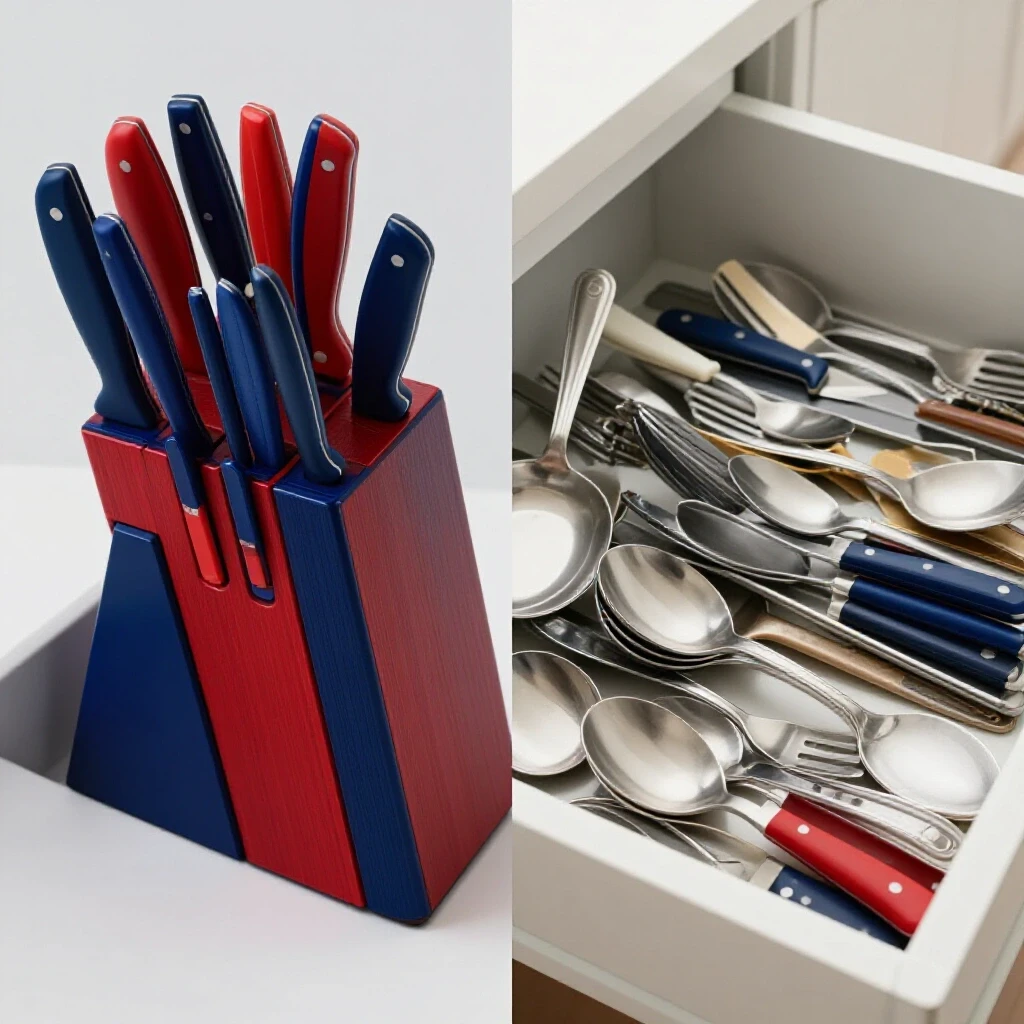
In my 13 years of material procurement, I have seen many homeowners struggle with this choice. A countertop block is the traditional route. It keeps tools within arm’s reach. However, it takes up valuable “real estate” on your counters. If you have invested in expensive granite or quartz, you might want to keep those surfaces clear. On the other hand, in-drawer systems hide the tools away, creating a minimalist look, but they require you to sacrifice a full drawer.
Safety Performance and Blade Exposure
Safety in a kitchen isn’t just about avoiding accidents; it is about how the storage design prevents unintentional contact with sharp edges. A well-designed system should ensure that the handle is the only part of the tool you touch when reaching for it.
In my safety tests, I found that countertop blocks provide a vertical or angled orientation that is very intuitive. You see the handle and pull. However, the “blind” nature of the slots means you can’t always see which tool you are grabbing if the handles look similar. Drawer inserts lay the tools flat. This allows for a full visual scan before you reach in. Interestingly, the drawer method actually reduced “accidental nicks” in my household because the blades are recessed into slots, pointing away from the user’s hand.
Space Efficiency and Kitchen Workflow
The decision often comes down to a trade-off between counter space and drawer volume. For a small kitchen, every square inch of counter is vital for prep work.
- Countertop Footprint: Usually occupies 25 to 50 square inches of surface area.
- Drawer Volume: Requires a standard 15-inch or 18-inch wide drawer, typically 2 to 3 inches deep.
- Vertical Clearance: Blocks require at least 12 to 15 inches of clearance under upper cabinets to allow tools to be pulled out.
Durability vs Maintenance Cost: A 15-Year Outlook
The long-term value of kitchen storage is measured by how much effort and money is required to keep it functional and sanitary over a decade of use. High-quality materials may cost more upfront but often require fewer replacements and less intensive cleaning.
When I perform a durability vs maintenance cost analysis, I look at the “wear layer” and the cleaning regimen. For a countertop block, the exterior is easy to wipe down, but the deep slots are nearly impossible to clean thoroughly. I have used pipe cleaners and compressed air, but dust still settles at the bottom. Drawer inserts are much easier to maintain. You can simply remove the entire tray, dump out any crumbs, and wipe the slots clean.
Maintenance Cycles for Different Materials
Maintaining your storage unit ensures it doesn’t become a breeding ground for bacteria or a source of damage for your tools. Different materials require vastly different levels of care.
- Natural Wood: Requires oiling with food-grade mineral oil every 6 months to prevent cracking.
- Polymer/Plastic: Dishwasher safe in some cases, but can develop deep scratches that harbor germs.
- Cork Inserts: Naturally antimicrobial but can crumble over time if they get too dry.
- Composite Materials: Highly durable and usually require only a damp cloth for cleaning.
Life-Cycle Costing Calculations
The upfront price of a high-end drawer insert might be $80 to $150, while a basic countertop block can be found for $40. However, if the block becomes unsanitary and needs replacement every 5 years, the costs flip.
| Feature | Countertop Wood Block | In-Drawer Wood Insert |
|---|---|---|
| Upfront Cost | $40 – $200 | $50 – $150 |
| Estimated Lifespan | 7 – 10 Years | 15+ Years |
| Annual Maintenance Time | 2 Hours (Deep Cleaning) | 15 Minutes (Wipe Down) |
| Blade Protection | High | Very High |
| Hygiene Rating | Moderate (Hard to clean slots) | High (Accessible slots) |
Installation Demands and Structural Requirements
Integrating storage into your kitchen requires checking dimensions and ensuring your cabinetry can support the weight and movement of the storage system. Proper installation prevents damage to both the kitchen and the tools.
For a countertop block, there is no real installation. You just set it down. However, weight is a factor. A heavy block is safer because it won’t tip over when you pull out a large chef’s knife. For in-drawer systems, you must measure the internal width, depth, and height of your drawer precisely. Most standard drawers are 21 inches deep, but custom cabinetry can vary. I always recommend using a non-slip liner under a drawer insert to keep it from sliding back and forth when you open the drawer.
Measuring for Success
Before purchasing an internal organizer, use this checklist to ensure a perfect fit: * Internal Width: Measure from the inside of the left drawer wall to the inside of the right. * Internal Depth: Measure from the back of the drawer face to the rear wall. * Clearance Height: Ensure your tallest handle won’t hit the cabinet frame when the drawer closes. * Slide Rating: Ensure your drawer slides are rated for at least 75 lbs to handle the weight of the insert and the tools.
Why Higher Upfront Costs Don’t Always Guarantee Durability
In my 13 years of supply chain analysis, I have seen that price often reflects branding or aesthetics rather than technical performance. It is essential to look at the construction methods used.
A $300 designer countertop block made of exotic wood might look stunning, but if the slots are cut too wide, the tools will wobble and potentially dull their edges against the wood. Conversely, a mid-priced drawer insert made of solid maple with dovetail joints might last thirty years. When evaluating high-end home materials, I look for “solid-stock” construction rather than veneers. Veneers can peel when exposed to the steam and humidity common in kitchens.
Technical Material Specifications to Seek
When reviewing a product’s spec sheet, look for these indicators of quality: * Material Origin: Sustainably harvested hardwoods like FSC-certified Maple or Walnut. * Finish Type: Food-safe oils or low-VOC (Volatile Organic Compound) water-based finishes. * Joinery: Look for “finger joints” or “dovetails” in drawer inserts rather than just glue and staples. * Warranty: A 5-year or lifetime warranty on structural integrity is a sign of a manufacturer’s confidence.
Practical Buying Worksheet for Homeowners
To make a confident decision, use this scoring matrix to evaluate your specific needs. Rate each category from 1 to 5 based on your kitchen habits.
- Counter Space Availability: (1 = Very Crowded, 5 = Plenty of Space)
- Drawer Availability: (1 = No Spare Drawers, 5 = Extra Drawer Space)
- Aesthetic Preference: (1 = Want Tools Hidden, 5 = Like Tools on Display)
- Cleaning Habits: (1 = Rarely Deep Clean, 5 = Frequent Deep Cleaning)
- Safety Concerns: (1 = Small Children Present, 5 = Adult-Only Household)
Scoring Results: * Higher Score (18-25): You likely prefer the convenience and visual presence of a countertop block. * Lower Score (5-17): An in-drawer organizer will better suit your need for clean counters and easy maintenance.
Final Supply Chain and Cost Recommendations
Choosing between these two storage methods is a balance of ergonomics, hygiene, and kitchen design. Based on my evaluations across multiple properties, the in-drawer method offers a superior long-term profile for most modern homeowners.
While the countertop block is iconic, the inability to thoroughly clean the interior slots is a significant technical drawback. In my own home, I transitioned to an in-drawer maple insert five years ago. The result has been clearer countertops and a much simpler cleaning routine. If you are currently in the middle of a renovation, I suggest planning for a dedicated “tool drawer” near your main prep area. This integrates the storage into the home’s architecture, which often adds more value than a standalone accessory.
Key Takeaways for Your Purchase
- Prioritize Material: Choose hardwoods like Maple or Walnut for the best balance of blade protection and durability.
- Check Dimensions: Always measure your drawer’s internal clearance before buying an insert.
- Consider Maintenance: If you hate cleaning small crevices, avoid deep-slotted countertop blocks.
- Invest in Quality: A solid wood insert is a one-time purchase that can last the life of your kitchen.
Frequently Asked Questions
Which material is the most hygienic for storing sharp tools?
Hardwoods with tight grains, such as Maple, are generally considered the most hygienic. They contain natural enzymes that inhibit bacterial growth. Furthermore, a drawer insert is often more hygienic than a block because the slots are shallower and easier to wipe out, preventing the buildup of dust and food particles.
Will a drawer organizer damage my expensive cutlery?
No, provided the insert is made of a material with a lower Janka hardness than the steel of your tools. Wood and cork are excellent choices because they “give” slightly when the blade touches them. Avoid metal or hard plastic inserts that don’t have individual slots, as tools can clatter together and chip.
How do I clean the inside of a countertop storage block?
Cleaning the deep slots of a block is difficult. The best method is to use a vacuum with a thin nozzle to suck out debris, followed by a long, thin brush or pipe cleaner dipped in a mild vinegar solution. Ensure the block is completely dry before re-inserting tools to prevent mold.
Does a drawer insert take up too much space?
A typical organizer takes up one standard drawer. For many, this is a fair trade for gaining 40 square inches of counter space. If you have a small kitchen, look for “tiered” drawer inserts that stack tools to save width while utilizing the full depth of the drawer.
Are bamboo organizers better than hardwood ones?
Bamboo is a sustainable and budget-friendly choice. It is very hard and water-resistant. However, because it is so hard, it can be slightly more abrasive on very fine, high-carbon steel edges compared to softer woods like Walnut.
Can I install a drawer insert myself?
Yes, most inserts are “drop-in” units. As long as you have measured your drawer correctly, you simply place the unit inside. Some models come with “expandable” sides to provide a custom fit for various drawer widths without the need for power tools.
What is the average lifespan of these storage solutions?
A high-quality solid wood drawer insert can easily last 15 to 20 years. Countertop blocks usually last 7 to 10 years before the finish wears down or the interior slots become too dirty to feel comfortable using.
Is there a safety risk with drawers if I have children?
Actually, many homeowners find drawers safer because they can be fitted with childproof latches. A countertop block is often within reach of a child who might pull a heavy tool down onto themselves. Hiding the tools behind a latched drawer adds an extra layer of security.
Does the weight of the storage unit matter?
Weight is very important for countertop blocks to ensure stability. For drawer inserts, weight is less of a factor for stability, but you must ensure your drawer slides can handle the added load of a heavy wood insert plus the weight of the tools.
Should I look for a specific finish on the wood?
Yes, look for food-grade finishes. Mineral oil or beeswax are the gold standards. Avoid heavy varnishes or lacquers that can flake off over time and end up on your food preparation tools. Regular re-oiling will keep the wood from absorbing moisture and cracking.
(This article was written by one of our staff writers, Andrew Morrison. Visit our Meet the Team page to learn more about the author and their expertise.)