Laminate Countertops: Pros, Cons, and Cost Analysis (Buyer’s Guide)

In the classic 1960s television era, the kitchen was often portrayed as a pristine, colorful hub where every surface looked identical and perfectly smooth. This aesthetic was driven by a specific type of material engineering that prioritized uniform appearance and ease of production. For a modern homeowner, choosing the right surfaces involves moving past the television image and looking at the technical material specifications that define how a product actually functions under daily pressure.
The Engineering Behind Multi-Layered Synthetic Surfaces
Synthetic surface materials are engineered composites designed to provide a balance between aesthetic flexibility and functional resilience. These products are created by fusing multiple layers of resin-impregnated paper under high pressure and heat, resulting in a dense, non-porous sheet. This material is then bonded to a structural core, typically made of wood fibers, to provide the necessary thickness and stability for residential applications.
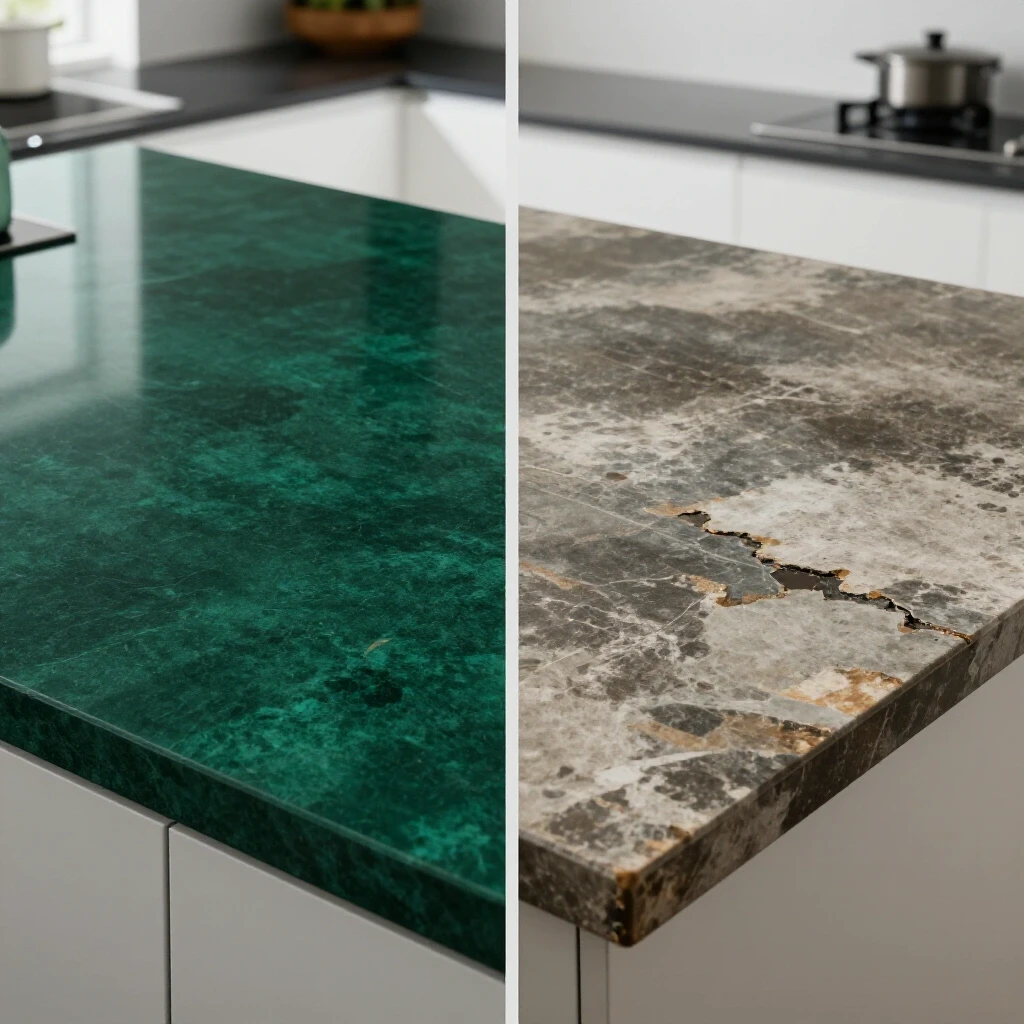
Understanding the “what” and “why” of these materials starts with the chemistry of the resins used. The core layers usually consist of kraft paper saturated with phenolic resin, which provides the material’s strength and impact resistance. The decorative layer, which provides the visual pattern, is treated with melamine resin. This specific chemical combination is used because melamine is exceptionally hard and resistant to heat and chemicals. When these layers are pressed together at pressures exceeding 1,000 pounds per square inch (psi), they undergo a chemical reaction called polymerization. This process permanently bonds the layers into a single, rigid sheet that does not delaminate under standard household conditions.
- Phenolic Resin: A synthetic polymer that acts as the structural “glue” for the internal layers.
- Melamine Resin: A hard, thermosetting plastic used for the top wear layer to provide scratch and stain resistance.
- Polymerization: The chemical process that creates a permanent bond between the paper layers and the resin.
- Substrate: The underlying material, usually particleboard or MDF, that provides structural support.
Understanding the Core Composition
The structural integrity of a surface depends heavily on the substrate material used beneath the decorative layer. Most residential options utilize either industrial-grade particleboard or Medium-Density Fiberboard (MDF) as the foundation. These cores are chosen for their flatness and stability, which prevents the surface from warping or telegraphing imperfections through the thin synthetic top layer.
Industrial-grade particleboard is the industry standard for most home material comparisons because it offers a high strength-to-weight ratio. It is composed of wood chips and shavings bonded with urea-formaldehyde or phenol-formaldehyde resins. MDF, on the other hand, consists of much finer wood fibers, resulting in a smoother edge and higher density. In a technical material specification analysis, MDF is often preferred for intricate edge profiles or areas where high moisture resistance is required, as its tighter fiber structure absorbs water more slowly than standard particleboard.
- Particleboard Density: Typically 45 to 50 pounds per cubic foot for high-quality residential grades.
- MDF Density: Generally ranges from 37 to 50 pounds per cubic foot, offering a more uniform internal structure.
- Screw-Holding Capacity: A critical metric for cabinet attachment; MDF generally outperforms particleboard in this area.
- Internal Bond Strength: The measure of how well the wood fibers stay together under tension.
Key Takeaway: The performance of the surface is a direct result of the chemical bond between the melamine top layer and the structural wood-fiber core.
Technical Standards and NEMA LD 3 Performance Metrics
To ensure consistency across the industry, synthetic surfaces are evaluated against the NEMA LD 3 standards. This set of rigorous tests, established by the National Electrical Manufacturers Association, measures how materials respond to physical stress, heat, and chemical exposure. For anyone conducting a trade-off analysis between different high-end home materials, these metrics provide the objective data needed to move beyond marketing claims.
The NEMA LD 3 standards include specific tests for wear resistance, which is measured in “cycles.” A machine rotates an abrasive pad over the surface until the decorative pattern is worn through. For a standard residential grade, the material must withstand at least 400 cycles. High-wear versions can exceed 1,000 cycles. Another critical test is the boiling water resistance test, where a container of boiling water is placed on the surface for 20 minutes. A passing grade requires no blistering, cracking, or color change, demonstrating the material’s thermal stability.
Side-by-Side Material Performance Specifications
| Performance Metric | Standard Grade (HGS) | Vertical Grade (VGP) | Post-Forming Grade (HGP) |
|---|---|---|---|
| Thickness (mm) | 1.2 mm | 0.7 mm | 1.0 mm |
| Wear Resistance (Cycles) | 400+ | 250+ | 350+ |
| Impact Resistance (mm) | 1200 mm drop | 600 mm drop | 900 mm drop |
| Boiling Water Resistance | No Effect | No Effect | No Effect |
| High Temp Resistance | Slight Effect | Slight Effect | Slight Effect |
| Radiant Heat Resistance | 100 Seconds | 80 Seconds | 100 Seconds |
These technical specifications allow homeowners to match the material grade to the specific needs of a room. For example, a heavy-use kitchen island would require a Horizontal General Purpose (HGS) grade, while a bathroom vanity with curved edges might utilize a Post-Forming (HGP) grade, which is thinner and designed to bend when heated.
Key Takeaway: Always check for NEMA LD 3 compliance to ensure the material meets the minimum industry requirements for heat and impact resistance.
Evaluating Surface Durability and Wear Layers
The durability of a synthetic surface is primarily determined by its wear layer, which is the transparent topmost coating. In technical material specifications, this layer is often enhanced with aluminum oxide particles. Aluminum oxide is one of the hardest minerals available, ranking just below diamond on the Mohs scale. By embedding these particles into the melamine resin, manufacturers can significantly increase the scratch resistance of the surface without affecting its clarity or color.
When evaluating durability vs maintenance cost, the texture of the surface also plays a significant role. A high-gloss finish may look sophisticated, but it often shows micro-scratches and fingerprints more readily than a matte or textured finish. From a supply chain perspective, textured surfaces are often more popular in high-traffic environments because they disperse light, making minor wear and tear less visible over time. This is a critical consideration for homeowners who want a low-maintenance lifestyle without sacrificing aesthetic appeal.
- Scuff Resistance: The ability of the surface to resist marks from rubber or plastic objects.
- Stain Resistance: Tested against 29 different household chemicals, including coffee, tea, and hair dye.
- Tactile Texturing: Surface finishes like “sculpted” or “linen” that provide physical depth.
- Lightfastness: The material’s ability to resist fading when exposed to ultraviolet (UV) light.
Impact Resistance and Structural Integrity
Impact resistance is a measure of how well the material can withstand a blunt force, such as a dropped heavy pot or a small appliance. This is measured by dropping a steel ball from a specific height onto the surface. The technical engineering specification for a high-quality horizontal surface usually requires an impact resistance of at least 50 inches (1270 mm).
The thickness of the laminate sheet itself contributes to this rating. A thicker sheet (1.2 mm) provides more “cushion” for the core, preventing the particleboard from denting. In my experience evaluating supply chains for multi-family housing, I have found that specifying a slightly thicker grade significantly reduces the frequency of surface fractures in high-use areas. This is a classic example of how a small increase in material spec can lead to a significant reduction in long-term maintenance needs.
Key Takeaway: Opt for aluminum-oxide-enhanced wear layers and thicker horizontal grades to maximize the lifespan of the surface.
Moisture Dynamics and Substrate Integrity
The most significant technical challenge for synthetic surfaces is moisture management. While the top melamine layer is completely non-porous and waterproof, the wood-fiber core is hygroscopic, meaning it naturally absorbs moisture from the air. If water reaches the core through a seam or an unsealed edge, it can cause the wood fibers to swell, leading to permanent deformation of the surface.
To mitigate this, industry standards recommend specific sealing protocols. All “cut-outs” for sinks or appliances should be sealed with a water-resistant silicone or a specialized lacquer. Furthermore, the use of “balanced” construction is essential. This means a backer sheet is applied to the underside of the substrate to provide equal tension to the top layer. Without a backer sheet, the substrate would absorb moisture unevenly, causing the entire panel to cup or bow over time.
- Edge Banding: The process of applying a protective strip to the exposed edges of the substrate.
- Post-Forming: A manufacturing technique where the laminate is heated and bent around a radius to eliminate seams.
- Water Vapor Transmission: The rate at which moisture passes through the material, which is near zero for the top layer.
- Substrate Swell Rate: The percentage of thickness increase after 24 hours of water immersion.
Strategic Selection for High-Traffic Home Environments
When choosing materials for a high-traffic home, it is important to look at the “wear-through” rating rather than just the initial appearance. In an appliance buying guide context, you wouldn’t buy a dishwasher without checking its decibel rating; similarly, you shouldn’t select a surface without checking its abrasion resistance. For families with active lifestyles, a “textured matte” finish often provides the best balance of durability and ease of cleaning.
I have observed in various material procurement logs that darker colors and high-gloss finishes tend to require more frequent cleaning to maintain their appearance. Conversely, mid-tone patterns with a slight texture can hide dust and minor surface streaks, reducing the daily maintenance burden. This trade-off analysis is vital for homeowners who want their kitchen to look clean without constant polishing.
Key Takeaway: Moisture resistance is about the integrity of the seams and the quality of the edge treatments, not just the top surface.
Financial Evaluations and Life-Cycle Costing
In a professional home material comparison, we look at the life-cycle cost, which includes the initial purchase, the cost of maintenance, and the expected replacement interval. Synthetic surfaces are often the most cost-effective option over a 10 to 15-year period because they do not require periodic sealing, buffing, or specialized chemical treatments.
The maintenance regimen for these materials is remarkably simple: a soft cloth and mild soap. Unlike other high-end home materials that may require specific pH-balanced cleaners or annual resealing to prevent staining, melamine-based surfaces are chemically inert. This means they do not react with common household acids like lemon juice or vinegar. When you factor in the lack of professional maintenance costs over a decade, the value proposition of these engineered surfaces becomes very clear.
Upfront Cost vs. 15-Year Maintenance Outlay
| Material Factor | Synthetic Surface (HPL) | Maintenance Requirement |
|---|---|---|
| Initial Sealing | None | Factory Sealed |
| Annual Maintenance | $0 | Soap and Water Only |
| Professional Refinishing | N/A | Not Possible/Not Needed |
| Stain Removal | Low | Non-porous surface |
| Expected Lifespan | 15-20 Years | Depends on Core Integrity |
By analyzing these factors, homeowners can see that the “cost of ownership” is almost entirely front-loaded. There are no hidden fees or recurring expenses associated with keeping the material in peak condition. This makes it an ideal choice for those who want a predictable budget for their home renovation.
Key Takeaway: The long-term value of synthetic surfaces lies in their zero-cost maintenance schedule and chemical resistance.
Technical Material Selection Worksheet
Use this scoring matrix to evaluate different surface options based on your specific household needs. Rate each factor from 1 to 5 (5 being the highest priority).
- Impact Resistance: Do you frequently use heavy cookware or small appliances? (Higher score = Need HGS Grade)
- Moisture Exposure: Is the surface near a high-splash area like a sink or dishwasher? (Higher score = Need MDF core and sealed edges)
- Visual Maintenance: How much time are you willing to spend cleaning fingerprints? (Higher score = Need Matte/Textured finish)
- Abrasive Wear: Will the surface be used for homework, crafts, or heavy sliding of objects? (Higher score = Need High-Wear/Aluminum Oxide layer)
- Chemical Exposure: Do you use harsh cleaners or have frequent contact with staining agents? (Higher score = Melamine-rich surface is ideal)
Total Score Analysis: – 15-20: Standard residential grade is sufficient. – 21-25: Upgrade to High-Pressure Laminate (HPL) with an enhanced wear layer and moisture-resistant core.
Conclusion
Selecting a home surface is a technical decision that requires balancing material science with lifestyle demands. By focusing on NEMA LD 3 standards, understanding the role of melamine and phenolic resins, and prioritizing the integrity of the substrate core, homeowners can make a confident purchasing decision. While higher upfront costs in other categories may offer different aesthetic benefits, the engineered resilience and zero-maintenance profile of high-pressure synthetic surfaces provide a compelling case for the practical evaluator. The goal is to choose a material that works for you, rather than one that requires you to work for it.
FAQ
What exactly is High-Pressure Laminate (HPL)? HPL is a material made by fusing layers of resin-impregnated paper under high heat and pressure. The result is a durable, non-porous sheet that is much stronger than the “low-pressure” versions often found in inexpensive, ready-to-assemble furniture. HPL is the standard for high-quality residential surfaces.
How does the wear layer protect against scratches? The top layer of a synthetic surface is made of melamine resin, which is naturally hard. Many high-end manufacturers also infuse this layer with aluminum oxide particles. These microscopic minerals act as a shield, absorbing the friction from sliding objects and preventing the decorative paper underneath from being damaged.
Can these surfaces handle heat from a hot pan? While they are tested to withstand boiling water and radiant heat (up to a point), they are not heat-proof. The melamine resin can withstand temperatures around 275°F (135°C) for short periods, but prolonged exposure to a hot pan can cause the resin to char or the adhesive bond to the substrate to fail. Always use a trivet.
Is there a difference between particleboard and MDF cores? Yes. Particleboard is made of larger wood chips and is the standard for most applications. MDF is made of finer fibers and is denser, making it more resistant to impact and providing a smoother surface for thin laminates. MDF is also slightly better at resisting moisture if the edges are properly sealed.
Why do some surfaces show more fingerprints than others? This is primarily due to surface “energy” and light refraction. High-gloss, smooth surfaces have more surface area in contact with your skin oils and reflect light directly, making the oils visible. Textured or matte surfaces break up the light and have less direct contact with the skin, hiding prints more effectively.
How do I know if a product meets industry standards? Look for a “NEMA LD 3” certification on the manufacturer’s technical data sheet. This ensures the product has passed standardized tests for wear, impact, and chemical resistance. Most reputable supply chain sources will provide these spec sheets upon request.
What is the best way to clean a non-porous synthetic surface? The best method is using a clean, damp, non-abrasive cotton cloth and a mild liquid detergent or household cleaner. Avoid abrasive powders or “magic” sponges, as these can create micro-scratches that dull the finish over time.
Are these materials environmentally friendly? Many modern synthetic surfaces are quite sustainable. The wood-fiber cores are often made from recycled wood waste or rapidly renewable forests. Additionally, many manufacturers have moved to low-VOC (Volatile Organic Compound) resins and adhesives to improve indoor air quality.
Can I repair a chip or a deep scratch? Small chips can sometimes be filled with specialized color-matched repair pastes, but these are generally cosmetic and not structural. Because the material is a composite of layers, it cannot be sanded down or refinished like solid wood. Prevention through proper grade selection is the best strategy.
What is “post-forming” and why does it matter? Post-forming is a process where the laminate is heated and bent around a curved edge. This creates a seamless transition from the top of the surface to the edge, which is highly beneficial in moisture-prone areas because it eliminates the seam where water could potentially enter the core.
(This article was written by one of our staff writers, Andrew Morrison. Visit our Meet the Team page to learn more about the author and their expertise.)