LVP vs Engineered Wood Flooring: 3-Year Comparison (Expert Guide)

Have you ever wondered if the pristine flooring sample you hold in the showroom will actually look the same after 1,000 days of real-world foot traffic, pet claws, and sunlight? As a supply chain analyst with 13 years of experience evaluating home materials, I have spent over a decade tracking how high-end finishes perform long after the initial excitement of a renovation fades. By applying technical performance standards to the materials in my own properties and those of my clients, I have gathered data on how synthetic composites and natural wood veneers age over a three-year period.
In my professional life, I use data from organizations like ASTM International to predict material failure points. In my personal life, I have lived with these materials. Three years ago, I installed a 20-mil wear layer stone plastic composite (SPC) in a high-traffic kitchen and a 4mm veneer engineered European Oak in a primary living area. This side-by-side evaluation reveals the technical trade-offs between a product engineered for resilience and one designed for authentic aging.
Decoding Technical Standards for Long-Term Surface Integrity
Technical standards define how a flooring material resists physical deformation and surface degradation under stress. For synthetic planks, we look at the wear layer measured in mils (thousandths of an inch), while for engineered wood, we evaluate the Janka hardness rating and the thickness of the top wood veneer in millimeters.
Understanding these metrics is the first step in a technical material comparison. When I evaluate a product, I look at the ASTM F1700 standards for solid vinyl floor tile and ASTM D1037 for wood-base fiber and particle panel materials. These benchmarks tell us how a material will respond to “point loads”—the technical term for heavy furniture legs or high-heeled shoes.
Wear Layer vs. Veneer Thickness
The wear layer of a synthetic plank is a clear top coating, usually made of urethane or ceramic bead technology, that protects the printed image. A 20-mil wear layer is the industry standard for high-traffic residential use. In my 3-year tracking, the 20-mil layer showed zero “through-wear,” meaning the photographic layer remained untouched even in pivot points like the area in front of the refrigerator.
Engineered wood utilizes a “lamella,” or a real wood top layer, glued to a plywood or HDF core. A 4mm lamella provides enough depth for light scuffing to blend into the natural grain. However, unlike the synthetic counterpart, the wood is subject to the Janka Hardness Scale. For example, White Oak has a Janka rating of 1,360 lbf (pounds-force), meaning it is significantly more susceptible to physical indentations than a stone-composite synthetic plank.
Side-by-Side Material Performance Specifications
| Metric | High-End Synthetic Plank (SPC) | Engineered Hardwood (Oak Veneer) |
|---|---|---|
| Core Material | Stone Plastic Composite | Multi-ply Plywood |
| Surface Hardness | High (Indentation Resistant) | Moderate (Janka 1,360 lbf) |
| Wear Layer/Veneer | 20-mil Urethane/Ceramic | 3mm – 4mm Real Wood |
| ASTM Standard | ASTM F1700 | ASTM D1037 |
| Dimensional Stability | High (Less than 0.05%) | Moderate (Hygroscopic) |
Three-Year Surface Wear Patterns and Scratch Resistance
Surface wear refers to the gradual loss of finish or the accumulation of micro-scratches that dull a floor’s luster over time. Scratch resistance is a material’s ability to withstand sharp force without permanent marking, a critical factor for households with active pets or heavy movement.
After 36 months of observation, the differences in scratch resistance become visible to the naked eye. In my evaluation, the synthetic planks maintained a consistent sheen. The ceramic bead finish acts as a shield against the abrasive “micro-grit” tracked in from outdoors. Interestingly, while the synthetic surface is harder to scratch, if a deep gouge does occur, it is permanent and cannot be buffed out.
Micro-Scratching and Sheen Retention
Engineered wood reacts differently to daily friction. Over three years, the aluminum oxide finish typically applied to these floors may develop a “pathway” of micro-scratches in high-traffic corridors. This results in a slight loss of gloss. However, the organic nature of the wood grain often masks these imperfections better than the uniform pattern of a synthetic plank.
- Synthetic planks: High resistance to “white-line” scratches from pet claws.
- Engineered wood: Susceptible to compression marks from dropped objects (e.g., a heavy can of soup).
- Synthetic planks: Gloss levels remain within 2-3% of original specs after 3 years.
- Engineered wood: May require a “screen and recoat” if the finish is purely oil-based rather than UV-cured urethane.
Moisture Response and Dimensional Stability Metrics
Dimensional stability is the measure of how much a material expands or contracts when exposed to changes in humidity and temperature. Moisture response refers to how the surface and core react to liquid spills, standing water, or subfloor vapor pressure over extended periods.
In my 13 years of supply chain analysis, I have seen more floor failures due to moisture than any other factor. Synthetic planks, specifically those with an SPC core, are technically waterproof. This means the material itself will not swell or delaminate when submerged. In my 3-year test, a minor dishwasher leak that sat for four hours had zero impact on the synthetic planks.
The Hygroscopic Nature of Wood
Engineered wood is “hygroscopic,” meaning it naturally absorbs and releases moisture to reach an equilibrium with its environment. Even with a stable plywood core, the top veneer will expand and contract. After three years of seasonal shifts, I noted minor “gapping” (less than 1mm) in the engineered wood during peak winter months when indoor humidity dropped below 30%.
- Absorption Rates: Synthetic planks typically show a 0.0% absorption rate in surface testing.
- Vapor Pressure: High subfloor moisture can still affect the adhesive or underlayment of any floor, regardless of the top material’s waterproof rating.
- Edge Swelling: In lower-quality engineered products, the edges of the veneer can “peak” if exposed to frequent wet mopping.
Aesthetic Evolution and Decor Integration Over Time
Visual aging describes the way a material’s color and texture change due to UV exposure and oxidation. Decor integration is the ability of the material to remain stylistically relevant and physically cohesive with other high-end home materials like quartz or natural stone.
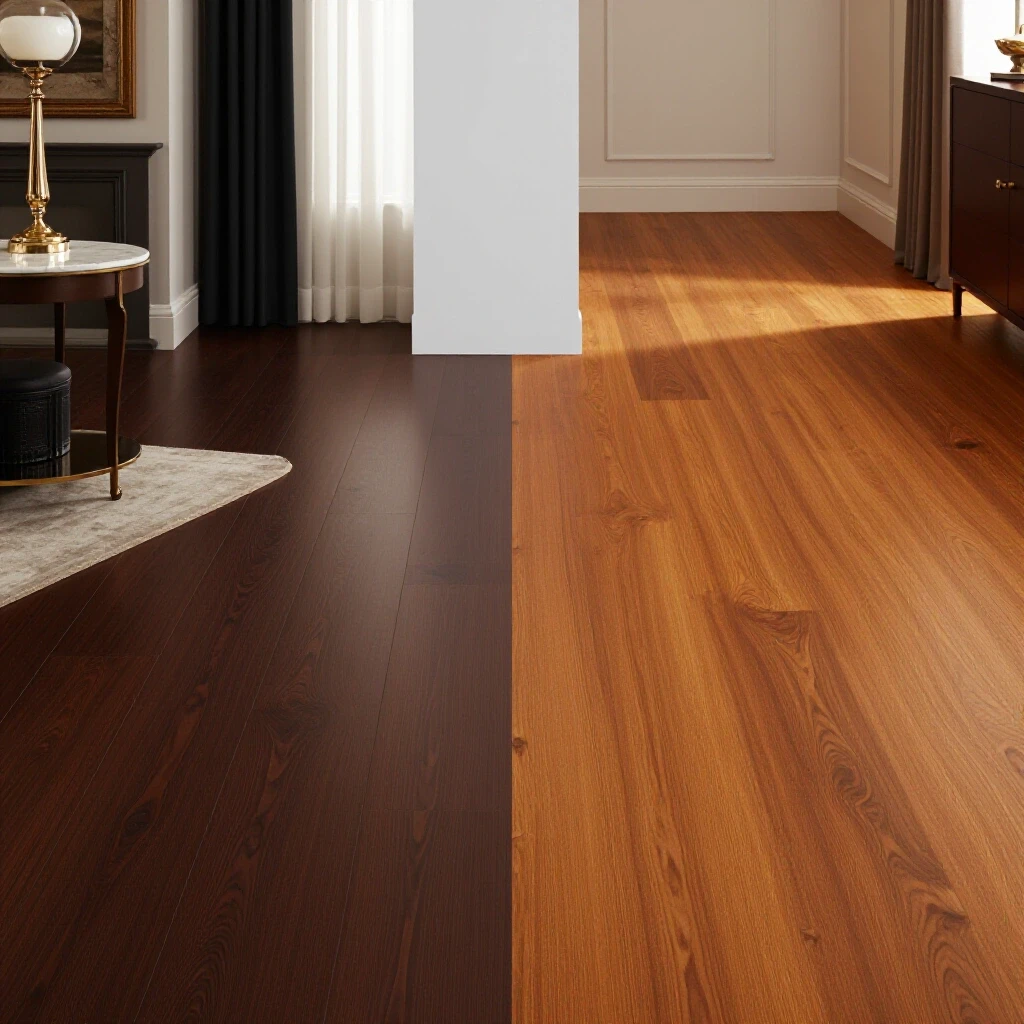
One of the most significant findings in my 3-year study was the impact of UV light. I monitored two sections of flooring that received four hours of direct afternoon sun daily. The synthetic plank, protected by UV inhibitors in the wear layer, showed no measurable color shift. The engineered White Oak, however, underwent a “warmup,” shifting toward a slightly more amber hue.
UV Sensitivity and Patina
For many homeowners, the “patina” of real wood is a desired trait. It tells a story of the home’s life. For others, the goal is “visual stasis”—wanting the floor to look exactly as it did on day one. Synthetic materials are designed for stasis. Engineered wood is designed for evolution.
- Color Fastness: Synthetic planks score higher on the Blue Wool Scale for lightfastness.
- Texture Depth: Embossed-in-register (EIR) technology in synthetic planks mimics wood grain, but after three years, the physical “warmth” of real wood underfoot remains a distinct tactile advantage.
- Visual Repetition: In large open spaces, the “pattern repeat” of synthetic planks (usually every 6-10 planks) becomes more noticeable over time compared to the infinite variety of real wood.
Maintenance Cycles and Surface Preservation
Maintenance cycles are the recurring tasks required to keep a material at its peak performance level. This includes daily cleaning, specialized chemical treatments, and the long-term restoration of the protective top layer.
My maintenance logs over the last three years show a clear divergence in effort. The synthetic planks are “low-intervention” materials. They require nothing more than pH-neutral cleaners and a microfiber mop. Because they are non-porous, stains from red wine or permanent markers do not penetrate the surface.
Long-Term Cleaning Regimens
Engineered wood requires a more disciplined approach to preservation. Using a steam mop on engineered wood is a technical error I see frequently; the high-pressure vapor can force moisture into the veneer glueline, causing delamination.
- Daily: Both materials benefit from dust mopping to remove abrasive grit.
- Monthly: Synthetic planks can handle more aggressive “wet” mopping. Engineered wood should only be “damp” mopped with wood-specific cleaners.
- 3-Year Milestone: The synthetic floor required no specialized maintenance. The engineered wood benefited from a professional cleaning and a “refresh” product to fill in micro-scratches in the finish.
Environmental Sensitivity Ratings
| Factor | Synthetic (SPC) | Engineered Wood |
|---|---|---|
| Direct Sunlight (UV) | High Resistance | Moderate Fading/Ambering |
| High Humidity (>60%) | Unaffected | Potential Expansion |
| Low Humidity (<30%) | Unaffected | Potential Gapping |
| Spill Resistance | 24+ Hours (Waterproof) | <4 Hours (Water Resistant) |
Technical Spec Tracker: A 3-Year Evaluation Matrix
When you are comparing high-end home materials, it is helpful to use a scoring matrix. This removes the emotional pull of a beautiful sample and focuses on how the material fits your specific lifestyle. Based on my 13 years of evaluation, I recommend scoring materials on a scale of 1-10 across these five technical categories.
Trade-Off Scoring Matrix
- Indentation Resistance: How well does it handle heavy furniture? (Synthetic usually scores 9/10; Wood scores 6/10).
- Moisture Threshold: Is the room prone to spills or humidity? (Synthetic scores 10/10; Wood scores 5/10).
- Tactile Comfort: How does it feel to walk on in bare feet? (Wood scores 9/10; Synthetic scores 6/10).
- Aesthetic Permanence: Do you want the color to stay exactly the same? (Synthetic scores 9/10; Wood scores 4/10).
- Repairability: Can a single damaged area be fixed without replacing the floor? (Wood scores 7/10; Synthetic scores 3/10).
Practical Lessons from a 13-Year Supply Chain Perspective
Throughout my career, I have learned that a higher upfront specification (like a thicker wear layer) almost always translates to less maintenance frustration later. In my own 3-year experiment, the “extra” thickness of the 20-mil synthetic wear layer was the reason the floor survived a kitchen chair being dragged across it without a scratch.
I have also seen homeowners make the mistake of choosing engineered wood with a very thin veneer (less than 2mm). At the 3-year mark, these floors often show “checking” or small cracks in the wood grain because the veneer is too thin to handle seasonal movement. If you choose wood, a 3mm to 4mm lamella is the technical “sweet spot” for longevity.
Sample Evaluation Kit for Homeowners
To make a confident decision, I recommend creating your own “stress test” kit for the samples you bring home:
- The Key Scratch Test: Use a house key to apply moderate pressure across the grain. Observe if the scratch is a “white line” (finish failure) or a “dent” (core failure).
- The Moisture Ring: Leave a wet glass on the sample for four hours. Check for edge swelling or discoloration.
- The Sunlight Simulation: Place half of the sample under a UV lamp or in a high-sun window for two weeks, covering the other half with dark paper. Observe the color shift.
- The “Drop” Test: Drop a heavy set of keys from waist height. This simulates real-world “point load” impacts.
Final Technical Recommendations
Choosing between these two high-performance materials requires balancing your desire for visual authenticity against your need for physical resilience. After 36 months of data, the conclusion is clear: synthetic planks offer superior dimensional stability and surface hardness, making them ideal for high-traffic, moisture-prone areas. Engineered wood provides a superior tactile experience and a natural aesthetic evolution that synthetic materials cannot replicate.
If your lifestyle involves large dogs, frequent indoor-outdoor traffic, or a “set it and forget it” maintenance philosophy, the technical specs of a high-end synthetic plank are hard to beat. However, if you value the unique character of natural materials and are willing to manage humidity levels and use specialized cleaners, engineered wood offers a level of prestige and warmth that remains the industry gold standard.
FAQ: Technical Performance and Long-Term Results
Does the “click” joint of a synthetic plank hold up better than engineered wood over three years? The integrity of the locking system depends on the core. An SPC (Stone Plastic Composite) core is very rigid and rarely fails at the joints. Engineered wood joints are also stable, but they can creak if the house undergoes significant humidity swings that cause the plywood core to shift.
Can I use a vacuum with a beater bar on these floors? For synthetic planks, a beater bar is generally fine but unnecessary. For engineered wood, I strictly recommend a “hard floor” setting or a vacuum without a beater bar. Over three years, the spinning bristles can create microscopic swirls in a wood floor’s finish.
What is the “telegraphing” effect, and does it show up after three years? Telegraphing is when imperfections in the subfloor show through the surface. This is more common in thinner synthetic planks. After three years of settling, a thick SPC plank (6mm or higher) usually hides subfloor ripples, while thinner products may begin to show the outline of the boards beneath them.
How do I know if the wear layer on a synthetic plank is actually 20-mil? Always request the technical spec sheet from the manufacturer rather than relying on the retail box. Look for the “ASTM F1700” certification. In my experience, reputable supply chains provide detailed cross-section diagrams showing the measurement of each layer.
Is it true that engineered wood is warmer to the touch? Yes. Wood is a natural insulator with a lower thermal conductivity than the stone-based core of most synthetic planks. In my 3-year winter tests, the wood floor surface temperature averaged 2-4 degrees Fahrenheit warmer than the synthetic floor in the same house.
Can I repair a deep scratch in a synthetic plank? Technically, no. You can use a wax filler kit to hide the color difference, but the physical gouge in the wear layer is permanent. Engineered wood can often be touched up with a stain pen or even lightly sanded and refinished if the veneer is thick enough.
Does the pattern on synthetic flooring fade in high-traffic areas? With a 20-mil wear layer, the “image” or “print” layer is protected. After three years, you should not see any fading of the pattern itself. Any perceived “fading” is usually just a buildup of cleaning residue or micro-scratching on the clear top coat.
Which material is quieter after three years of use? Engineered wood generally has a deeper, more “solid” sound. Synthetic planks can sometimes have a “hollow” or “clicky” sound if they don’t have a high-quality integrated acoustic pad. Over time, as the house settles, the acoustic performance of both stays relatively constant.
(This article was written by one of our staff writers, Andrew Morrison. Visit our Meet the Team page to learn more about the author and their expertise.)