Projector vs TV: Which Is Better for Movie Nights? (Comparison)

When I first began outfitting my own properties over a decade ago, I tried a quick fix for a glare issue in my living area by simply hanging heavy blankets over the windows. It was a temporary solution that looked terrible and gathered dust, but it taught me a vital lesson about how light interacts with home materials. Since then, I have spent 13 years as a supply chain analyst, looking at the technical data behind the products we bring into our homes. Choosing between a large-panel glass display and a reflective projection system is not just about the screen size; it is a complex trade-off of material science, structural requirements, and long-term upkeep.
Understanding the Material Science of Visual Surfaces
Material science in home entertainment focuses on how different substrates manage light, heat, and physical wear over time. To make a smart choice, we must look at the “what” and “why” behind the surfaces we stare at for hours.
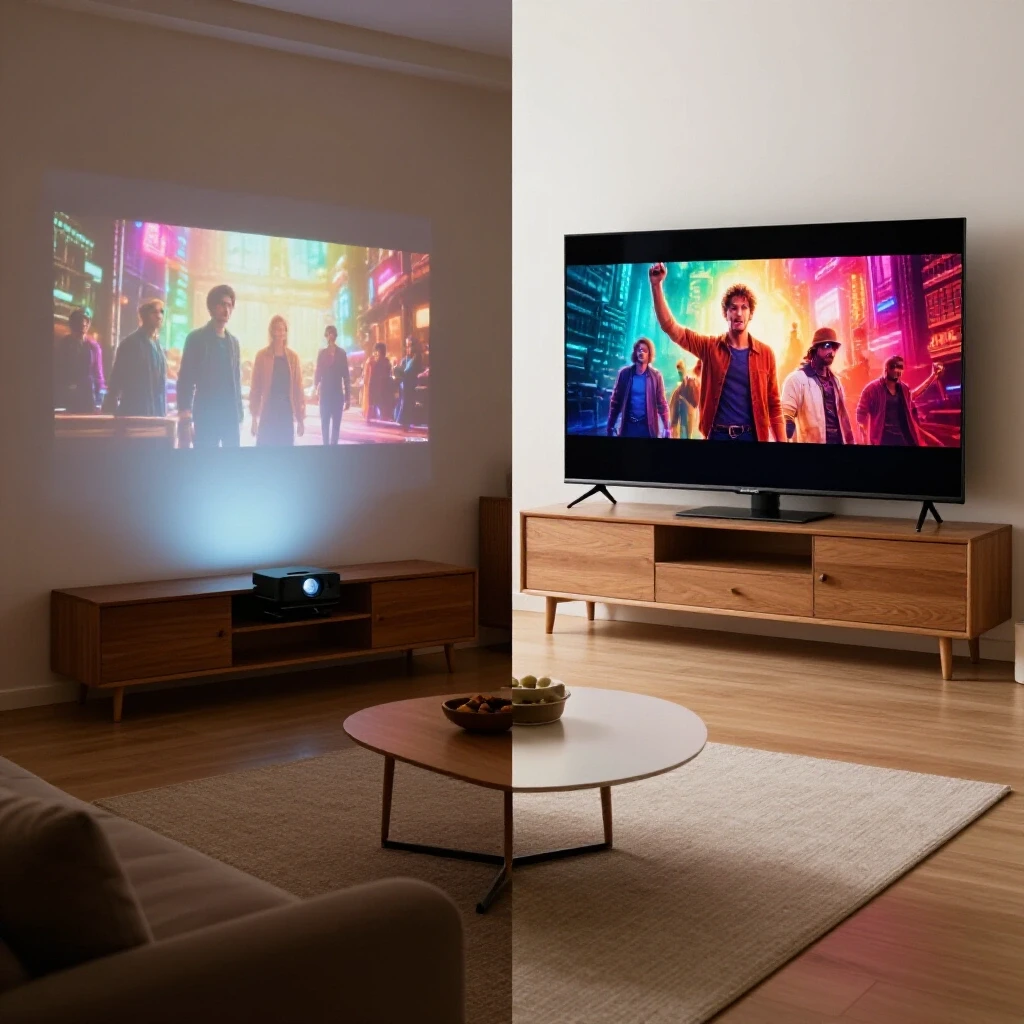
In my years of evaluating high-end home materials, I have categorized these systems into two distinct groups: emissive surfaces and reflective substrates. An emissive surface, like a standard high-definition panel, creates its own light using layers of glass and liquid crystals. A reflective substrate, like a theater screen, relies on light bouncing off a specialized fabric.
The technical performance of these materials is often measured by their “gain” or their ability to resist ambient light. For instance, ASTM E179 is a standard used to measure the reflecting properties of materials. When you choose a screen material, you are essentially choosing how much light is lost to the room versus how much is directed back to your eyes.
Why Higher Upfront Costs Don’t Always Guarantee Durability
In the world of home material comparison, we often assume that a higher price tag means a product will last longer. However, my procurement logs show that durability is more about environmental fit than the initial invoice.
I remember a project where I installed a massive glass-fronted panel in a room with floor-to-ceiling windows. Despite the high cost of the unit, the material itself—aluminosilicate glass—was highly reflective. This caused the family to keep the brightness at maximum levels, which shortened the lifespan of the internal components. In contrast, a matte-finish projection screen in a basement environment required almost no power to maintain visibility, leading to a much longer lifecycle for the hardware.
- Emissive Panels: These use rigid glass or polymer layers. They are highly durable against dust but sensitive to physical impact.
- Reflective Fabrics: These are often made of PVC or fiberglass. They are flexible and can be rolled up, but they are prone to “stretching” or “sagging” over several years.
Side-by-Side Material Performance Specifications
| Metric | Glass-Fronted Panels | Fabric Projection Screens |
|---|---|---|
| Surface Hardness (Mohs) | 5 to 7 (Highly Scratch Resistant) | < 1 (Easily Torn or Scratched) |
| Light Management | Emissive (Internal Source) | Reflective (External Source) |
| Environmental Sensitivity | Low (Handles humidity well) | High (Prone to mold/warping) |
| ASTM Standard | ASTM D1003 (Haze/Transmittance) | ASTM D523 (Specular Gloss) |
| Weight per Square Foot | 5 – 10 lbs | 0.5 – 1.5 lbs |
Evaluating the Real Trade-Offs of Installation and Structure
Installation complexity is a hidden cost that many homeowners overlook during an appliance buying guide search. The structural demands of these two systems are vastly different.
A large-scale glass panel requires a reinforced mounting system. According to the National Association of Home Builders (NAHB), a standard interior wall may need additional blocking (horizontal wood supports) to safely hold a 100-pound display. I have seen many DIY projects fail because the homeowner didn’t realize that a 98-inch panel puts significant shear stress on standard drywall.
On the other hand, a projection system is much lighter but requires precise spatial flow. You have to consider the “throw distance,” which is the physical space between the lens and the screen. If your room has a ceiling fan or a low-hanging chandelier, the material path of the light will be blocked. This is a trade-off analysis between weight and space.
- Check wall stud spacing: Ensure studs are 16 inches on center before mounting heavy panels.
- Evaluate ceiling height: Projectors often require a drop-down mount that can interfere with head clearance.
- Light Control: Analyze the room’s porosity to light. If you have many windows, a reflective fabric will struggle without blackout materials.
Long-Term Maintenance and Lifecycle Costing
Maintenance cycles vary significantly between these two theater solutions. As a supply chain analyst, I look at the “Total Cost of Ownership” over a 15-year period.
Glass panels are non-porous and easy to clean with a simple microfiber cloth. They do not trap odors or dust. However, if the internal light source fails, the entire unit usually needs to be replaced. This is a high-risk, low-maintenance profile.
Reflective screens are often porous. Over time, dust can settle into the grain of the fabric, dulling the image. If you live in a humid environment, the fiberglass or vinyl backing can develop “waves” or “curls.” My data suggests that a high-quality tensioned screen needs to be recalibrated or replaced every 7 to 10 years to maintain its technical material specifications.
Upfront Cost vs. 15-Year Maintenance Outlay
| Component | Initial Material Cost | 15-Year Maintenance | Total Lifecycle Cost |
|---|---|---|---|
| Fixed Glass Panel | High | Low (Cleaning only) | Moderate |
| Projection System | Moderate | High (Bulb/Screen replacement) | High |
| Hybrid Laser System | Very High | Very Low | High |
Sourcing and Material Origin Impacts
When sourcing high-end home materials, where the product comes from matters. Most glass panels are sourced from large-scale manufacturing hubs in East Asia, where the supply chain for aluminosilicate glass is most mature. This leads to very tight manufacturer tolerances.
Projection screens are often assembled in smaller batches. The quality of the PVC or the “beading” on the screen surface can vary. When I evaluate these, I look for “color neutrality.” A low-quality screen might have a slight yellow or blue tint, which ruins the visual experience. Always ask for a material sample kit before committing to a full-size screen.
- Sample Kit Tip: Shine a flashlight through the screen sample. If you see a lot of light passing through the back, the material is too thin and will lose contrast.
- Scratch Test: For glass panels, use a plastic stylus to check for “drag.” High-quality coatings should feel slick, not sticky.
Practical Steps for Homeowners
To make a confident decision, you should use a systematic approach. Don’t let the “wow factor” of a big screen cloud your judgment on durability vs maintenance cost.
- Measure your light: Use a basic light meter app on your phone. If your room exceeds 50 lux during the day, a reflective screen will likely require expensive light-rejecting materials.
- Check your power: Large panels can pull significant wattage. Ensure your circuit can handle the load alongside other appliances.
- Review the warranty limits: Most warranties for glass panels cover “dead pixels,” while screen warranties focus on “fabric delamination.” Read the fine print.
High-Tech Composites and Smart Integration
The industry is moving toward high-tech composites. We are now seeing “Ambient Light Rejecting” (ALR) screens that use a microscopic triangular structure to reflect light from the projector while absorbing light from the ceiling. This is a masterpiece of material engineering.
Similarly, glass panels are becoming thinner and more efficient. Some now use “Quantum Dot” layers, which are tiny semiconductor particles that improve color without needing more power. These smart appliance integration capabilities mean that your choice today will likely be more energy-efficient than a model from five years ago.
Actionable Buying Worksheet
Use this scoring matrix to determine which material fits your lifestyle. Rate each category from 1 to 5.
- Room Light Control: (1 if bright, 5 if a dark basement)
- Maintenance Willingness: (1 if you hate cleaning, 5 if you don’t mind dusting)
- Structural Support: (1 if thin walls, 5 if reinforced masonry)
- Longevity Goal: (1 if you upgrade every 3 years, 5 if you want it for 15 years)
If your score is high on light control and maintenance, a projection system is a great fit. If you scored high on structural support and longevity with low maintenance, a fixed glass panel is the winner.
Conclusion: Confident Purchasing Decisions
Choosing the right viewing surface is a balance of technical specs and lifestyle fit. By understanding the material science—from the hardness of the glass to the tensile strength of the screen fabric—you can avoid the “quick fix” mistakes I made early in my career. Focus on the data, respect the structural limits of your home, and choose the material that matches your long-term maintenance goals.
Frequently Asked Questions
What is the life expectancy of a high-end glass panel versus a projector bulb? A high-quality glass panel is typically rated for about 60,000 to 100,000 hours of use. In contrast, traditional projector bulbs often last between 3,000 and 5,000 hours. However, modern laser-based projection systems have closed this gap, often reaching 20,000 to 30,000 hours without needing a replacement.
Does a projector screen really need a special coating? Yes, the coating on a screen material determines its “gain.” A gain of 1.0 means the light is reflected equally in all directions. A higher gain coating (like 1.5) focuses the light toward the center of the room, making the image appear brighter but narrowing the viewing angle.
How do I clean a fabric projection screen without damaging it? Most professional screens are made of vinyl or fiberglass and should only be cleaned with a very mild soap and water solution. Never use abrasive cleaners or solvents, as these can strip the reflective coating or “beading” from the surface, permanently ruining the image quality.
Can I use a regular white wall instead of a screen material? While a white wall is a “quick fix,” it is rarely a good long-term solution. Standard wall paint has a porous texture that scatters light unevenly. Furthermore, walls are rarely perfectly flat, and any slight bump or texture will create a shadow when hit by the projector’s light at an angle.
Is it harder to install a 100-inch TV or a projector and screen? A 100-inch TV is significantly harder to install due to its weight and fragility. It often requires three to four people and specialized mounting hardware. A projector and screen are lighter and can usually be handled by two people, but they require more time for “alignment” and “calibration” to ensure the image fits the screen perfectly.
What is “Ambient Light Rejection” (ALR) material? ALR is a specialized screen material designed with a microscopic physical structure. It is engineered to reflect light coming from a specific angle (the projector) toward the viewer, while absorbing or diverting light coming from other angles (like windows or ceiling lights). It is the best material choice for rooms that cannot be made completely dark.
Do glass panels suffer from “burn-in” over time? Modern panels have largely mitigated this issue, but it can still occur if a static image is left on the screen for hundreds of hours. This is a chemical degradation of the emissive material. For home theater use, where content is constantly moving, this is rarely a concern for most homeowners today.
How does humidity affect these different materials? Humidity is the enemy of fabric screens. High moisture levels can cause the fibers in the screen backing to expand and contract, leading to “waves” in the material. Glass panels are much more resistant to humidity, though extreme moisture can eventually affect the internal electronics if the housing is not properly sealed.
(This article was written by one of our staff writers, Andrew Morrison. Visit our Meet the Team page to learn more about the author and their expertise.)