How to Fix a Messy Spatula Drawer for Easy Organization (Guide)

Discussing innovation in the home often brings to mind high-tech gadgets or smart appliances, but the most impactful changes usually happen at the logistical level. For a busy family, innovation is found in the way we manage the flow of physical objects through our most used spaces. By applying industrial logistics to the kitchen, we can transform a source of daily frustration into a streamlined system that actually serves our needs.
Managing Spatial Logistics in High-Traffic Kitchen Drawers
Spatial logistics refers to the strategic arrangement of items to maximize efficiency and minimize movement. In a kitchen, this involves analyzing how frequently tools are used and placing them in the most accessible zones. Proper logistics prevent the common “jammed drawer” scenario that causes frustration and physical resistance for busy families during meal preparation.
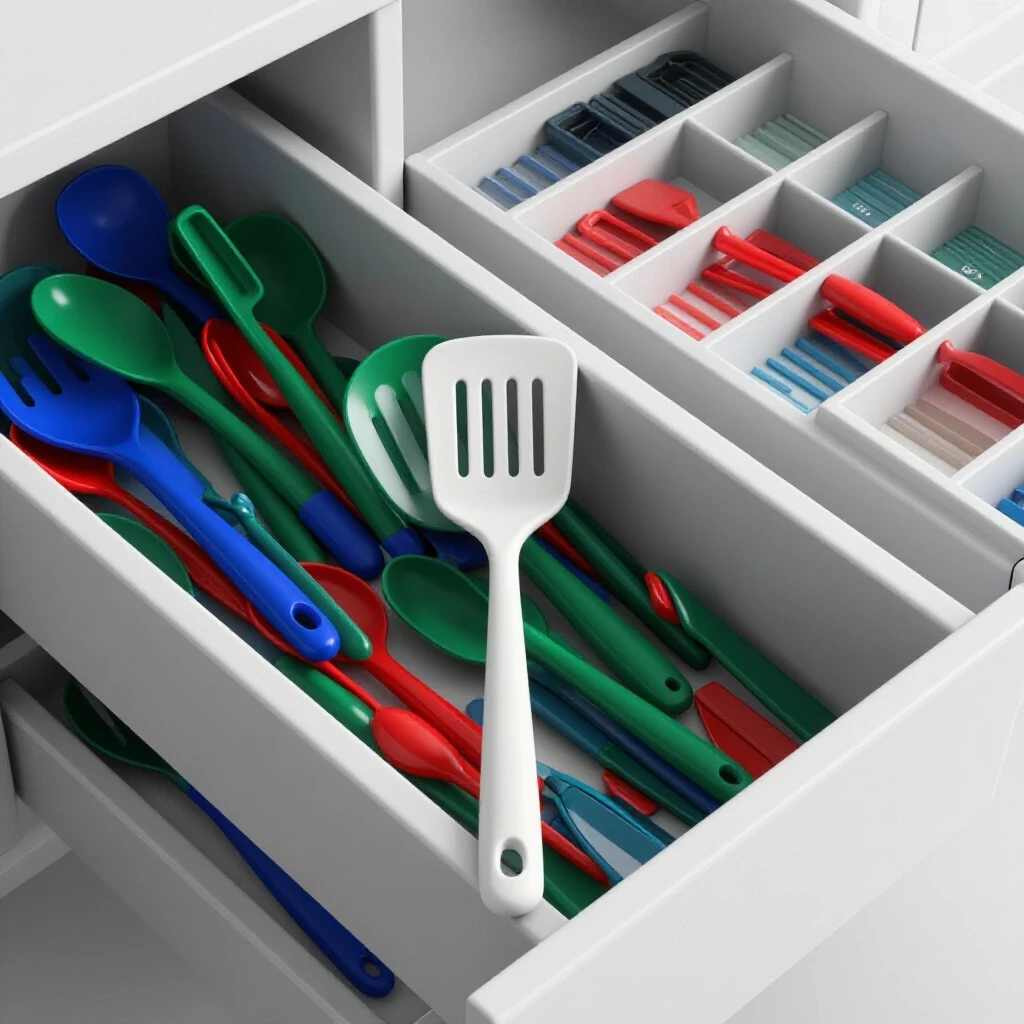
In my eleven years of managing family household systems, I have found that the kitchen drawer is often the first point of failure. We treat these spaces as “catch-alls” for every turner, whisk, and ladle we acquire. When the volume of items exceeds the physical capacity of the drawer, we experience a logistics bottleneck. This is where the drawer gets stuck because a long utensil has wedged itself against the frame.
Environmental psychology research suggests that visual clutter in high-use areas like the kitchen increases cortisol levels. When you open a drawer to find a tangled mess of nylon and silicone, your brain experiences a micro-stressor. Over time, these small moments of friction lead to mental fatigue. By treating our drawers as a professional sorting facility, we can reduce this cognitive load significantly.
Defining Retrieval Friction in Kitchen Storage
Retrieval friction is the amount of physical and mental effort required to find, remove, and replace an item. Low friction means you can grab a tool with one hand without moving anything else. High friction occurs when you have to dig through layers of utensils or “jiggle” the drawer just to get it to slide open.
To measure this, I use a Retrieval Step Count. A successful home organization system should allow for a “one-touch” retrieval. If you have to move three items to get to the one you want, your system has failed. This is why deep, unorganized piles are the enemy of a sustainable home.
| Storage Method | Retrieval Step Count | Friction Level | Reversion Risk |
|---|---|---|---|
| Open Bin (Mixed) | 4-6 Steps | High | Very High |
| Stacked Trays | 3-5 Steps | Medium | High |
| Individual Slots | 1 Step | Low | Low |
| Custom Dividers | 1 Step | Very Low | Minimal |
The Sorting Framework for Functional Home Storage
A sorting framework is a logical set of rules used to categorize items based on their utility and frequency of use. Instead of organizing by color or material, this method focuses on the “Inflow/Outflow” principle. By identifying which tools are actually active in your daily cooking cycle, you can clear out the “dead stock” that causes clutter.
When my family and I tackled our primary utensil drawer, we didn’t just move things around. We performed a full spatial audit. We emptied the drawer completely and tracked what we actually used over a seven-day period. This data-driven approach revealed that 20% of our tools were doing 80% of the work.
Sustainable decluttering is not about getting rid of everything; it is about ensuring every item has a dedicated “parking spot.” If an item does not have a defined home, it becomes a “floater” that migrates across surfaces, creating visual noise. We used a simple log to track our sorting progress and ensure we weren’t just shifting the mess.
Implementing the Inflow/Outflow Control Method
Inflow/Outflow control is a logistical strategy where you limit the number of items in a space to its actual capacity. To prevent the drawer from becoming overstuffed again, we established a “one-in, one-out” rule for new kitchen gadgets. This maintains a healthy space utilization percentage, which should ideally hover around 80%.
- Step 1: The Total Empty. Remove every single item and wipe down the drawer base.
- Step 2: The Utility Test. Group items by function (flipping, stirring, whisking).
- Step 3: The Frequency Sort. Place the most used items in a “Primary Zone” near the front.
- Step 4: The Cull. Remove duplicates or tools that are broken or melted.
Reducing Household Clutter with Custom Zoning Maps
A zoning map is a visual or mental plan that assigns specific areas of a drawer to specific categories of items. By creating “zones,” you reduce the time the brain spends searching for an object. This reduces decision fatigue and makes it easier for children and other family members to put things back correctly.
In our home, we found that long-handled tools like spatulas and tongs often caused the most trouble. They are bulky and prone to overlapping. By creating a custom map, we assigned the left side of the drawer to “Flat Tools” and the right side to “Round Tools.” This simple division immediately reduced the “tangle factor.”
Spatial ergonomics studies show that we tend to reach for items in the “strike zone”—the area directly in front of our dominant hand. By placing the most essential flippers and spoons in this zone, we reduced our daily cooking time. The goal is to create a functional home storage system that feels intuitive rather than restrictive.
Visual vs. Functional Organization Systems
Many people focus on “visual” organization, which looks good in photos but fails in real life. Functional organization focuses on how the drawer operates under pressure. A functional system uses dividers to create physical boundaries that prevent items from migrating when the drawer is slammed shut.
- Visual Systems: Focus on color coordination and matching bins.
- Functional Systems: Focus on tool clearance, grip accessibility, and sliding resistance.
- The Hybrid Approach: Using clear acrylic or wood dividers that provide both a clean look and high-speed retrieval.
Selecting Low-Maintenance Storage Solutions for Families
Low-maintenance storage gear consists of durable, easy-to-clean dividers that do not shift during use. These solutions should be “set and forget,” meaning they don’t require constant adjustment or re-tightening. For kitchen drawers, materials like bamboo, heavy-duty plastic, or custom-cut foam are ideal for long-term stability.
We initially tried cheap, expandable plastic dividers, but they frequently collapsed. This is a classic example of “system friction.” If the organization tool itself requires maintenance, it will eventually be discarded. We transitioned to fixed-width bamboo dividers and used museum gel to anchor them to the drawer bottom.
When selecting your gear, measure the internal drawer height carefully. A common mistake is buying dividers that are too tall, preventing the drawer from closing, or too short, allowing items to slide over the top. Aim for dividers that occupy at least 75% of the drawer’s vertical clearance.
Comparing Divider Materials for Durability and Grip
Different materials offer varying levels of “grip” and durability. In a kitchen environment, you need something that can handle the occasional moisture and the weight of heavy metal tools.
| Material | Durability | Ease of Cleaning | Stability (Grip) |
|---|---|---|---|
| Bamboo | High | Medium | Medium |
| Acrylic | High | High | Low (needs pads) |
| Silicone | Medium | High | High |
| Custom Foam | Low | Low | Very High |
- Measure twice: Get the exact length, width, and depth.
- Check for “dead space”: Ensure dividers go all the way to the back.
- Test the slide: Open and close the drawer rapidly to see if items move.
- Label if necessary: For families with kids, a small label on the divider edge helps maintain the system.
Building Systematic Habit Loops for Maintenance
Habit loops are three-part cycles consisting of a cue, a routine, and a reward. In the context of kitchen organization, the cue is finishing a meal, the routine is placing the clean tool in its specific slot, and the reward is a clear counter and an easy-to-open drawer. Systematic habits ensure that the home doesn’t revert to chaos within days.
The “Daily Maintenance Timeline” is a tool we use to keep our systems running. It shouldn’t take more than 120 seconds to reset the kitchen drawers at the end of the day. If it takes longer, the system is too complex. We found that by simplifying the categories, even our youngest children could help with the “unloading the dishwasher” phase of the loop.
Interestingly, organizational behavior studies show that when a system is easy to follow, people are more likely to adhere to it. We call this “path of least resistance” organizing. If the spatula has a clear, wide slot, it is easier to put it away than to leave it on the counter.
The 2-Second Rule for Sustainable Decluttering
The 2-second rule states that it should take no more than two seconds to put an item away. If you have to unstack three bins or move a heavy lid to reach a slot, you won’t do it when you’re tired. By optimizing our drawer layouts, we reached a point where putting away the entire utensil set takes less than a minute.
- Morning Check: Ensure no rogue items were tossed in the wrong spot overnight.
- Evening Reset: A quick 30-second scan before bed to align the tools.
- Monthly Audit: Spend 5 minutes every month checking for items that haven’t been used.
Actionable Metrics for a High-Efficiency Kitchen
To ensure your decluttering journey is successful, you need to track your progress with real numbers. These metrics help move the project from a “feeling” of being organized to a measurable state of efficiency. We tracked our “Drawer Jam Rate” and saw it drop from five times a week to zero after implementing these changes.
- Item Density: No more than 10 items per square foot of drawer space.
- Sorting Time-Box: Never spend more than 15 minutes on a single drawer during a reset.
- Clearance Gap: Maintain a 1-inch gap between the tallest tool and the drawer frame.
- Usage Rate: If an item hasn’t been touched in 6 months, it moves to secondary storage (the “deep” cabinets).
By focusing on these logistics, we created a kitchen that supports our busy lives rather than draining our energy. The goal is a functional, lived-in space where the systems are so simple they become invisible.
Frequently Asked Questions
Why does my kitchen drawer keep getting stuck even after I organize it?
Drawers usually jam because of “vertical migration.” This happens when long or curved utensils, such as ladles or spatulas, shift and stand upright as the drawer moves. To fix this, use dividers to keep long items lying flat and parallel to the drawer sides. Ensure your space utilization rate is below 85% to allow for movement without items overlapping and catching on the frame.
What is the best material for drawer dividers in a busy family home?
Bamboo and heavy-duty acrylic are the most sustainable choices. Bamboo is aesthetically pleasing and durable, while acrylic is easy to wipe clean and allows for high visibility. For the highest level of stability, look for dividers with rubberized feet or use a small amount of adhesive putty to prevent them from sliding when the drawer is opened quickly.
How do I decide which kitchen tools to keep and which to get rid of?
Use the “7-Day Utility Test.” Place all your utensils in a temporary box and only put them back in the drawer after you use them. At the end of the week, the items left in the box are your “low-frequency” tools. These can be moved to a higher shelf or donated, reducing the daily volume and clutter in your primary workspace.
How can I get my children to follow the organization system?
The key is reducing “cognitive load” through visual cues. Use wide slots for categories rather than hyper-specific spots for every single fork. If a child can clearly see where the “big spoons” go without having to move anything else, they are much more likely to put them away correctly. Simple, clear dividers act as a physical map that even young children can follow.
What should I do with oversized tools that don’t fit in standard dividers?
Oversized items like rolling pins or extra-long tongs should be moved to a “Secondary Zone.” This might be a deeper bottom drawer or a decorative crock on the counter. Trying to force these into a standard utensil drawer is a major cause of retrieval friction and mechanical jams.
How often should I “reset” my kitchen drawers?
A well-designed system should only require a “micro-reset” of about 30 to 60 seconds daily. A deeper audit should happen once every three to six months. During this time, check for any broken items or new gadgets that have crept into the space without a designated “parking spot.”
Is it better to use a pre-made tray or individual dividers?
Individual, adjustable dividers are generally superior to pre-made trays. Trays often have “dead zones” or small compartments that don’t fit your specific tools, leading to wasted space. Adjustable dividers allow you to customize the width of each slot to match your specific spatulas and whisks, maximizing every square inch of the drawer.
How do I prevent small items like corn holders from getting lost in the drawer?
Small items should be contained in a “Sub-Zone.” Use a small, shallow lidded box or a dedicated tiny bin within one of the larger divided sections. This prevents small objects from sliding under larger tools or getting pushed to the very back of the drawer where they become “lost inventory.”
What is the “one-touch” rule in kitchen organization?
The one-touch rule means you should be able to grab any tool you need without having to move, lift, or shift another item. If you have to dig through a pile of spatulas to find the one you want, you are adding unnecessary steps to your cooking process. Achieving one-touch retrieval is the ultimate goal of a low-friction kitchen system.
How do I measure my drawer for custom dividers?
Measure the internal width, depth, and height. Subtract about 1/8th of an inch from your measurements to ensure the dividers can be placed easily without scratching the sides. Most importantly, measure the height of your tallest utensil while it is lying flat to ensure it won’t hit the top of the cabinet frame when the drawer closes.
(This article was written by one of our staff writers, Christopher Bennett. Visit our Meet the Team page to learn more about the author and their expertise.)