Yoga Mat Storage Ideas for Small Spaces (Easy Solutions)

High-performance home organization is not about buying more space; it is about the technical optimization of the square footage you already own. In my 13 years as a supply chain analyst, I have evaluated everything from industrial-grade flooring to high-end cabinetry, and I have found that the same engineering principles apply to even the smallest home projects. When you are dealing with limited floor area, the materials you choose for organizing your fitness gear must meet specific standards for tensile strength, surface friction, and long-term durability.
Understanding the Material Science of Compact Equipment Retention
Material science is the study of how the physical structure of a material determines its behavior and performance in real-world applications. In the context of keeping rolled equipment secure in tight quarters, we must look at variables like the coefficient of friction and structural rigidity to ensure the solution does not fail under constant use.
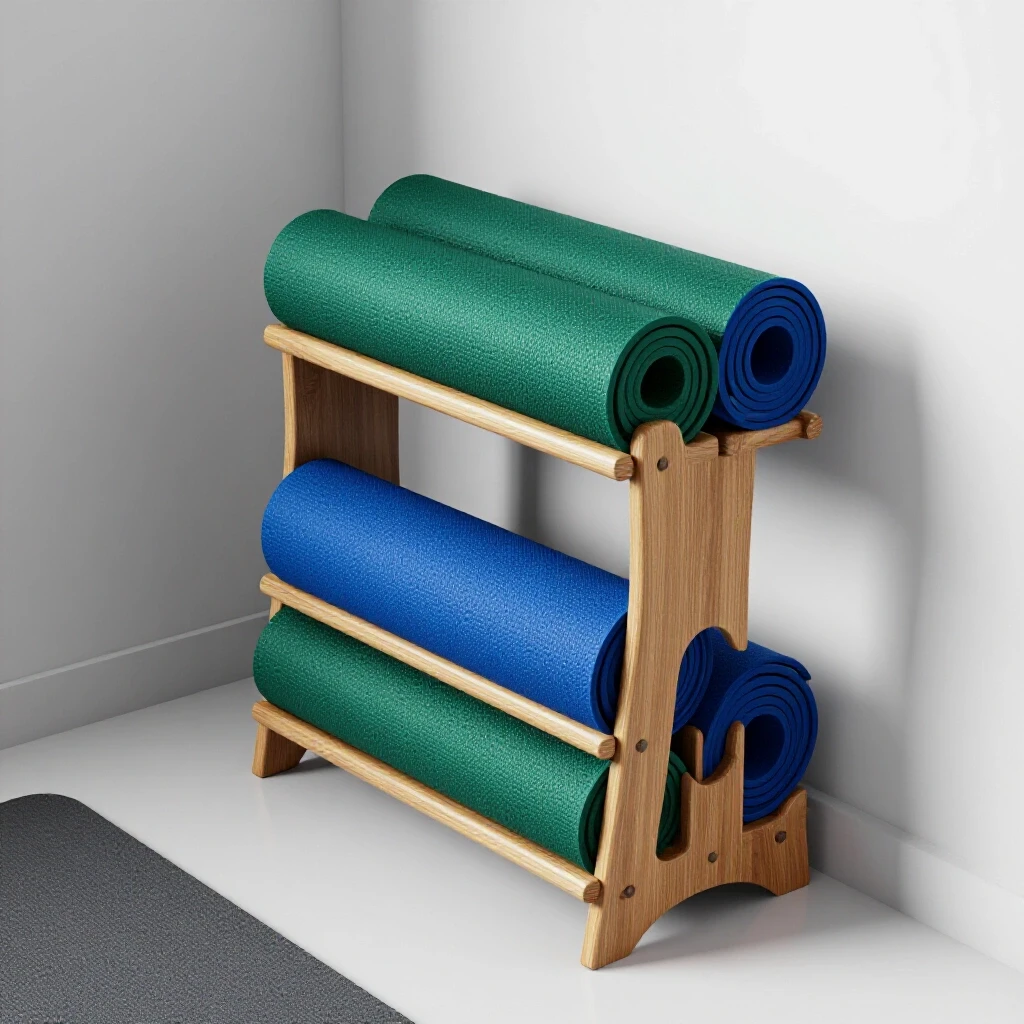
When I first moved into a compact urban condo, I realized that standard storage solutions often lacked the technical specs required for long-term stability. I needed a way to keep my gear off the floor without damaging the walls or the equipment itself. This requires an understanding of “tensile strength”—the maximum load a material can support without breaking—and “porosity,” which affects how a material reacts to moisture and cleaning agents. For a small-scale DIY project, choosing a non-porous material like treated wood or powder-coated metal is essential to prevent the buildup of oils or sweat from the equipment.
Why Material Density Matters for Vertical Equipment Retention
Density refers to the mass of a material per unit volume, which directly impacts its ability to hold fasteners and resist warping over time. In a small home, you cannot afford bulky structures, so you must rely on high-density materials that offer strength without the mass.
| Material Type | Density (kg/m³) | Janka Hardness (lbf) | Moisture Resistance | Maintenance Cycle |
|---|---|---|---|---|
| Solid White Oak | 770 | 1,360 | Moderate | 2-3 Years (Oil/Wax) |
| Extruded Aluminum | 2,700 | N/A | High | 5+ Years |
| Recycled PVC | 1,400 | N/A | Excellent | 10+ Years |
| Plywood (Birch) | 680 | 1,260 | Low | 1-2 Years (Sealer) |
Building on this data, I have found that while aluminum offers the highest density-to-weight ratio, it often lacks the aesthetic warmth required for a living space. Conversely, solid hardwoods like White Oak provide the structural integrity needed for wall-mounted brackets while maintaining a high Janka hardness rating, which measures the force required to embed a steel ball into the wood. This rating is a key indicator of how well your storage solution will resist scratches from repeated use.
Comparative Analysis of Upcycled Substrates for Small-Footprint Organization
An upcycled substrate is a base material repurposed from its original intent to serve a new structural function. Using existing household materials requires a trade-off analysis between the cost of new high-end materials and the durability of repurposed items.
Interestingly, many homeowners overlook the technical potential of heavy-duty leather straps or industrial copper piping left over from plumbing renovations. In my own home, I compared the performance of leather vs. metal for holding rolled mats. Leather provides a high coefficient of friction, meaning the mat stays in place without sliding. However, leather is organic and subject to “creep”—a slow deformation under a constant load. Metal, while more difficult to install, offers a permanent, rigid solution that will not sag over the next 15 years.
Structural Loads and Fastener Selection for Wall-Mounted Solutions
A structural load is the amount of force exerted on a support system, and for vertical storage, we focus on “shear stress,” which is the force acting parallel to the wall surface. If you are mounting a bracket into drywall, the technical specifications of your anchors are more important than the bracket itself.
According to the National Association of Home Builders (NAHB), standard 1/2-inch drywall has limited pull-out strength. If you are creating a DIY rack, you must ensure your fasteners reach the wall studs or use toggle bolts rated for at least 50 pounds of shear force. During a renovation of a 1920s bungalow, I learned that older plaster walls require different technical approaches than modern drywall. Using a simple plastic plug in old plaster is a recipe for material failure; instead, I recommend using a mounting board to distribute the load across multiple points.
Evaluating the Real Trade-Offs: Upfront Cost vs. 15-Year Maintenance
The true cost of a home material is not the price tag at the hardware store, but the “Life-Cycle Cost,” which includes the initial purchase, installation labor, and the cost of cleaning and repairs over 15 years.
- Initial Sourcing: Upcycling a wooden pallet might cost $0, but the labor to sand, seal, and ensure it meets ASTM safety standards for indoor air quality (avoiding chemically treated “HT” or “MB” pallets) can be significant.
- Maintenance Requirements: A raw wood finish will require re-oiling every 24 months to prevent cracking. A powder-coated metal or a high-grade laminate will require only a damp cloth for a decade.
- Replacement Cycles: Low-grade plastic hooks often suffer from UV degradation or “brittle failure” after 5 years, whereas a solid wood or metal solution can last the lifetime of the home.
Sourcing and Material Science Principles for Small Spaces
When sourcing materials for a compact project, I look for “dimensional stability,” which is the ability of a material to maintain its original shape as temperature and humidity change. This is particularly important if your storage is located near a bathroom or a drafty window.
- Check the Grain: If using wood, look for quarter-sawn boards. They have a more stable grain structure and are less likely to cup or twist than plain-sawn lumber.
- Verify the Finish: For metal components, ensure they are powder-coated rather than spray-painted. Powder coating is a thermal process that creates a much harder, more impact-resistant “wear layer.”
- Assess the Porosity: If you are using fabric or rope, check the absorption rate. Synthetic fibers like nylon or polyester are better than cotton because they do not hold onto moisture, which prevents mold growth in small, poorly ventilated spaces.
Hands-On Material Performance Tests
Before committing to a permanent installation, I recommend performing a few simple tests on your chosen materials. These tests mimic the ASTM standards used in industrial labs but can be done at home with basic tools.
- The Scratch Test: Use a coin to apply firm pressure to a sample of your material. If it leaves a deep gouge, the material’s hardness is insufficient for high-traffic equipment storage.
- The Load Test: Hang a weight double the mass of your equipment from your bracket for 48 hours. Measure the “deflection” (how much it bends). If the deflection is more than 1/8 of an inch, the material or design is too weak.
- The Adhesion Test: If you are painting or sealing a surface, apply a piece of high-tack tape, press firmly, and rip it off. If the finish comes with it, the surface preparation was inadequate.
Installation Demands and Professional Sourcing Guides
The complexity of an installation is often a hidden cost. A simple “floating” shelf for rolled gear might look easy, but achieving a level, secure fit in a small space with uneven walls requires precision.
I always keep a “spec sheet” for my home projects. This includes the exact measurements of the equipment—usually a standard 24-inch width and a 6-inch rolled diameter—and the “clearance” required to remove the item without hitting other furniture. In my supply chain work, we call this “spatial tolerance.” If your clearance is less than 2 inches, you will likely scuff your walls within the first month of use.
Lifetime Maintenance and Cleaning Regimens
Maintenance is the key to protecting your investment. For any material used to hold fitness equipment, the cleaning regimen must be non-abrasive to protect the wear layer.
For wooden components, avoid cleaners with high water content. Instead, use a pH-neutral wood soap. For metal or plastic, a simple solution of isopropyl alcohol and water is effective at breaking down oils without damaging the finish. I have seen many high-end materials ruined by “over-maintenance”—using harsh chemicals that strip the protective sealers and lead to premature oxidation or rot.
Technical Spec Tracker for DIY Organization
When you are ready to build your own solution, use this matrix to score your potential materials. A higher score indicates a better fit for a long-term, low-maintenance home environment.
| Feature | Wood (High Grade) | Metal (Recycled) | Synthetic (High-Tech) |
|---|---|---|---|
| Tensile Strength | 7/10 | 10/10 | 8/10 |
| Ease of DIY | 9/10 | 4/10 | 6/10 |
| Stain Resistance | 5/10 | 9/10 | 10/10 |
| Aesthetic Value | 10/10 | 7/10 | 5/10 |
| Total Score | 31/40 | 30/40 | 29/40 |
Practical Tips for Matching Materials to Your Lifestyle
Choosing the right material is a balance of technical performance and personal lifestyle. If you value a “natural” look and don’t mind a bit of sanding every few years, solid wood is your best bet. If you want a “set it and forget it” solution, look for industrial metals or high-density polyethylene (HDPE) scraps.
Avoid the mistake of choosing a material based solely on its upfront cost. A cheap plastic hook might save you $20 today, but if it fails and damages your wall, the repair cost could exceed $200. Always look for materials that have a “provenance”—a known origin and a set of technical specs you can verify.
Final Supply-Chain and Cost Recommendations
In my 13 years of analyzing supply chains, I have learned that the best value often comes from “over-specifying” the small things. Use a screw that is slightly longer than necessary. Choose a wood that is slightly harder than required. By building a safety margin into your organization’s design, you ensure that your small space remains functional and tidy for years to come.
To start, audit your current inventory of scrap materials. Look for hardwood offcuts, sturdy metal brackets, or even heavy-duty cotton webbing. Measure your available wall space and calculate the “static load” of your equipment. Once you have these metrics, you can confidently source the materials that provide the best trade-off between durability and cost.
Frequently Asked Questions
What is the best material for holding a heavy rolled mat in a small space? For heavy loads in tight quarters, powder-coated steel or solid hardwoods like Oak or Maple are superior. They offer high tensile strength and minimal deflection. If you are using a DIY approach, ensure the material is at least 3/4 inch thick to prevent warping under the constant weight of the equipment.
How do I know if my wall can support a DIY storage rack? You must locate the wall studs using a stud finder or the “knock test.” Standard studs are spaced 16 or 24 inches apart. If you cannot find a stud, you must use heavy-duty toggle bolts. Avoid using simple plastic expansion anchors, as they are prone to “creep” and can eventually pull out of the drywall under a constant load.
Is recycled PVC a good material for home organization? Yes, recycled PVC is excellent for moisture resistance and durability. It is non-porous, meaning it won’t absorb sweat or odors. However, it lacks the structural rigidity of wood or metal over long spans, so it is best used for smaller brackets or as a lining material rather than a primary support structure.
How often should I maintain a wooden storage solution? If the wood is finished with a hard-wax oil, you should re-apply a thin coat every 2 to 3 years. If it is sealed with a polyurethane film, it can last 10 years or more, though it is harder to repair if it gets scratched. Regular dusting with a dry microfiber cloth is usually sufficient for weekly maintenance.
What is the “Janka Hardness” and why does it matter for my project? The Janka Hardness test measures the resistance of a wood sample to denting and wear. For equipment storage, a higher Janka rating (above 1,000 lbf) is better because it prevents the mat or the hanging hardware from leaving permanent indentations in the wood over time.
Can I use leather straps for long-term storage? Leather is aesthetically pleasing and has great grip, but it is prone to stretching (creep). If you use leather, choose “vegetable-tanned” leather that is at least 3mm thick. Be prepared to tighten or replace the straps every few years as they conform to the weight of the rolled equipment.
What is the difference between a “static load” and a “dynamic load”? A static load is the weight of the equipment just sitting there. A dynamic load is the force applied when you quickly pull the equipment out or toss it back in. Your storage solution should be rated for a dynamic load that is at least 2 to 3 times the actual weight of the mat to ensure safety.
Are there eco-friendly material options that are still durable? Bamboo is an excellent technical choice. It has a high tensile strength—often compared to steel—and is a rapidly renewable resource. However, ensure it is “strand-woven” bamboo, which is much denser and more durable than traditional “vertical” or “horizontal” bamboo constructions.
How do I prevent my DIY rack from scratching the wall? Apply a thin layer of felt or rubber “gaskets” to the back of your mounting brackets. This creates a buffer that absorbs vibrations and prevents the hard material of the rack from rubbing against the softer paint and drywall, especially in small spaces where movement is common.
What is the most common mistake in small-space organization? The most common mistake is ignoring “clearance zones.” People often build storage that fits the item but forget to leave enough room for their hands to grasp the item or for the item to be removed without hitting a nearby door or piece of furniture. Always add a 2-inch “buffer zone” to your measurements.
(This article was written by one of our staff writers, Andrew Morrison. Visit our Meet the Team page to learn more about the author and their expertise.)