How to Organize Mudrooms for Winter Coats and Gear (Step-by-Step)

In the colder regions of the Pacific Northwest or the snowy corridors of the Midwest, the transition into winter isn’t just a change in weather. It is a massive logistical shift for every household. As an operations professional, I view the entryway of a home as a high-volume distribution center. During the summer, the “inventory” is light: sandals and windbreakers. But when the temperature drops, the volume of gear triples in weight and quadruples in physical size. If your home feels like it is drowning in parkas and snow pants, it is likely because your entryway system was designed for a lower “throughput” than what winter demands.
My own family struggled with this for years. I would spend hours on a Saturday afternoon lining up boots and color-coding bins, only to find a pile of damp wool and heavy polyester on the floor by Monday evening. The failure wasn’t due to a lack of effort. It was a failure of spatial ergonomics. We were using high-friction storage solutions, like hangers and deep bins with lids, for items that required low-friction processing. By applying logistics principles to our mudroom, we reduced the daily sorting time from fifteen minutes down to less than three.
The Spatial Logistics of Entryway Overload
Spatial logistics refers to the study of how people and objects move through a confined area to maximize efficiency and minimize effort. In a home, the entryway is a transition zone where the “flow rate” of items is highest.
When we talk about managing heavy winter gear, we have to consider the “retrieval friction” of every item. Friction is the amount of physical and mental energy required to put something away or take it out. A coat on a hanger inside a closet behind a closed door is a high-friction item. It requires three distinct steps: open the door, find a hanger, and loop the coat. In contrast, a heavy-duty wall hook is a low-friction solution. It requires one step: the drop. For a busy parent or a child coming home from school, those two extra steps are often the difference between a tidy floor and a cluttered one.
Why High-Friction Systems Cause Rapid Clutter Reversion
Clutter reversion happens when the energy required to maintain a system exceeds the energy the user is willing to spend. This is often triggered by “decision fatigue,” a psychological state where the quality of choices deteriorates after a long period of decision-making.
Research in environmental psychology suggests that “visual noise,” such as a tangled pile of dark coats, can trigger a mild stress response. When you walk through the door after a long workday, your brain is already taxed. If your storage system requires you to make complex decisions, like “Which bin does this specific scarf go in?”, you are more likely to simply drop the item. To combat this, we must design systems that prioritize “one-touch” processing.
Table 1: Storage Friction Index for Winter Gear
| Storage Method | Physical Steps | Mental Effort | Success Rate |
|---|---|---|---|
| Closed Closet with Hangers | 4-5 Steps | High | Low (20%) |
| Open Cubbies with Bins | 2-3 Steps | Medium | Moderate (55%) |
| Heavy-Duty Wall Hooks | 1 Step | Low | High (90%) |
| Floor Baskets (No Lids) | 1 Step | Low | High (85%) |
A Sorting Framework for High-Volume Outerwear
A sorting framework is a logical set of rules used to categorize inventory based on its frequency of use and physical requirements. For winter gear, we categorize by “velocity.”
In a warehouse, “high-velocity” items are those that move in and out every day. In your home, these are the primary winter coats, the daily boots, and the gloves used for the morning commute or school run. “Low-velocity” items are the backup snow suits, the heavy-duty shoveling gear, or the extra scarves. The most common mistake is treating all winter gear as equal. When you mix high-velocity items with low-velocity items, the storage space becomes overcrowded, making it harder to find what you need quickly.
Step 1: The Seasonal Capacity Audit
Before implementing a new system, you must determine your “spatial capacity limit.” This is the maximum number of items a space can hold before the system breaks down.
- Count the number of family members.
- Allocate a “Primary Slot” for one heavy coat and one pair of boots per person.
- Measure the available wall or floor space in your entry zone.
- Calculate the “density”: A heavy parka requires approximately 4 to 6 inches of horizontal space on a hook or rail.
Step 2: Removing the “Dead Inventory”
During my family’s last organization sprint, I realized we had three coats per person in the main mudroom area. This created a “logistics bottleneck.” We moved the secondary coats to a different area of the house, which immediately increased the “flow rate” of the daily gear. If an item hasn’t been worn in the last two weeks of cold weather, it is no longer a high-velocity item and should be moved out of the primary transition zone.
Designing Low-Friction Zones for Heavy Gear
Zoning is the practice of dividing a space into specific areas based on the activity performed there. In a mudroom, we create “active zones” and “buffer zones.”
The active zone is the area between knee height and eye height. This is where the most frequent interactions happen. The buffer zones are the floor (for heavy footwear) and the high shelves (for out-of-season or rarely used items). By mapping these zones correctly, you align the storage system with natural human movement, which significantly reduces the mental fatigue associated with tidying up.
Creating a High-Speed Zoning Map
A zoning map ensures that every item has a dedicated “home” that is easy to reach. This reduces the time spent searching for missing items, which is a major source of morning stress for families.
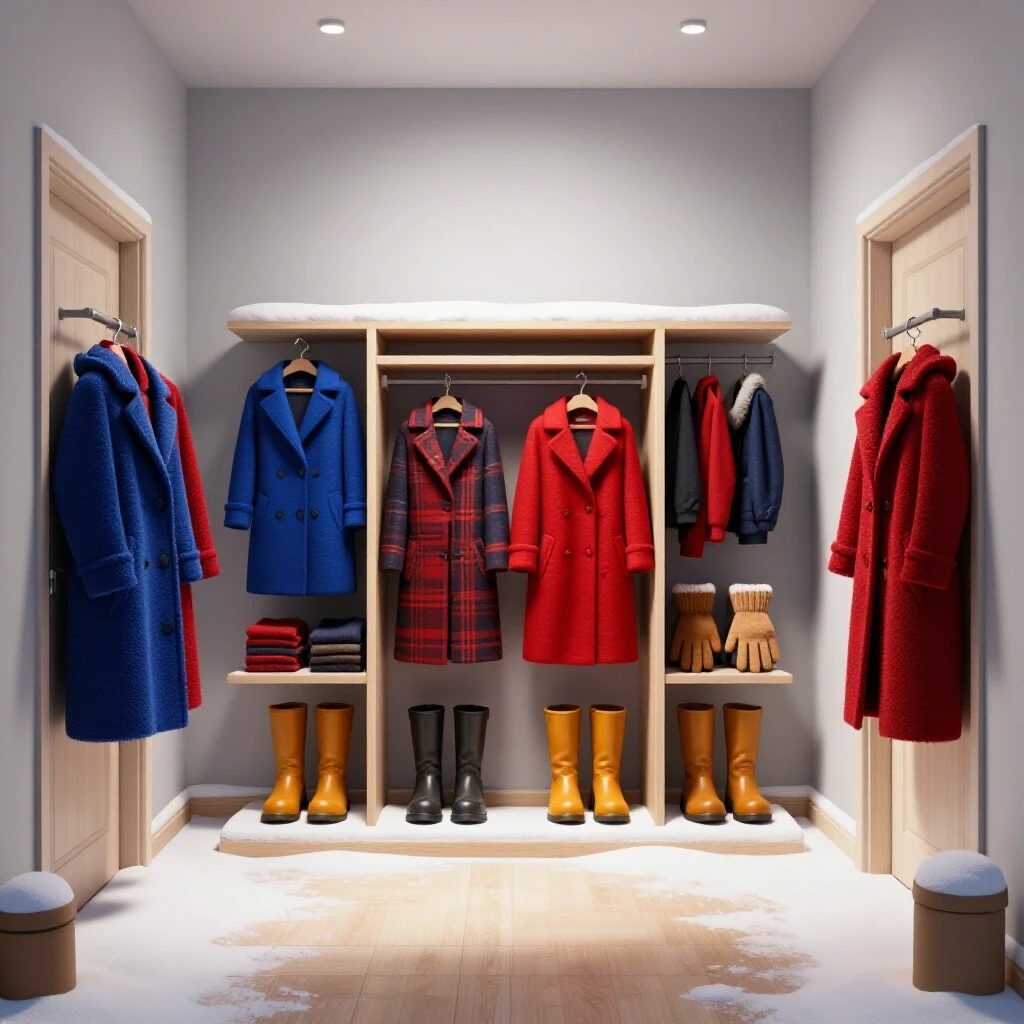
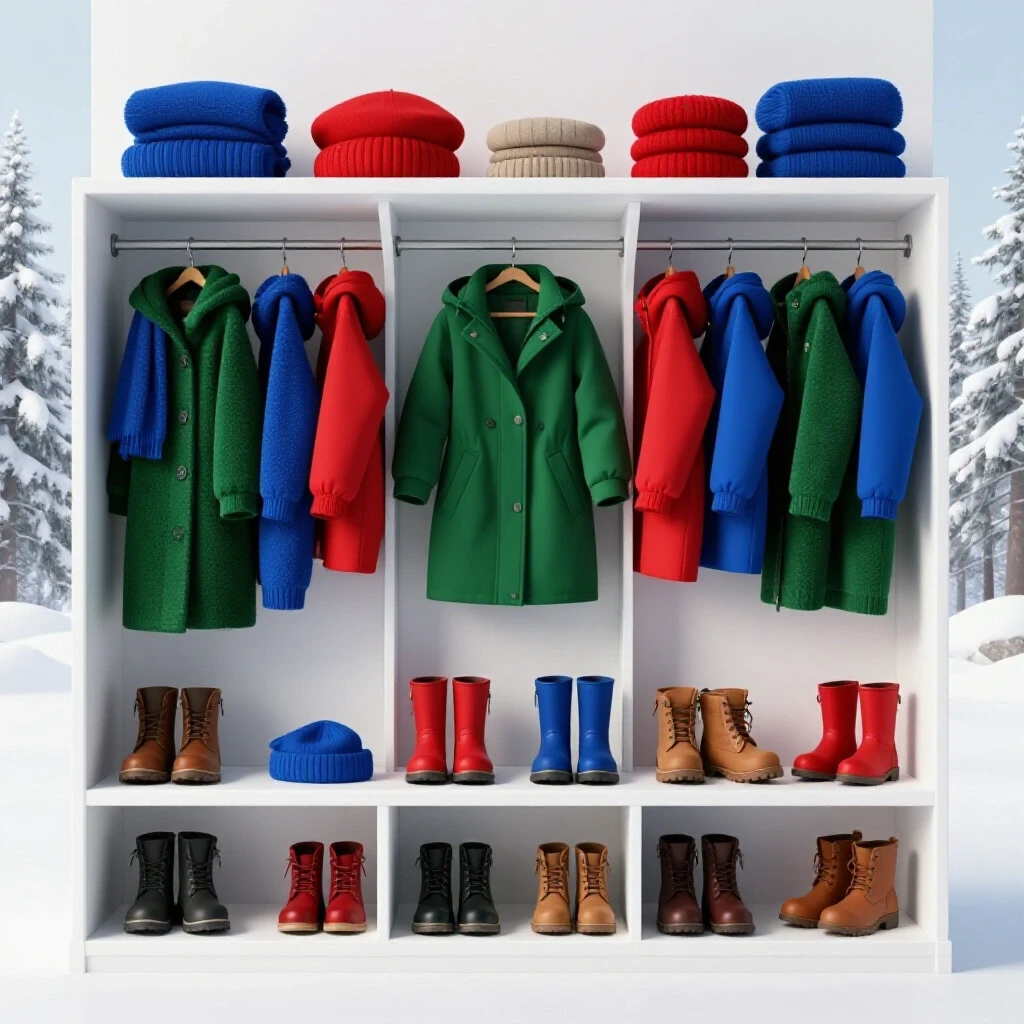
- The Anchor Zone (Hooks): Install heavy-duty hooks at different heights. Lower hooks (36-48 inches) are for children’s coats, while higher hooks (60-70 inches) are for adults.
- The Footwear Foundation: Use open shelving or heavy-duty mats for boots. Avoid shoe racks with small slots; heavy winter boots will not fit and will end up on the floor.
- The Accessory Hub: Use open-topped baskets for hats and gloves. Assign one basket per person to eliminate the need for sorting between family members.
Table 2: Item-Density Guidelines for Entryway Planning
| Item Type | Space Requirement (Horizontal) | Vertical Placement | Storage Tool |
|---|---|---|---|
| Heavy Winter Parka | 6 Inches | Eye Level | Double-Prong Hook |
| Adult Winter Boots | 10-12 Inches | Floor Level | Boot Tray/Open Shelf |
| Child Winter Boots | 7-9 Inches | Floor Level | Open Cubby |
| Hats & Gloves | 12×12 Inch Bin | Waist Level | Open-Top Basket |
Selecting Gear for Heavy Payloads and Low Maintenance
Selecting gear involves choosing the physical tools (hooks, shelves, bins) that can withstand the weight and moisture of winter apparel. Not all storage solutions are created equal.
Heavy winter coats can weigh between 3 and 7 pounds when dry, and even more when damp. “Aesthetic” hooks often fail because they cannot handle the shear force of multiple heavy layers. Similarly, flimsy plastic bins can crack in cold temperatures or under the weight of heavy accessories. For a system to be sustainable, the hardware must be “over-engineered” for the task.
Why Open Storage Beats Closed Storage for Families
In organizational behavior studies, “visibility” is a key factor in habit adherence. If people can see where an item belongs, they are more likely to put it there. Closed cabinets and drawers create a “visual barrier” that increases the cognitive load of the task.
- Open Bins: Allow for “toss-and-go” storage. This is the lowest-friction method for small items like mittens.
- Heavy-Duty Hooks: Look for “double-prong” hooks. These allow you to hang a coat and a set of snow pants on a single wall stud, doubling your vertical capacity.
- Modular Shelving: Use systems that can be adjusted. As children grow, their coats get longer, and their boots get bigger. A static system will fail within two seasons.
Digital Inventory for Off-Season Rotation
For families with limited space, a digital inventory can help manage the “overflow.” By using a simple spreadsheet or a dedicated home organization app, you can track which bins contain the “extra” heavy gear stored in the attic or basement. This prevents “duplicate purchasing,” where you buy a new set of snow gloves because you can’t find the ones you bought last year.
- Label every “overflow” bin with a unique number.
- Photograph the contents of the bin before sealing it.
- Store the photo and bin number in your digital log.
- When the temperature drops, consult the log rather than digging through every bin.
Building Sustainable Family Habits and Routine Maintenance
A system is only as good as the habits that support it. In logistics, this is called “system feedback.” It is the process of checking the system regularly to ensure it is still functioning as intended.
For a family, this means establishing a “reset” routine. Even the best low-friction system will experience some “drift” where items end up in the wrong place. By scheduling a five-minute weekly reset, you prevent the small amount of daily clutter from snowballing into a major project.
The 3-Second Rule for Household Systems
The 3-second rule states that if it takes longer than three seconds to put an item away, the system is too complex. When we redesigned our mudroom, we tested every family member. If my six-year-old couldn’t hang his coat in three seconds, the hook was too high or the area was too crowded.
- Daily Maintenance: A quick sweep of the floor to ensure boots are on the mats.
- Weekly Reset: Moving any “stray” items back to their assigned bins or hooks.
- Monthly Audit: Checking for items that are no longer being used (e.g., a coat that has become too small) and removing them from the active zone.
Table 3: Daily Maintenance Timelines by Family Size
| Family Size | Daily Sorting Time | Weekly Reset Time | System Friction Level |
|---|---|---|---|
| 2 People | 2 Minutes | 5 Minutes | Very Low |
| 4 People | 5 Minutes | 10 Minutes | Low |
| 6+ People | 8 Minutes | 15 Minutes | Moderate |
Overcoming Common Mudroom Bottlenecks
A bottleneck is a point in a process where the flow is restricted. In an entryway, this usually happens at the “point of entry” where everyone tries to take off their gear at the same time.
To solve this, we must expand the “processing area.” If everyone crowds around a single small rug, the system will collapse. By extending the waterproof flooring or adding a second bench, you allow multiple people to de-gear simultaneously. This reduces the “queue time” and the likelihood of gear being abandoned on the floor.
Avoid These Organizing Mistakes
- Over-categorizing: Don’t try to have a separate bin for “thick gloves” and “thin gloves.” One bin for “Gloves” is sufficient and easier to maintain.
- Prioritizing Symmetry over Function: It might look nice to have all hooks at the same height, but it is functionally inefficient for a family of varying heights.
- Using Small Hangers for Heavy Coats: Thin wire or plastic hangers will bend and break under the weight of a winter parka, leading to coats on the closet floor.
Actionable Steps for Your Cold Weather Gear Fix
Establishing a functional system for heavy outerwear doesn’t require a total overhaul. It requires a shift in how you view the “logistics of the home.” Start by observing how your family currently enters the house. Where do they drop their things? That “drop point” is usually the most logical place for a low-friction storage solution.
- Conduct a Spatial Audit: Count your high-velocity items and compare them to your available hooks and shelves.
- Install Heavy-Duty Hardware: Replace decorative hooks with functional, double-prong versions anchored into wall studs.
- Implement the “One-In, One-Out” Rule: For every new winter item that enters the active zone, an old or unused item must be moved to the buffer zone or donated.
- Set a Reset Timer: Use a 5-minute timer on Sunday evenings to clear the “drift” and prepare the entryway for the week ahead.
By focusing on flow rates and reducing retrieval friction, you can create an entryway that handles the heaviest winter loads without the mental fatigue of constant reorganization. The goal isn’t a “perfect” space, but a sustainable system that works for your real, lived-in home.
Frequently Asked Questions
How do I handle wet or snowy gear without creating a mess? Use a tiered system. The “Primary Zone” should include a heavy-duty, waterproof tray with a raised grid. This allows air to circulate under the boots, speeding up the drying process while containing the moisture. For wet coats, ensure hooks are spaced at least 8 inches apart to allow for airflow between garments.
What is the best way to store heavy snow pants? Snow pants are bulky and often slide off standard hangers. The most efficient method is using a dedicated “lower” hook or a large, open-top basket. If you use hooks, look for “loop-style” hooks that can catch the waistband or the suspender straps easily.
How can I make the system work for young children? The key is “vertical accessibility.” Mount a row of sturdy hooks at the child’s chest height. Use open baskets on the floor or a low shelf for their hats and mittens. If they don’t have to reach or open anything, they are much more likely to follow the system.
How many hooks does each person actually need? In a cold-weather climate, the minimum is two hooks per person: one for the primary heavy coat and one for “secondary” items like snow pants or a backpack. If space allows, a third hook for a “dry-out” zone is ideal.
My entryway is tiny. How do I manage heavy coats in a small space? Maximize your vertical real estate. Install two rows of hooks, one high and one low. Use the “velocity” principle strictly: only the coat being worn today stays in the entryway. All other winter gear must be moved to a secondary storage area.
How do I prevent “bin creep” where baskets start overflowing? This is a capacity limit issue. When a bin overflows, it’s a signal that the “inventory” has exceeded the “spatial limit.” Perform a quick sort to remove items that are outgrown or rarely used. Bins should never be more than 75% full to allow for easy searching.
What should I do with “guest” winter gear? Keep 2-3 “floating” hooks available specifically for guests. If you don’t have wall space, a heavy-duty free-standing coat rack can be brought out specifically for the winter months and tucked away during the summer.
Are labels necessary for a family system? Labels are highly effective for “Accessory Hubs.” Use large, clear text or even pictures for younger children. Labels serve as a visual “anchor” that reminds everyone where an item belongs, reducing the mental effort of sorting.
How do I deal with the salt and grit that comes in with winter gear? Incorporate a “cleaning station” into your logistics. A small handheld vacuum kept near the mudroom allows for a 30-second daily cleanup of grit before it gets tracked into the rest of the house. This prevents the “clutter” from feeling like “dirt.”
Can I use a bench for storage? Yes, but avoid benches with “flip-tops.” They require you to move everything off the bench to get inside, which is high-friction. Instead, use an open-front bench where baskets can slide in and out easily.
(This article was written by one of our staff writers, Christopher Bennett. Visit our Meet the Team page to learn more about the author and their expertise.)