How to Organize Your Basement: What to Keep and Why (Guide)

Three years ago, my basement was less of a storage area and more of a logistical bottleneck. As an operations professional, I am trained to spot inefficiencies in supply chains, yet I was failing to manage the flow of goods in my own home. My wife and I would spend entire Saturdays “organizing,” only to find the space in total disarray by the following Tuesday. The frustration wasn’t just about the mess; it was the mental weight of knowing that valuable items were buried under layers of indecision. We decided to stop focusing on the act of cleaning and start focusing on the science of selective retention. By treating our basement like a functional distribution center rather than a junk drawer, we identified exactly which items earned their place in our lives.
Understanding the Logistics of Selective Retention
Selective retention is the process of keeping only those items that serve a verified purpose in your current lifestyle or future home projects. This approach shifts the focus from what to get rid of toward what provides the most value for the square footage it occupies.
In logistics, we look at the “carrying cost” of inventory. In a home, every item you keep has a psychological carrying cost. If you keep a set of vintage shutters for a future DIY project, they occupy physical space and mental bandwidth. To make this work for a busy family, we categorized our kept items into three streams: immediate utility, seasonal rotation, and creative potential. By defining why an item stayed, we could determine exactly where it should live to minimize daily friction.
Why Subterranean Spaces Fail the Family Stress Test
Basements often become high-friction zones because they lack the clear visual boundaries found in kitchens or living rooms. When a space lacks a defined purpose, it defaults to becoming a catchment area for everything that doesn’t have a “home.”
Environmental psychology suggests that “out of sight” does not mean “out of mind.” Even if your clutter is behind a basement door, your brain maintains a mental map of that unfinished business. This leads to visual processing overload when you finally do enter the space. For our family, the goal was to reduce the “search time” for any kept item to under 60 seconds. We realized that if it takes longer than a minute to find the holiday lights or a specific power tool, the system has failed.
The Impact of Retrieval Friction on Daily Habits
Retrieval friction refers to the number of physical and mental steps required to access an item. High friction leads to abandonment, where family members buy duplicates because finding the original is too difficult.
| Storage Method | Physical Steps to Access | Retrieval Friction Score (1-10) | Best Use Case |
|---|---|---|---|
| Open Shelving / No Lids | 1 | 2 | Daily use items, kids’ active toys |
| Clear Bins with Lids | 2 | 4 | Seasonal decor, craft supplies |
| Stacked Opaque Totes | 4+ | 8 | Long-term archives, rarely used gear |
| Deep Corner Piles | 10+ | 10 | Non-functional storage (Avoid) |
Establishing Functional Zones for Kept Items
Zoning is a spatial management technique that groups related items together based on the frequency of their use and the nature of their utility. This prevents “category drift,” where items from different parts of your life begin to mingle and create chaos.
In our home, we mapped out the basement into four distinct quadrants. We kept our high-use DIY tools near the workbench and placed our seasonal lifestyle gear—like camping equipment and holiday decorations—in the furthest, least accessible corners. This ensures that the prime real estate is reserved for items that support our weekly routines.
Identifying the “Keep” Categories for Long-Term Success
When we audited our belongings, we didn’t just look at what was “nice.” We looked at what was functional. We categorized our kept inventory into these specific groups to ensure sustainable decluttering:
- Lifestyle Support: Items used for hobbies, sports, or family outings that happen at least twice a year.
- Home Maintenance & DIY: Tools, leftover paint for touch-ups, and hardware required to keep the house running.
- Repurposing Potential: High-quality materials like reclaimed wood or vintage frames intended for specific, scheduled projects.
- Sentimental Archives: A strictly limited volume of items that represent family history, stored in standardized, protective containers.
Implementing Low-Maintenance Home Organization Systems
A sustainable system is one that requires the least amount of effort to maintain. If a storage solution is too beautiful or complex, busy parents will inevitably stop using it during a hectic week.
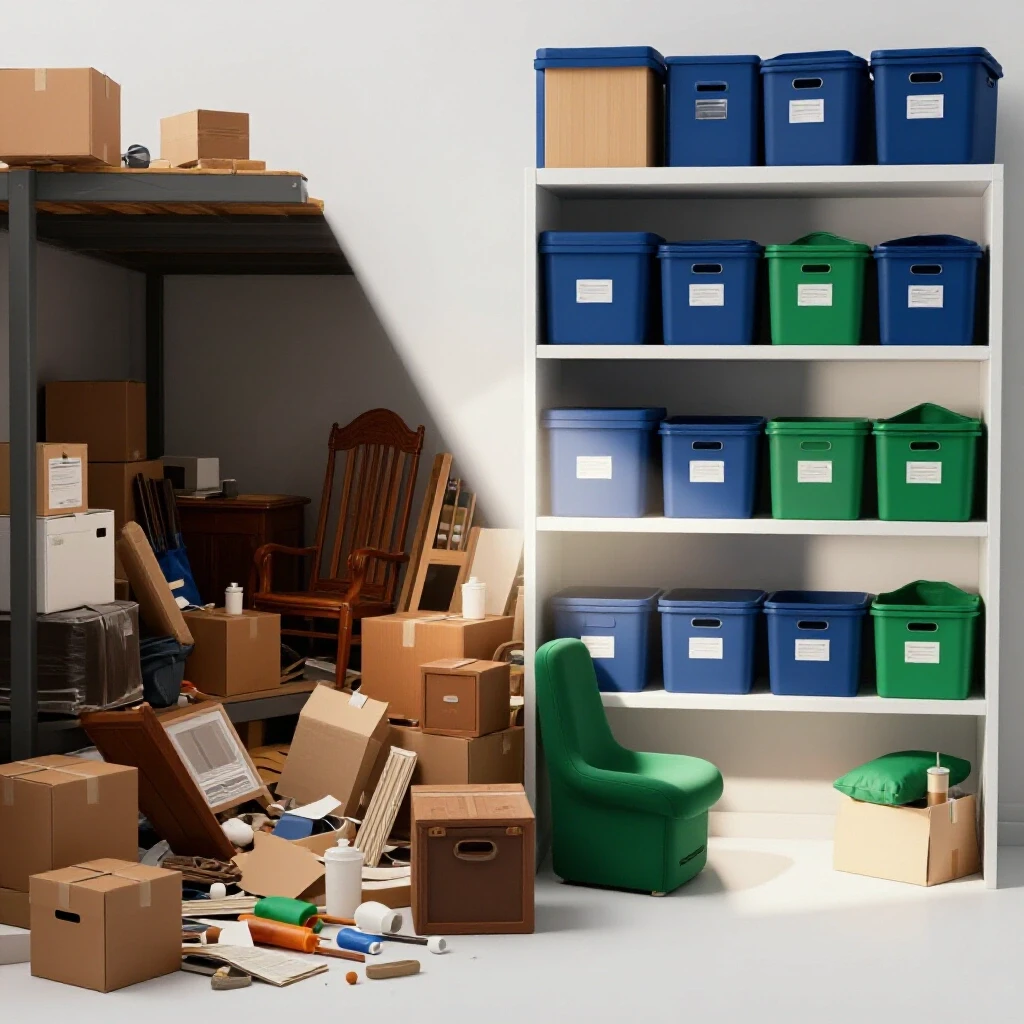
We moved away from “pretty” baskets and toward industrial-grade shelving and clear, uniform bins. This reduced the cognitive load of remembering what was inside each container. In operations, we call this “visual management.” If you can see the inventory level at a glance, you are much less likely to overbuy or lose track of what you own. This simple shift significantly reduced our household clutter because every kept item had a transparent, labeled home.
The Efficiency of Standardized Containers
Using a single type of bin for all kept items eliminates the “Tetris effect” of trying to stack mismatched containers. We chose heavy-duty, clear 66-quart latched bins for the majority of our basement inventory.
- Uniformity: Identical bins stack securely, maximizing vertical space utilization.
- Visibility: Transparent sides allow family members to identify contents without opening the lid.
- Durability: Industrial-grade plastic resists moisture and protects kept items from basement humidity.
- Labeling: We used a simple QR code system linked to a digital spreadsheet, allowing us to search our basement inventory from our phones.
Integrating Kept Items into Daily Lifestyle Routines
The ultimate goal of keeping an item is to eventually use it. Many families keep items for “someday,” but we found that scheduling the use of these items is the only way to justify their storage.
For example, we kept a collection of large glass jars and wooden crates. Instead of letting them gather dust, we integrated them into our home styling. The jars became pantry storage for bulk dry goods, and the crates were repurposed as shoe cubbies in the mudroom. By finding immediate roles for these objects, we transitioned them from “stored clutter” to “functional assets.” This is the core of functional home storage: every kept object must eventually pay rent by being useful.
Measuring the Success of Your Spatial Management
In a professional setting, we use Key Performance Indicators (KPIs) to measure success. You can apply these same metrics to your home to ensure your organization holds up over time.
We track our “reversion rate”—how many days it takes for a zone to become messy again. If a zone reverts in less than a week, the system is too complex. We also track “sorting speed.” When new items enter the basement, how long does it take to put them in their designated zone? In a high-efficiency home, this should take less than five minutes.
Household Maintenance Metrics for Busy Families
- Daily Reset Time: 5–10 minutes per person to return items to their zones.
- Zone Audit Frequency: Once every six months to ensure kept items still have utility.
- Space Utilization: Aim for 70% capacity on shelves to allow for easy “air flow” and item retrieval.
- Inflow-Outflow Balance: For every new item kept, ensure its storage location can accommodate it without crowding.
Overcoming Decision Fatigue in the Sorting Process
Decision fatigue occurs when the brain becomes exhausted from making too many choices. This is why many parents give up halfway through a basement project.
To combat this, we used a “binary sorting” method. We didn’t ask, “Do I like this?” Instead, we asked, “Does this fit into one of our four functional zones?” If the answer was yes, it was immediately placed in a bin. If the answer was no, it was set aside for a different process. This removed the emotional weight of the task and allowed us to process the entire basement in short, 90-minute sprints.
Frequently Asked Questions
How do I decide what is worth keeping in a small basement? Focus on items that have a high “replacement cost” or are used frequently. If an item is cheap to replace and hasn’t been used in two years, its “carrying cost” in your small space is likely higher than its value. Prioritize tools, seasonal gear, and items that support your active hobbies.
What is the best way to label bins so the whole family follows the system? Use broad, clear categories rather than hyper-specific ones. Instead of “Blue Christmas Ornaments,” use “Holiday Decor.” Large, bold text labels on the narrow end of the bin are easiest to read. For tech-savvy families, adding a QR code that lists the specific contents can be a game-changer for finding small parts.
How can I stop my basement from becoming a “dumping ground” again? Establish a “staging zone” near the entrance. Anything coming into the basement must stay in the staging zone until it is properly sorted into its permanent zone. This prevents clutter from spreading into the functional areas and makes it easier to manage in short bursts of time.
What should I do with items I want to keep for DIY projects? Give yourself a “project shelf.” If the materials for a DIY project don’t fit on that designated shelf, you have too many projects. This physical limit forces you to prioritize which kept items are actually going to be used and which are just taking up space.
How do I handle sentimental items without they taking over the space? Limit sentimental storage to a specific number of bins—for example, one bin per family member. This “fixed capacity” rule allows you to keep the most meaningful items while ensuring they don’t encroach on the functional space needed for daily life.
Is open shelving better than closed cabinets for a basement? In most cases, heavy-duty open shelving is superior for basements. It provides better airflow, which is crucial for preventing mustiness, and it forces you to maintain organization because the items are visible. Closed cabinets often hide “micro-clutter” that eventually leads to a total system breakdown.
How often should I re-evaluate the items I’ve kept? A bi-annual “inventory check” is usually sufficient. Most families find that doing this at the change of seasons (Spring and Fall) works best, as you are already accessing your seasonal storage zones during those times.
What are the most durable bins for long-term basement storage? Look for bins made of polypropylene with reinforced corners and latching lids. Avoid the brittle, clear plastic bins that crack easily under weight. Brands that offer “rugged” or “industrial” lines are generally the most sustainable choice for high-traffic family homes.
How do I involve my children in maintaining the basement system? Keep their kept items, like sports gear or out-of-season toys, on lower shelves where they can reach them. Use picture labels if they are young. The key is to make it as easy for them to put something away as it is to drop it on the floor.
What is the “One-Touch Rule” in home logistics? The One-Touch Rule suggests that you should try to handle an item only once before it reaches its final destination. When you bring something into the basement, take the extra thirty seconds to put it in its correct bin rather than leaving it on a table to “deal with later.”
(This article was written by one of our staff writers, Christopher Bennett. Visit our Meet the Team page to learn more about the author and their expertise.)