Best Sports Gear Storage Ideas for Families (Easy Solutions)

Many parents make the same mistake when a sports season ends: they treat their storage spaces as a permanent graveyard for equipment. We often think that if we just shove the jerseys, cleats, and balls into a bin and slide it into the back of a closet, we have “organized” the mess. In reality, we have simply created a logistical bottleneck. This “out of sight, out of mind” approach is what I call storage debt. Just like financial debt, it accumulates interest in the form of mental fatigue and physical clutter. When the next season rolls around, the frustration of digging through unorganized bins causes a frantic cycle of re-buying items we already own, further crowding our homes.
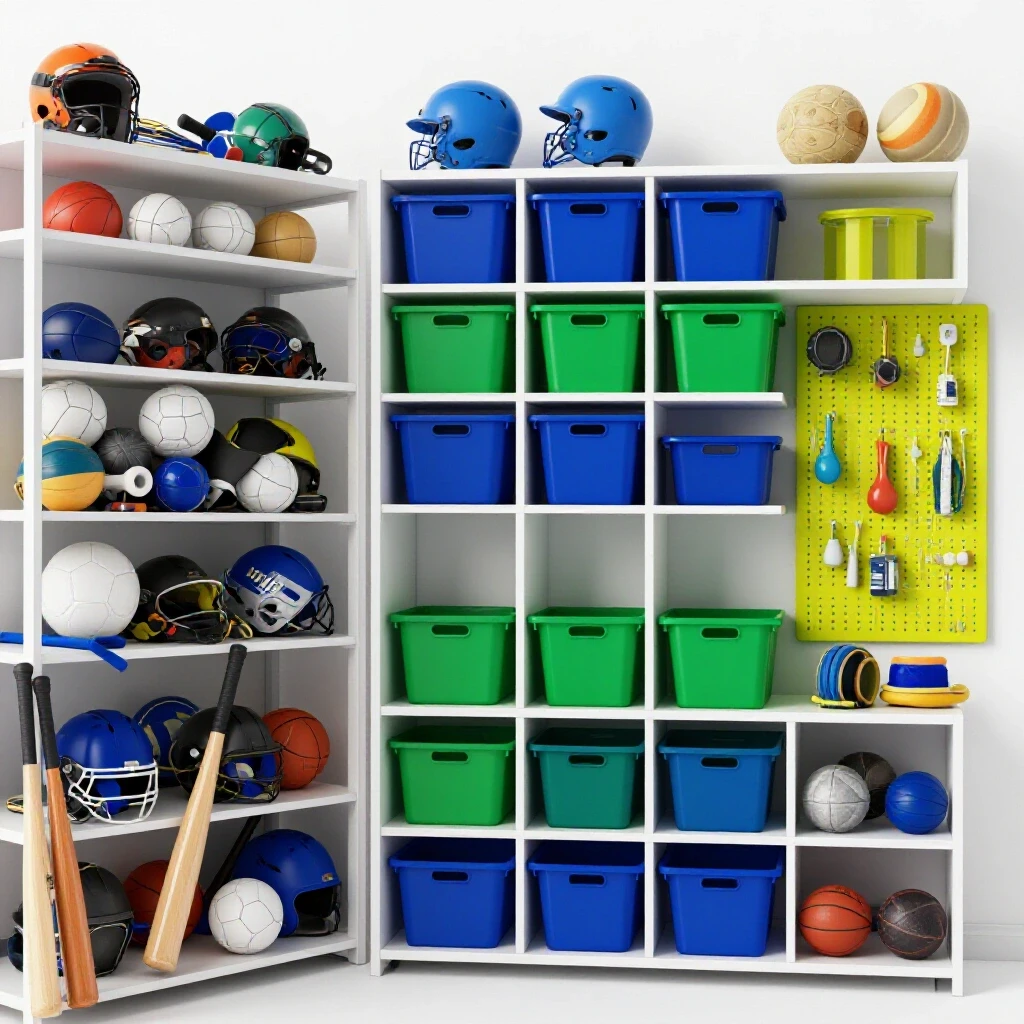
In my eleven years managing logistics for both professional operations and my own busy household, I have seen how these “hidden” piles of gear slowly erode the functionality of a home. My family and I have faced the “Great Cleat Avalanche” more than once. We would spend a Saturday afternoon cleaning the mudroom, only to have it revert to a chaotic state by Wednesday. The problem wasn’t a lack of effort; it was a failure of the system. We were using high-friction storage—bins with tight lids stacked four deep—that made it impossible for a tired child or a busy professional to maintain. By shifting our focus from “hiding” gear to managing its flow, we created a sustainable environment that survives the transition between seasons.
The Spatial Logistics of Athletic Equipment Management
Spatial logistics is the study of how items move through a space and how that movement affects the efficiency of the environment. In a family home, your storage areas act as a warehouse.
When we ignore the flow of items, we experience spatial capacity limits. This is the point where a room can no longer hold more items without losing its primary function. For example, if your entryway is so full of equipment that you can no longer comfortably open the front door, you have exceeded your spatial capacity. Environmental psychology research suggests that visual clutter—like a pile of mixed sports gear—increases cortisol levels in adults. This “visual noise” signals to the brain that there is unfinished work, leading to the mental fatigue many parents feel at the end of a long day.
Why High-Friction Systems Lead to Rapid Clutter Reversion
Retrieval friction is the amount of physical and mental effort required to put an item away or take it out. If a system requires more than two or three steps, it is likely to fail in a busy household.
A common example of high-friction storage is the “stacked bin” model. To get to the bottom bin, you must move the top three. This creates a barrier to both retrieval and return. Interestingly, studies in organizational behavior show that when the “cost” of returning an item to its place is too high, humans will naturally default to the path of least resistance—leaving the item on the floor. To build a sustainable home organization system, we must reduce this friction to near zero.
| Storage Method | Retrieval Steps | Friction Level | Sustainability Rating |
|---|---|---|---|
| Open Front Cubbies | 1 Step | Low | High |
| Wall-Mounted Pegs | 1 Step | Low | High |
| Lidded Bins (Stacked) | 4+ Steps | High | Low |
| Deep Toy Chests | 3+ Steps | Medium | Medium |
The Sorting Framework: Evaluating What Survived the Season
Before you can organize, you must audit. A logistical audit involves looking at the “inflow” and “outflow” of your household goods. For athletic gear, this means deciding what is still functional and what has reached the end of its lifecycle.
I recommend a 20-minute sorting time-box for each child’s gear. This prevents decision fatigue, which is the declining quality of choices made after a long period of decision-making. During this time, you aren’t just cleaning; you are performing a quality control check. We use a simple “Keep, Donate, Recycle” matrix to speed up the process. If an item is worn out, it is an “outflow” and must leave the house immediately to prevent it from taking up valuable “buffer space” in your storage zones.
Defining Your Spatial Buffer
In logistics, a buffer is extra space kept empty to allow for the movement of goods. In a home, your shelves should never be 100% full. Aim for an 80% item-density guideline. This 20% of empty space allows you to shift items around without causing a total system collapse. When we cram every inch of a closet with old jerseys and shin guards, we lose the ability to organize new items as they enter the home.
- Storage Volume Metric: Calculate the total cubic feet of your storage area and ensure your gear only occupies 80% of that volume.
- Sorting Time-Box: Limit gear audits to 20 minutes per category (e.g., just soccer gear) to maintain high energy and focus.
- Decision Matrix: Use a “12-month rule.” If the item wasn’t used in the last year and won’t fit the child next year, it must be removed.
Designing High-Efficiency Zoning Maps
A zoning map is a visual plan of your home that designates specific areas for different types of activity and storage. For athletic equipment, we divide the home into three primary zones based on the frequency of use.
Zoning reduces the cognitive load of the family. When everyone knows that “Zone 1” is for daily items and “Zone 3” is for long-term storage, the question of “Where does this go?” disappears. This is a fundamental part of reducing household clutter. In my own home, we mapped out the garage and mudroom to ensure that the transition between a summer sport and a winter sport took less than an hour of physical labor.
Zone 1: The Active Transition Area
This area is for items used multiple times a week. It should be located near the primary entrance or exit. This is where you use low-friction solutions like open hooks and floor-level baskets. The goal here is “drop and go.”
Zone 2: The Mid-Season Buffer
This zone holds items used occasionally or gear for the “next” season that is starting soon. This might be an upper shelf in a closet or a dedicated cabinet. Items here should be visible but don’t need to be at arm’s reach.
Zone 3: Long-Term Archive
This is for gear that has survived the season but won’t be needed for several months. This is where you can use lidded containers or DIY shelving in less accessible areas like an attic or a high garage shelf. Even here, clear labeling is essential to prevent these bins from becoming “mystery boxes.”
| Zone Type | Location | Retrieval Frequency | Storage Gear Example |
|---|---|---|---|
| Zone 1 (Active) | Mudroom/Entry | Daily | Heavy-duty wall hooks |
| Zone 2 (Buffer) | Closet Shelves | Weekly/Monthly | Open-top fabric bins |
| Zone 3 (Archive) | High Shelves | Seasonal | Labeled DIY wooden crates |
Selecting Low-Maintenance Storage Solutions for Families
When choosing how to house your gear, prioritize durability and visibility over aesthetics. Many functional home storage systems fail because they rely on opaque bins that hide the contents. If you can’t see it, you will forget you have it.
I have found that DIY solutions often outperform expensive retail kits because they can be customized to the specific dimensions of your equipment. For example, building a simple “ball corral” using bungee cords and a wooden frame allows kids to pull a ball from the bottom without knocking over the entire stack. This is a low-friction, high-visibility solution that aligns with how children actually behave.
The Problem with Visual-Only Organization
Many “Pinterest-style” systems focus on how things look rather than how they work. They use matching white baskets or identical jars. While beautiful, these systems often fall apart because they are too rigid. If a new piece of equipment doesn’t fit the “look,” it ends up on the floor. A logistics-based system focuses on “functional home storage,” where the goal is a tidy, working space, not a photo-ready one.
- Use Vertical Space: Install simple wooden slats or “French cleats” on walls to hang bulky items like bags and rackets.
- Repurpose Household Items: Old laundry baskets are excellent for holding long items like bats or sticks.
- Label Everything: Use a high-contrast labeling system. For younger children, use icons or pictures of the gear.
- Avoid Deep Bins: Items at the bottom of a 24-inch deep bin will never be seen again. Stick to shallow containers or drawers.
Building Sustainable Habit Loops for the Whole Family
No storage system, no matter how well-designed, can survive a family that doesn’t use it. To make your decluttering journey successful, you must integrate it into your daily routines. This is where we apply the concept of “habit stacking”—attaching a new habit to an existing one.
In our house, the “Sunday Reset” is our primary maintenance loop. We spend 15 minutes as a family checking the mudroom. We move items that are no longer in season from Zone 1 to Zone 3. This prevents the slow creep of clutter. By making it a timed, collective effort, we reduce the individual burden on any one parent and teach the children the value of spatial management.
Reducing Sorting Friction for Children
Children have different ergonomic needs than adults. If a hook is too high, the coat will end up on the floor. If a bin lid is too heavy, the toys will stay out. We measured our children’s reach and placed their Zone 1 storage at that exact height. This simple adjustment reduced our daily cleanup duration by an average of 10 minutes per day.
- Standard Item-Density: Keep bins only 75-80% full so children can easily slide items back in.
- Retrieval Step Count: Aim for a “1-motion” return for daily gear (e.g., throwing a ball into a basket).
- Feedback Loops: When a system fails, don’t blame the person. Ask, “Where is the friction in this system?” and adjust the storage accordingly.
Maintaining Order Over the Months
The true test of a system is not how it looks on day one, but how it looks on day ninety. Sustainable decluttering requires a mindset of continuous improvement, or “Kaizen.” Every few months, take a look at your zoning map. Is the gear for the current season in the most accessible spot?
We recently realized that our “Zone 2” closet was becoming a bottleneck because the bins were too large. We swapped them for smaller, modular units that allowed us to categorize items by sport rather than by child. This small change saved us significant time during the busy weekday morning rush.
Digital Inventory for High-Volume Households
For families with multiple children in various sports, a simple digital log can prevent duplicate purchases. I use a basic spreadsheet on my phone to track “What Survived.” It lists the item, the size, and its location (Zone 3, Shelf B). When it’s time to sign up for a new season, a quick glance at the log tells me exactly what we need to buy and what we already have tucked away.
- Item Name: (e.g., Soccer Cleats)
- Size: (e.g., Youth 4)
- Condition: (e.g., Good/Fair)
- Storage Location: (e.g., Blue Bin, Attic)
Practical Next Steps for a Managed Home
Transitioning your home from a state of “clutter-reversion” to “sustainable order” doesn’t happen overnight. Start small. Choose one sport that just ended and apply the sorting framework to it today.
By focusing on reducing friction and understanding the logistics of your home, you can create a space that supports your busy lifestyle rather than adding to your stress. Remember, the goal is not a perfect home; it is a functional one that allows your family to focus on the joy of the game rather than the frustration of the mess.
- Audit: Spend 20 minutes today sorting through one bag of gear.
- Zone: Identify your Zone 1 (Active) area and clear out anything not used this week.
- Simplify: Remove one lid from a bin that you use frequently to reduce retrieval friction.
- Repeat: Set a calendar reminder for a 15-minute “System Check” next Sunday.
Frequently Asked Questions
How do I handle gear that is used year-round versus seasonal items? Year-round items should remain in Zone 1 (high-access) or Zone 2 (mid-access). If space is limited, use a “rotating door” policy. Only the items needed for the current week’s practice should be in the most accessible spot. Everything else moves to a secondary shelf. This keeps the “active” area from becoming overcrowded.
What is the best way to store bulky items like hockey bags or sets of golf clubs? Bulky items benefit from “off-the-floor” storage. Use heavy-duty wall hooks or a dedicated floor “parking spot” marked with tape. This defines exactly where the item belongs and prevents it from drifting into walkways. Avoid putting these in bins; they are too large and create too much friction.
How do I get my kids to actually put their gear away? Focus on ergonomics and friction. If the storage is at their eye level and requires only one motion (like a drop-in bin), they are much more likely to use it. Use positive reinforcement and make the “Sunday Reset” a team activity rather than a chore.
Should I wash everything before putting it into long-term storage? Yes. From a logistical standpoint, putting away dirty gear is “storing a problem.” Sweat and dirt can degrade materials over time, leading to equipment failure. Ensure everything is dry before it goes into a bin to prevent mold, which can ruin an entire “archive” of gear.
How can I manage “hand-me-down” gear without it becoming clutter? Create a specific “Growth Bin” in Zone 3. Label it by size (e.g., “Youth 6-8”). When a child outgrows an item that is still in good condition, it goes straight into that bin. If the bin gets full, you must follow the “one-in, one-out” rule to maintain your spatial capacity.
What do I do if I don’t have a mudroom or a garage? Use “vertical zoning” in a hallway or behind a door. Over-the-door organizers or a series of wall-mounted baskets can act as a “micro-mudroom.” The principles of low-friction and high-visibility remain the same regardless of the size of the space.
How do I know if a storage bin is “too complex”? If you find yourself or your family leaving items on top of or next to the bin instead of inside it, the system is too complex. This usually means there are too many steps (lids, latches, stacking) involved in the process. Simplify by removing the lid or moving the bin to a more accessible location.
Is it worth keeping gear “just in case” a younger sibling might want to play? Only if you have the “buffer space” available. Logistics is about trade-offs. If keeping that gear makes your daily life more stressful because of clutter, the cost of keeping it is higher than the cost of buying it used later. Set a limit of one bin per future sport.
(This article was written by one of our staff writers, Christopher Bennett. Visit our Meet the Team page to learn more about the author and their expertise.)