How to Declutter ‘Just in Case’ Items: True Costs & Solutions (Guide)

There is a specific kind of warmth that comes from a home where the systems actually work for the people living in them. It is the feeling of a Tuesday evening where soccer cleats find their place, dinner prep happens on a clear counter, and the hallway closet doesn’t spill its contents when you reach for a lightbulb. My journey into managing home logistics began eleven years ago, not out of a desire for a museum-like house, but out of a desperate need for a functional one. As an operations professional, I realized that my family’s home was essentially a small-scale warehouse with a major problem: our “inventory” of items kept for potential future needs was choking our daily flow.
I remember a specific Saturday afternoon when I tried to organize our “utility room.” I had bought matching bins and a label maker, hoping that a visual refresh would solve our clutter. Within four days, the bins were overflowing with items we didn’t use, and the floor was covered in things we actually needed but couldn’t fit inside. We were treating our living space like a long-term storage facility. By applying industrial logistics to our home, we shifted from “organizing the mess” to “managing the volume.” This guide explores how to identify the physical and spatial costs of keeping items for hypothetical scenarios and how to build systems that prioritize daily movement over speculative storage.
The Logistical Impact of Speculative Item Retention
This section examines how holding onto objects for “what if” scenarios reduces the available square footage for daily activities. We define spatial capacity as the total volume of usable storage in a home, and we analyze how low-utilization inventory creates bottlenecks in high-traffic zones like kitchens and entryways.
In my professional background, we look at “dead stock”—items that take up space but don’t move. In a family home, speculative items function as dead stock. When we keep a box of specialized craft supplies or a set of holiday dishes we haven’t used in three years, we aren’t just keeping an object; we are paying a spatial tax. Every cubic foot occupied by a “maybe” item is a cubic foot that cannot hold a “definitely” item. This leads to what I call “overflow friction,” where daily essentials end up on counters or floors because the designated storage spots are full of items held for potential future utility.
Environmental psychology research suggests that visual density—the amount of “stuff” in our field of vision—directly correlates with cognitive load. When every surface is a storage spot for items held for a rainy day, our brains have to work harder to process our surroundings. In our home, I measured the “sorting time” for our mail and school papers. When the kitchen island was clear, sorting took three minutes. When the island was cluttered with items we were “holding onto just in case,” sorting took twelve minutes because we had to move things around just to find a surface to work on.
Understanding Spatial Volume and Density Metrics
Spatial volume metrics help us understand the physical limits of our homes by comparing the total available storage to the current item count. By calculating item density, we can determine if a shelf is functioning at peak efficiency or if it is over-capacity, which leads to system failure.
In logistics, we aim for a storage utilization rate of about 85%. Anything higher makes it impossible to move items in and out without significant effort. If your coat closet is packed at 100% capacity with “extra” coats and gear, you will struggle every morning to hang up your daily jacket. This is a primary cause of why homes revert to clutter: the “inflow” of daily items cannot enter the “storage zone” because the zone is already full of low-utilization inventory.
- Item-Density Guideline: Aim for 20% “white space” on every shelf to allow for easy retrieval.
- Volume Metric: If an item hasn’t been touched in 12 months, its spatial cost likely outweighs its potential utility.
- The 1-in-1-out Rule: For every speculative item kept, one active item must have a clear, low-friction home.
| Storage Area | Ideal Utilization | Common “Just in Case” Culprits | Impact on Daily Flow |
|---|---|---|---|
| Kitchen Cabinets | 75% | Specialty appliances, extra Tupperware | Slows down meal prep and cleanup |
| Hallway Closet | 80% | Old coats, extra linens, bulk paper goods | Makes daily departures stressful |
| Garage/Basement | 70% | Scrap wood, old electronics, hobby gear | Prevents access to seasonal tools |
| Kids’ Playroom | 60% | Outgrown toys, broken game sets | Leads to floor-level clutter and tripping |
The Relationship Between Item Retention and Maintenance Time
This section explores how every object kept for a hypothetical future need adds to the total daily maintenance time of the household. We define “retrieval friction” as the number of steps and movements required to access an item, and we analyze how high item density increases this friction.
Every item in your home requires maintenance. It must be dusted, moved, organized, or worked around. When we keep items for “someday,” we are committing to maintaining those items today. In my family, we noticed that “cleaning the living room” took 45 minutes longer when we had decorative items and “extra” furniture that served no current purpose. We were spending our weekends managing inventory rather than enjoying our space.
Logistical flow rates tell us that the more obstacles in a path, the slower the movement. If you have to move three “just in case” boxes to get to your holiday decorations, you have a high-friction system. We want to aim for a “Two-Step Retrieval” model: you should be able to reach any frequently used item in two movements or fewer (e.g., open a door, grab the item). Items held for speculative needs often break this rule, forcing us to shuffle, stack, and restack bins.
Calculating Retrieval Step Counts and Sorting Friction
Retrieval step counts measure the physical effort required to find and use an object, while sorting friction tracks how difficult it is to put things away. High-friction systems are the leading cause of “clutter creep,” where items are left on surfaces instead of being returned to their homes.
When I redesigned our pantry, I realized the “just in case” bulk bags of flour were blocking the daily cereal boxes. To get the cereal, we had to move the flour. This is a four-step retrieval (move flour, reach cereal, move flour back, close door). By moving the speculative flour to a lower, less-prime shelf, we reduced the cereal to a two-step retrieval. This small change saved us roughly 15 minutes of collective frustration every week.
- Step Count Goal: Active items should be 1-2 steps away.
- Sorting Time-Box: Daily “reset” of a room should take no more than 10 minutes.
- Friction Check: If you have to use two hands to move something to get to another thing, the friction is too high.
Designing Low-Maintenance Household Zoning Maps
This section defines the concept of “zoning” as a method of organizing a home based on the frequency of item use rather than item category. We explain how to map a home into high-velocity and low-velocity zones to ensure that speculative items do not interfere with daily routines.
In a warehouse, the items that sell the fastest are placed near the loading dock. In a home, your “loading dock” is your entryway, kitchen, and mudroom. These are High-Velocity Zones. Items kept for potential future needs belong in Low-Velocity Zones, such as the top of a closet, the back of a basement, or a high garage shelf. The mistake most busy parents make is mixing these velocities. When “just in case” craft supplies live in the kitchen junk drawer, they create a bottleneck for the pens and scissors you need every day.
We used a “Spatial Audit” to map our home. We identified that our dining table had become a “holding zone” for items that didn’t have a clear destination. By creating a “Transit Zone” (a small basket near the stairs) for items moving between floors, we reduced the visual clutter on the table by 60%. This allowed the table to remain a functional space for eating and homework without the constant need for a “deep clean.”
High-Velocity vs. Low-Velocity Storage Strategies
Zoning strategies distinguish between items used daily and those kept for occasional or hypothetical needs. By physically separating these categories, families can maintain order in high-traffic areas even if the storage areas for speculative items are less organized.
- Prime Real Estate (Eye level to waist level): Reserved for items used at least 3 times a week.
- Secondary Storage (Below waist or above eye level): Reserved for weekly items.
- Deep Storage (Attic, basement, high shelves): Reserved for seasonal and speculative items.
- The “Buffer Zone”: A small, designated space for items that are currently in transition (e.g., library books, items to be returned).
| Zone Type | Access Frequency | Ideal Location | Maintenance Requirement |
|---|---|---|---|
| High-Velocity | Daily | Kitchen counters, entry hooks | Daily 2-minute reset |
| Medium-Velocity | Weekly | Closet shelves, bathroom drawers | Weekly 10-minute check |
| Low-Velocity | Monthly/Seasonal | Top shelves, under-bed storage | Monthly audit |
| Speculative | Yearly/Maybe | Garage, attic, storage units | Bi-annual “Keep/Toss” review |
Reducing System Friction with Functional Container Selection
This section addresses the common mistake of choosing containers based on aesthetics rather than logistical function. We define “system friction” in the context of storage bins and explain why open-access systems are more sustainable for busy families than complex, lidded, or opaque containers.
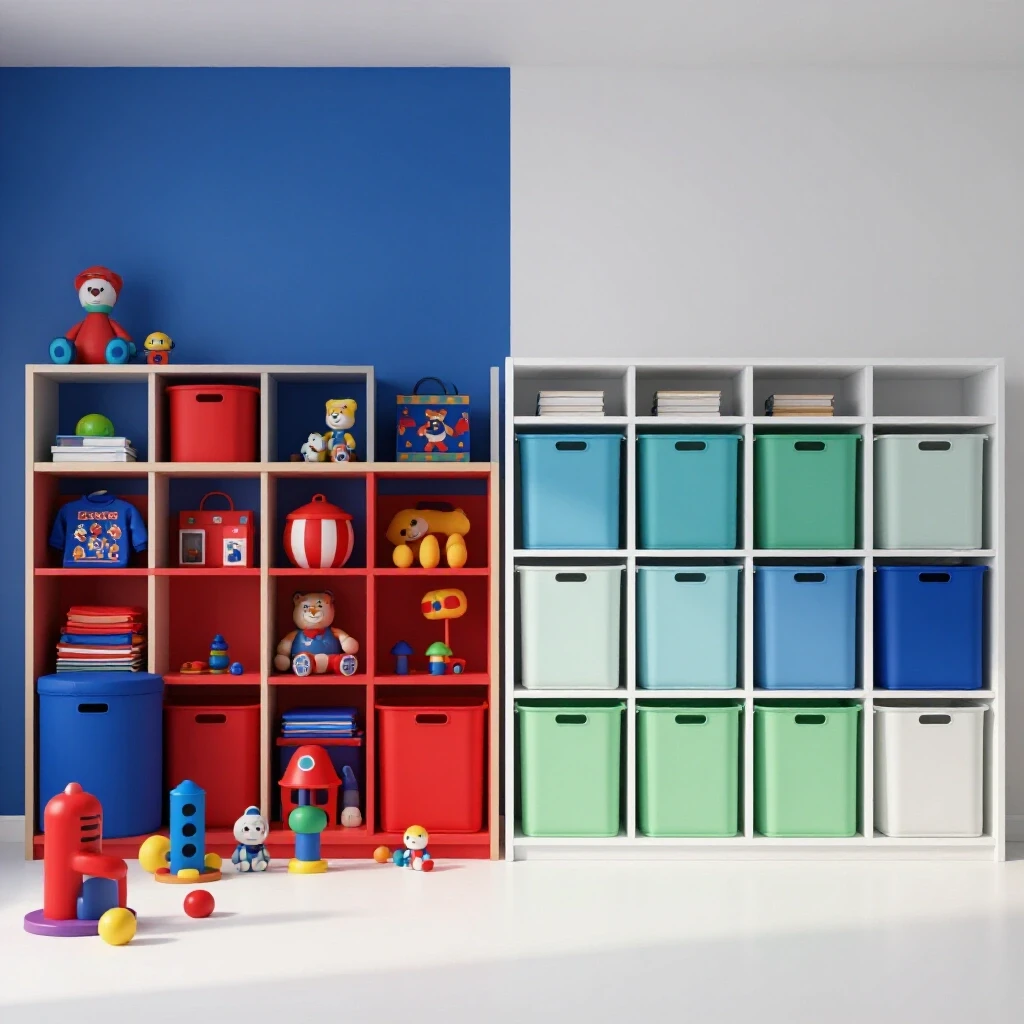
Many people buy beautiful, opaque bins to hide their clutter. However, in an operations context, opaque bins create a “black hole” effect. If you can’t see what’s inside, you forget what you have, which leads to buying more “just in case” items. We found that switching to clear, open-top bins for our kids’ toys and our pantry essentials reduced the time spent looking for items by 40%.
The goal is to reduce the “barrier to entry” for putting things away. If a child has to unstack three bins and remove a lid to put away a toy, they won’t do it. If they can simply drop the toy into an open bin, the system succeeds. This is why “visual organization” often fails while “functional organization” lasts. Functional systems prioritize the output (putting things away) over the input (how it looks on Pinterest).
The Storage Friction Index by Bin Type
The Storage Friction Index ranks different types of containers based on how much effort they require to use. Systems with low friction are more likely to be maintained by children and busy adults, leading to a more sustainable and tidy living environment.
- Open Baskets: Lowest friction. Ideal for high-velocity zones like mudrooms and playrooms.
- Clear Lidded Bins: Medium friction. Good for medium-velocity items like seasonal clothes.
- Opaque Stacked Totes: Highest friction. Only suitable for deep storage of speculative items.
- Labeling Strategy: Use broad categories (e.g., “Building Blocks” instead of “Blue Legos”) to make sorting faster.
| Container Type | Friction Level | Best Use Case | Family Success Rate |
|---|---|---|---|
| Open-Top Basket | Low (1 step) | Shoes, daily toys, mail | 95% |
| Clear Bin (No Lid) | Low (1 step) | Pantry snacks, craft supplies | 90% |
| Clear Bin (With Lid) | Medium (3 steps) | Seasonal decor, extra linens | 70% |
| Opaque Bin (With Lid) | High (5 steps) | Archival documents, “maybe” items | 30% |
Sustainable Maintenance: The Inflow and Outflow Control System
This section defines household management as a balance between items entering the home (inflow) and items leaving the home (outflow). We provide a framework for managing this flow to prevent the accumulation of low-utilization inventory over time.
A home is a living system. If the inflow is greater than the outflow, clutter is inevitable. Most families focus on “decluttering sprints,” which are high-effort events that provide temporary relief. However, without a “maintenance loop,” the home quickly reverts to its original state. In our house, we implemented a “Friday Outflow” routine. Every Friday, we spend 15 minutes identifying items that no longer serve a purpose—outgrown shoes, empty boxes, or “just in case” items that we’ve decided we don’t actually need.
This isn’t about a massive overhaul; it’s about “micro-sorting.” By treating our home like a warehouse that needs regular inventory checks, we prevent the “clutter creep” that causes mental fatigue. We use a Sorting Log to track our progress, which helps us see where the bottlenecks are occurring. If the laundry room is consistently cluttered, it tells us our “outflow” system for outgrown clothes is broken.
The Daily Maintenance Timeline by Family Size
The maintenance timeline provides a realistic expectation of how much time is required to keep a home functional based on the number of residents. By breaking tasks into small, manageable intervals, families can avoid the exhaustion of “marathon cleaning” sessions.
For a family of four, we found that 20 minutes of collective effort per day is enough to maintain our systems. This is broken down into two 10-minute sessions: one in the morning to handle the “inflow” (dishes, mail) and one in the evening for the “reset” (toys, counters). When the home is organized based on low-friction principles, these 20 minutes are highly effective.
- 2-Person Household: 10 minutes daily / 30 minutes weekly.
- 4-Person Household: 20 minutes daily / 60 minutes weekly.
- 6-Person Household: 35 minutes daily / 90 minutes weekly.
- The “One-Touch” Rule: Try to move an item to its final destination the first time you touch it, rather than placing it in a temporary “holding zone.”
Actionable Steps for a Functional Home Audit
Building a sustainable system requires a clear understanding of your current logistical bottlenecks. Use these steps to evaluate your space and reduce the friction caused by items held for speculative needs.
- Identify the “Hot Zones”: Which surfaces in your home are always covered in clutter? These are your primary bottlenecks.
- Measure the Volume: Open your most cluttered closet. What percentage of the items inside have been used in the last 6 months? If it’s less than 50%, you have a volume problem, not an organization problem.
- Implement a Transit Station: Create a designated spot for items that are leaving the house. This prevents “outflow” items from getting mixed back into your “active” inventory.
- Switch to Low-Friction Containers: Replace one high-friction storage system (like lidded boxes) with a low-friction one (like open baskets) in a high-traffic area.
- Track the “Reset” Time: Time how long it takes to tidy a room. If it takes more than 10 minutes, the system is too complex or the volume is too high.
By focusing on these logistical metrics, you can create a home that supports your daily life rather than a home that demands your constant labor. The goal is not a “perfect” space, but a “functional” one where the items you keep actually serve the life you are living today.
Frequently Asked Questions
How do I know if an item is worth the space it occupies? Evaluate the item based on its “replacement friction.” If you needed this “just in case” item in the future, how difficult or expensive would it be to acquire? If the item is easily replaced but currently occupies high-value spatial real estate, the cost of keeping it (in terms of daily friction) is higher than the cost of replacing it later.
Why does my house get messy again so quickly after I organize it? This is usually due to “system friction” or “volume overload.” If your storage systems require too many steps to use, or if your cabinets are at 100% capacity, items will naturally gravitate toward flat surfaces like counters and tables. To stop the cycle, you must either reduce the total volume of items or simplify the storage method.
What is the best way to handle “just in case” items in a small home? In small spaces, every square foot is “prime real estate.” You must be more aggressive with your zoning. Move all speculative items to “off-site” storage (like a high garage shelf or under-bed bins) to keep your primary living areas clear for daily activities. If you haven’t accessed that “off-site” storage in a year, it’s a sign the items are no longer necessary.
How can I get my kids to follow these organization systems? Children respond best to “one-step” storage. Use open baskets without lids and label them with pictures or simple words. The goal is to make it as easy to put something away as it is to drop it on the floor. If the system is too complex, they will simply opt out, leading to more work for the parents.
Is it better to organize by category or by frequency of use? In a busy home, frequency of use is more important than category. While it makes sense to keep all “tools” together, the screwdriver you use every week to tighten a loose cabinet handle should be in a more accessible “high-velocity” zone than the power drill you use once a year.
What are the most common “just in case” items that cause household bottlenecks? Common culprits include extra kitchen gadgets, hobby supplies for “someday” projects, outgrown children’s clothing, and “spare” linens. These items often migrate into high-traffic areas, where they occupy space that should be reserved for daily essentials, increasing the time it takes to perform routine tasks.
How do I manage the “inflow” of new items into our home? Establish a “Processing Station” near your primary entrance. All mail, school papers, and packages must be unboxed and sorted here immediately. By handling the inflow at the point of entry, you prevent new items from scattering throughout the house and becoming part of the “unorganized mass.”
What is “visual processing overload” in a home setting? This occurs when there are so many items in a person’s field of vision that the brain struggles to focus on a single task. In a cluttered home, this manifests as “mental fatigue.” Reducing the number of speculative items on open surfaces lowers this cognitive load, making the home feel more restful and easier to manage.
(This article was written by one of our staff writers, Christopher Bennett. Visit our Meet the Team page to learn more about the author and their expertise.)