Best Basement Flooring Options for Moisture Issues (Expert Guide)

Imagine you have just finished a three-month renovation of your lower-level living space. You chose a beautiful material that looks like natural oak, spent thousands on professional installation, and moved in your heavy furniture. Six months later, you notice a slight musty smell and a faint cupping at the seams of the planks. This scenario is a common result of failing to align material technical specifications with the unique environmental demands of below-grade concrete slabs.
In my 13 years as a supply chain analyst, I have seen that the most expensive material is rarely the best performing if it is poorly matched to its environment. When evaluating high-end home materials for subterranean spaces, the primary challenge is not aesthetics, but moisture vapor transmission. Concrete is porous; it breathes and moves water from the high-pressure soil outside to the low-pressure air inside. If your flooring choice acts as a complete vapor barrier without the right adhesive or underlayment, you are essentially trapping water against a structural surface.
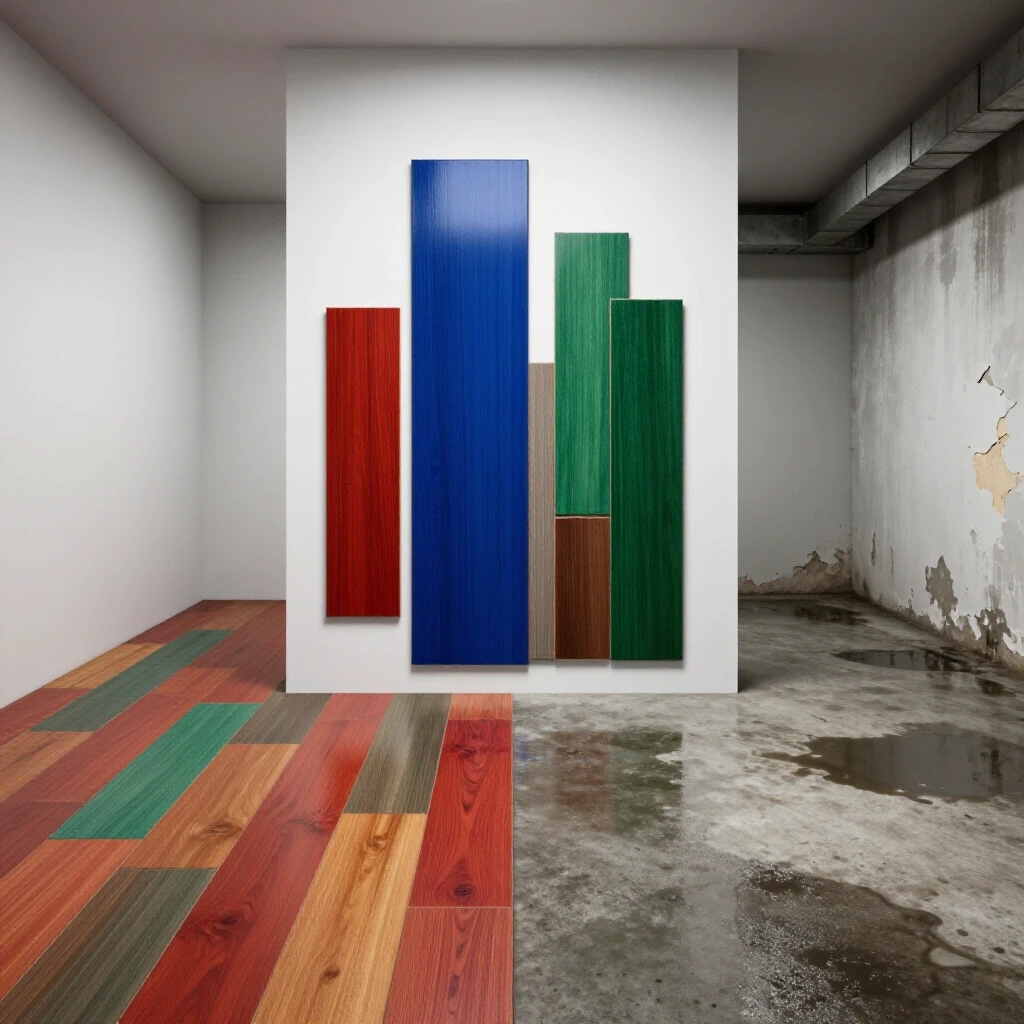
The goal of this guide is to move past marketing claims and look at the technical data. We will evaluate how different materials respond to hydrostatic pressure and vapor emissions. By using a systematic trade-off analysis, you can determine if a higher upfront cost for a specific material translates into a lower life-cycle cost over the next fifteen years.
Technical Standards for Subterranean Material Performance
Technical standards are the benchmarks used to measure how a material behaves under specific stresses like water immersion or heavy foot traffic. For below-grade environments, we look at ASTM International ratings to determine if a product can survive the alkaline environment of a damp concrete slab. These ratings provide an objective way to compare a $4-per-square-foot vinyl against a $12-per-square-foot porcelain tile.
Understanding Vapor Emission and Hydrostatic Pressure
Hydrostatic pressure occurs when groundwater levels rise above the level of your floor, pushing liquid water through cracks or pores in the concrete. Vapor emission is the slower process of moisture turning into gas and rising through the slab. Both forces can degrade adhesives and warp materials if not properly managed.
Before selecting a material, it is vital to understand the “perm rating” of your flooring and underlayment. A perm rating measures how much water vapor can pass through a material. In a lower-level environment, you generally want a system that either completely blocks moisture (and can handle the pressure) or one that allows the slab to breathe.
- ASTM F1869: This is the Calcium Chloride test. It measures the moisture vapor emission rate (MVER) from the surface of the concrete. A standard limit for many adhesives is 3 lbs per 1,000 square feet over 24 hours.
- ASTM F2170: This test uses in-situ probes to measure the relative humidity (RH) inside the concrete slab itself. Most modern flooring manufacturers require an RH of 75% to 90% for successful installation.
- Alkalinity (pH) Testing: High moisture often brings salts to the surface, raising the pH of the concrete. A pH above 9 can chemically break down the glues used in luxury vinyl or engineered products.
Assessing Your Slab Using Empirical Methods
Empirical testing involves gathering direct evidence from your specific environment rather than relying on general assumptions about your home’s age or location. By performing a home material comparison through localized testing, you can identify “hot spots” where moisture is most prevalent. This data dictates whether you need a topical sealer or a floating floor system.
The 48-Hour Plastic Sheet Assessment
This simple test involves taping a 24-by-24-inch square of clear plastic to your concrete floor, sealing all edges with duct tape. After 48 hours, you check for condensation on the underside of the plastic or a dark spot on the concrete. This provides a visual confirmation of vapor transmission that technical spec sheets cannot show for your specific house.
During my own home renovation ten years ago, I performed this test in four corners of the room. Interestingly, only one corner showed significant darkening. This led me to discover a clogged exterior downspout that was dumping water right against that foundation wall. Fixing the drainage was a $50 task that saved a $6,000 flooring investment. If you see significant moisture during this test, you must prioritize materials with high moisture tolerance, such as inorganic composites or ceramic products.
Comparing High-Performance Materials for Damp Environments
A thorough trade-off analysis requires looking at the physical composition of the flooring. We categorize these materials by their “hyscopic” nature—how much they expand or contract when they absorb water. For lower levels, we prioritize materials with low absorption rates and high dimensional stability.
Luxury Vinyl Plank (LVP) and Wear Layer Specifications
Luxury Vinyl Plank is a multi-layered synthetic product designed to mimic wood or stone while remaining waterproof. It usually consists of a backing layer, a core (SPC or WPC), a high-resolution image layer, and a clear wear layer. Its primary benefit is that the material itself will not rot or warp when exposed to water.
When comparing LVP options, look closely at the “mil” thickness of the wear layer. A 12-mil layer is standard for residential use, but for a high-traffic lower level, a 20-mil or 28-mil layer provides significantly better scratch resistance.
- SPC (Stone Plastic Composite): This core is made of limestone and stabilizers. It is incredibly dense and has high dimensional stability, meaning it won’t expand much in heat or humidity.
- WPC (Wood Plastic Composite): This core includes air agents to make it softer and warmer underfoot. While waterproof, it is less dent-resistant than SPC.
Porcelain and Ceramic Tile Performance Data
Ceramic and porcelain tiles are inorganic materials fired at extremely high temperatures, making them naturally resistant to mold and moisture. Porcelain is specifically defined by its water absorption rate. According to ASTM C373, porcelain must have a water absorption rate of 0.5% or less.
Tile is often the “gold standard” for durability vs maintenance cost in damp areas. However, the trade-off is the installation complexity and the “cold” feel of the floor. If you choose tile, you must also account for the cost of a high-quality uncoupling membrane, which allows the tile to stay intact even if the concrete slab beneath it develops small cracks.
Side-by-Side Material Performance Specifications
| Feature | Stone Plastic Composite (SPC) | Porcelain Tile | Epoxy Coating |
|---|---|---|---|
| ASTM Moisture Rating | High (Floating) | Excellent (Bonded) | Moderate (Vapor Barrier) |
| Thickness | 5mm – 8mm | 8mm – 12mm | 1mm – 3mm |
| Janka Hardness | N/A (Dent Resistant) | Extremely High | High |
| Absorption Rate | < 0.05% | < 0.5% | 0% |
| Installation Style | Click-Lock (Floating) | Mortar & Grout | Roll-on / Squeegee |
| Typical Warranty | 15 – 25 Years | Lifetime (Material) | 1 – 5 Years |
Financial Evaluations: Upfront Cost vs. 15-Year Outlay
In supply chain analysis, we look at the Total Cost of Ownership (TCO). A product that costs $3 per square foot but needs replacement every seven years is far more expensive than a $10 product that lasts thirty years. For lower-level flooring, the “replacement cost” includes moving furniture, removing old material, and potentially remediating mold.
Analyzing the Real Trade-Offs of High Upfront Costs
A higher upfront price often pays for a thicker wear layer or a more sophisticated locking mechanism. For example, a “drop-lock” system on a premium vinyl plank reduces the chance of the joints breaking under the weight of a pool table or heavy treadmill. If the joints break, moisture can seep between the planks, leading to odors even if the planks themselves are fine.
Consider the following 15-year cost projection for a 500-square-foot space:
- Low-End Laminate ($2/sq ft): Initial cost $1,000. Potential for failure in 5 years due to moisture. Replacement cost at year 6: $1,500 (labor + material). Total 15-year cost: $2,500+.
- Mid-Range SPC Vinyl ($5/sq ft): Initial cost $2,500. Expected life 15+ years. Maintenance: Minimal. Total 15-year cost: $2,500.
- Premium Porcelain Tile ($8/sq ft + $6 labor): Initial cost $7,000. Expected life 50+ years. Maintenance: Grout sealing every 5 years. Total 15-year cost: $7,200.
While tile is the most expensive, it is a “one-and-done” investment. SPC vinyl represents the “sweet spot” for many homeowners who want a balance of durability and reasonable entry cost.
Installation Demands and Structural Requirements
The success of any floor in a damp environment depends 90% on the preparation of the substrate. If your concrete is uneven, a click-lock floor will flex, eventually snapping the tongues and grooves. This is known as “deflection.”
Subfloor Leveling and Moisture Barriers
Most manufacturers specify that a floor must be level within 3/16 of an inch over a 10-foot radius. If your slab has dips, you must use a self-leveling underlayment. Furthermore, even “waterproof” floors benefit from a 6-mil poly film moisture barrier laid over the concrete. This acts as a cheap insurance policy, preventing vapor from reaching the underside of your flooring.
- Clean the slab: Remove all old adhesive, paint, or drywall mud.
- Check for Flatness: Use a 10-foot straight edge to identify high and low spots.
- Apply Primer: If using a leveler, a latex primer ensures the new material bonds to the old concrete.
- Install Vapor Barrier: Overlap seams by 6 inches and seal with waterproof tape.
Long-Term Cleaning and Maintenance Regimens
Maintenance costs are often overlooked during the buying phase. Some materials require specific pH-neutral cleaners to avoid stripping the wear layer. Others, like natural stone or certain epoxies, may require periodic resealing to maintain their moisture resistance and aesthetic appeal.
Maintaining Integrity Through the Decades
For vinyl floors, avoid steam mops. While the floor is waterproof, the high-pressure steam can force moisture into the joints and weaken the adhesive bond of the layers. A simple damp mop with a manufacturer-approved cleaner is usually sufficient.
For tile, the weak point is the grout. Using a high-performance epoxy grout instead of standard cementitious grout can eliminate the need for sealing and prevent mold growth in the joints. This is a classic example of how a slightly higher material cost during installation can eliminate a recurring maintenance task.
Actionable Buying Worksheet: The Trade-Off Matrix
Use this matrix to score your top three material choices. Rate each category from 1 to 5 (5 being the best).
- Moisture Tolerance: How well does the material handle 90% RH?
- DIY Friendliness: Can you install it yourself to save on labor?
- Comfort/Warmth: How does it feel in the winter?
- Durability: What is the wear layer or hardness rating?
- Total Cost (15 Years): Initial price plus expected maintenance.
Scoring Guide: * 20-25 Points: Excellent fit for your lifestyle and home. * 15-19 Points: Good fit, but may require extra prep or maintenance. * Below 15 Points: Consider a different material to avoid future failure.
Conclusion and Next Steps
Choosing the right flooring for a below-grade space requires a shift from aesthetic-first thinking to technical-first thinking. By prioritizing moisture testing and understanding the material science of SPC cores or porcelain absorption, you protect your investment from the inevitable vapor pressure of the earth.
My recommendation is to start by purchasing three different sample kits. Place them in your lower level, spill water on them, and try to scratch them with a key. Combine this “torture test” with the 48-hour plastic sheet assessment on your slab. This hands-on data, combined with the technical specs we have discussed, will give you the confidence to make a purchase that lasts as long as your home.
Frequently Asked Questions
Does “waterproof” mean I don’t need to worry about moisture in the concrete?
No. While the flooring material itself may not be damaged by water, moisture trapped underneath can lead to mold growth on the subfloor or the breakdown of the locking joints. Always use a vapor barrier or ensure the slab is within the manufacturer’s RH limits.
What is the difference between a wear layer in “mils” and “millimeters”?
A “mil” is one-thousandth of an inch (0.001″). It is a measurement of the clear protective top layer. A “millimeter” (mm) usually refers to the total thickness of the entire plank. Don’t confuse the two; a 6mm plank might only have a 12-mil wear layer.
Can I install engineered wood in a subterranean space?
It is risky. While engineered wood is more stable than solid wood, it still contains real wood fibers that can swell and delaminate if the relative humidity stays high. If you choose this, you must have a perfectly dry slab and a high-quality moisture-rated adhesive.
How do I know if my concrete has a high pH level?
You can buy a simple pH testing kit that uses distilled water and pH paper. If the reading is above 10, you need a specialized primer to prevent the alkalinity from eating away at your flooring’s backing or glue.
Is a thicker plank always better?
Not necessarily. A thick plank with a weak core (WPC) may be less durable than a thinner plank with a stone-composite core (SPC). Look at the core type and the wear layer thickness rather than just the total thickness.
What is the best way to handle an uneven concrete floor?
Self-leveling underlayment is the most effective solution. It is a cement-based product that you pour over the floor; it finds its own level and hardens into a flat surface, which is essential for the longevity of click-lock flooring.
Why does my new vinyl floor sound “clicky” when I walk on it?
This usually happens because the subfloor isn’t flat, or the underlayment is too thick/soft. The “clicking” is the sound of the air gap between the floor and the slab being compressed. Ensuring a flat subfloor is the only way to prevent this.
Should I choose a floor with a pre-attached pad?
Integrated pads are convenient and often designed to be mold-resistant. However, check if the manufacturer allows an additional vapor barrier underneath. In very damp areas, a separate 6-mil poly film is still recommended even with a pre-attached pad.
How long should I wait after a new concrete pour before installing flooring?
A general rule is 30 days of drying time for every inch of concrete thickness. However, you should never guess. Use an ASTM F2170 probe test to verify the internal moisture levels before proceeding.
Can I use area rugs over my below-grade flooring?
Yes, but avoid rugs with thick rubber or latex backings. These can trap moisture against the floor, causing discoloration or “ghosting” on vinyl and preventing the slab from breathing if you have a breathable floor like tile.
(This article was written by one of our staff writers, Andrew Morrison. Visit our Meet the Team page to learn more about the author and their expertise.)