How to Organize Bathroom Drawers for Daily Ease (Step-by-Step Guide)

Every morning, I used to stand in front of my bathroom vanity, digging through a tangled mess of hair ties, half-empty toothpaste tubes, and loose razor blades. As a professional in operations and logistics, I felt the irony of managing complex supply chains by day while failing to manage a single drawer at home. My wife and I would spend our weekends tidying up, only for the space to revert to chaos by Wednesday morning. This cycle wasn’t just annoying; it was a source of daily mental fatigue that set a frantic tone for our entire family before we even left the house.
In my professional life, we call this “operational friction.” In a warehouse, if a worker has to move three boxes to reach the one they need, the system is broken. In our home, we were experiencing the same thing. We had plenty of storage bins, but they were too complex. They required too many steps to maintain, especially for our children. I realized that sustainable decluttering isn’t about how a drawer looks in a photo; it’s about how quickly you can find what you need and how easily you can put it back.
The Psychological Impact of Morning Spatial Friction
Spatial friction refers to the physical and mental resistance encountered when interacting with an environment. In a high-traffic area like a bathroom, high friction leads to “decision fatigue,” where the brain becomes exhausted by the constant micro-choices required to navigate a cluttered space.
Environmental psychology research suggests that visual clutter acts as a constant “to-do” list for the brain, raising cortisol levels. When you open a drawer and see a jumble of items, your brain must filter out the noise to find the target object. Over time, this repeated visual processing overload contributes to a sense of being overwhelmed. For busy parents, this is often the “last straw” in a morning routine. By applying logistics principles, we can reduce this cognitive load by creating a predictable, low-friction environment.
Understanding Retrieval Steps and Access Speeds
Retrieval steps are the individual physical movements required to access an item, such as opening a lid, moving a tray, or shifting secondary items. In a functional home storage system, the goal is to keep daily-use items at a “one-step” or “two-step” access level.
When we analyzed our family’s morning routine, we found that my daughter had to move four different containers to find her hairbrushes. This is a high-friction system. According to spatial ergonomics studies, any item used daily should be accessible in under three seconds. If it takes longer, the user is likely to leave the item on the counter rather than putting it away, leading to rapid clutter reversion.
| Retrieval Level | Steps Required | Maintenance Sustainability |
|---|---|---|
| Level 1 (Primary) | 1 step (Open drawer, grab item) | High |
| Level 2 (Secondary) | 2-3 steps (Open drawer, lift lid) | Moderate |
| Level 3 (Tertiary) | 4+ steps (Move items, unstack bins) | Low |
Diagnostic Spatial Audits for Daily Grooming Areas
A spatial audit is a systematic evaluation of how a storage area is currently used versus its intended purpose. It involves measuring the volume of items, tracking the frequency of use, and identifying “logistics bottlenecks” where items accumulate.
To start a sustainable decluttering journey, you must first understand why the current system failed. Most families fail because they organize for “storage capacity” rather than “flow.” We performed an audit on our main vanity and found that 60% of the items were used less than once a month, yet they occupied the most accessible drawer space. This is a classic inflow/outflow imbalance. By identifying these bottlenecks, you can redesign the space to prioritize daily convenience over long-term storage.
Measuring Spatial Capacity and Item Density
Spatial capacity is the total volume available within a storage unit, while item density refers to how much of that volume is occupied. For a system to remain low-maintenance, the density should never exceed 80%.
When a drawer is 100% full, there is no “buffer zone” for new items or slight disorganization. This leads to the “cramming” effect. In our house, we aim for a 75% density rule. This allows us to see every item at a glance without having to shift things around. We use a simple metric: if you can’t see the bottom of the drawer in at least three places, it is over-capacity.
- Storage Volume Metric: Measure the height, width, and depth of the drawer to determine the “active cubic inches.”
- Item-Density Guideline: Aim for 70-80% occupancy to ensure easy retrieval.
- Sorting Time-Box: Limit the initial audit to 15 minutes per drawer to prevent burnout.
Applying Industrial Sorting Methods to Personal Care Items
Sorting frameworks are logical rules used to categorize items based on their utility and frequency of use. In industrial settings, this is often called “ABC Analysis,” where ‘A’ items are high-value/high-use and ‘C’ items are low-use.
For our family, we adapted this into a “Frequency-First” model. Instead of sorting by category (like “all hair products”), we sorted by how often we touched them. This shift was a breakthrough. It meant that my daily razor was no longer buried under the “fancy” shaving cream I only use on weekends. This method reduces the “sorting friction” that often leads to messy drawers.
The Decluttering Sorting Log and Red Tag Method
The “Red Tag” method involves marking items you aren’t sure about and placing them in a temporary “holding zone.” If the item isn’t used within a set timeframe, it is removed from the active storage area.
During our family organization sprint, we used a simple log to track what we actually used over a seven-day period. This data-driven approach removed the emotional difficulty of decluttering. We weren’t “throwing things away”; we were simply moving “low-velocity” items to less accessible areas. This ensures that the prime real estate in your drawers is reserved for the things that keep your morning moving.
- Daily Use (A): Toothbrushes, deodorant, daily skincare.
- Weekly Use (B): Hair masks, nail clippers, exfoliants.
- Monthly/Rare Use (C): Travel-sized toiletries, backup supplies, first aid.
Creating High-Efficiency Zoning Maps for Families
Zoning is the practice of dividing a storage space into dedicated areas based on user behavior or item category. A well-designed zoning map ensures that every family member knows exactly where their items belong.
In a shared bathroom, “user-based zoning” is often more effective than “category-based zoning.” My children were much better at maintaining their space when they had a clearly defined “zone” that was theirs alone. We mapped out our drawers like a warehouse floor plan, assigning the front-most sections to the most frequently used items. This spatial management principle reduces the time spent searching and increases the likelihood of items being returned to their homes.
Reducing Retrieval Friction with Logical Layouts
A logical layout follows the natural movement of the user. For example, if you stand on the left side of the sink, your most-used items should be in the top-left section of the drawer.
We noticed that my wife was reaching across her body to get her hair dryer, adding unnecessary movement to her routine. By rearranging the drawer to follow her natural “reach path,” we reduced her daily retrieval step count. This might seem small, but over a year, these micro-efficiencies significantly reduce morning stress and mental fatigue.
- Map the Reach Zone: Identify the area closest to the user’s standing position.
- Place “A” Items in the Reach Zone: Ensure these are visible immediately upon opening the drawer.
- Use Modular Inserts: Create physical boundaries between zones to prevent “item creep.”
- Label for Logic: Use simple, clear labels that even a child can understand.
Selecting Low-Maintenance Dividers and Modular Units
Container friction is the resistance added to a system by the storage gear itself. High-friction containers have lids, latches, or require stacking, whereas low-friction containers are open-top and easy to access.
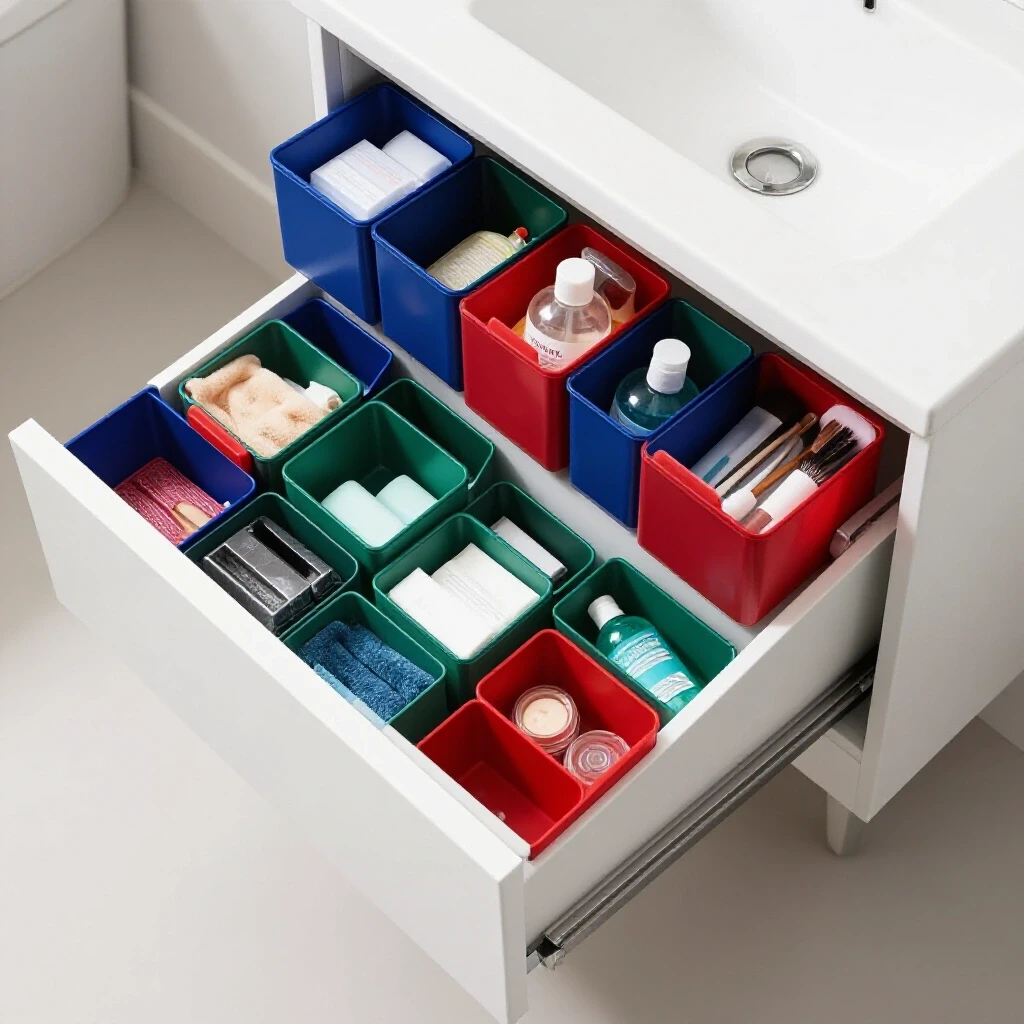
I’ve seen many families buy beautiful, complex acrylic sets that look great on social media but fail in real life. If a child has to unlatch a box to put away their comb, they won’t do it. We switched to open-top, modular dividers that can be easily wiped clean. These functional home storage solutions focus on “drop-and-go” maintenance, which is essential for busy professionals who don’t have time for meticulous organizing every day.
Visual vs. Functional Organization Systems
Visual systems focus on aesthetics (color-coding, uniform bottles), while functional systems focus on the speed of the task. For sustainable decluttering, function must always come before form.
In our home, we realized that decanting shampoos into matching bottles was a “high-maintenance” task that we couldn’t sustain. It added an extra step to our shopping and cleaning routine. Instead, we focused on “functional grouping.” We use dividers to keep the original bottles upright and separated. This reduced our system maintenance time from 20 minutes a week to almost zero.
| Feature | Visual-Focused System | Functional-Focused System |
|---|---|---|
| Access Speed | Slower (due to lids/uniformity) | Faster (open-top/clear zones) |
| Maintenance Level | High (requires constant “reset”) | Low (designed for “drop-and-go”) |
| Family Compliance | Low (too many rules) | High (intuitive and simple) |
| Durability of Order | Days | Months |
Building Sustainable Habit Loops for Morning Routines
A habit loop consists of a cue, a routine, and a reward. In the context of home organization systems, the “cue” is finishing your grooming, the “routine” is placing the item back in its zone, and the “reward” is a clear counter and a stress-free exit.
The reason most systems fail within days is that they don’t account for the “human element.” We built a “two-minute reset” into our morning routine. Because our drawers were designed with low-friction dividers and clear zones, this reset actually took less than 60 seconds. By making the “correct” behavior the “easiest” behavior, we created a self-sustaining loop that doesn’t require constant willpower.
Maintenance Timelines and System Feedback Loops
A feedback loop is a period of observation where you assess if a system is working or if it needs adjustment. No system is perfect on the first try; it must evolve with the family’s needs.
We check our drawer systems every 30 days. If we notice a specific drawer is getting messy, we don’t blame the person using it; we look at the logistics. Is the divider too small? Is the item density too high? By treating disorganization as a “system failure” rather than a personal failure, we reduce the frustration often associated with household chores.
- Daily: 60-second “drop-and-go” reset.
- Weekly: Wipe down surfaces and check for “item creep.”
- Monthly: 5-minute audit to remove empty bottles or unused items.
- Quarterly: Re-evaluate zoning if family needs have changed (e.g., a child starting a new skincare routine).
Case Study: Redesigning the “Chaos Drawer”
In our own home, we had one drawer that was the catch-all for everything from band-aids to spare lightbulbs. It was a logistical nightmare. We applied the principles of spatial management to transform it from a “black hole” into a high-functioning storage unit.
First, we emptied the drawer and measured its “active volume.” We found that 40% of the space was wasted because items were stored flat rather than vertically. We introduced deep, modular dividers that allowed us to stand items up, increasing our “visual footprint”—the ability to see everything at once. We then assigned “prime real estate” to the items used every morning. The result was a reduction in “search time” from 30 seconds to under 3 seconds.
Family Sorting Matrix for Shared Spaces
This matrix helped us decide where items should live based on who used them and how often.
| Item | Primary User | Frequency | Zone Assignment |
|---|---|---|---|
| Toothpaste | Everyone | 2x Daily | Front-Center (Shared) |
| Hair Gel | Dad | 1x Daily | Front-Right (Dad’s Zone) |
| Makeup Palette | Mom | 1x Daily | Front-Left (Mom’s Zone) |
| First Aid | Family | 1x Monthly | Back-Center (Utility Zone) |
| Extra Soap | Family | 1x Quarterly | Deep Storage (Under Sink) |
Practical Next Steps for a Low-Maintenance System
Redesigning your storage doesn’t have to be an all-day project. In fact, the most successful systems are built in small, logical increments. Start with the one drawer that causes the most frustration during your morning routine.
By focusing on reducing friction and aligning the system with your family’s actual behavior, you can create a space that stays tidy with minimal effort. Remember, the goal isn’t a “perfect” drawer; it’s a functional home that supports your life rather than draining your energy.
- Clear the Deck: Empty the drawer completely to see the available volume.
- Categorize by Speed: Group items by how quickly you need to grab them in the morning.
- Measure and Map: Measure your drawer and sketch a simple zoning map before buying any dividers.
- Install Low-Friction Gear: Use open-top bins and adjustable dividers to create clear boundaries.
- Test and Tweak: Use the system for a week, then adjust any zones that feel “clunky” or high-friction.
Frequently Asked Questions
Why do my drawers get messy again so quickly after I organize them?
Most systems fail because they are designed for aesthetics rather than “flow.” If a system requires too many steps to put an item away—like opening a lid or moving another bin—users will naturally avoid those steps, especially when rushed. To fix this, reduce “retrieval friction” by using open-top dividers and keeping daily-use items in the most accessible “reach zones.”
What is the best way to organize a deep bathroom drawer?
Deep drawers often suffer from “item layering,” where things get buried at the bottom. The best approach is to use vertical storage. Use tall dividers or stackable bins with drawers so you can access the bottom layer without moving the top. Always place “high-velocity” (frequently used) items at the very top or front.
How do I get my kids to keep their drawers organized?
Children respond best to “intuitive zoning.” Give them a dedicated space that is easy to reach and uses “drop-and-go” storage. Avoid complex categories; instead, use broad zones like “hair” or “teeth.” Labels with pictures or simple words can also help reinforce where items belong without requiring constant parental supervision.
Should I use lids on my storage bins inside drawers?
Generally, no. Lids add an extra step to both retrieval and “put-away” tasks, which increases system friction. In a drawer, the drawer itself acts as the lid, protecting items from dust. Use open-top modular dividers to keep items separated while allowing for “one-touch” access.
How much empty space should I leave in my drawers?
A good rule of thumb from logistics is the “80% Rule.” Never fill a storage space more than 80% capacity. Leaving 20% “buffer space” allows you to see items clearly and prevents the drawer from becoming jammed. It also provides room for new items without requiring a total system overhaul.
What are “high-velocity” items in a bathroom context?
In logistics, velocity refers to how quickly an item moves through a system. In your bathroom, high-velocity items are those used at least once a day, such as toothbrushes, deodorant, and daily skincare. These should always occupy “prime real estate”—the front and center of your top drawers.
How do I handle “backup” items like extra shampoo or soap?
Backup items are “low-velocity” and should not occupy your daily grooming drawers. Store these in a “secondary zone,” such as under the sink or in a linen closet. Only bring them into the primary drawer when the current item is empty. This prevents “spatial crowding” in your most-used areas.
Is it worth buying expensive organizing sets?
Not necessarily. The most effective systems are based on logic, not the price of the containers. Simple, adjustable dividers or even repurposed sturdy boxes can work well if they fit the dimensions of your drawer and support your zoning map. Focus on the “fit and friction” rather than the brand name.
(This article was written by one of our staff writers, Christopher Bennett. Visit our Meet the Team page to learn more about the author and their expertise.)