How to Store Cutting Boards Efficiently (Space-Saving Tips)

“I feel like I spend half my life moving three heavy wooden slabs just to find the small one for a quick apple snack, and by Tuesday, they are all just shoved back into a heap.” This frustration, shared by a parent of three during one of my recent home consultations, perfectly illustrates the breakdown of common kitchen systems. When we talk about reclaiming cabinet volume, we are really talking about reducing the physical and mental effort required to maintain our homes.
In my eleven years managing logistics and operations, I have learned that the most effective systems are those that account for human laziness and the chaos of a busy family schedule. We often treat our kitchens as static galleries, but they are high-traffic processing centers. If a storage method requires you to move more than one item to get to what you need, it is a high-friction system. High-friction systems are the primary reason why even the most motivated parents find their counters cluttered again just days after a deep clean.
My own family’s journey into sustainable decluttering began when I realized our kitchen cabinets were designed for maximum density rather than maximum flow. We had a stack of flat prep surfaces buried under heavy pans. To get the one board we needed, we had to lift ten pounds of cast iron. Naturally, no one wanted to put the boards back properly, leading to a permanent “leaning tower” on the counter. By applying spatial management principles, we transitioned to vertical, slim-profile solutions that saved significant volume and reduced our daily stress.
The Logistics of Kitchen Friction and Retrieval Costs
Kitchen friction is the measurable resistance encountered when attempting to access or store household items. In the context of flat kitchen tools, friction increases every time you have to move a secondary object to reach a primary one. Lowering this resistance is the cornerstone of functional home storage and long-term order.
In logistics, we look at “pick times”—the duration it takes to pull an item from a shelf. If your flat prep surfaces are stacked horizontally, your pick time is high because you must unstack and restack. This creates a “bottleneck” in your kitchen workflow. Environmental psychology suggests that when a task feels physically demanding, we experience “anticipatory fatigue,” which leads us to leave the item on the counter instead of putting it away.
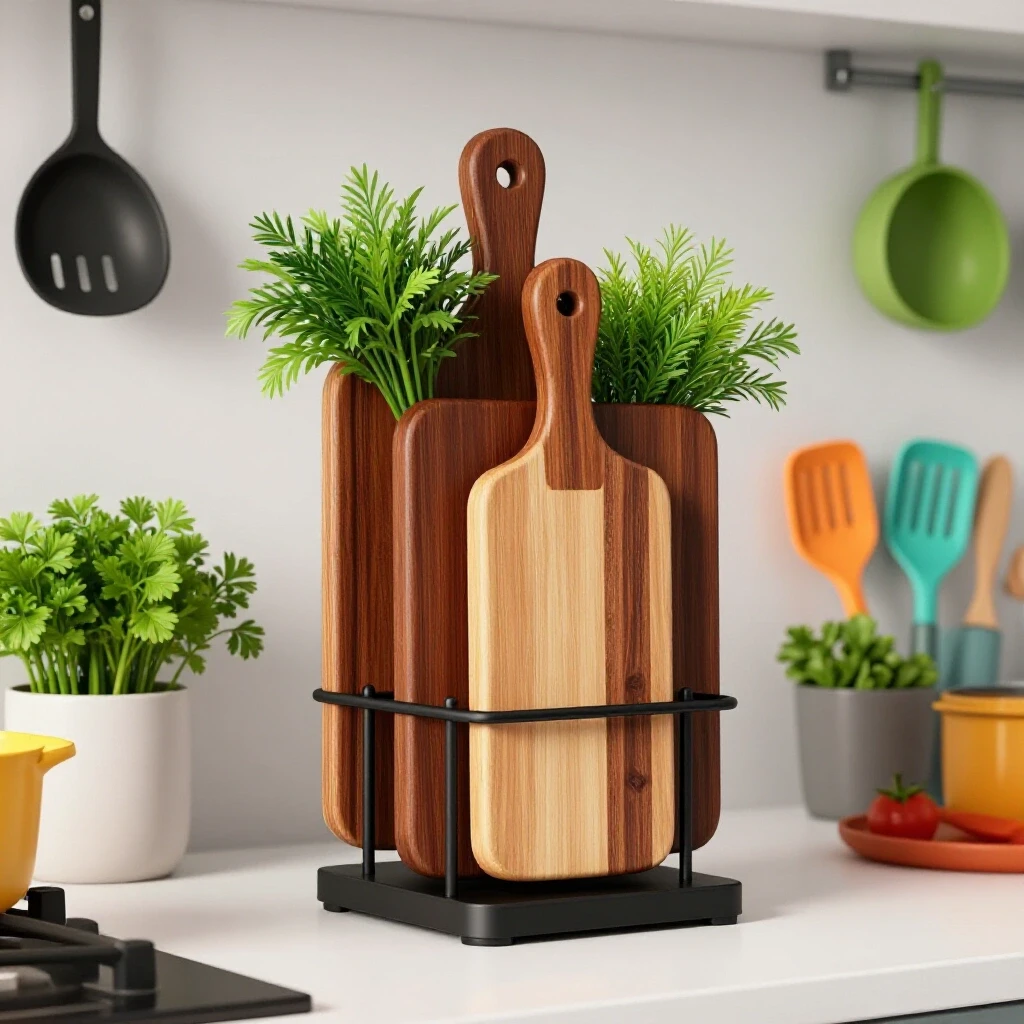
To solve this, we must shift from horizontal stacking to vertical orientation. Verticality allows for “single-touch” retrieval. When every item has its own slim-profile slot, you can pull it out and slide it back in without disturbing its neighbors. This reduces the cognitive load of tidying up, making it much more likely that your family will follow the system.
Understanding Spatial Capacity and Volume Recovery
Spatial capacity refers to the total usable three-dimensional area within a storage unit, while volume recovery is the process of reclaiming wasted “air space.” Most kitchen cabinets are deep but lack internal divisions, leading to “dead zones” where items are lost or inaccessible. Optimizing these zones is vital for reducing household clutter.
When we stack flat items horizontally, we utilize the footprint of the cabinet but waste the vertical height. Conversely, by installing slim dividers or upright supports, we use the height of the shelf to house items side-by-side. This simple shift can increase your effective storage volume by up to 40% because it eliminates the need for “buffer space” typically required to reach into the bottom of a heavy pile.
| Storage Method | Retrieval Steps | Maintenance Difficulty | Space Utilization |
|---|---|---|---|
| Horizontal Stacking | 4-6 steps | High | 60% (Poor) |
| Vertical Slots | 1 step | Low | 95% (Excellent) |
| Leaning Against Wall | 2 steps | Moderate | 30% (Wasteful) |
Designing Low-Maintenance Vertical Systems
Low-maintenance systems prioritize ease of use over aesthetic perfection, ensuring they can be sustained by busy professionals and children. These systems rely on simple physical barriers that dictate exactly where an item belongs. By creating dedicated zones for slim items, you remove the “decision fatigue” associated with cleaning up.
In my home, we moved away from generic “catch-all” bins. Instead, we looked at the specific dimensions of our prep tools. We found that by installing a few simple, narrow dividers in a lower cabinet, we could store six different boards in the space previously occupied by a messy pile of three. This is a prime example of functional home storage that adapts to the family’s needs rather than forcing the family to adapt to a rigid, complex product.
DIY Wood and Wire Divider Frameworks
A DIY divider framework involves using basic materials like plywood or heavy-gauge wire to create individual “stalls” for kitchen items. These builds are effective because they can be customized to the exact height and width of your cabinet, ensuring no volume is wasted. This approach is a core part of a sustainable decluttering journey.
- Measure the tallest item: Ensure your cabinet has enough vertical clearance.
- Cut simple plywood inserts: Create a “comb” structure where boards can slide between teeth.
- Install wire tension rods: For a non-permanent solution, vertical tension rods can create sturdy dividers.
- Secure with adhesive mounts: Small wooden blocks glued to the base of the cabinet can act as “tracks” to keep boards upright.
These solutions work because they provide immediate visual feedback. If a slot is empty, the family knows exactly what is missing and where it goes back. This clarity is what prevents the rapid reversion to clutter that many parents experience.
Utilizing Adhesive Mounts and Cabinet Doors
Adhesive mounts allow you to utilize the “hidden” surface area on the inside of cabinet doors or the sides of a pantry. This strategy is particularly useful for slim, lightweight items that often get lost in deep drawers. By moving these items to a vertical surface, you free up high-value drawer space for bulkier tools.
We once struggled with a “junk drawer” that was 30% flat boards. By using simple adhesive hooks and a thin wire cradle on the inside of a lower cabinet door, we moved those boards out of the drawer entirely. This reduced the “item density” of the drawer, making it easier to find everything else. It took ten minutes to install but saved us hours of digging over the following months.
Measuring Success through Sorting Speed and Friction
In professional logistics, we don’t just guess if a system is better; we measure it. You can apply these same metrics to your home organization systems. A successful system should result in a measurable decrease in the time it takes to “reset” the kitchen after a meal.
- Retrieval Step Count: The number of physical movements required to get an item. (Goal: 1-2).
- Reset Time: The total seconds it takes to put away all prep surfaces after they are dry. (Goal: Under 15 seconds).
- Visual Processing Load: The number of distinct “piles” visible to the eye. (Goal: Zero piles, only designated slots).
The Storage Friction Index for Families
The Storage Friction Index (SFI) is a tool I developed to help families identify which parts of their home are most likely to fail. An area with an SFI of 1 is effortless, while an SFI of 5 requires significant moving of objects. Vertical, slim-profile storage typically rates as a 1 or 2, making it highly sustainable for households with children.
| Task | Horizontal Pile (SFI) | Vertical Divider (SFI) | Improvement |
|---|---|---|---|
| Grabbing a large board | 4 | 1 | 75% Faster |
| Putting away a small board | 5 | 1 | 80% Faster |
| Finding a specific size | 3 | 1 | 66% Faster |
Aligning Family Behavior with Organizational Systems
A system is only as good as the people using it. If your children or spouse find a storage solution too complex, they will bypass it. This is why “pro-organizer” setups with dozens of tiny bins often fail in real lived-in homes. We need “low-friction” entry points that require zero thought.
I found that labeling the shelf rather than the item helped my kids immensely. On the base of our vertical divider, I put small marks indicating “Large,” “Medium,” and “Small.” This eliminated the “where does this go?” question that often leads to items being left on the counter. It turned a chore into a simple matching game, which is a key strategy for reducing household clutter in a family environment.
Reducing Decision Fatigue in Daily Maintenance
Decision fatigue occurs when the brain is overwhelmed by too many choices or steps. When you look at a cluttered counter, your brain has to decide: “Where does this go? Do I have to move that first? Is there room?” A vertical, slotted system makes the decision for you. The slot is either empty or full.
By removing these micro-decisions, you preserve your mental energy for more important things, like parenting or work. This is the “psychological benefit” of sustainable organization. It isn’t about the boards being “pretty”; it’s about the boards not being a source of irritation at 6:00 PM when you are tired.
Practical Steps for a Spatial Audit
Before you build or install anything, you must perform a spatial audit. This involves looking at your current flow and identifying where the “logistics bottlenecks” occur. Don’t look for what is messy; look for what is difficult to use.
- Empty the target cabinet: Take everything out to see the true volume available.
- Categorize by thickness: Group your boards and flat items by how much “width” they need.
- Count your “picks”: For one week, notice which items you use most frequently.
- Identify the “Prime Zone”: The area between your waist and shoulders is the most valuable. Flat items should be stored here or just below in a way that requires no bending or reaching deep into a dark corner.
Home Organization Matrix for Kitchen Tools
Use this matrix to decide where to place your vertical storage. Items used daily should have the lowest friction, while specialty items can be placed in slightly higher-friction zones (like the very back of a cabinet).
| Frequency of Use | Optimal Storage Location | Recommended Divider Type |
|---|---|---|
| Daily (3+ times) | Counter-top or Door-mount | Open-access wire or wood |
| Weekly (1-2 times) | Lower cabinet, front | Fixed plywood dividers |
| Monthly/Specialty | Upper shelf or cabinet back | Deep vertical slots |
Sustainable Maintenance and Habit Loops
The final piece of the puzzle is the “habit loop.” A habit loop consists of a cue (a clean board), an action (sliding it into a slot), and a reward (a clear counter). If the action is easy, the loop becomes automatic. If the action is hard (lifting a stack of heavy pans), the loop breaks.
In our house, we established a “dry-and-fly” rule. Once a board is dry, it must “fly” to its designated slot. Because the vertical system is so easy to use, this habit took only a few days to stick. We no longer have a “drying rack graveyard” that stays full for days. The physical design of the storage supported the behavior we wanted to see.
Tracking Progress and System Adjustments
No system is perfect on day one. As an operations professional, I recommend a “two-week review.” After fourteen days of using your new vertical setup, ask yourself: * Is there still a pile on the counter? * Which slot is always the hardest to reach? * Do we have more boards than slots?
If the system is failing, it usually means the friction is still too high. Maybe the slots are too tight, or the location is inconvenient. Adjust the dividers or move the zone. The goal is a functional home storage system that works for your specific family’s rhythm.
Frequently Asked Questions
Why is vertical storage better than stacking for saving space? Vertical storage utilizes the height of a cabinet that is usually wasted. When you stack items, you need “clearance” space above the stack to lift items out. Vertical slots allow items to sit side-by-side, filling the entire volume of the cabinet without requiring extra room for your hands to maneuver a heavy pile.
How do I prevent wooden boards from warping in a vertical rack? Ensure there is at least 0.5 to 1 inch of “airflow gap” between each divider. This allows air to circulate around the board. Never store boards while they are damp; wait until they are fully dry before placing them in a slim-profile slot. This prevents moisture buildup and maintains the integrity of the wood.
What is the best DIY material for creating cabinet dividers? For most busy homes, 1/4-inch plywood or simple tension rods are best. Plywood is sturdy and can be cut to fit any depth. Tension rods are excellent for renters or those who don’t want to use tools, as they can be placed vertically between two shelves to create instant partitions.
How many slots should I build for my kitchen? Count your current inventory and add two extra slots for future “inflow.” In logistics, we call this “buffer capacity.” Having a few empty slots ensures that even if you buy a new tool, the system doesn’t immediately break and revert to a cluttered state.
Can I use this vertical system for things other than cutting boards? Absolutely. This logic applies to any flat, slim-profile item, such as baking sheets, muffin tins, or large platters. By grouping all “flat-ware” together in a vertical zone, you reclaim massive amounts of cabinet volume and reduce the overall “visual noise” in your kitchen.
Is it better to store these items in a high or low cabinet? Heavy boards should be stored in lower cabinets to prevent strain and accidents. Lightweight boards or plastic mats can be stored in higher cabinets. Always aim for the “waist-to-shoulder” zone for your most-used items to minimize the physical effort of retrieval.
How do I handle boards of different sizes in one system? Design your dividers with varying widths. Create a few narrow slots (1 inch) for thin plastic mats and wider slots (2-3 inches) for heavy butcher blocks. This “custom zoning” ensures that every item fits snugly and doesn’t lean, which maximizes the space saved.
What if my cabinets are too shallow for vertical storage? If your cabinets lack depth, consider using the inside of the cabinet door. A slim wire rack or a set of heavy-duty adhesive hooks can hold boards vertically against the door, utilizing space that would otherwise be completely empty.
How does this reduce my mental fatigue? Mental fatigue often comes from “visual clutter” and “decision friction.” A stack of boards is a visual mess that requires you to think about how to navigate it. A vertical rack is a clear, orderly system that requires zero thought. When your environment is predictable, your brain can relax.
What is the most common mistake when setting up this system? The most common mistake is making the slots too tight. If you have to “force” a board into a slot, the friction is too high, and you won’t use it. Always leave a little extra room for easy “glide-in” storage. Efficiency is more important than packing things as tightly as possible.
(This article was written by one of our staff writers, Christopher Bennett. Visit our Meet the Team page to learn more about the author and their expertise.)