How to Declutter Cookbooks for a Functional Kitchen (Step-by-Step)

In my eleven years managing logistics and operations, I have learned that the most durable systems are those that account for human nature rather than fighting against it. In my own home, the kitchen was often the first place where our organizational systems collapsed. We would spend a Saturday morning lining up our culinary hardcovers by color, only to find them stacked in a messy pile by Tuesday. The problem was not a lack of effort; it was a failure to account for “retrieval friction”—the physical and mental resistance we feel when trying to put something back where it belongs.
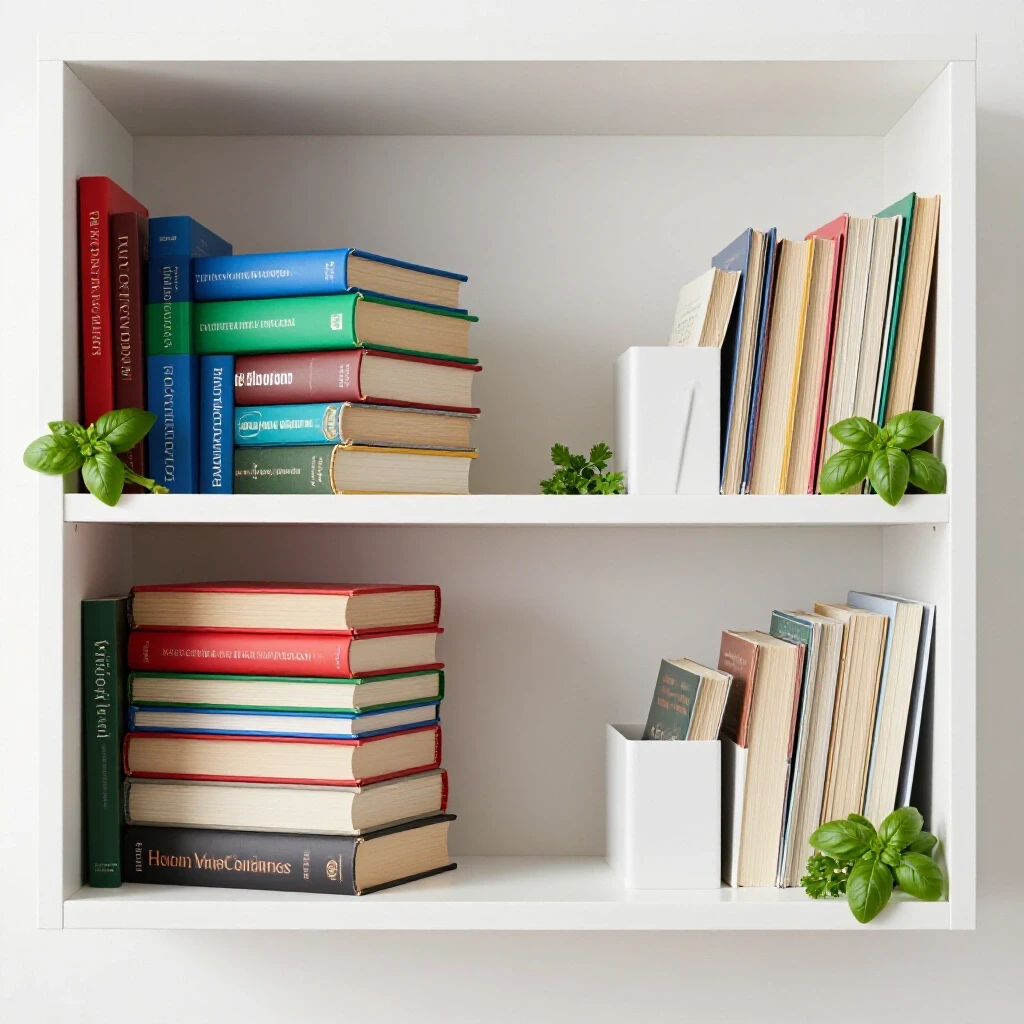
As a parent and a professional, I realized that our storage for printed volumes needed to mirror a well-oiled warehouse. It had to be intuitive enough for a tired adult to use and simple enough for a child to respect. By applying spatial management principles, I transformed our overflowing shelves into a functional display that supports our lifestyle. This guide focuses on the logistics of managing your physical book collection to ensure your kitchen remains a calm, productive environment.
The Spatial Psychology of Kitchen Volume Management
Spatial psychology examines how the physical environment influences our stress levels and decision-making processes. When a kitchen counter is crowded with mismatched spines and bulky binders, it creates visual processing overload, making the room feel smaller and more chaotic than it actually is.
In logistics, we call this “visual noise.” Every item your eyes land on requires a micro-decision: Should I move this? Does this belong here? Over time, this leads to decision fatigue. For a busy professional, coming home to a kitchen filled with disorganized stacks of books adds to the mental load of the day. Research in environmental psychology suggests that clear surfaces and organized vertical storage can significantly lower cortisol levels in residents. By streamlining how we store our printed collections, we are not just cleaning a room; we are reclaiming mental energy.
Understanding Visual Processing Overload
Visual processing overload occurs when the brain is forced to interpret too many distinct shapes, colors, and textures simultaneously. In the context of a book collection, this happens when volumes of different sizes are shoved into a single space without a logical order.
When our brains cannot find a pattern, we perceive the space as “cluttered,” even if the items are technically on a shelf. To combat this, we must apply industrial sorting principles to our home libraries. This means grouping items by height or spine color to create a cohesive visual “block” that the brain can process as a single unit rather than twenty separate objects.
Reducing Retrieval Friction in Culinary Storage
Retrieval friction is the measurable amount of effort required to take an item out and, more importantly, put it back. If you have to move a heavy mixer to reach a specific volume, or if books are packed so tightly that they require two hands to extract, the system is high-friction and will eventually fail.
In my home, I found that our “failed container models” often involved deep bins where books were stacked horizontally. To get the book at the bottom, my children would have to remove everything on top. Naturally, they never put the books back. We transitioned to a “vertical-only” rule. By ensuring every spine is visible and accessible without moving another object, we reduced our retrieval time from fifteen seconds to under two.
The Storage Friction Index by Bin and Shelf Type
| Storage Method | Friction Level | Retrieval Steps | Sustainability Rating |
|---|---|---|---|
| Deep Opaque Bins | High | 4-5 steps | Low |
| Tight Horizontal Stacks | Medium-High | 3-4 steps | Medium-Low |
| Open Vertical Shelving | Low | 1-2 steps | High |
| Forward-Facing Ledges | Very Low | 1 step | Very High |
A Logical Framework for Selective Retention
Selective retention is the process of auditing a collection based on its functional utility and aesthetic value. Instead of keeping every printed volume we have ever owned, we must treat our shelf space as “prime real estate” that must be earned.
In logistics, we use a “velocity report” to see how often items move. You can apply this to your home by looking at which books you actually touch. If a volume has not been opened in a year and does not contribute to the room’s design, it is “dead stock.” Removing these items increases your spatial capacity, allowing the books you actually use to breathe and stay organized.
The Use-Aesthetic Matrix for Sorting
- High Use / High Aesthetic: These are your “anchor volumes.” They belong at eye level in the most accessible zones.
- High Use / Low Aesthetic: These are your workhorses. They should be placed in easy-access areas but perhaps stored in a uniform binder or behind a cabinet door.
- Low Use / High Aesthetic: These function as decor. Place them on higher shelves where they can be seen but don’t take up prime workspace.
- Low Use / Low Aesthetic: These are candidates for removal or long-term archival storage in a different room.
Designing High-Efficiency Zoning for Printed Volumes
Zoning is the practice of dividing a room into specific areas based on the frequency of activity. In a kitchen, your “Zone A” is the immediate workspace, while “Zone C” might be the top of a pantry or a distant corner shelf.
By mapping your kitchen, you can ensure that your most-used books are within arm’s reach of where you actually stand. This reduces “travel time” within the room. In our house, we mapped our kitchen and found that we were storing our favorite volumes across the room from our prep area. By moving them just four feet closer, we maintained the system for months because it finally aligned with our natural movement patterns.
Standard Item-Density Guidelines for Shelving
To maintain a functional system, you should never exceed an 80% utilization rate for your shelf space.
- Total Linear Inches: Measure the total width of your shelves.
- Target Capacity: Multiply that number by 0.80.
- The “Breathing Room” Rule: The remaining 20% of space allows for easy retrieval and prevents the “clamped” look that increases visual stress.
- Sorting Time-Box: Dedicate 15 minutes every three months to ensure the 80% rule is still being met.
Custom Shelving and Aesthetic Integration
Aesthetic integration ensures that your storage solutions don’t look like an afterthought. When storage matches the architecture of the home, it feels permanent and intentional, which encourages family members to respect the system.
For many families, DIY solutions like custom-built floating shelves or uniform binders can bridge the gap between function and style. If you have a collection of loose papers or thin softcovers, placing them in matching high-quality binders creates a clean, uniform look. This hides the “visual noise” of mismatched covers while keeping the information accessible.
Building a Low-Maintenance Storage Configuration
- Use Floating Ledges: These are excellent for displaying the “current favorites” and keeping them off the counter.
- Install Heavy-Duty Brackets: Printed volumes are surprisingly heavy; ensure your shelving can handle 20-30 pounds per linear foot.
- Incorporate Uniform Dividers: Use sturdy bookends to prevent the “domino effect” when one book is removed.
- Label the “Home”: A small, discreet label on the shelf edge can tell family members exactly where a volume belongs.
Building Sustainable Habit Loops for the Family
A habit loop is a three-part process: a cue, a routine, and a reward. To keep a kitchen organized, the “cue” is finishing a task, the “routine” is returning the book to its zone, and the “reward” is a clear, stress-free workspace for the next day.
In our family, we established a “One-In, One-Out” policy. If I buy a new hardcover, an old one must be donated or moved to the basement. This prevents “spatial creep,” where the collection slowly grows until it overwhelms the designated storage area. By setting these boundaries, we manage the inflow and outflow of items with minimal effort.
Daily Maintenance Timelines by Family Size
The time required to maintain your system scales with the number of people using it. However, with a low-friction system, these times remain manageable.
- 1-2 People: 2 minutes of daily “reset” time to return volumes to shelves.
- 3-4 People: 5 minutes of daily “reset” time; requires a designated “return station” for books used during the day.
- 5+ People: 8 minutes of daily “reset” time; involves a weekly audit to ensure books haven’t migrated to other rooms.
Case Study: The Bennett Family Kitchen Pivot
Three years ago, our kitchen was at a breaking point. We had 45 printed volumes crammed into a single cabinet. It took an average of 22 seconds to find a specific book and 40 seconds to put it back because of the tight fit. We were suffering from “system friction.”
We performed a spatial audit and realized only 12 of those books were used regularly. We moved 20 to a decorative shelf in the dining room and donated the rest. We then installed two open-access ledges near the stove. The results were measurable: – Retrieval Time: Dropped from 22 seconds to 3 seconds. – Countertop Clearance: Increased by 15% as books no longer sat out in piles. – Maintenance Adherence: The system has remained intact for over 18 months without a major “re-organizing” session.
Next Steps for a Functional Kitchen
Establishing a sustainable system for your printed collection does not require a total renovation. It requires a shift in how you view your space and your items.
- Perform a 10-minute audit: Identify the five books you use most and the five you haven’t touched in years.
- Measure your friction: Try to pull out a book. If it takes more than one hand or involves moving other items, your friction is too high.
- Create a Zone A: Clear a small space at eye level for your most-used volumes.
- Adopt the 80% Rule: Remove enough items so that your shelves feel “light” and easy to navigate.
Frequently Asked Questions
How do I decide which books to keep in the kitchen and which to move? Focus on frequency of use and physical condition. If you use a book at least once a month, it belongs in the kitchen. If you keep it for sentimental reasons or because it has a beautiful cover, but you rarely open it, move it to a bookshelf in a living or dining area where it serves as decor.
What is the best way to organize books of different heights? To reduce visual noise, group books by height. This creates a “staircase” effect or a clean horizontal line that is easier for the brain to process. Avoid “sandwiching” small books between large ones, as this makes the small ones harder to see and retrieve.
How can I stop my family from leaving books on the counter? Usually, this happens because the “home” for the book is too hard to reach. Ensure that the shelf is at a comfortable height (between waist and eye level) and that there is enough “breathing room” to slide the book back in with one hand.
Are binders better than original covers for organization? Binders are excellent for loose pages or softcovers that don’t stand up well on their own. They provide a uniform look that reduces visual clutter. However, for high-quality hardcovers, original spines are often more durable and easier to grip.
How often should I declutter my collection? A quick audit every six months is usually enough. Look for volumes that are physically damaged or those that no longer align with your current lifestyle. If you haven’t reached for a book in two full seasons, it is likely taking up valuable space.
What should I do with books that have sentimental value but are never used? Treat them as “archival items.” They don’t need to occupy prime kitchen real estate. Move them to a higher shelf, a glass-front cabinet in another room, or a dedicated memory box. This honors the sentiment without cluttering your workspace.
How do I handle oversized books that don’t fit on standard shelves? Oversized volumes are best stored on lower shelves or in a horizontal stack of no more than three books. Stacking them horizontally can actually serve as a “pedestal” for a smaller decorative item, integrating them into the room’s design.
Is it better to have open shelves or closed cabinets for books? Open shelves have lower retrieval friction, making them better for books you use daily. Closed cabinets are better for protecting volumes from kitchen grease and dust, but they add an extra step to the retrieval process. I recommend a mix: open shelves for “Zone A” favorites and closed cabinets for the rest.
(This article was written by one of our staff writers, Christopher Bennett. Visit our Meet the Team page to learn more about the author and their expertise.)