How to Build DIY Closet Shelves on a Budget (Step-by-Step Guide)

Discussing safety is the most critical starting point for any home modification. In my twelve years as a facilities manager, I have seen how small oversights lead to significant property damage or personal injury. Before you pick up a saw or a drill, you must account for what lies behind your drywall, such as electrical conduits or copper plumbing lines.
When I moved into my first fixer-upper, I rushed a small storage project in a hallway closet. I assumed the wall was clear, but I narrowly missed a main vent stack because I didn’t use a reliable sensor. That moment taught me that even a simple weekend task requires the same rigor I apply to commercial building maintenance. Since then, I have prioritized using manufacturer-recommended fasteners and double-checking every measurement against the actual dimensions of the space.
Planning Functional Storage for Small Spaces
Planning involves assessing your current storage needs, measuring the physical dimensions of the closet, and determining the weight capacity required for your items. This phase ensures that the materials you purchase will fit the space and support your belongings without sagging or pulling away from the wall over time.
Before buying lumber, I always sketch a layout on graph paper. This prevents me from over-buying materials and helps me visualize the vertical spacing. For a standard reach-in closet, I recommend a depth of 12 to 16 inches for the planks. This provides enough room for folded clothes or bins without making the closet feel cramped.
I follow a simple rule: measure twice, then measure again. Walls in older homes are rarely perfectly square or plumb. If you cut your wood based on a single measurement at the back of the closet, you might find the front is a quarter-inch wider, leaving a visible gap. I take measurements at the back, middle, and front to ensure a snug fit.
Estimating Time and Labor Requirements
Estimating the time for a project allows you to manage your weekend effectively without leaving your home in a state of disarray. A typical custom rack installation takes between six and ten hours of active work, depending on the complexity of the layout and your familiarity with power tools.
In my experience, the “active hours” are often interrupted by hardware store runs or tool issues. I break the project into two distinct blocks. Saturday is for measuring, purchasing materials, and cutting the wood. Sunday is for installation and finishing. This schedule allows for any paint or wood glue to dry overnight, which is a standard practice in professional facility maintenance.
| Project Phase | Estimated Active Time | Difficulty Rating (1-10) |
|---|---|---|
| Site Prep & Measuring | 1.5 Hours | 3 |
| Material Sourcing | 2.0 Hours | 2 |
| Cutting & Sanding | 2.0 Hours | 5 |
| Installation & Leveling | 3.0 Hours | 6 |
| Finishing & Cleanup | 1.5 Hours | 4 |
Essential Tool Inventory and Safety Protocol
A proper tool inventory includes the specific equipment needed to measure, cut, and secure wood components to a wall. Having the right tools on hand prevents the frustration of mid-project stops and ensures that the final assembly is level, secure, and compliant with basic residential building standards.
I maintain a “go-bag” for my home projects that mirrors what I use at work. For building wooden storage, you don’t need high-end industrial machinery. A basic circular saw or even a hand saw can handle the cuts. However, a high-quality stud finder is non-negotiable. It is the only way to ensure your brackets are anchored into the structural framing of the house rather than just the fragile drywall.
- Stud Finder: A device used to locate the vertical wood framing members behind the wall.
- Spirit Level: A tool with a bubble-filled vial used to ensure the racks are perfectly horizontal.
- Power Drill/Driver: Used for boring pilot holes and driving screws into the studs.
- Circular Saw or Miter Saw: For making clean, straight cuts in your lumber.
- Tape Measure: A steel ribbon marked with inches and centimeters for precise layout.
- Safety Glasses and Dust Mask: Essential PPE (Personal Protective Equipment) to protect your eyes from splinters and lungs from sawdust.
Understanding Fastener Ratings and Load Limits
Fastener ratings refer to the amount of weight a screw or anchor can safely hold before failing. Using the wrong screw can lead to the entire structure collapsing under the weight of your stored items, which is a common failure point in many amateur home upgrades.
I always use 2.5-inch or 3-inch wood screws to ensure at least 1.5 inches of the thread enters the wall stud. Drywall is typically 0.5 inches thick, so a short screw will barely grab the wood behind it. According to many manufacturer technical guides, a single #8 wood screw driven into a pine stud can support significant shear weight, but the weak link is often the bracket or the wood itself.
- Shear Strength: The ability of a fastener to resist forces that want to “slice” it off.
- Withdrawal Strength: The force required to pull a screw straight out of the wood.
- Pilot Hole: A small hole drilled before the screw is inserted to prevent the wood from splitting.
Material Selection for Budget-Friendly Upgrades
Material selection involves choosing between different types of wood, such as pine, plywood, or medium-density fiberboard (MDF), based on cost and durability. This step determines the longevity of the project and how much you will spend on raw materials versus the cost of a professional installation.
For my own home, I often choose 3/4-inch sanded plywood or 1×12 pine boards. Pine is affordable and easy to work with, but it can warp if the closet is in a high-humidity area like a laundry room. Plywood is more stable but requires “edge banding” or a small trim piece to hide the layered edges. I avoid particle board because it sags easily and doesn’t hold screws well over time.
| Material Type | Cost per Linear Foot | Durability | Best Use Case |
|---|---|---|---|
| Pine (Solid Wood) | Moderate | High | Heavy clothing or tools |
| Sanded Plywood | Moderate | High | Wide shelves or bins |
| MDF | Low | Moderate | Light linens or shoes |
| Primed Finger-Joint | Low | Moderate | Cleats and supports |
Why Support Cleats are Better than Brackets Alone
A support cleat is a thin strip of wood screwed horizontally into the wall studs that the shelf sits upon. This method distributes the weight across multiple studs rather than putting all the stress on a few individual metal brackets, which is a safer and more professional approach.
When I installed a new system in my guest room, I used 1×2 pine strips as cleats along the back and sides of the closet. This creates a “ledge” for the wood planks to rest on. It is much easier to level a single long strip of wood than it is to align four or five separate brackets. In facility management, we call this “redundant support,” and it is a hallmark of a project built to last.
Step-by-Step Execution of the Installation
The execution phase is the sequence of physical tasks required to turn raw lumber into a finished storage system. This includes marking the walls, cutting the wood to size, securing the supports, and performing a final load test to ensure the structure is safe for daily use.
I start by clearing everything out of the closet. This gives me room to move and prevents dust from getting on my clothes. I use a pencil to mark the height of each rack on the wall. I then use my level to draw a line across the entire length of the closet. This line is my guide for the support cleats.
- Locate and mark all studs within the closet area using a stud finder.
- Cut your support cleats to the length of the back and side walls.
- Drill pilot holes in the cleats at each stud location to prevent splitting.
- Screw the cleats into the studs, checking for level as you go.
- Measure the distance between the side cleats and cut your main planks to fit.
- Place the planks onto the cleats and secure them with small finish nails or screws.
Troubleshooting Uneven Walls and Missed Studs
Troubleshooting involves identifying and fixing errors that occur during the build, such as a screw that doesn’t hit a stud or a wall that bows outward. Learning to adapt to these common house quirks is what separates a successful DIYer from someone who gets frustrated and gives up.
If I miss a stud, I don’t just leave the hole. I back the screw out and use a toggle bolt or a high-quality drywall anchor rated for at least 50 pounds. However, I never rely solely on anchors for the main weight-bearing supports. If a wall is bowed, I might need to “scribe” the wood, which means trimming the edge of the plank to match the curve of the wall. This is a more advanced technique, but it results in a much cleaner look.
Finishing and Long-Term Maintenance
Finishing includes sanding down rough edges and applying a protective coating like paint or polyurethane to the wood. Maintenance involves periodically checking the fasteners to ensure they haven’t loosened and verifying that the wood isn’t showing signs of excessive stress or sagging.
I prefer to paint my supports before they go on the wall. It saves me the trouble of trying to paint inside a dark, cramped closet later. I use a durable semi-gloss enamel paint because it is easy to wipe clean if shoes or boxes leave scuff marks. Once the project is done, I do a “dry-fit” test by placing a few heavy items on the racks and watching for any movement or noise.
- Sanding: Using 120-grit followed by 220-grit sandpaper to make the wood smooth to the touch.
- Cure Time: The time it takes for paint or finish to reach its maximum hardness, usually 24 to 48 hours.
- Load Testing: Gradually adding weight to the structure to ensure it is stable.
When to Call a Professional
Knowing when to call a professional is a vital safety skill. If you discover mold behind your old shelves, see frayed electrical wiring, or find that your walls are structurally unsound, it is time to stop and consult a licensed contractor.
In my career, I have seen “simple” projects turn into major renovations because a homeowner ignored a leaky pipe or a cracked floor joist. If you are uncomfortable with a power saw or if the closet walls are made of crumbling plaster that won’t hold an anchor, there is no shame in seeking help. A safe home is more important than a completed DIY project.
Project Summary and Final Checklist
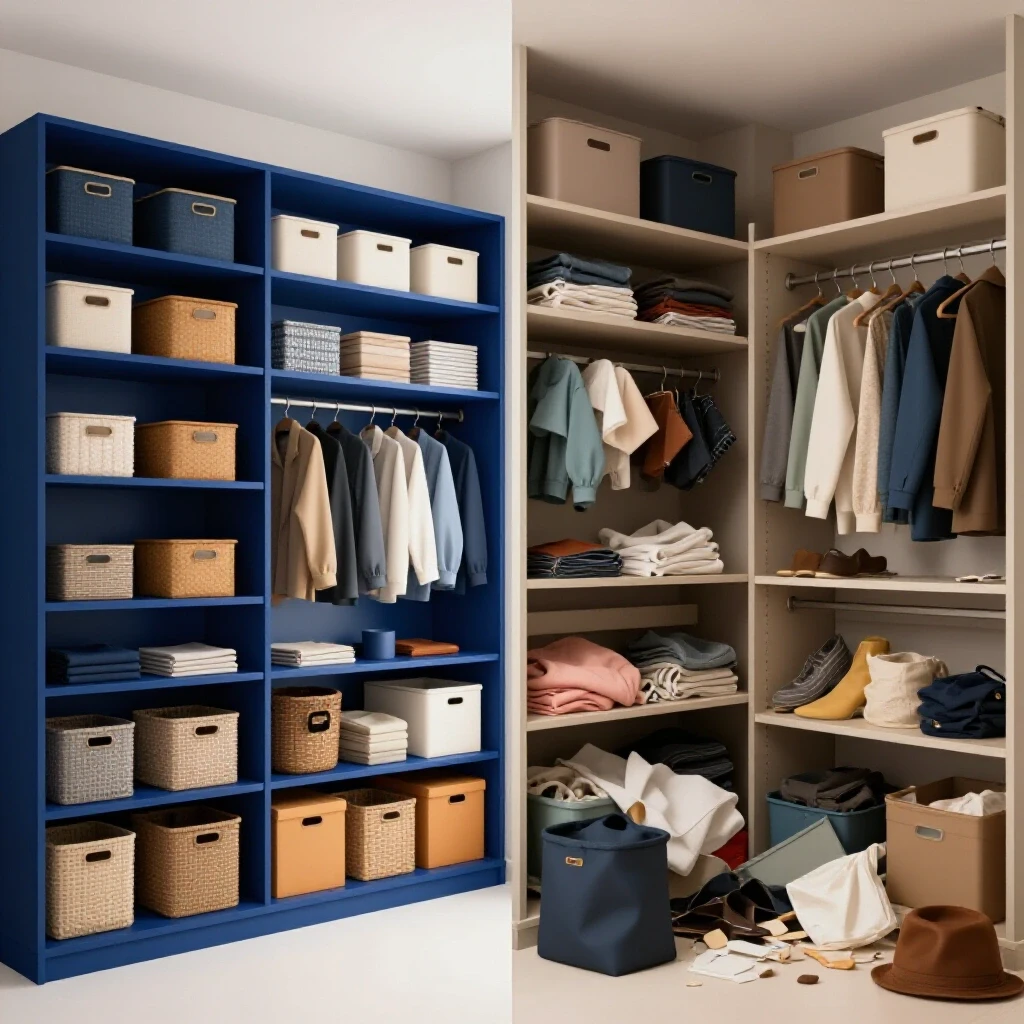
To wrap up your weekend project, go through a final quality control checklist. This ensures that you haven’t missed any safety steps and that the closet is ready for use. A well-organized closet not only adds value to your home but also reduces daily stress by making your belongings easier to find.
- Are all screws driven into studs or secured with heavy-duty anchors?
- Is every surface level and stable when pushed?
- Have all sharp edges and splinters been sanded down?
- Is there adequate clearance for the closet door to open and close?
- Have you cleaned up all sawdust and debris from the floor?
By following these steps, you have transformed a cluttered space into a functional storage area. The skills you learned here, from finding studs to leveling supports, will serve you well in future home upgrades.
Frequently Asked Questions
What is the best wood to use for affordable shelving?
For most budget-conscious projects, 3/4-inch plywood or 1×12 pine boards offer the best balance of cost and strength. Pine is easier to find and cut, while plywood is less likely to warp over time. Avoid thin MDF or particle board for heavy items, as they tend to sag under weight.
How do I find studs if my stud finder is unreliable?
You can use a strong magnet to find the screws or nails that hold the drywall to the studs. Alternatively, look for electrical outlets, which are almost always mounted to the side of a stud. Tapping on the wall and listening for a “solid” thud versus a hollow sound can also help narrow down the location.
How much weight can a standard wooden shelf hold?
A shelf supported by cleats screwed into studs every 16 inches can typically hold 40 to 50 pounds per linear foot. However, this depends on the thickness of the wood and the depth of the shelf. Deeper shelves (over 12 inches) create more leverage and may require additional brackets for support.
Do I need to use wood glue for this project?
While not strictly necessary for basic closet storage, wood glue adds a layer of “mechanical bond” between the cleats and the planks. It can help prevent the wood from squeaking or shifting over time. If you use glue, remember that it is permanent and will make future disassembly difficult.
Can I install these in a closet with plaster walls?
Plaster walls are much more brittle than drywall and often require specialized masonry bits and anchors. In older homes, it is even more critical to find the underlying wood lath or studs. If the plaster is crumbling, you may need to mount a “backer board” to the studs first to provide a solid surface.
What is the most common mistake people make with this project?
The most frequent error is failing to hit the studs. Relying on plastic drywall anchors for heavy storage is a recipe for failure. Another common mistake is not checking for level at every step, resulting in shelves that look slanted or cause items to slide off.
How do I prevent the wood from sagging in the middle?
For spans longer than 36 inches, you should add a vertical support or a center bracket. You can also “stiffen” the shelf by attaching a 1×2 trim piece to the front edge. This creates an “L” shape that significantly increases the wood’s resistance to bending.
Is it necessary to paint or seal the wood?
Sealing the wood protects it from moisture and prevents it from absorbing odors. In a closet, raw wood can also snag delicate fabrics like silk or wool. A simple coat of water-based polyurethane or a durable latex paint is usually enough to provide a smooth, protective surface.
How much money will I save by doing this myself?
A professional closet installation can cost anywhere from $500 to $1,500 depending on the size. By purchasing your own lumber and hardware, you can often complete the same task for $100 to $200. The primary “cost” is your time and the investment in basic tools.
What should I do if my walls are not square?
Very few walls are perfectly 90 degrees. To handle this, measure the width at the back of the shelf and the front. Cut your wood to the smaller measurement, or “scribe” the end of the board by holding it against the wall and tracing the gap with a compass. This allows you to trim the wood to fit the exact contour of the wall.
(This article was written by one of our staff writers, Robert Callahan. Visit our Meet the Team page to learn more about the author and their expertise.)