How to Build a Space-Efficient Corner Desk for Home Offices (Guide)

In today’s world of fast furniture and disposable products, choosing to build your own custom L-shaped workstation is a significant step toward eco-consciousness. By selecting high-quality, sustainable materials like FSC-certified plywood and low-VOC finishes, you reduce the environmental impact of shipping and the waste of short-lived particleboard items. I have spent 12 years managing facilities and upgrading two personal homes, and I have learned that building something that lasts is the ultimate form of sustainability. This guide focuses on creating a durable, space-saving corner surface that fits your specific room layout while respecting both your budget and the planet.
Assessing the 90-Degree Workspace Area
This initial phase involves analyzing the specific corner where you plan to install your new surface. You must evaluate wall squareness, identify stud locations, and determine the ideal height for ergonomic use. Proper assessment ensures the final structure fits tightly against the walls without gaps or structural stability issues.
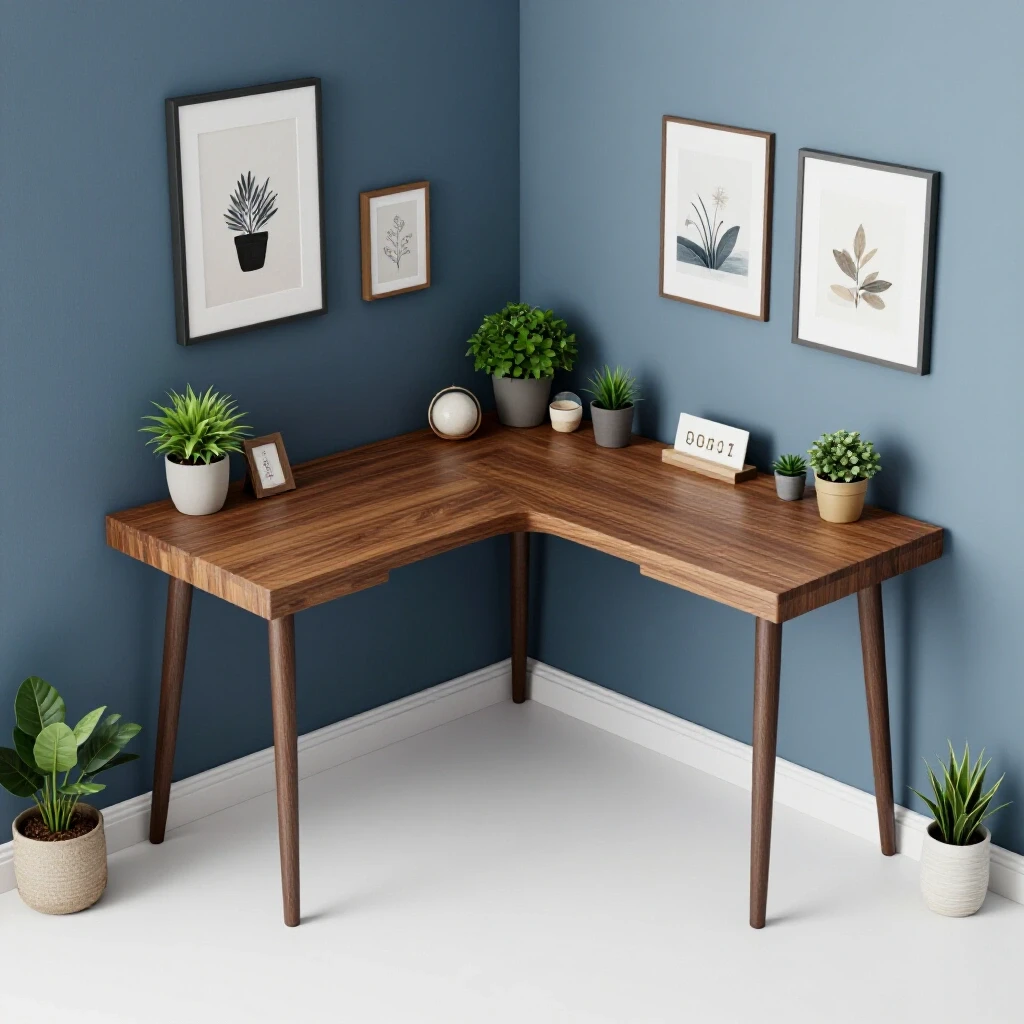
Before you buy a single piece of wood, you need to understand the reality of your walls. In my experience, very few corners in a standard home are a true 90-degree angle. Over time, houses settle, and drywall mud builds up in corners, creating slight curves. If you cut a piece of plywood at a perfect 90-degree angle, you might find a frustrating gap when you try to slide it into place. To avoid this, I use the 3-4-5 rule. Measure three feet out from the corner on one wall and four feet out on the other. The diagonal distance between those two points should be exactly five feet if the corner is square.
Measuring for a Custom L-Shaped Workstation
Accurate measurements are the foundation of any successful home project. You must record the length of both wall sections, the desired depth of the surface, and the height from the floor. These dimensions will dictate how much material you need and how the support structures will be positioned for maximum safety.
Standard desk height is usually between 28 and 30 inches. However, since you are the builder, you can customize this to your own height. Sit in your preferred chair and measure the distance from the floor to your elbows. This is often the most comfortable height for a typing surface. When measuring the length, consider any obstructions like baseboard heaters or electrical outlets. You do not want to block access to your power sources, as moving them would require a licensed electrician and significantly increase your project timeline.
Identifying Wall Studs and Support Points
Locating the vertical framing members inside your walls is critical for a wall-mounted corner platform. These studs are the only parts of the wall capable of holding the weight of the wood and the items you place on it. Identifying them early prevents the risk of the structure pulling away from the drywall.
Most modern homes have studs spaced 16 inches apart on center. Use a high-quality stud finder to mark these locations along both walls of the corner. I always verify my stud finder’s reading by using a small trim nail to poke holes in the wall where I think the stud is. Since these holes will be covered by the desk surface or support cleats, they are a safe way to ensure you are hitting solid wood.
Essential Tools for Building a Space-Saving Corner Surface
Having the right equipment is the difference between a frustrating weekend and a successful project. This list includes the basic hand and power tools required to cut, sand, and mount your materials safely. Each tool serves a specific purpose in ensuring the structural integrity and finish of your workspace.
- Circular Saw: Used for making long, straight cuts in plywood sheets.
- Power Drill and Driver: Essential for pre-drilling holes and driving screws into wall studs.
- Level (at least 4 feet long): Necessary to ensure the surface is flat and not tilted.
- Stud Finder: A reliable tool to locate the vertical supports behind your drywall.
- Orbital Sander: Provides a smooth finish to the wood surface before sealing.
- Clamps: Useful for holding pieces together during assembly or glue-up.
- Tape Measure: A standard 25-foot tape is sufficient for this project.
- Safety Gear: This includes ANSI-rated safety glasses, ear protection, and a dust mask.
| Tool Type | Essential or Optional | Purpose | Estimated Cost |
|---|---|---|---|
| Circular Saw | Essential | Cutting plywood to size | $50 – $120 |
| 4-Foot Level | Essential | Ensuring a flat work surface | $20 – $40 |
| Orbital Sander | Essential | Smoothing the wood grain | $40 – $80 |
| Kreg Jig | Optional | Creating hidden pocket holes | $40 – $100 |
| Speed Square | Essential | Marking 90-degree lines | $10 – $15 |
Selecting Materials for an Angled Home Office Surface
Choosing the right wood and fasteners determines the longevity and weight capacity of your project. You need to balance cost with durability, selecting materials that can withstand daily use without warping or sagging. This section covers the best types of plywood and the hardware needed for a secure installation.
I recommend using 3/4-inch hardwood plywood, such as birch or oak. Avoid 1/2-inch plywood, as it lacks the stiffness required for a long span and will likely sag under the weight of a computer or books. Hardwood plywood has a thin veneer of nice wood on the outside and a solid core, making it both attractive and strong. For the support system, you will need 2×2 or 2×4 lumber to create “cleats” that screw directly into the wall studs.
Understanding Plywood Grades and Core Strength
Plywood is categorized by the quality of its surface veneers, ranging from Grade A to Grade D. For a furniture project, you should look for A-B or B-C grades, which have at least one side that is smooth and free of large knots. The internal layers also matter for screw-holding strength and overall stability.
When you go to the lumber yard, look for “Cabinet Grade” plywood. It has more layers than standard construction plywood, which makes it much more stable. In my 12 years of DIY, I have seen many projects fail because the builder used cheap CDX plywood that warped within a month. Spending an extra $20 on a higher-grade sheet is a wise investment that saves you from having to rebuild the entire project later.
Hardware and Fasteners for Structural Integrity
The screws and brackets you choose are the only things keeping your desk from falling. You must use fasteners that are long enough to penetrate through the drywall and deep into the wood studs. This ensures the load is transferred to the house’s framing rather than the fragile gypsum board.
- Wall Cleat Screws: 3-inch or 3.5-inch #10 wood screws.
- Plywood to Cleat Screws: 1.25-inch wood screws.
- Wood Glue: A high-quality PVA glue for all wood-to-wood joints.
- Heavy-Duty Brackets: If your desk spans more than 4 feet, consider adding a metal L-bracket for mid-span support.
Step-by-Step Construction of the Wall-Mounted Corner Platform
This phase covers the actual assembly, from the first cut to the final mounting. Following a logical order of operations prevents common mistakes, such as forgetting to sand before assembly or mounting the supports at the wrong height. We will move through cutting, sanding, and the critical dry-fit process.
I always start by cutting my wall cleats first. These are the wooden strips that will act as a shelf for the plywood to sit on. By installing these first, you can double-check your measurements against the actual wall before you cut your expensive hardwood plywood. This “measure twice, cut once” philosophy has saved me hundreds of dollars in wasted materials over the years.
Cutting and Shaping the 90-Degree Angle Desk
Using a circular saw to cut large sheets of plywood requires a steady hand and a straight edge. You will need to cut two rectangular pieces that meet in the corner or one large L-shape if your plywood sheet is big enough. Precision here is vital for a clean look where the two pieces join.
To get a professional-looking cut with a circular saw, I use a “sacrificial” piece of foam insulation board on the floor. Lay the plywood on top of the foam and set your saw blade depth to just barely cut through the wood. This supports the wood and prevents the bottom from splintering. Always use a straight edge or a guide rail clamped to the plywood to ensure your cuts are perfectly straight. If you are joining two pieces to form the “L,” a miter joint is difficult for beginners; a simple butt joint is much easier to execute and can be very strong if glued and screwed properly.
Securing the Framework to the Wall Studs
Installing the support cleats is the most important part of the project for safety. These must be perfectly level and screwed directly into the studs you located earlier. If the cleats are not level, your desk will be tilted, which is not only annoying but also causes items to roll off.
- Mark a level line at your desired height (minus the thickness of the plywood) along both walls.
- Hold your 2×2 cleat up to the line and transfer your stud marks onto the wood.
- Pre-drill holes in the cleat to prevent the wood from splitting.
- Drive the 3-inch screws through the cleat and into the studs.
- Check for level again after the first screw is in, then finish the rest.
| Project Phase | Active Time | Waiting/Cure Time | Difficulty (1-10) |
|---|---|---|---|
| Planning & Measuring | 1 Hour | 0 Hours | 2 |
| Cutting & Sanding | 3 Hours | 0 Hours | 5 |
| Cleat Installation | 2 Hours | 0 Hours | 4 |
| Assembly & Mounting | 2 Hours | 12 Hours (Glue) | 6 |
| Finishing (Stain/Seal) | 2 Hours | 24-48 Hours | 3 |
Why Skipping Dry-Fitting Leads to Project Failure
Dry-fitting is the process of assembling your project without glue or permanent fasteners to check the fit. This step allows you to identify issues with wall angles or measurements while they are still easy to fix. Skipping this stage is a common mistake that often results in a desk that doesn’t fit its intended space.
I once spent an entire Saturday building a custom surface, only to find that the corner of my room was actually 92 degrees, not 90. Because I hadn’t dry-fitted the piece, I had already applied glue and permanent screws. I had to rip the whole thing apart, damaging the wood in the process. Now, I always place the plywood on the wall cleats first. If there is a gap against the wall, I use a tool called a “scribe” to mark the curve of the wall onto the wood, then trim it for a tight fit.
Safety Protocols and Code Compliance
While a desk is not usually governed by strict residential building codes like a deck or an addition, you should still follow basic safety principles. These include weight-bearing limits and ensuring you do not interfere with electrical or fire safety systems. Safety is always the priority when modifying your living space.
According to general construction standards, a wall-mounted cleat system using #10 screws into studs can support significant weight, but you should aim for a “safety factor.” If you expect the desk to hold 50 pounds of equipment, build it to hold 200 pounds. This accounts for someone accidentally leaning on the desk. Also, ensure your desk does not block any egress points (windows or doors) required by fire codes.
- Always wear eye protection when using power tools to prevent flying wood chips from causing injury.
- Use a dust mask or respirator when sanding plywood, as the glues used in the wood can be irritating to the lungs.
- Ensure all power cords are in good condition and that you are using a GFCI-protected outlet if working in a garage or basement.
Final Finishing and Maintenance
The finish protects the wood from spills, scratches, and humidity changes. A well-applied finish also makes the surface easier to clean and enhances the natural beauty of the wood grain. This section covers the final steps to transition your project from a raw construction to a piece of home furniture.
After your dry-fit is successful and you have permanently attached the surface to the cleats, it is time to sand. Start with 80-grit sandpaper to remove any major imperfections, then move to 120-grit, and finish with 220-grit for a smooth touch. For the sealer, I prefer a water-based polyurethane. It dries quickly, has a low odor, and doesn’t yellow over time. Apply at least three coats, lightly sanding with 320-grit paper between each coat to remove any “nibs” or dust particles.
Troubleshooting Common Installation Hurdles
Even with careful planning, you might encounter issues like stripped screws or wood that splits during assembly. Knowing how to recover from these small failures is what separates a seasoned DIYer from a frustrated beginner. Most problems have simple solutions if you stay calm and analytical.
If you strip a screw hole in a wall stud, do not try to force a larger screw into it. Instead, take a few toothpicks or a small wooden dowel, coat them in wood glue, and jam them into the hole. Once the glue dries, cut them flush and re-drill a smaller pilot hole. This gives the screw new wood fibers to bite into. If your plywood splinters while cutting, it usually means your saw blade is dull or you are moving too fast. Slow down and use a high-tooth-count finishing blade for cleaner results.
Conclusion and Next Steps
Building a custom L-shaped workstation is a rewarding project that maximizes the efficiency of your home. By following these steps, you have created a functional, sturdy surface that fits your space perfectly without the high cost of a professional contractor. Your next steps are to let the finish cure fully before placing heavy equipment on the surface and to periodically check the wall fasteners to ensure they remain tight. This project not only saves money but also builds the skills you need for more complex home upgrades in the future.
FAQ
How much weight can a wall-mounted corner platform actually hold? When properly secured into at least three or four wall studs using 3-inch #10 wood screws, a 3/4-inch plywood surface with a 2×2 cleat system can easily support 150 to 200 pounds. However, the weight should be distributed evenly. If you plan on placing very heavy items in the center of a long span, you must add a support leg or a heavy-duty steel bracket to prevent the wood from bowing over time.
Do I really need to use a level, or can I just measure from the floor? You must use a level. Floors in many homes are not perfectly flat or level. If you measure up 30 inches from a sloped floor at several points, your desk will be sloped as well. Using a 4-foot level ensures that the work surface is perfectly horizontal, regardless of any imperfections in the flooring.
What is the best way to hide the raw edges of the plywood? Raw plywood edges show the internal layers, which can look unfinished. The best way to hide them is by using “edge banding,” which is a thin strip of real wood veneer with heat-activated glue on the back. You simply iron it onto the edge, trim the excess with a utility knife, and sand it smooth. Alternatively, you can nail a thin strip of solid wood trim to the edge for a more robust look.
Can I build this project using only hand tools? While it is possible, it is significantly more difficult and time-consuming. Cutting a 4×8 sheet of 3/4-inch plywood with a hand saw requires a lot of physical effort and makes it harder to maintain a perfectly straight line. A circular saw and a power drill are the minimum power tools I recommend for a project of this scale to ensure the results are safe and functional.
How do I handle a corner that is nowhere near 90 degrees? If your corner is significantly “out of square,” you should use a technique called scribing. Hold your plywood up to the wall as close as it will go. Set a compass to the width of the largest gap. Run the point of the compass along the wall while the pencil side marks the plywood. Cut along that pencil line, and the wood will now follow the exact contour of your crooked wall.
Is it safe to mount this to metal studs instead of wood studs? Yes, but you cannot use standard wood screws. For metal studs, you must use toggle bolts or specialized heavy-duty metal piercing screws. Toggle bolts are generally preferred for heavy loads because they expand behind the metal track, providing a much stronger hold than threads alone.
How long should I wait before putting my computer on the new desk? You should wait at least 24 hours after the final coat of polyurethane is applied before putting lightweight items on the surface. For heavy equipment like monitors or desktop towers, I recommend waiting 72 hours. This allows the finish to “outgas” and harden sufficiently so that the feet of your equipment don’t leave permanent indentations in the finish.
What should I do if I hit an electrical wire while drilling into a stud? If you feel the drill bit “pop” through something or if your circuit breaker trips, stop immediately. Do not touch the screw or the drill. Turn off the power to that circuit at the main breaker box. You will need to open a small section of the drywall to inspect the damage. If a wire is nicked, it must be repaired according to the National Electrical Code (NEC), which usually means installing a junction box or pulling a new wire. If you are not comfortable with this, call a licensed electrician.
How do I prevent the plywood from “tear-out” when I’m cutting it? Tear-out happens when the saw blade teeth exit the wood, pulling fibers with them. To prevent this, place a strip of blue painter’s tape over your cut line before you start. The tape holds the wood fibers in place while the blade passes through. Also, ensure you are using a blade with at least 40 to 60 teeth designed for “finish” or “plywood” cuts.
Is it better to paint or stain the surface? This is a matter of preference, but staining shows the natural beauty of the wood grain. If you choose to paint, you must use a high-quality primer first, especially on plywood, to prevent the grain from “raising” and creating a rough texture. Use an enamel-based paint for the topcoat, as it dries harder and resists the sticking that can happen with standard latex wall paint.
(This article was written by one of our staff writers, Robert Callahan. Visit our Meet the Team page to learn more about the author and their expertise.)