How to Declutter Closets and Attics for Lasting Organization (Guide)

Does your home feel like a pressure cooker where the only way to find relief is to shove the excess behind a closed door? Most of us treat our closets and attics like a “purgatory” for items we aren’t ready to deal with yet. We tell ourselves we are organizing, but in reality, we are just relocating the chaos to a place where we don’t have to look at it every day.
In my eleven years managing logistics for large-scale operations, I have learned that “out of sight” rarely means “out of mind.” In fact, hidden clutter acts as a silent tax on your mental energy. My own journey into sustainable decluttering began when I realized my family’s hallway closet had become a safety hazard. Every time I opened the door, I had to brace myself for a falling vacuum attachment or a rogue board game. We would spend hours “cleaning” on Saturdays, only for the same closet to explode by Tuesday.
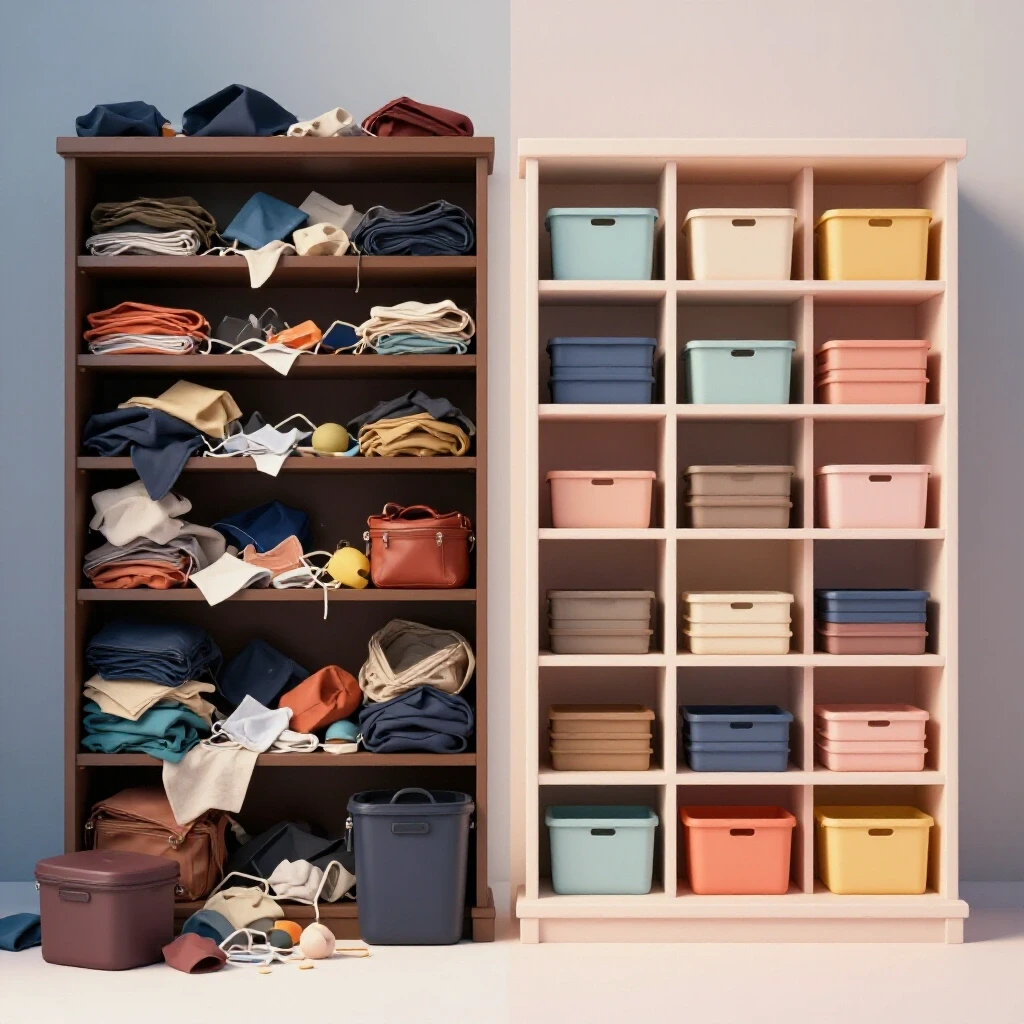
This happened because I was focused on how the space looked rather than how it functioned. I was using high-friction storage systems that required too many steps for my kids—and honestly, for me—to maintain. By applying industrial spatial management principles to our home, we shifted from temporary tidying to long-term functional home storage. We stopped trying to be “perfect” and started being efficient.
The Psychological Weight of Concealed Disorganization
Spatial psychology explores how our environment influences our stress levels and cognitive function. When we fill our internal cabinetry and upper-level storage areas with “decisions we haven’t made yet,” we create a background hum of anxiety that follows us through the day.
Even when doors are closed, your brain maintains a mental map of the items in your home. This is known as “cognitive load.” Research in environmental psychology suggests that physical disorder competes for your attention, leading to increased cortisol levels. For a busy parent, this manifests as feeling “touched out” or overwhelmed without a clear reason. By addressing the items tucked away in your attic or the back of your wardrobe, you aren’t just cleaning a shelf; you are clearing mental bandwidth.
Understanding Visual Processing Overload in Storage Spaces
Visual processing overload occurs when your brain is forced to scan too many items to find a single target. In a cluttered closet, every item is a piece of data your brain must sort through.
When you open a door to a wall of mixed items, your brain experiences a “micro-stress” event. If you have to move three boxes to find your winter boots, you are likely to leave the boots in the hallway later because the “retrieval cost” is too high. This is why many home organization systems fail within days; they ignore the human tendency to take the path of least resistance.
Why Traditional Closet Systems Fail Busy Families
Logistical failure in a home happens when the “inflow” of items exceeds the “outflow,” or when the system for storing those items is too complex for the users.
Most people buy storage bins based on how they look on a store shelf. However, in logistics, we evaluate a system based on “retrieval friction.” This is the number of physical steps required to get an item out or put it back. If a system requires you to unstack three bins, remove a lid, and move a heavy box, that system has high friction. High-friction systems are the primary reason homes revert to a cluttered state.
The Storage Friction Index
To help my family, I developed a simple way to measure why our closets were failing. We look at how many “touches” an item needs.
| Storage Method | Friction Score (1-10) | Why It Fails | Best Use Case |
|---|---|---|---|
| Lidded bins stacked 3-high | 9 | Too many steps to reach the bottom bin. | Long-term attic storage for seasonal decor. |
| Deep, dark shelves | 7 | Items at the back are forgotten and “lost.” | Large, rarely used items like camping gear. |
| Open-front bins/baskets | 2 | Zero lids to remove; easy to toss items inside. | Kids’ shoes, daily linens, or frequently used toys. |
| Clear drawers | 3 | Visibility is high; one-handed operation. | Craft supplies, office items, or toiletries. |
Retrieval Step Counts and System Failure
In our house, we aim for a “Two-Step Rule” for daily-use items. If it takes more than two steps to put something away, it will likely end up on a flat surface like a counter or chair. For example, hanging a coat on a hook is one step. Putting it on a hanger, opening the closet door, and sliding it onto a rod is three steps. For a tired professional after a 10-hour shift, those extra two steps are often the difference between a tidy home and a cluttered one.
A Logistics-First Approach to Sorting Stored Goods
Sustainable decluttering requires a standardized sorting process. In industrial settings, we use “triage” to move items through a facility. You can apply this same logic to your attic or bedroom closets.
The goal is not to “clean” but to “process.” When you enter a storage space, you are the floor manager. You need to decide the fate of every object based on its “utility value” and “frequency of use.” I recommend using a time-boxed interval of 20 to 30 minutes. This prevents the decision fatigue that leads to “piling” rather than “sorting.”
The Four-Pile Triage Method
This method removes the emotional weight of decluttering by turning it into a series of binary choices.
- Immediate Relocation: Items that belong in another room and are used daily.
- Active Storage: Items used at least once a month (should be at eye level).
- Deep Storage: Items used once a year (attic or high shelves).
- System Outflow: Items to be sold, donated, or recycled.
Decluttering Sorting Log for High-Volume Areas
Use this log to track your progress in large areas like an attic. It helps you see the “flow rate” of items leaving your home.
| Item Category | Quantity | Destination | Time Taken |
|---|---|---|---|
| Outgrown Kids’ Clothes | 4 bins | Donate/Sell | 15 mins |
| Holiday Decorations | 6 boxes | Deep Storage (Attic) | 10 mins |
| Old Electronics/Cables | 1 box | E-waste Recycle | 5 mins |
| Unused Bedding | 2 bags | Donate | 5 mins |
Mapping Your Storage Zones for Maximum Efficiency
Zoning is the practice of dividing a space based on the “velocity” of the items stored there. In a warehouse, high-velocity items (the ones that sell fastest) are placed near the loading dock. In your home, your high-velocity items (the ones you use daily) should be in the “Prime Zone.”
Prime Zone real estate is the area between your knees and your shoulders. This is where you can reach items without a stool or bending over. Anything tucked away in the back of a closet or the far corners of an attic should be low-velocity inventory.
Creating a Custom Zoning Map
- The Prime Zone (Daily/Weekly): Middle shelves of closets. Contains current-season clothes, towels, and frequently used tools.
- The Upper Reach (Monthly/Seasonal): Top shelves. Contains out-of-season clothing, extra blankets, or specialized kitchen gear.
- The Low Zone (Heavy/Bulky): Closet floors. Reserved for heavy items like vacuums or sturdy bins of shoes.
- The Deep Attic (Annual): Areas requiring a ladder. Reserved for holiday decor, tax records, and sentimental keepsakes.
Spatial Capacity Limits
A major mistake families make is filling a closet to 100% capacity. In logistics, a facility is considered “full” at 85% capacity. Once you cross that threshold, you lose the “buffer space” needed to move items around. If your closet is packed tight, you will struggle to put things back, leading to a quick reversion to clutter. Aim to leave at least 15% of your shelf space empty to allow for system “breathing room.”
Reducing System Friction with the Right Containers
Not all storage solutions are created equal. Many “pretty” systems are actually high-maintenance traps. For a busy family, functional home storage should prioritize visibility and accessibility over aesthetics.
I once spent $200 on matching wicker baskets for our linen closet. They looked great for a week. But because I couldn’t see what was inside, I ended up overbuying towels and lightbulbs. We eventually switched to clear, modular bins with simple labels. The “visual feedback” of seeing our inventory levels immediately reduced our household clutter.
Selecting Low-Maintenance Storage Gear
- Clear Polypropylene Bins: These are the gold standard for attics and closets. They are durable, stackable, and allow you to see contents without opening them.
- Modular Drawer Units: Excellent for small items in closets like socks, batteries, or craft supplies. They turn deep shelves into usable “pull-out” space.
- Over-the-Door Organizers: These utilize “dead space” for high-frequency items like cleaning supplies or shoes.
- Heavy-Duty Shelving: In attics, never stack bins directly on each other more than two high. Use freestanding metal shelving to create “slots” for each bin. This reduces the friction of retrieving the bottom box.
Smart-Label Tracking Systems
For items tucked away in the attic, I recommend a digital inventory method. You can use QR code labels that link to a photo or list of what is inside the box.
- Pack the bin and take a photo of the contents.
- Assign a number to the bin (e.g., Attic-01).
- Keep a simple spreadsheet or note on your phone with the bin number and a list of items.
- When you need the “blue camping stove,” you check your phone, see it’s in Attic-05, and go straight to it.
Building Sustainable Habits for Long-Term Order
No storage system can survive a lack of discipline, but a good system makes discipline easier. The goal is to create “habit loops” that require minimal willpower.
We use a “One-In, One-Out” rule for our closets. If I buy a new pair of shoes, an old pair must leave the house. This maintains a constant “inventory level” and prevents the slow creep of hidden items. For my children, we use “Reset Triggers.” Before dinner, we do a 5-minute sweep to ensure high-velocity items are back in their designated zones.
Daily Maintenance Timelines by Family Size
The amount of time required to maintain your home organization systems scales with the number of residents.
| Family Size | Daily Reset Time | Weekly Audit Time | Monthly Deep Sort |
|---|---|---|---|
| 1-2 People | 5 minutes | 15 minutes | 30 minutes |
| 3-4 People | 10 minutes | 30 minutes | 1 hour |
| 5+ People | 20 minutes | 45 minutes | 2 hours |
Reducing Decision Fatigue in Sorting
The biggest bottleneck in any decluttering journey is the “I might need this someday” trap. To combat this, I use a “Probabilistic Sorting” rule. If I haven’t used an item in 12 months, the probability of me needing it in the next 12 months is less than 5%.
For items in the attic, we use the “Date Stamp” method. When we put a box in the attic, we write the date on the tape. If we go to the attic two years later and the tape is still sealed, we know the contents are no longer part of our active life. This data-driven approach removes the emotional friction of letting go.
Practical Steps to Reclaim Your Hidden Spaces
If you are feeling overwhelmed by the state of your closets or attic, do not try to fix everything in one weekend. That leads to “decluttering burnout.” Instead, follow this structured plan.
- Perform a Spatial Audit: Walk through your home and identify the “Bottleneck Closet”—the one that causes the most daily frustration.
- Clear the Floor First: Removing items from the floor of a closet immediately reduces visual stress and increases mobility.
- Implement One Low-Friction Change: Replace one lidded box with an open basket or add three hooks to a wall.
- Set an Outflow Deadline: If you have a pile of donations, put them in your car immediately. If they stay in the hallway, they are still clutter.
- Audit Your Inflow: Before your next shopping trip, check your Prime Zone inventory. Do you actually need more, or is the current supply just hidden?
By focusing on flow, friction, and functionality, you can design a home that supports your busy life rather than adding to your workload. The goal isn’t a museum-quality space; it’s a functional environment where you spend less time searching for things and more time living your life.
Frequently Asked Questions
How do I stop my kids from ruining the closet system I just built? The key is to design for the lowest common denominator. If a child has to open a lid, they won’t put the toy away. Use open-topped bins at their height and use “picture labels” instead of words. Reduce the steps to “zero” by using floor-level baskets for daily items.
What is the best way to organize a very deep closet where things get lost? Deep closets are a logistical nightmare. The best solution is to install “pull-out” drawers or use long, narrow bins that act like drawers. This allows you to bring the items at the back into the light without digging. Always leave a “pathway” if the closet is walk-in.
Is it worth buying expensive matching containers? Generally, no. Uniformity looks good, but functionality is more important. It is better to have mismatched clear bins that let you see your stuff than beautiful opaque baskets that hide it. Start with what you have, test the system for a month, and then invest in modular units if the system works.
How often should I audit my attic storage? A twice-yearly audit is sufficient for most families. The best times are during seasonal transitions (spring and autumn) when you are already moving items like holiday decor or heavy clothing. If a bin hasn’t been opened in two years, it’s time to evaluate if its contents are still serving you.
How can I manage sentimental items tucked away in the attic? Sentimental clutter is difficult because its value is emotional, not functional. Limit yourself to one “Legacy Box” per family member. When the box is full, you must curate it before adding anything new. This forces you to keep only the most meaningful items rather than every drawing or card.
What should I do if my spouse/partner isn’t on board with the new system? Focus on “system friction” rather than “tidiness.” Ask them which areas frustrate them the most. If they struggle to put away their shoes, don’t ask them to be neater—change the storage to a simple floor rack or hooks that fit their natural habits.
How do I deal with “decision fatigue” when sorting through years of hidden items? Use a timer. Work for 25 minutes, then take a 5-minute break away from the space. Never try to sort for more than two hours at a time. When you feel yourself starting to say “I’ll just keep this for now” to every item, your brain is tired. Stop and resume another day.
Are vacuum-sealed bags good for long-term storage? They are excellent for reducing volume for items like guest bedding or winter coats. However, they can be high-friction because you need a vacuum to reseal them. Only use them for items you know you won’t need for at least six months.
How do I know if a storage system is “sustainable”? A system is sustainable if it stays 90% intact for three weeks without a “deep clean.” If you find yourself having to “re-organize” every weekend, the system is too complex. Simplify the steps until the order maintains itself naturally.
What is the “80/20 Rule” of home organization? In most homes, 80% of the daily activity involves only 20% of the items. Your goal is to identify that 20% and place it in the most accessible Prime Zones. The remaining 80% can be tucked away in less accessible areas like high shelves or the attic.
(This article was written by one of our staff writers, Christopher Bennett. Visit our Meet the Team page to learn more about the author and their expertise.)