How to Deal With Decluttering Regrets and Move Forward (Guide)

Three years ago, I spent nearly four hundred dollars on a set of matching, airtight containers for our pantry. I spent an entire Saturday pouring flour, cereal, and snacks into these beautiful clear bins. I even used a label maker to mark every single one. By Tuesday, the system had completely collapsed. My kids had left three half-empty bags of pretzels on the counter because they couldn’t figure out which bin was which, and I was too tired from work to wash the “empty” containers before refilling them. This failure taught me a vital lesson in logistics: a system that looks good but adds extra steps to your day is destined to fail.
Analyzing Why Professional-Style Systems Often Fail in Real Homes
Spatial logistics refers to the movement of items through a home and how physical layout affects the speed of storage and retrieval. When we design spaces based on how they look rather than how we move, we create “retrieval friction,” which is the primary cause of household messes returning.
In my professional background in operations, we look at “flow rates.” In a home, this translates to how quickly an item can be put away after use. Most people struggle with household clutter because their storage systems require too many “touches.” For example, if you have to move two boxes to get to a third box, you are unlikely to put the third box back properly when you are done. This is a failure of spatial ergonomics, not a lack of willpower.
Environmental psychology research suggests that visual complexity—too many colors, shapes, or labels—can lead to cognitive load. When your brain is already tired from a long workday or parenting, a complex storage system feels like another chore. To build something that lasts, we have to reduce the number of physical and mental steps required to maintain the space.
Developing a Low-Friction Sorting Framework for Busy Parents
A systematic process for categorizing household items based on frequency of use and volume ensures that high-demand items remain accessible. This framework moves away from the “all or nothing” approach and focuses on how often you actually touch an object.
When I re-evaluated our failed pantry, I realized I was treating “birthday candles” (used once a year) the same as “school snacks” (used twice a day). This is a major logistical error. To fix this, I developed a sorting model based on “Velocity of Use.”
- High-Velocity Items: Used daily or multiple times a day. These must be stored between hip and eye level with zero lids or barriers.
- Medium-Velocity Items: Used weekly. These can be stored on higher or lower shelves in open bins.
- Low-Velocity Items: Used monthly or seasonally. These are the only items that belong in lidded containers or on the highest shelves.
By applying this logic, we reduced our daily “sorting time” significantly. Instead of a 20-minute cleanup every night, the family could reset the main living areas in under five minutes because every high-velocity item had a “landing pad” that required only one hand to use.
Creating High-Efficiency Zoning Maps for Household Flow
Zoning involves dividing the home into specific functional sectors based on activity levels, much like a distribution center prioritizes high-speed goods. This prevents “item drift,” where objects from one room slowly migrate and settle in another.
In our home, we mapped out “Action Zones.” For instance, the “Entryway Zone” was failing because it was too small for the volume of bags and shoes coming in. We measured the square footage and realized we were trying to fit 150% of the zone’s capacity into 100% of the space. We had to move out-of-season coats to a “Deep Storage Zone” in the basement to make the daily zone functional.
| Zone Type | Purpose | Max Capacity | Retrieval Friction Goal |
|---|---|---|---|
| Active Zone | Daily essentials (keys, bags, shoes) | 80% full | 1 step (no lids) |
| Support Zone | Weekly supplies (cleaning, bulk food) | 90% full | 2 steps (open bins) |
| Deep Storage | Seasonal/Archival (holiday, keepsakes) | 100% full | 3+ steps (lidded/stacked) |
When a zone exceeds 90% capacity, “sorting friction” increases exponentially. You start having to move things to find things. Keeping Active Zones at 80% capacity allows for the “buffer space” needed to put things away quickly without precision.
Selecting Sustainable Storage Solutions Based on Usage Metrics
The physical vessels used to hold items should be evaluated by how much effort they require to open, fill, or empty. One of my biggest mistakes was buying deep, dark bins for my children’s toys. They couldn’t see what was at the bottom, so they dumped the entire bin out every time they wanted one toy.
We now use a “Friction Index” to choose containers. A clear, open-top bin has a friction score of 1. A bin with a latching lid has a score of 3. For a busy professional or a child, a score of 3 is often too high for daily habits.
- Visibility: Can you see the contents without touching the bin? (Mesh or clear plastic).
- Accessibility: Can you grab the item with one hand?
- Durability: Can the container survive being dropped or slid across the floor?
- Uniformity: Do the bins stack or sit side-by-side without wasted “air space”?
By switching to shallow, clear, open bins for the kids’ toys, we saw an immediate 40% reduction in “dump-and-spread” behavior. They could find the specific Lego piece or doll without emptying the container.
Why High-Friction Bins Lead to Rapid Clutter Reversion
Many families find that their homes revert to a mess because their storage requires “precision placement.” If a bin is exactly the size of the items inside it, you have to carefully arrange them to make them fit. This is a high-friction activity that fails when you are in a rush.
Logistically, we want “loose-fit storage.” This means the container should be about 20% larger than the volume of the items it holds. This allows for “toss-in” cleaning. In our house, we replaced the “precision” shoe rack with large, open baskets. The shoes are still contained, but the “cost” of putting them away dropped from a 10-second precise movement to a 1-second toss.
Storage Friction Index by Bin Type
- Open Basket/Tote: 1 Step (Best for high-use items).
- Pull-out Drawer: 2 Steps (Open drawer, place item).
- Lidded Bin (No Latch): 2 Steps (Lift lid, place item).
- Latched/Gasket Bin: 3-4 Steps (Unlatch, lift, place, relatch).
- Stacked Lidded Bins: 5+ Steps (Move top bins, unlatch, place, restack).
If you find a specific area of your home is always messy, count the steps it takes to put an item away there. If it’s more than two steps, the system is the problem, not the person.
Building Family-Friendly Maintenance Habit Loops
Sustainable decluttering is not a one-time event; it is a management of “inflow” and “outflow.” In logistics, we call this “Inventory Management.” If more items come into the house than leave, the system will eventually crash regardless of how many bins you buy.
We implemented a “One-In, One-Out” rule for specific categories like clothing and toys. To make this work for a busy family, we kept an “Outflow Bin” in the laundry room. When a child outgrows a shirt or gets bored with a toy, it goes into the bin immediately. We don’t wait for a “decluttering day.”
- The 5-Minute Reset: Every evening before the kids go to bed, we do a “low-friction sweep.” Because we have open bins and clear zones, this is a high-speed activity.
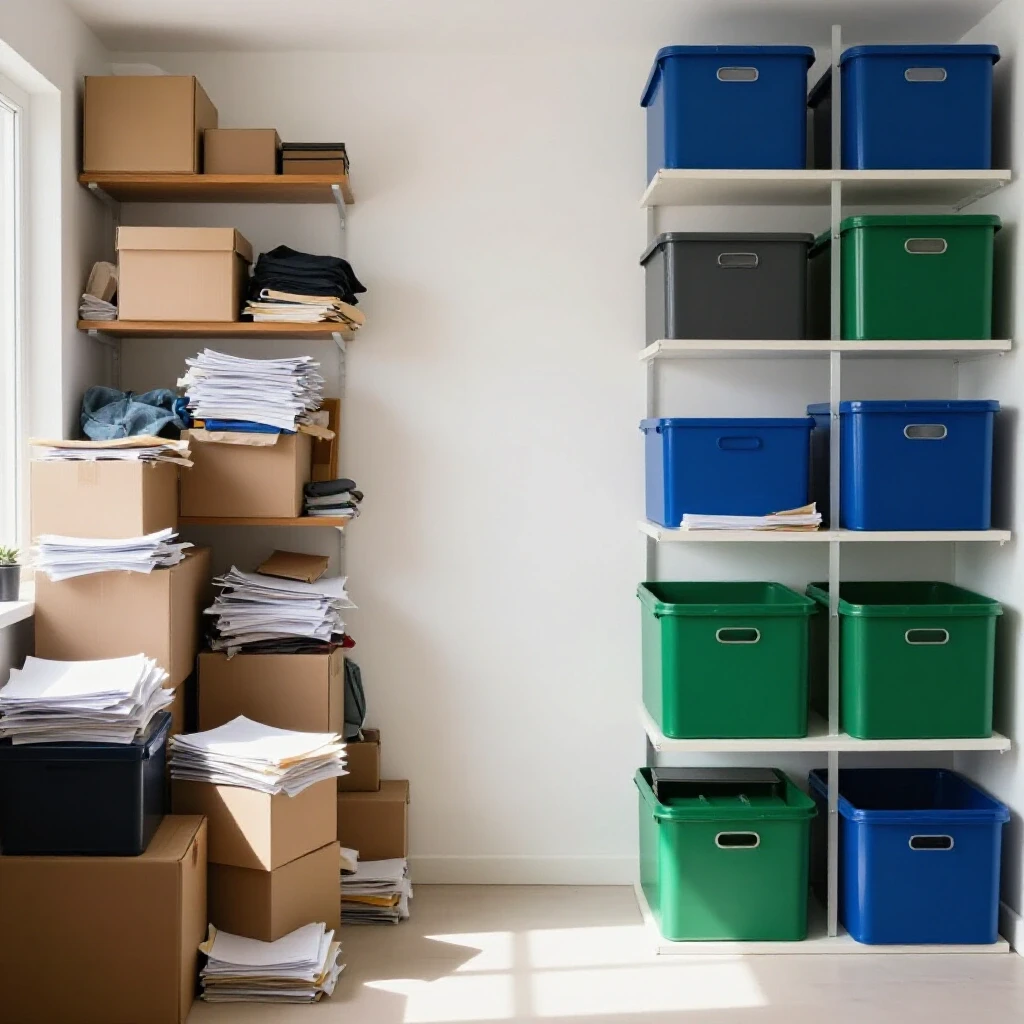
- Visual Cues: We use color-coded bins for different family members. My son knows the blue bins are his. He doesn’t have to read a label; he just looks for the color.
- Monthly Capacity Audit: Once a month, I spend 15 minutes checking our “Active Zones.” If a shelf looks crowded, we move the least-used items to “Deep Storage.”
This approach treats the home like a living organism that needs constant, minor adjustments rather than a static space that stays “perfect.”
Correcting Common Logistics Errors in Small Spaces
One of the most frequent errors I see is the “misuse of vertical space.” In warehouses, we use every inch of height. In homes, people often leave the top two feet of a closet empty while the floor is buried in boxes.
However, the “regret” here is often putting frequently used items too high. I once stored our daily vacuum attachments on a high shelf to “get them out of the way.” As a result, I stopped using them because it was too much work to get the step stool.
- Measure your “Reach Zone”: This is the area between your knees and your shoulders. 80% of your daily items should live here.
- Use “Over-the-Door” systems: These are excellent for high-velocity items like cleaning sprays or kids’ craft supplies because they utilize wasted space without adding “door-opening friction.”
- Avoid “Deep Shelving” for small items: If a shelf is 24 inches deep, small items will get lost at the back. Use “drawer inserts” or long, narrow bins to create a “pull-out” effect.
A Practical Sorting Log for Household Transitions
When you are resetting a room that has failed, use a log to track why items are accumulating. This data-driven approach prevents you from making the same storage mistakes twice. For one week, look at the “hot spots” where clutter piles up (usually the kitchen island or the entryway bench).
Decluttering Sorting Log Example:
- Item: Junk Mail. Location: Kitchen Counter. Reason: No “Inflow Station” at the door. Fix: Add a small paper bin in the entryway.
- Item: Kids’ Hoodies. Location: Living Room Floor. Reason: Hooks in the closet are too high. Fix: Install low hooks at the child’s height.
- Item: Charging Cables. Location: Nightstand. Reason: No “tangle control.” Fix: Weighted cable holder on the tabletop.
By identifying the “logistical bottleneck,” you can solve the problem permanently rather than just cleaning it up over and over again.
Sustainable Strategies for Long-Term Order
The goal of a functional home is not to have zero items on the counters; it is to have a home that can be reset to “base level” in 15 minutes or less. This is achieved through “low-friction” systems and “clear zoning.”
We have learned to embrace “functional imperfection.” My pantry doesn’t look like a magazine cover anymore. There are half-empty bags of chips, but they are in a large, open “Salty Snacks” bin where everyone can see them. The floor is clear, the counters are usable, and most importantly, my mental fatigue has vanished. I no longer spend my weekends “re-organizing” the same three closets.
Frequently Asked Questions
Why does my house get messy again just days after I organize it? This usually happens because the system has too much “retrieval friction.” If it takes more than two steps to put an item away (e.g., opening a closet, moving a box, unlatching a lid), the item will likely be left on a flat surface instead. To fix this, simplify your containers and move high-use items to more accessible locations.
How do I get my kids to follow an organization system? Design the system for the “lowest common denominator.” Use open bins without lids, place hooks at their eye level, and use visual cues like colors instead of complex labels. If a child can’t put something away with one hand in under three seconds, the system is too complex for them.
Are expensive clear bins worth the investment? Only if they reduce friction. Clear bins are great for visibility, which reduces “search time.” However, if they have tight-fitting lids or are difficult to stack, they can actually make clutter worse. Always prioritize the “open-top” design for items you use daily.
What is the “80% Capacity Rule” and why does it matter? In logistics, a warehouse that is 100% full is actually inefficient because there is no room to move items around. The same applies to your home. When a shelf or drawer is 80% full, you can easily see and grab what you need. Once it hits 100%, you have to move items to get to other items, which creates clutter.
How can I manage “paper clutter” without a complex filing system? Create a “One-Touch” inflow station. Place a recycling bin and a small “To Action” tray right where you walk in the door. 90% of mail is junk; if you drop it in the recycling bin before it ever touches your kitchen counter, you’ve solved the problem at the source.
What should I do with items I might need “someday”? Move these to “Deep Storage.” These are low-velocity items. Store them in lidded, labeled bins in a garage, basement, or high closet shelf. This keeps your “Active Zones” clear for the things you actually use every day.
How do I handle “sentimental clutter” that I’m not ready to toss? Apply the “Spatial Capacity” rule. Decide on one specific bin or shelf for keepsakes. Once that space is full, you must remove one old item before adding a new one. This forces you to curate your most important memories without letting them take over your functional living space.
What is the best way to organize a small kitchen with limited cabinet space? Focus on “Vertical Real Estate” and “Frequency of Use.” Store heavy appliances you only use once a month in a different room or a high cabinet. Use “shelf risers” to double your storage space for plates and bowls. Keep only your daily-use items on the “prime real estate” of the middle shelves.
How often should I “audit” my organization systems? A quick 15-minute check once a month is usually enough. Look for “friction points”—areas where items are piling up or where you find yourself frustrated. Adjust the bins or the location of items based on how your family’s needs have changed over that month.
What is “Visual Overload” and how does it affect my stress levels? Visual overload occurs when your brain has to process too many competing shapes, colors, and objects in your line of sight. This leads to decision fatigue and mental exhaustion. By using uniform bins and clear counters, you reduce the “visual noise,” which helps your brain relax when you are at home.
(This article was written by one of our staff writers, Christopher Bennett. Visit our Meet the Team page to learn more about the author and their expertise.)