How to Install Floating Floors Without Common Beginner Errors (Guide)

Focusing on textures and the tactile feel of a new room, I remember the first time I stood in my hallway with a pile of planks and a sense of misplaced confidence. As a facilities manager with 12 years of experience, I am used to managing large-scale maintenance, yet my first residential floor project taught me that the smallest details often dictate the longest-lasting results. I had researched the basics, but I underestimated the physical toll and the precision required for a truly professional finish.
In my early DIY years, I treated home upgrades as a race against the clock. I wanted the visual payoff immediately. However, rushing through the foundational steps of a click-lock system leads to structural headaches that no amount of trim can hide. This guide draws from those early errors and my professional background to help you navigate your own weekend DIY projects with a focus on safety, code compliance, and structural integrity.
Preparing the Foundation for Resilient Surfaces
Subfloor preparation involves cleaning, leveling, and repairing the structural base of your room before laying any new materials. This step ensures the surface is flat within manufacturer-specified tolerances, typically one-eighth of an inch over ten feet. Neglecting this foundation often leads to joint failure and annoying floor squeaks later.
When I tackled my first 1940s fixer-upper, I assumed the plywood subfloor was “good enough.” It looked flat to the naked eye. However, once the planks were down, I noticed a “bounce” in the center of the room. This deflection occurs when the floor system bridges a low spot rather than resting firmly against the substrate.
To avoid this, you must use a long straightedge or a laser level to identify high and low spots. For concrete slabs, use a high-quality self-leveling underlayment. For wood subfloors, you may need to sand down high ridges or add layers of thin plywood to low areas.
Why Moisture Testing is Non-Negotiable
A moisture test measures the humidity levels within your subfloor to ensure it is dry enough for a new covering. Excess moisture can cause wood-based planks to swell or mold to grow underneath waterproof luxury vinyl. This is a critical step for basement upgrades or rooms over crawlspaces.
In my second home, I learned the hard way that a dry-looking concrete slab can still hold significant moisture. I now use a pinless moisture meter to check multiple points across the room. If the readings are outside the manufacturer’s recommended range, a 6-mil poly film vapor barrier is mandatory. This small investment prevents thousands of dollars in potential water damage.
| Metric | Tolerance/Requirement |
|---|---|
| Subfloor Flatness | 1/8 inch over 10 feet |
| Concrete Moisture (Calcium Chloride Test) | < 3 lbs per 1,000 sq ft / 24 hrs |
| Wood Subfloor Moisture Content | Within 2% of flooring material |
| Acclimation Time | 48 to 72 hours minimum |
Essential Equipment for Successful Plank Laying
A DIY tool list for flooring should prioritize precision and physical protection to ensure the project remains safe and manageable. Using the right specialized hand tools reduces the risk of damaging the delicate tongue-and-groove locking mechanisms. High-quality equipment also speeds up the cutting process, allowing for cleaner transitions.
Many beginners try to “make do” with a standard hammer and a scrap piece of wood. I did this once and ended up mushrooming the edges of my planks. Now, I never start without a dedicated installation kit.
- Tapping Block: A plastic or rubber block designed to distribute the force of a mallet blow across the edge of a plank without damaging the locking joint.
- Pull Bar: A metal tool used to snug planks together in tight spaces, such as against a wall or under a door casing, where a tapping block won’t fit.
- Rubber Mallet: Used in conjunction with the tapping block; it provides enough force to seat the joints without the harsh impact of a steel hammer.
- Spacers: Small plastic wedges used to maintain a consistent expansion gap around the perimeter of the room.
- Miter Saw or Floor Cutter: Necessary for making clean cross-cuts at the end of each row.
- Jigsaw: Essential for “scribing” or cutting complex shapes around pipes, vents, and door frames.
- Moisture Meter: A diagnostic tool used to verify that the subfloor is within safe limits for installation.
Safety Gear and Ergonomics
Safe home repairs start with personal protective equipment (PPE). Flooring is notoriously hard on the body, specifically the knees and lower back. I recommend investing in professional-grade gel knee pads. Standard foam pads often compress within an hour, leaving you kneeling on hard surfaces for the rest of the weekend.
Always wear safety glasses when cutting, especially if using a power saw. If your flooring material contains stone or composite materials, a dust mask is vital to prevent inhaling fine particulates. I also keep a first aid kit nearby, as the sharp edges of cut planks can easily cause minor lacerations.
The Critical Role of Material Acclimation
Acclimation is the process of allowing your flooring materials to adjust to the temperature and humidity of the room where they will be installed. This prevents the planks from expanding or contracting excessively after they are locked together. Skipping this step is a primary cause of floor buckling and gap formation.
During a particularly humid July, I rushed a project by starting the installation two hours after the boxes arrived. By October, when the furnace kicked on and dried out the air, the planks contracted so much that huge gaps appeared between the rows. I had to disassemble half the floor to fix it.
Most manufacturers require 48 to 72 hours of acclimation. Cross-stack the boxes in the center of the room, away from exterior walls or direct sunlight. This allows air to circulate around each box, ensuring the core of the material reaches the same equilibrium as the room’s ambient environment.
Maintaining Proper Expansion Gaps
An expansion gap is a deliberate space left between the edge of the flooring and any vertical surface, such as walls or cabinets. This gap allows the entire floor “island” to shift slightly as seasonal humidity changes occur. Without this space, the floor will press against the walls and lift in the center.
I often see DIYers push their first row tight against the drywall. This is a mistake. Most residential building codes and manufacturer specs require a 1/4-inch to 3/8-inch gap. Use your spacers religiously. If you find a spacer has fallen out or been crushed, stop and fix it immediately.
Understanding Thermal Expansion
Materials expand when warm and contract when cool. In a floating system, the planks are not attached to the subfloor, so they move as a single unit. If you have a large open-concept area exceeding 30 or 40 feet in any direction, you may need an “expansion joint” or a T-molding in the middle of the floor to prevent excessive stress on the locking joints.
Step-by-Step Execution Phases
The execution phase of step-by-step home upgrades begins with a dry-run to ensure the final row isn’t a tiny, unstable sliver. Measuring the room and calculating the layout prevents aesthetic and structural issues. Once the layout is confirmed, the physical installation proceeds row by row, focusing on staggered joints and tight seals.
Phase 1: The Layout and Dry-Run
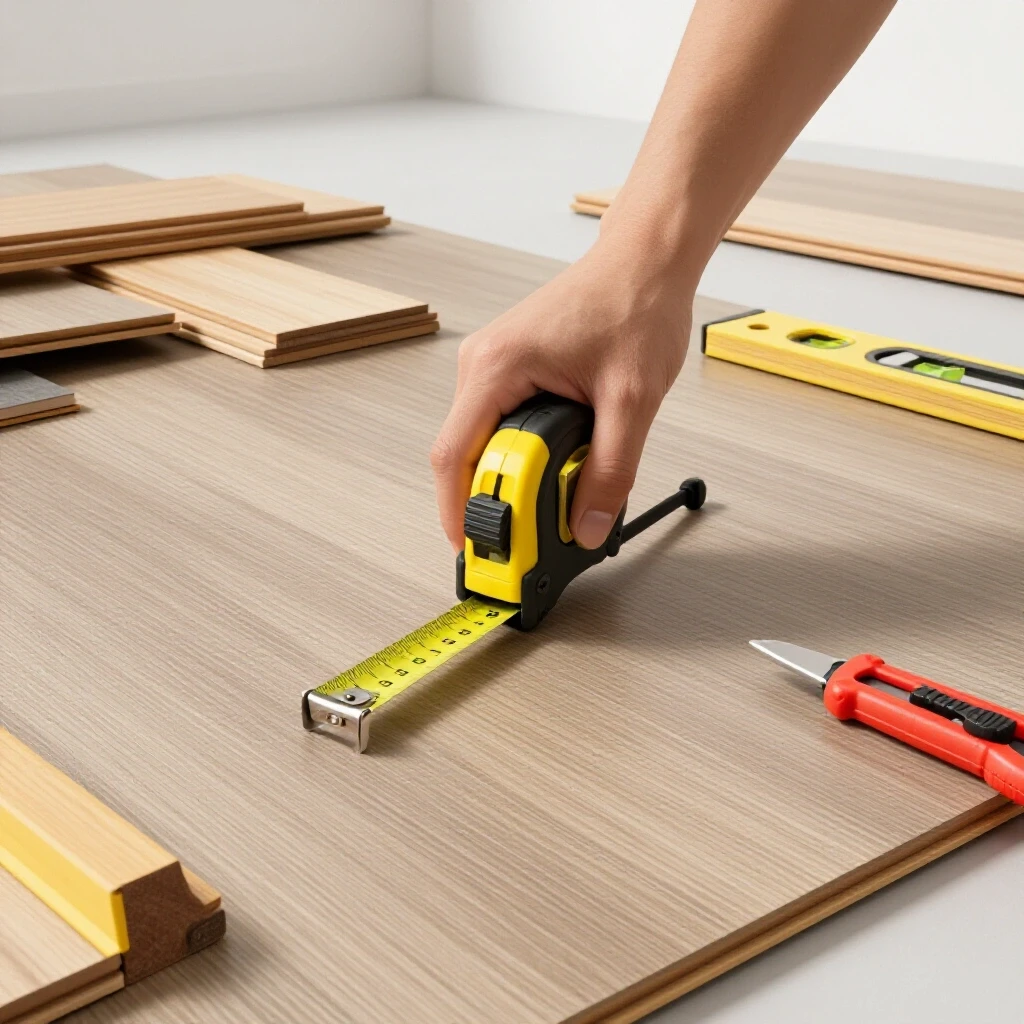
Before opening a single tube of adhesive or clicking a plank, measure the width of the room. Divide that width by the width of a single plank. If your remainder is less than two inches, you should rip (cut lengthwise) your first row to ensure the last row is wide enough to be stable.
I always “dry-fit” the first three rows. This means laying them out without fully locking them or removing spacers. This allows me to see if the walls are out of square—which they almost always are in older homes. Interestingly, starting straight is more important than starting flush with a crooked wall.
Phase 2: Setting the First Row
Install the first row with the “tongue” side facing the wall. Use spacers every 12 inches. When you reach the end of the row, cut the last plank to fit, leaving the required expansion gap. If the leftover piece is longer than 8 to 12 inches, use it to start the second row.
Phase 3: Staggering the Joints
Staggering is the practice of ensuring the end-joints of adjacent rows are at least 6 to 8 inches apart. This creates a “stair-step” pattern that provides structural strength. In my early projects, I didn’t pay attention to this, and the floor looked like a repetitive grid, which is visually distracting and structurally weaker.
- Row 1: Full plank start.
- Row 2: Start with a 2/3 plank.
- Row 3: Start with a 1/3 plank.
- Repeat the pattern to ensure no joints align across rows.
Phase 4: Engaging the Locking Mechanism
Most modern systems use a “drop-and-lock” or “angle-angle” system. You insert the long side of the plank at a 30-degree angle, then drop it down. Use your tapping block and mallet to gently snug the short end into the previous plank. You should hear or feel a distinct “click.” If there is a visible gap, do not try to force it; pull it back out and check for debris in the groove.
| Task | Estimated Time (150 sq ft room) | Difficulty (1-10) |
|---|---|---|
| Prep and Leveling | 4-6 Hours | 6 |
| Underlayment Install | 1 Hour | 2 |
| Flooring Installation | 6-8 Hours | 5 |
| Trim and Transitions | 3 Hours | 4 |
Troubleshooting Common Installation Hurdles
Troubleshooting involves identifying why a joint won’t close or why a plank feels “hollow” after installation. Most issues stem from debris in the locking channel or an uneven subfloor. Addressing these problems immediately prevents the need for a full teardown later in the project.
One common frustration is the “bouncing” plank. If you step on a finished section and it gives way, there is likely a dip in the subfloor you missed. Building code doesn’t strictly dictate how to fix this, but manufacturer guides suggest lifting the planks and using a floor leveling compound or shimming the area with extra underlayment if the dip is minor.
Another issue is the “peaking” joint, where two planks push upward against each other. This is almost always caused by a lack of expansion gaps. If the floor hits a wall, it has nowhere to go but up. You can often fix this by removing the baseboard and trimming the edge of the plank with a multi-tool to create the necessary space.
Finishing Touches and Maintenance
The final phase of a flooring project involves installing transition strips and baseboards to cover the expansion gaps. This is where the project truly comes together visually. Transition strips are used where the new floor meets a different material, like carpet or tile, or where it passes through a doorway.
When I install baseboards, I make sure to nail them into the wall studs, not the floor. If you nail the baseboard into the flooring, you have effectively “pinned” it, defeating the purpose of a floating system. The floor must be able to slide underneath the trim.
Cleaning and Long-Term Care
After the project is complete, avoid wet-mopping for at least 24 hours to let any underlayment adhesives or seam sealers cure, though most floating systems are ready for immediate foot traffic. Use a microfiber mop and a cleaner specifically formulated for your floor type. Avoid wax or steam cleaners, as high heat can delaminate the layers of many modern planks.
Knowing When to Call a Professional
While most weekend DIY projects are manageable, there are times when the scope exceeds a homeowner’s typical toolset. If you discover structural rot in your joists or significant “heaving” in a concrete slab (cracks wider than 1/4 inch with vertical displacement), these are signs of foundation issues.
In my facilities management role, I’ve seen how ignored structural issues can lead to catastrophic failure. If the subfloor requires extensive grinding or structural reinforcement, the investment in a professional ensures the safety and longevity of your home. However, for a standard room with a sound foundation, following these steps will yield a result you can be proud of for years.
FAQ
How long should I wait before walking on my new floor?
Most click-lock floating systems can be walked on immediately after installation because they do not rely on adhesives. However, if you used a transition strip that required construction adhesive, wait at least 24 hours before stepping on that specific area.
Can I install these planks over existing tile or vinyl?
Yes, provided the existing floor is well-bonded, flat, and not cushioned. You must ensure the tile grout lines are not too deep or wide, as they can “telegraph” through the new floor over time. Filling deep grout lines with a patch compound is a smart precaution.
What happens if I don’t leave an expansion gap?
Without a gap, the floor will likely “buckle” or “tent” when the humidity rises. This happens because the material expands but has no room to move horizontally, forcing the planks to lift off the subfloor at the joints.
How do I cut planks around a circular pipe?
The best method is to create a paper template of the area. Transfer the shape to your plank and use a jigsaw with a fine-tooth blade. Ensure you still leave a small expansion gap around the pipe, which can be covered with a decorative “escutcheon” ring.
Is underlayment always necessary?
It depends on the product. Many modern planks come with a pre-attached cork or foam backing. If your flooring has this, adding a second layer of underlayment can make the floor too “squishy,” leading to joint failure. Always check the manufacturer’s technical guide.
How do I fix a gap that opens up between planks after a few months?
If a gap appears, you can often use a “floor gap fixer” block—a tool with double-sided adhesive that sticks to the plank. You then tap the block with a mallet to slide the plank back into its locked position.
Can I install a floating floor under heavy kitchen cabinets?
Generally, no. Heavy cabinetry “pins” the floor, preventing it from expanding and contracting. It is best to install the cabinets first, then lay the floor around them, covering the gaps with toe kicks or molding.
What is the best way to clean up after the project?
Use a vacuum with a hard-floor setting to remove all sawdust and debris from the joints and perimeter. Avoid using a vacuum with a beater bar, as it can scratch the finish of the new planks.
How do I handle door casings that are too low for the new floor?
Use an undercut saw or a multi-tool to trim the bottom of the door casing. This allows the flooring to slide underneath the trim for a clean, professional look without having to make complicated “jigsaw” cuts around the molding.
Why is my floor making a clicking sound when I walk on it?
Clicking sounds are usually caused by a subfloor that isn’t flat. The “tongue” of the plank is rubbing against the “groove” as the floor deflects into a low spot. This is why subfloor leveling is the most critical step of the process.
(This article was written by one of our staff writers, Robert Callahan. Visit our Meet the Team page to learn more about the author and their expertise.)