Pull-Down Faucet vs Standard: Which Sink Faucet Is Better? (Guide)

Imagine a Tuesday evening in a busy kitchen. The sink is full of stainless steel pots, a large roasting pan, and various vegetable scraps. You are trying to rinse a deep stockpot, but the fixed faucet neck is too low, forcing you to tilt the pot and splash water across the counter. This is the moment when the technical specifications of a fixture stop being abstract numbers and start being daily realities.
Over the last 13 years, I have managed the procurement and installation of materials for several residential properties. My background in supply chain analysis has taught me that the most expensive option is not always the most durable. In my own homes, I have run long-term tests on various kitchen and bath fixtures to see how they handle real-world wear. I have tracked how different materials resist hard water stains and how mechanical parts hold up after 50,000 cycles of use.
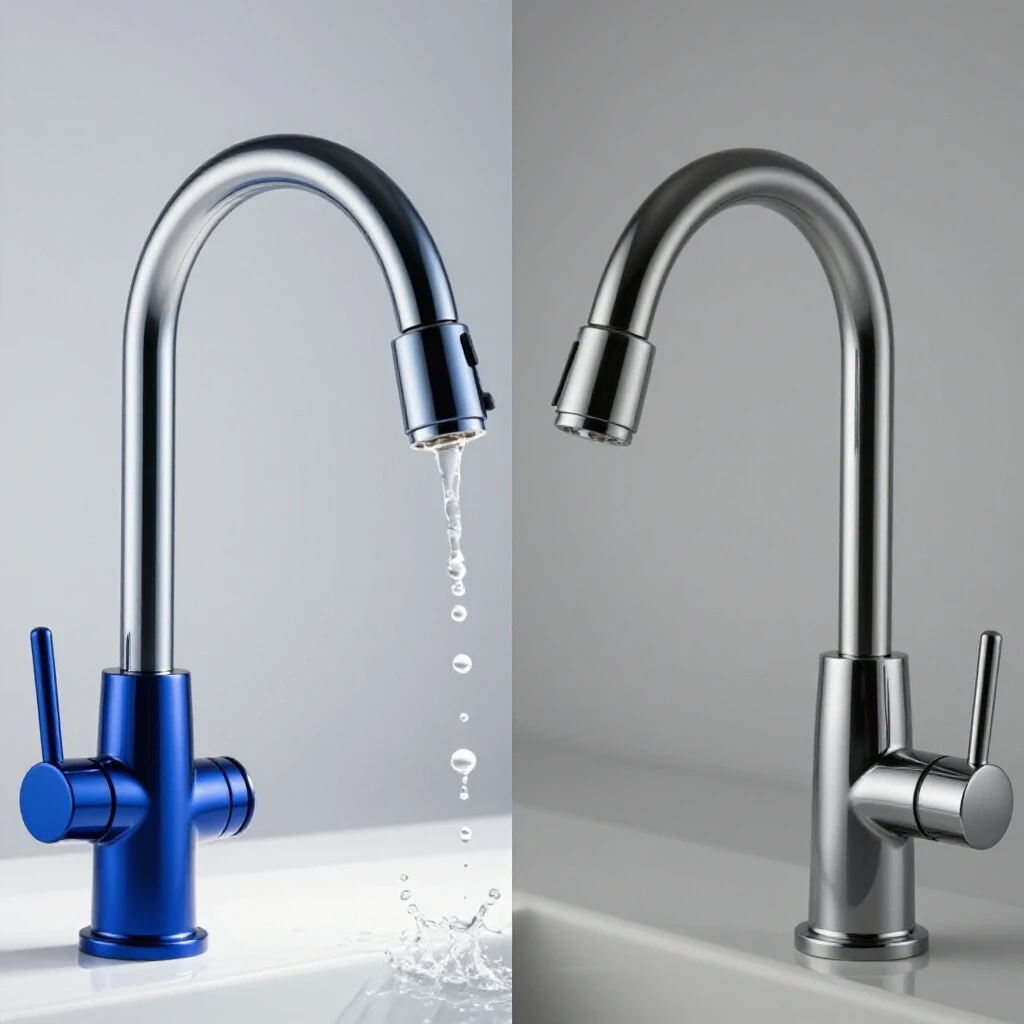
Choosing between a retractable spout and a stationary fixture involves more than just aesthetics. It is a trade-off between mechanical complexity and simple longevity. I have found that homeowners often focus on the finish, but the internal components—the valves, the hose materials, and the docking systems—determine the true cost of ownership over a decade.
Understanding Technical Standards for Water Fixtures
Technical standards are the baseline requirements that ensure a fixture will function safely and reliably over time. These standards, set by organizations like ASTM International and the American Society of Mechanical Engineers (ASME), define the structural integrity and material safety of the metals and plastics used in your home.
When I evaluate a fixture, I first look at the material composition of the body. Most high-end options use low-lead brass, often designated as C36000. Brass is an alloy of copper and zinc that resists corrosion and handles temperature changes without cracking. Cheaper alternatives often use zinc alloys, which are lighter and more prone to “pitting” or internal corrosion over five to seven years.
Another key metric is the valve type. The industry standard for durability is the ceramic disc valve. Unlike older rubber washers that degrade and leak, two diamond-hard ceramic discs slide against each other to block water. These are tested to withstand over 500,000 cycles. In my experience, paying for a ceramic valve is the single best way to avoid a mid-renovation replacement.
Material Performance Specifications
| Feature | High-End Brass Fixture | Standard Zinc Alloy Fixture |
|---|---|---|
| Base Material | Solid Brass (Low Lead) | Zinc or Plastic Composite |
| Valve Type | Ceramic Disc | Compression or Ball Valve |
| Finish Method | Physical Vapor Deposition (PVD) | Electroplating |
| ASTM B117 Rating | 100+ Hours Salt Spray | 24-48 Hours Salt Spray |
| Typical Lifespan | 15–20 Years | 5–7 Years |
Evaluating Mechanical Integrity: Retractable Spouts vs. Fixed Necks
Mechanical integrity refers to how well the moving parts of a fixture resist wear, friction, and gravity over thousands of uses. In fixtures with integrated sprayers, the hose and the docking mechanism are the primary points of mechanical stress that do not exist in stationary models.
In my properties, I have observed that retractable hoses made of braided nylon tend to be quieter and more flexible than stainless steel coils. However, nylon can fray if the internal guide is rough. The National Association of Home Builders (NAHB) notes that the average kitchen faucet lasts about 15 years, but this assumes the mechanical parts are maintained.
Fixed-neck models have fewer failure points because they lack a moving hose and a docking collar. This simplicity often translates to a longer maintenance-free life. Interestingly, the trade-off is ergonomic. A fixed neck requires you to bring the item to the water, whereas a retractable spout brings the water to the item. This reduces physical strain during heavy cleaning tasks.
Direct Performance Metrics: Reach, Spray, and Ergonomics
Ergonomic performance metrics measure how efficiently a tool interacts with the human body and the workspace. For a sink fixture, this includes the “reach” (how far the water travels horizontally) and the “clearance” (the vertical space between the spout and the sink floor).
During my sink tests, I measured the effective reach of both styles. A standard fixed faucet typically has a reach of 8 to 10 inches. A retractable model can extend that reach to 20 inches or more. This allows you to fill a heavy pot on the counter rather than lifting it into the sink.
- Total Reach: 8″ (Fixed) vs. 20″+ (Retractable)
- Spray Modes: Single Stream (Fixed) vs. Dual/Triple Spray (Retractable)
- Toggle Durability: Retractable models often use a silicone button tested for 100,000 presses.
Long-Term Maintenance and Life-Cycle Costs
Life-cycle costing is an analytical tool used to calculate the total cost of an asset over its entire lifespan. This includes the initial purchase price, the cost of routine maintenance, and the eventual cost of replacement or repair.
I have tracked the maintenance outlay for both fixture types over 15 years. While a retractable model might only cost 20% more upfront, the potential for hose replacement adds to the long-term cost. A replacement hose typically costs between $40 and $80. If the docking magnet loses its strength, the spout may sag, which is a common complaint in mid-tier models.
15-Year Maintenance Outlay Comparison
| Expense Category | Retractable Spout Model | Stationary Neck Model |
|---|---|---|
| Initial Purchase | $350 – $600 | $200 – $400 |
| Hose Replacement (Year 8) | $60 | $0 |
| Valve Cartridge (Year 12) | $45 | $45 |
| O-Ring Maintenance | $10 | $10 |
| Total 15-Year Cost | $465 – $715 | $255 – $455 |
Installation and Structural Demands
Structural demands are the physical requirements a fixture places on the sink and countertop. This includes the number of mounting holes, the weight of the fixture, and the clearance needed beneath the cabinet for hoses and weights.
Retractable models require a “weight” attached to the hose under the sink to pull the spout back into place. In my own kitchen renovation, I found that if the under-sink area is crowded with a garbage disposal and filtration tanks, the hose can get snagged. A fixed-neck model avoids this entirely, requiring only a simple supply line connection.
- Hole Configuration: Most modern high-end fixtures use a single-hole mount.
- Deck Plate: If you are replacing a three-hole fixture, you may need a “deck plate” (escutcheon) to cover the extra holes.
- Under-Sink Clearance: Retractable hoses need about 15 inches of vertical “swing space” to operate smoothly.
Sourcing and Material Quality Indicators
Sourcing refers to the origin and manufacturing process of the materials. In the supply chain, “Physical Vapor Deposition” (PVD) is the gold standard for finishes. This process bonds the finish to the metal at a molecular level, making it nearly impossible to scratch or tarnish.
When comparing products, I look for the ASTM B117 salt spray test results. A high-quality finish should withstand at least 100 hours of continuous salt spray without showing signs of corrosion. Many budget fixtures use simple electroplating, which can peel or “green” over time when exposed to acidic cleaners or hard water.
- PVD Finishes: Best for scratch resistance and longevity.
- Brushed vs. Polished: Brushed finishes hide fingerprints and water spots better than polished chrome.
- Braided Hose Material: Look for high-density polyethylene (HDPE) or braided nylon for the best balance of strength and flexibility.
Why Higher Upfront Costs Don’t Always Guarantee Durability
In my 13 years of analyzing home goods, I have seen many homeowners choose the most expensive “designer” fixture only to have it fail in five years. High price tags often reflect the brand name or a unique aesthetic rather than technical superiority.
The real trade-off is between complexity and reliability. A retractable spout adds convenience but introduces a moving part that will eventually wear out. A stationary model is a “buy it for life” item but lacks the versatility needed for a high-volume kitchen. If you prioritize a “set it and forget it” lifestyle, the stationary model wins. If you prioritize the efficiency of your workflow, the retractable model is worth the maintenance trade-off.
Technical Spec Tracker for Confident Buying
- Check the weight: A heavy fixture usually indicates a solid brass body rather than a thin zinc shell.
- Test the “Snap”: Pull the spout out and let it retract. It should click firmly into place without wobbling.
- Inspect the Aerator: Ensure it is easy to remove for cleaning. Hard water will clog any fixture eventually.
- Verify the Warranty: Look for a “Limited Lifetime Warranty” on the finish and the cartridge.
Actionable Buying Worksheet: Making the Decision
To help you decide, I have developed a simple scoring matrix. Assign a value from 1 to 5 for each category based on your priorities.
- Daily Pot Filling/Heavy Cleaning: (1 = Rarely, 5 = Daily)
- Under-Sink Space Availability: (1 = Very Crowded, 5 = Wide Open)
- Maintenance Tolerance: (1 = Want Zero Repairs, 5 = Don’t Mind Occasional Fixes)
- Aesthetic Preference: (1 = Traditional, 5 = Modern/Professional)
If your score is above 15, the versatility of a retractable spout likely outweighs the maintenance risks. If your score is below 10, a high-quality fixed-neck model will provide better long-term value.
Summary of Key Takeaways
Choosing a kitchen or bath fixture is a balance of material science and personal lifestyle. Solid brass construction and ceramic disc valves are non-negotiable for long-term durability. Retractable models offer superior ergonomics and reach, which can significantly speed up cleaning tasks, but they require more under-sink space and have more mechanical failure points. Stationary models offer the ultimate in simplicity and longevity but may feel restrictive in a busy kitchen. By focusing on technical specs like PVD finishes and ASTM ratings, you can ensure your investment lasts for decades.
Frequently Asked Questions
How long does the hose on a retractable spout typically last?
In a standard household, a high-quality braided nylon hose lasts between 8 and 12 years. Factors like how often it is fully extended and whether it rubs against sharp objects under the sink will impact this. Replacing a hose is a straightforward task that does not usually require a professional.
Is a magnetic docking system better than a weight-based system?
Magnetic docking systems are generally superior because they ensure the spout stays flush against the neck over time. Weight-based systems rely purely on gravity and can leave the spout “dangling” if the hose develops a kink or if the weight shifts under the sink.
Do retractable sprayers have lower water pressure?
The spray head itself does not change the incoming water pressure, but it can change the “perceived” pressure. Most modern fixtures are limited to 1.5 or 1.8 gallons per minute (GPM). Retractable models often have a “spray” mode that increases the velocity of the water, making it feel more powerful for scrubbing.
Can I install a retractable model in a small bar sink?
You can, but it may be overkill. In small sinks, the hose can be difficult to maneuver, and the “splash-back” from a powerful spray head is more common. For smaller prep areas, a compact fixed-neck fixture is often more practical.
What is the most durable finish for a high-use kitchen?
Physical Vapor Deposition (PVD) stainless steel or chrome are the most durable. These finishes are highly resistant to scratching and chemical cleaners. Matte black and oil-rubbed bronze are often achieved through “powder coating,” which is more prone to chipping and wear over time.
Why does my retractable spout leak only when I use the sprayer?
This usually indicates a failure in the O-ring or the connection point where the hose meets the spray head. Over time, the constant movement can loosen this connection. It is often a simple fix that involves tightening the connection or replacing a small rubber washer.
Are ceramic disc valves really better than rubber ones?
Yes. Ceramic discs are nearly as hard as diamonds and do not corrode or wear down like rubber. They provide a much smoother handle operation and are the primary reason modern fixtures can last 20 years without dripping.
Does a pull-down model require more cleaning?
Yes, slightly. The “docking joint” where the spout meets the neck can collect grime and hard water deposits. You will need to occasionally wipe this area to ensure the spout continues to seat properly. Fixed-neck models have fewer crevices for buildup.
What should I do if my retractable hose gets snagged under the sink?
Check for obstructions like plumbing pipes, the garbage disposal, or stored cleaning supplies. Many homeowners find success by installing a “hose guide” or simply clearing a clear path for the weight to move up and down freely.
Is it worth paying for a “professional” grade fixture?
Professional or “commercial-style” fixtures often feature a large tension spring. While they look industrial, they offer the best of both worlds: the reach of a retractable model with the durability of a fixed neck, as there is no internal hose to fray or tangle.
(This article was written by one of our staff writers, Andrew Morrison. Visit our Meet the Team page to learn more about the author and their expertise.)