How to Repair a Dented Door for a Smooth Finish (Step-by-Step)

Maintaining a home often feels like a constant battle against small imperfections. You walk past a room every day, and eventually, your eyes land on that one unsightly ding in the middle of a bedroom door. It might have come from a moving box, a stray vacuum cleaner, or a child’s toy. These small blemishes do not stop the door from closing, but they certainly disrupt the visual flow of your living space. For a busy professional, these minor eyesores can become a source of nagging frustration.
In my twelve years managing facilities and upgrading my own homes, I have learned that fixing these surface issues is one of the most rewarding weekend DIY projects. It does not require a massive tool kit or a week of your time. Instead, it requires patience and the right sequence of steps. I remember my first attempt at this years ago; I rushed the drying time and ended up with a patch that looked worse than the original dent. Since then, I have refined a process that balances a high-quality look with the reality of a packed schedule. By focusing on the surface finish rather than a full replacement, you save money and keep perfectly functional materials out of the landfill.
Assessing Surface Damage and Planning the Restoration
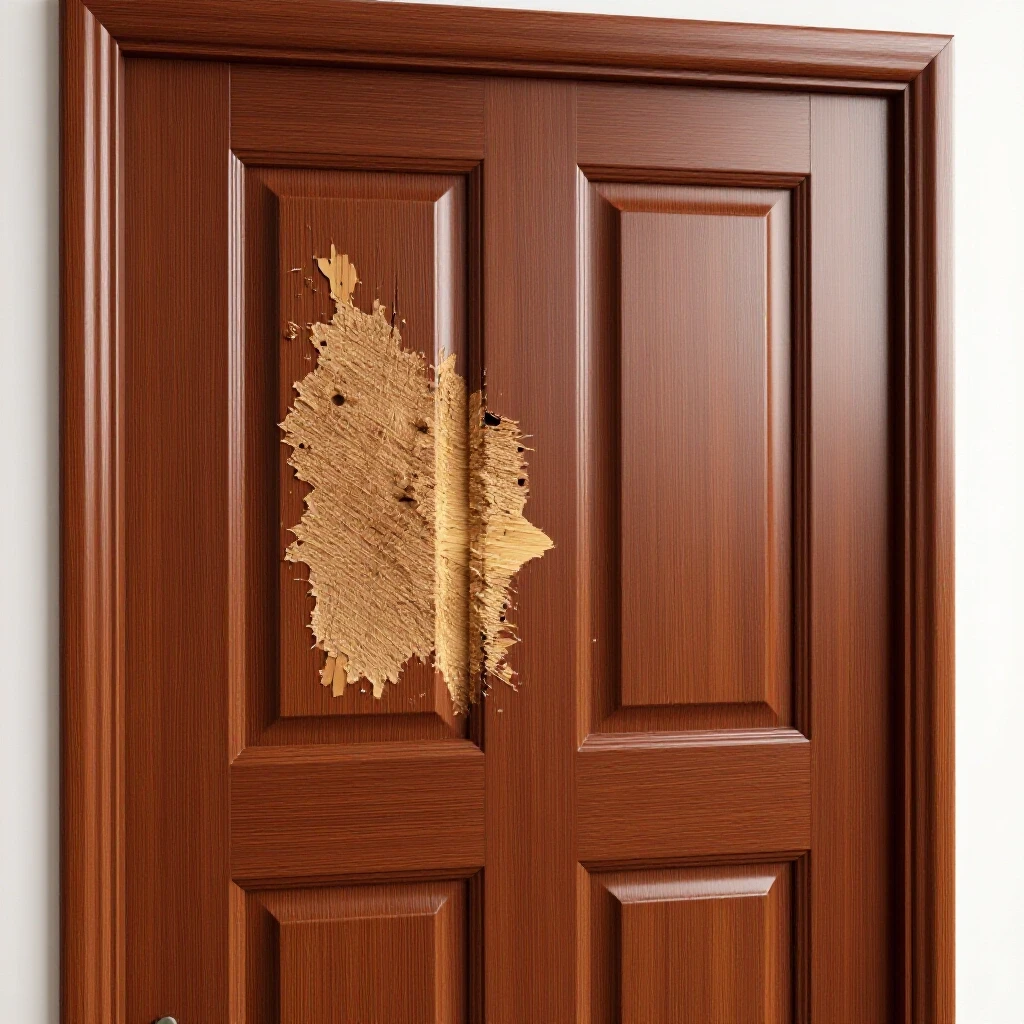
Before grabbing a putty knife, you must understand the depth and type of the blemish you are addressing. Cosmetic restoration focuses on fixing the “skin” of the door without affecting how it hangs or swings.
This phase involves looking at the light hitting the surface to see the true extent of the indentation. A dent might look small, but the surrounding area often has a slight “crown” or raised edge where the material was displaced. I always use a bright flashlight held at a sharp angle against the door. This reveals shadows that tell me exactly where the filler needs to go. In my experience, taking five minutes to map out the damage prevents the frustration of realizing you missed a spot after the paint has already dried.
Identifying Door Material and Finish Types
Knowing what your door is made of determines which filler and sanding technique you should use for your DIY home improvement. Most modern interior doors are either hollow-core composite or solid wood.
Hollow-core doors are essentially a thin veneer or hardboard over a honeycomb interior. These require a lightweight filler that won’t sag. Solid wood doors are more forgiving but can expand and contract with humidity. I once made the mistake of using a very rigid filler on a solid oak door in a humid laundry room. Within three months, the patch popped out because it couldn’t move with the wood. For most interior cosmetic tasks, a high-quality wood filler or a lightweight spackling compound designed for trim is your best bet.
| Material Type | Recommended Filler | Sanding Grit | Estimated Drying Time |
|---|---|---|---|
| Hollow-Core Composite | Lightweight Spackle or Wood Filler | 150 to 220 | 30–60 Minutes |
| Solid Wood (Painted) | All-purpose Wood Filler | 120 to 220 | 2–4 Hours |
| Solid Wood (Stained) | Color-Matched Wood Putty | 180 to 320 | 4–6 Hours |
Essential Supplies and Timeline for Surface Restoration
Having all your materials ready before you start is the hallmark of a safe home repair. There is nothing worse than having wet filler on a door and realizing you ran out of fine-grit sandpaper.
For these weekend DIY projects, I recommend a “go-bag” approach. I keep a small bin with my filling and sanding supplies so I can tackle these blemishes as they appear. This prevents the project from creeping into your Sunday evening. Based on my facility maintenance standards, a typical cosmetic fix takes about 30 minutes of active work, but you need to account for the “passive” time while products cure.
The Cosmetic Restoration Tool List
You do not need heavy machinery for this task, but using the right hand tools will make the difference between a patch that disappears and one that stands out.
- Putty Knife (2-inch flexible blade): A flexible steel or plastic blade allows you to “feather” the edges of the filler.
- Sanding Block: Never use just your fingers to sand; the soft pads of your fingers will create an uneven “valley” in the filler.
- Sandpaper Multi-pack: You will need 120-grit for initial leveling and 220-grit for the final smooth finish.
- Tack Cloth or Microfiber Towel: This is essential for removing fine dust that prevents paint from sticking.
- Small Container of Filler: Choose a “stainable” or “paintable” version depending on your door’s finish.
- Primer and Matching Paint: Even if the filler says it is “primer-included,” I always use a separate primer for a better color match.
Preparing the Work Area and Surface Substrate
Substrate preparation is the process of cleaning and roughening a surface so that a new material can bond to it securely. If the surface is oily or too smooth, your repair will eventually peel off like a scab.
In my early DIY days, I skipped the cleaning step on a kitchen door. The invisible grease from years of cooking prevented the filler from sticking. Now, I always start by wiping the area with a mild degreasing soap and water. Once dry, I lightly scuff the dent and the immediate one-inch area around it with 120-grit sandpaper. This creates “tooth,” which are microscopic scratches that give the filler something to grab onto.
Creating a Clean Environment for Better Adhesion
A successful DIY home improvement depends on a workspace free of dust and debris that could get trapped in your finish.
- Lay down a drop cloth: Even a small amount of sanding dust can get ground into your carpet or hardwood.
- Remove or protect hardware: If the dent is near a handle or hinge, take the extra two minutes to remove the hardware rather than trying to work around it.
- Ensure good lighting: As mentioned before, side-lighting is your best friend for seeing the “flatness” of your work.
Applying Filler and Leveling Techniques
Applying the filler is where most people get nervous, but the secret is to apply it in thin layers rather than one big glob. Most fillers shrink slightly as the moisture evaporates, so a single thick layer will often crack or leave a dip.
I prefer the “overfill and sand back” method. I use my putty knife to press the filler firmly into the dent to eliminate air pockets. Then, I apply a second pass, leaving the filler just slightly higher than the surrounding door surface—about the thickness of a business card. This allows for the natural shrinkage that happens during the drying process. If the dent is deeper than 1/8th of an inch, I always apply two thin coats, letting the first one dry completely before adding the second.
The Art of Feathering for a Seamless Look
Feathering is the technique of thinning out the edges of your filler so they blend perfectly into the original surface.
When you pull the putty knife across the dent, start with firm pressure on the “good” part of the door, lighten the pressure as you cross the dent, and then increase pressure again on the other side. This creates a smooth transition. If you see “ridges” from the edges of your putty knife, don’t try to fix them while the filler is wet. It is much easier to sand those ridges away once they are dry. Trying to over-work wet filler usually leads to pulling the material out of the hole entirely.
Sanding and Texturing for a Smooth Finish
Sanding is the most critical part of the step-by-step home upgrades process because it determines how the light will hit the final product. If you can feel the repair with your eyes closed, you will be able to see it once it is painted.
I use a circular motion with a sanding block, starting with 150-grit paper. I move the block in wide arcs that extend well beyond the patch itself. This “blending” ensures there isn’t a sudden change in the door’s texture. Once the patch is level with the door, I switch to 220-grit paper for a polished finish. After sanding, I always run my hand over the area. Your fingertips are incredibly sensitive to tiny changes in height. If it feels like a single, continuous surface, you are ready for the next step.
Managing Dust and Debris
Dust management is a key part of keeping your home clean during a weekend DIY project.
- Vacuum immediately: Use a brush attachment to suck up the bulk of the sanding dust.
- Use a tack cloth: This is a sticky cheesecloth that picks up the microscopic particles a vacuum misses.
- Check for “pills”: Sometimes sandpaper creates little balls of dust; make sure these are cleared away so they don’t get stuck in your paint.
Priming and Color Matching the Final Surface
Many DIYers think they can just dab a bit of leftover paint on the patch and be done. However, filler is much more porous than the rest of the door. If you don’t prime it, the patch will soak up the paint differently, resulting in a “flat” or “dull” spot known as flashing.
I always use a high-quality primer. This seals the filler and provides a uniform base for the topcoat. I suggest painting from “edge to edge” or “joint to joint” on the specific panel you are repairing. This makes any slight color variation much less noticeable because the “break” in the paint happens at a natural corner or seam of the door.
| Step | Action | Tool | Why It Matters |
|---|---|---|---|
| 1 | Prime | Small Foam Roller | Seals the porous filler to prevent “flashing.” |
| 2 | First Coat | High-Quality Brush | Provides the base color and hides the patch. |
| 3 | Light Sand | 320-grit Paper | Removes “nibs” or dust bumps between coats. |
| 4 | Final Coat | Small Foam Roller | Creates the final texture and sheen match. |
Troubleshooting Common Cosmetic Failures
Even with 12 years of experience, things can go wrong. The key is knowing how to recover without starting from scratch.
One common issue is “shrinkage cracks.” This happens if the filler was applied too thick or if the room was too cold. If you see a crack, don’t panic. Simply apply a very thin “skim coat” of filler over the crack, let it dry for 20 minutes, and sand it smooth. Another issue is “texture mismatch.” If your door has a wood grain texture and your patch is perfectly smooth, it will stand out. You can mimic wood grain by lightly dragging a stiff-bristled brush through the filler while it is still slightly tacky.
When to Sand and When to Re-apply
Knowing when to stop is a skill in itself. If you find yourself sanding for more than ten minutes on a single spot, you might have applied too much filler.
If you sand too far and the dent becomes visible again, it is better to add another thin layer of filler than to try and “hide” it with thick paint. Paint is not a filler; it will follow the contours of whatever is underneath it. I have seen many people try to fill a hole with five coats of paint, only to end up with a messy, dripping glob that never dries correctly. Stick to the process: fill, sand, prime, paint.
Final Clean-up and Maintenance
Once the final coat of paint is dry to the touch—usually about two hours—you can remove any painter’s tape and re-install hardware. However, “dry to the touch” is not the same as “fully cured.”
Most interior paints take 14 to 30 days to fully cure to their maximum hardness. During this time, I tell my family to be extra careful around the door. Avoid scrubbing the patch or hitting it with the vacuum again. For long-term maintenance, keep a small jar of the touch-up paint and a tiny craft brush in your utility closet. This allows you to fix tiny nicks in seconds before they become larger projects.
Project Planning Checklist
Use this checklist to ensure you stay on track and achieve a result you are proud of.
- [ ] Damage assessed with side-lighting.
- [ ] Surface cleaned with degreaser.
- [ ] Area scuffed with 120-grit sandpaper.
- [ ] First layer of filler applied and dried.
- [ ] Second layer applied (if needed) and dried.
- [ ] Surface sanded level with a sanding block.
- [ ] Dust removed with a tack cloth.
- [ ] Primer applied and dried.
- [ ] Final paint coat applied to the entire panel.
- [ ] Tools cleaned and stored.
Conclusion
Taking the time to restore the surfaces in your home is about more than just aesthetics; it is about taking pride in your environment. These small weekend upgrades are the perfect way for a busy professional to see immediate, tangible results from their labor. By following a structured approach—proper cleaning, patient filling, and careful sanding—you can achieve a finish that blends in with the rest of your home. You don’t need to be a full-time tradesperson to get these results; you just need to respect the materials and the process. Now that you have the plan, take a look around your home. That dented door doesn’t have to stay that way.
FAQ
How long should I wait between applying filler and sanding? Most lightweight fillers are ready to sand in 30 to 60 minutes if the room is at least 70 degrees Fahrenheit. If the air is humid or cold, it can take up to four hours. A good rule of thumb is to press your fingernail into a hidden edge of the filler; if it feels hard and doesn’t leave an indent, it is ready.
Can I use regular wall spackle on a wooden door? While you can use lightweight spackle for very small nicks on a painted door, it is generally softer than wood filler. For doors that see a lot of use, a dedicated wood filler is better because it dries harder and handles the vibration of the door opening and closing much better than wall spackle.
What if my door has a wood grain texture I don’t want to lose? This is a common challenge. After applying the filler and sanding it flat, you can use a graining tool or even the tip of a toothpick to “draw” the grain lines into a thin layer of wet filler. Once it dries, a light sanding will soften the lines so they match the surrounding wood.
Do I really need to paint the whole door? Not necessarily the whole door, but I highly recommend painting the entire “section” or “panel” where the repair was made. If you just paint a circle over the dent, the difference in the paint’s texture (the “stipple”) will be visible when the sun hits it.
Is it safe to sand doors in a house with children or pets? Yes, provided you take basic precautions. Most modern fillers are non-toxic, but the fine dust can be an irritant. Always wear a dust mask, keep a vacuum running nearby to catch dust as it falls, and wipe down the area thoroughly when you are finished.
Why does my patch look darker than the rest of the door? This is usually caused by “flashing,” where the porous filler has soaked up the resins in the paint. This is why priming is so important. If you already painted and it looks dark, apply a coat of primer over the spot and then two fresh coats of paint.
Can I fix a dent that goes all the way through the door? This guide is strictly for cosmetic surface indentations. If a hole goes all the way through a hollow-core door, the internal structure is compromised, and the repair process is much more complex, often requiring expanding foam and structural mesh.
How do I match the paint color if I don’t have the original can? You can use a sharp utility knife to carefully peel a one-inch square of paint from a hidden area, like the very top edge of the door. Take that sample to a local paint store, and they can use a spectrophotometer to create a near-perfect match.
What is the best temperature for doing this repair? Most manufacturers recommend a temperature between 60 and 80 degrees Fahrenheit. If it is too hot, the filler will dry too fast and crack. If it is too cold, the chemicals in the paint and filler won’t bond correctly.
Will the repair hold up if the door is in a bathroom with high humidity? Yes, as long as you use a high-quality, moisture-resistant primer and a topcoat with a semi-gloss or satin finish. These finishes create a barrier that prevents moisture from reaching the filler underneath.
Can I use a hair dryer to speed up the drying time? You can use a hair dryer on a low, cool setting, but avoid high heat. High heat can cause the surface of the filler to dry and skin over while the inside remains wet, which leads to bubbling and cracking later on.
What should I do if the filler keeps falling out of the dent? This usually happens if the dent is too shallow or too smooth. Use a bit of coarse sandpaper to roughen up the inside of the dent. This gives the filler more surface area to grip. Also, ensure the area is completely free of any wax or furniture polish.
(This article was written by one of our staff writers, Robert Callahan. Visit our Meet the Team page to learn more about the author and their expertise.)