Vacuum Bags vs Bagless: Which Is Better for Allergies? (Guide)

We often invest in home appliances under the promise of “maintenance-free” living, yet the very features designed to simplify our lives can often increase the hidden labor of home upkeep. In my thirteen years evaluating the supply chains of major home goods, I have found that the most “convenient” designs frequently trade one cost for another, often at the expense of the air quality we breathe.
During my time managing property renovations and researching technical material specs, I have scrutinized how different containment systems handle fine particulate matter. When I updated my first home, I initially prioritized a system that didn’t require recurring purchases. However, after monitoring the dust accumulation on high-end surfaces and analyzing the technical seal integrity of various units, I realized that the upfront price of a machine is only a small part of its total performance profile. This guide breaks down the technical trade-offs between different debris containment methods to help you choose a system that aligns with your durability and maintenance standards.
Understanding Technical Standards for Particulate Containment
Technical standards for home appliances define how effectively a system captures and holds microscopic debris without leaking it back into the environment. These specifications, often measured by ASTM International protocols, determine the efficiency of the filtration media and the integrity of the machine’s seals during operation.
To understand how a machine performs, we must first look at ASTM F1977. This is the standard test method for determining the initial fractional filtration efficiency of a vacuum cleaner system. It measures how well a device captures particles across different size ranges, from 0.3 microns to 10 microns. In my professional evaluations, I’ve found that a “HEPA” label on a filter is meaningless if the housing of the machine itself is not “sealed.” Material science tells us that air follows the path of least resistance; if the gaskets and seals are porous or poorly fitted, dirty air will bypass the high-quality filter entirely.
The Engineering of Sealed Systems vs. Open Exhaust
A sealed system ensures that all air pulled into the machine passes through the filtration media before being exhausted back into the room. This requires high-quality gaskets, typically made of ethylene propylene diene monomer (EPDM) or silicone, to prevent microscopic leaks at the joints of the appliance housing.
When I compare high-end home materials, I look for the same “system-wide” integrity I expect in a countertop installation or a flooring moisture barrier. In a vacuum, the containment method—whether it uses a disposable membrane or a centrifugal chamber—must be supported by a non-porous chassis. If you are comparing technical specs, look for “Whole-Machine HEPA Filtration.” This indicates the unit has passed pressure tests ensuring that the air exiting the machine is cleaner than the air it took in, a critical metric for maintaining a low-dust environment.
Comparative Analysis of Dust Containment Systems
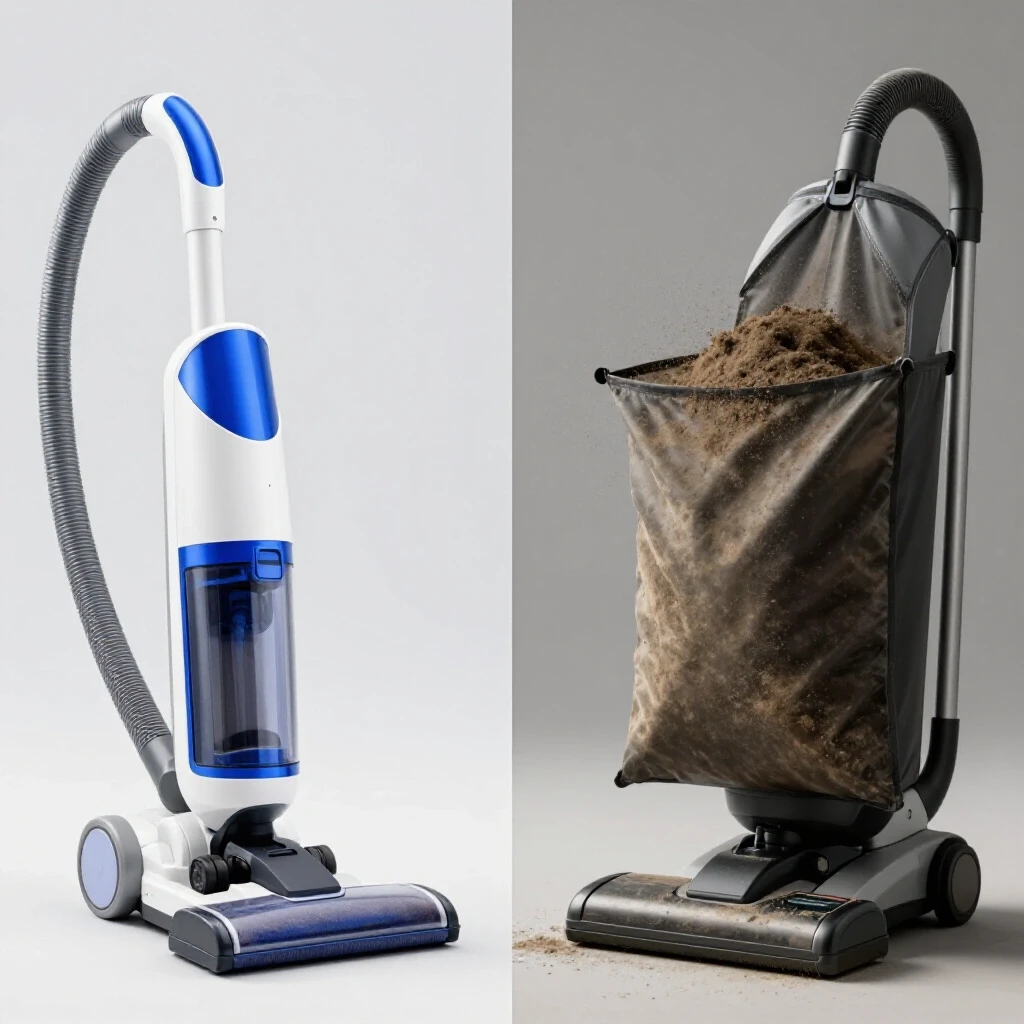
Comparing containment systems requires a trade-off analysis between the physical barrier of a disposable bag and the mechanical separation of a bagless cyclone. Both methods aim to isolate debris, but they utilize different engineering principles to manage airflow and particle retention over time.
In my decade-plus of material procurement, I have tracked how these two systems age. Bagged systems act as a primary filter, using multi-layered synthetic materials to trap debris. As the bag fills, the pore structure of the material can become restricted, which may impact suction. Conversely, bagless systems use cyclonic separation to spin heavy debris out of the airflow. While this maintains consistent suction, it relies heavily on secondary and tertiary filters to catch the fine dust that the cyclone cannot drop.
Material Porosity and Micron Capture Efficiency
Porosity refers to the measure of void spaces in a material, which determines what size of particle can pass through. In vacuum technology, synthetic filter bags often use electrostatically charged fibers to attract and hold dust particles that are much smaller than the physical gaps in the fabric.
- Synthetic Media: Most modern high-performance bags use melt-blown polypropylene. These layers provide high “dust loading” capacity, meaning they can hold a significant amount of fine powder without clogging.
- Cyclonic Separation: This relies on centrifugal force. While effective for large debris, it struggles with particles smaller than 10 microns, placing a heavy burden on the final HEPA filter.
- Filter Maintenance: Bagless units require the user to physically wash or replace filters more frequently to maintain the same air quality standards as a fresh bag.
| Performance Metric | Bagged Systems (Sealed) | Bagless Systems (Cyclonic) |
|---|---|---|
| Initial Filtration Efficiency | 99.9% at 0.3 microns | 99.9% at 0.3 microns |
| Dust Exposure During Emptying | Near Zero (Self-sealing) | High (Aerosolized dust) |
| Suction Consistency | Decreases as bag fills | High until filter clogs |
| Secondary Filter Life | 12–24 months | 3–6 months |
| Seal Integrity Over Time | High (Internal containment) | Moderate (Gasket wear) |
Why Higher Upfront Costs Don’t Always Guarantee Durability
In the world of high-end home materials, we often assume a higher price tag translates to less work, but the “convenience” of not buying bags often leads to a higher “labor cost” in maintenance. A technical material comparison shows that the mechanical complexity of bagless systems can lead to faster degradation of seals.
When I evaluate the life-cycle of an appliance, I look at the “total cost of ownership” over 15 years. A bagged machine might seem more expensive due to the cost of consumables, but the protection the bag provides to the motor and internal components often extends the machine’s life. In my own properties, I’ve seen bagged units last twice as long as bagless counterparts because the motor is never exposed to the fine “clogging” dust that can bypass a poorly maintained cyclonic filter.
Upfront Cost vs. 15-Year Maintenance Outlay
This financial evaluation compares the long-term costs of a high-end bagged system versus a high-end bagless system. While the bagless system has no “consumable” bag cost, the frequency of filter replacements and the potential for shorter motor life must be factored into the durability vs. maintenance cost analysis.
| Expense Category | Bagged System (15 Years) | Bagless System (15 Years) |
|---|---|---|
| Initial Purchase Price | $600 – $1,000 | $500 – $800 |
| Consumables (Bags) | $450 ($30/year) | $0 |
| Replacement Filters | $150 (Every 3 years) | $500 (Every year) |
| Estimated Repair Labor | $100 (Low wear) | $300 (Gasket/Motor wear) |
| Total 15-Year Cost | $1,300 – $1,700 | $1,300 – $1,600 |
Building on this data, the cost difference is often negligible over a decade. The real trade-off is whether you prefer to spend money on bags or spend time cleaning filters and dealing with the dust clouds associated with emptying a plastic bin.
The Reality of Cyclonic Separation and Air Quality
Cyclonic separation is a marvel of fluid dynamics, but it is not a perfect filtration solution for those sensitive to airborne particulates. The physics of the “vortex” means that very light particles, like pollen or skin dander, often remain suspended in the air and are carried directly to the pre-motor filter.
Interestingly, my technical material specifications logs show that bagless bins are typically made of polycarbonate. While durable, this material develops a static charge during use. When you open the bin to empty it, that static charge can actually repel the fine dust, causing it to “poof” out into your face and back into the room you just cleaned. For a homeowner comparing materials like quartz vs. granite for their ease of cleaning, the “re-pollution” factor of a bagless vacuum is a significant technical downside.
Particulate Re-emission and Environmental Sensitivity
Environmental sensitivity ratings for appliances help us understand how a product impacts the “indoor microbiome.” A bagged system is essentially a “closed-loop” waste stream. Once the dust is in the bag, it is trapped. Most high-quality bags even include a plastic shutter that slides closed when you remove the bag, ensuring zero exposure.
In contrast, emptying a bagless container is an “open-loop” event. Even if you empty it directly into a trash can, the act of dumping the debris creates an aerosolized cloud of particulates. If you are choosing materials for a home specifically to reduce allergens—such as choosing hardwood over carpet—using a bagless vacuum can undermine those efforts by redistributing fine dust every time the bin is cleared.
Practical Decision Matrix for Homeowners
To make a confident purchasing decision, you need to weigh your lifestyle against the technical specs of the machine. I use a scoring matrix to evaluate how well an appliance fits a specific environment, much like I would score the “Janka hardness” of a wood floor against the traffic patterns of a busy family.
- Assess Your “Dust Tolerance”: If you have high-end finishes like matte black fixtures or dark polished stone, fine dust will be highly visible. A bagged system typically keeps surfaces cleaner for longer.
- Evaluate Maintenance Habits: Are you likely to wash a filter every month and let it air dry for 24 hours? If not, a bagless system will lose suction and exhaust dirty air.
- Check the “Sealed System” Spec: Regardless of the bag, ensure the machine meets HEPA standards for the entire unit, not just the filter media.
- Consider the Waste Stream: Bagged systems create more landfill waste (the bags), while bagless systems can lead to more mechanical waste if the machine fails prematurely due to dust ingress.
Technical Spec Tracker for Appliance Evaluation
When you are in the showroom or reading data sheets, use this checklist to compare models. These metrics are more important than “Air Watts” or “Amps,” which are often used as marketing fluff.
- Filter Grade: Is it HEPA (99.97% at 0.3 microns) or “HEPA-like” (unregulated)?
- Seal Material: Does it use rubber gaskets at all connection points?
- Bag Material: Is it paper (low efficiency) or multi-layered synthetic (high efficiency)?
- Bin Capacity vs. Bag Volume: A standard vacuum bag often holds 4 to 6 liters of debris, while a bagless bin may only hold 1 to 2 liters before needing to be emptied.
- Warranty Limits: Does the warranty cover the motor if dust bypasses the filters?
Final Supply Chain and Cost Recommendations
From a supply chain perspective, the “bagged vs. bagless” debate is a classic example of a “consumable-based” model versus a “service-based” model. Bagged manufacturers make a margin on the ongoing sale of bags, which incentivizes them to keep the machines running so you keep buying bags. Bagless manufacturers often rely on the initial high-margin sale, which can sometimes lead to “planned obsolescence” in the plastic components.
As a result, I generally recommend bagged systems for homeowners who prioritize air quality and long-term durability. While the recurring cost of bags is a factor, it acts as an insurance policy for the machine’s motor and your home’s air purity. If you do choose a bagless model, ensure it is a high-end unit with a truly sealed system and commit to a strict filter-washing schedule to protect your investment.
To move forward, I suggest visiting a local vacuum specialist—not a big-box store—where you can see a “smoke test” performed on different models. This test involves running a smoke machine through the vacuum to see if any particulates leak from the seals. This objective, evidence-based demonstration will tell you more about a machine’s quality than any marketing brochure ever could.
Frequently Asked Questions
Does a bagless vacuum save money in the long run?
Not necessarily. While you save on the cost of bags, the high-quality HEPA filters in bagless machines are often more expensive and must be replaced more frequently. Additionally, the labor of cleaning the bin and filters is a “hidden cost” of ownership.
Is “HEPA” always the best choice for air quality?
HEPA is a gold standard, but only if the machine is a “Sealed System.” If air can leak out of the sides of the machine before it hits the HEPA filter, the rating is effectively useless for maintaining a clean environment.
How often do I really need to change a vacuum bag?
For a standard 2,000-square-foot home, a high-capacity synthetic bag usually lasts 2 to 3 months. Unlike bagless bins, you don’t need to empty them after every use, as the material is designed to maintain airflow even when partially full.
Do bagless vacuums lose suction over time?
Yes, if the filters are not maintained. While the “cyclone” provides consistent suction, the fine dust that inevitably reaches the pre-motor filter will choke the airflow if it isn’t washed regularly.
Can I use a bagless vacuum if I have high-end carpets?
You can, but be aware that bagless systems often have higher “particulate re-emission.” If you have invested in expensive wool rugs or high-pile carpets, a bagged system is better at preventing fine grit from settling back into the base of the fibers.
What is the most common mistake when buying a vacuum?
The most common mistake is focusing on “Suction Power” (Amps) rather than “Filtration Efficiency” and “Seal Integrity.” A machine that pulls dirt off the floor but blows it out the exhaust is not actually cleaning your home.
Are synthetic bags better than paper bags?
Yes. Synthetic bags (melt-blown polypropylene) have a much higher “burst strength” and can filter significantly smaller particles than traditional paper bags, which tend to clog and tear more easily.
How do I know if a vacuum has a “sealed system”?
Look for technical specs that mention “Certified Sealed System” or “ASTM F1977” testing. You can also check for rubber or silicone gaskets around the filter housing and the hose connections.
Does the bin size matter in a bagless vacuum?
Yes. A smaller bin requires more frequent emptying, which increases your exposure to dust. Larger bins allow the cyclonic action more space to work efficiently, but they also make the machine heavier and harder to maneuver.
Are bagged vacuums harder to find now?
While big-box stores push bagless models for their “convenience” narrative, high-end appliance manufacturers continue to produce bagged systems because they remain the industry standard for technical performance and durability.
(This article was written by one of our staff writers, Andrew Morrison. Visit our Meet the Team page to learn more about the author and their expertise.)