How to Declutter an Overstuffed Closet for Stress-Free Mornings (Guide)

Focusing on family life often means managing a constant stream of clothing, shoes, and accessories. In my eleven years as an operations professional, I have seen how bottlenecks in a warehouse can stop production. The same thing happens in our homes. When our closets are packed to the ceiling, the simple act of getting dressed becomes a logistical nightmare. My own family struggled with this for years. We would spend twenty minutes every morning digging through piles, only to leave the house feeling frustrated and late.
I realized that our wardrobe storage was not just a mess; it was a failed system. We were treating our closets like junk drawers rather than functional zones. By applying spatial management principles, we shifted from a state of constant “re-organizing” to a sustainable model that actually works for busy parents and children. This guide breaks down how to identify the friction in your own home and build a system that lasts.
The Spatial Logistics of Wardrobe Overcrowding
Spatial logistics involves the study of how items move through a defined area and the limits of that area’s capacity. In a home setting, this means understanding that every square inch of a closet has a maximum volume it can hold before the system breaks down and becomes unusable.
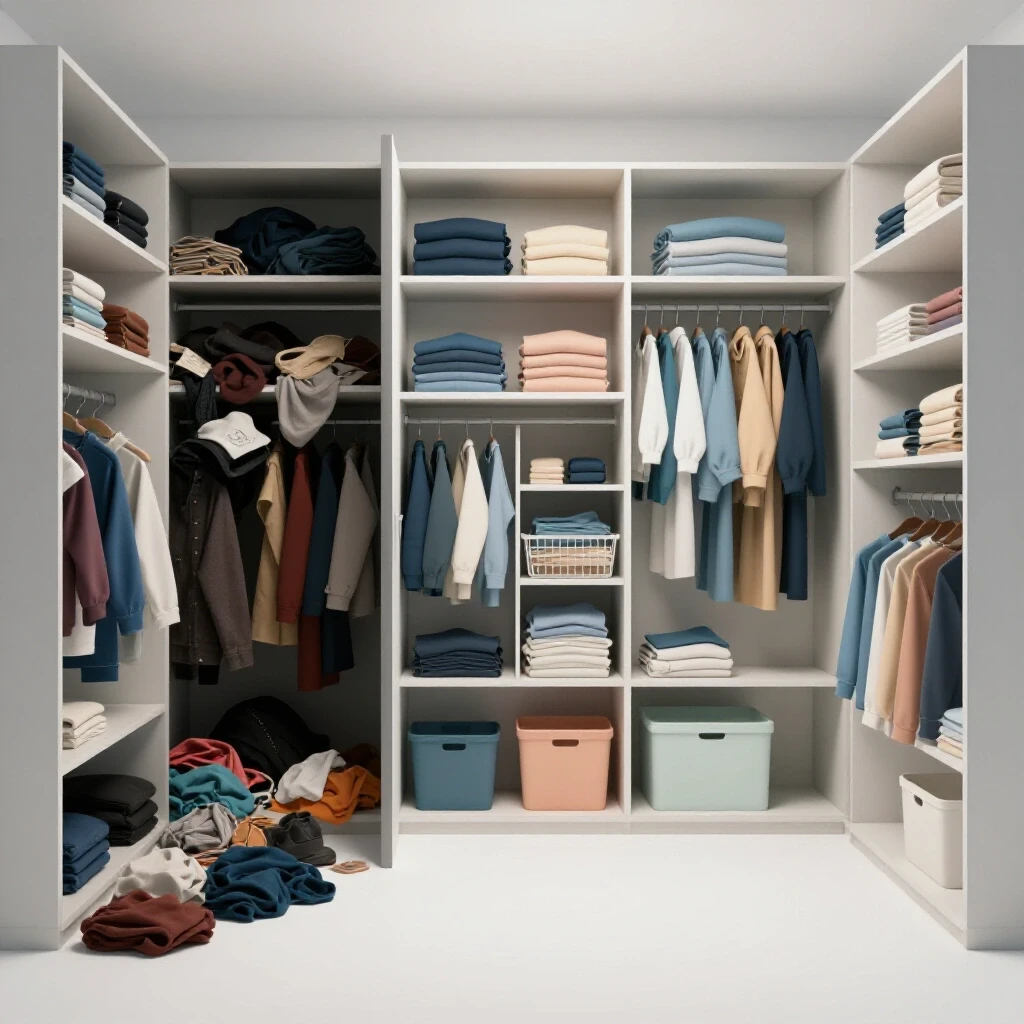
When a closet reaches 100% capacity, the “flow” of the room stops. In logistics, we call this a “gridlock state.” You cannot put an item away without moving three other things. This creates high retrieval friction. Research in environmental psychology suggests that when we are surrounded by more items than we can easily manage, our brains remain in a state of low-level “alert,” which leads to mental fatigue.
To fix this, we must aim for a 75% to 80% utilization rate. This “buffer space” allows you to move hangers, see your shoes, and put away clean laundry without a struggle. In my house, we found that reducing the volume of clothes by just 20% cut our morning dressing time in half.
How Visual Clutter Increases Decision Fatigue
Decision fatigue is the mental exhaustion we feel after making too many choices. In a crowded closet, your brain has to filter through dozens of irrelevant items just to find one shirt. This constant filtering drains your energy before your workday even begins.
When you look into a packed space, your eyes cannot find a “landing spot.” This causes visual overwhelm. By creating clear sightlines and grouping items by type, you reduce the cognitive load required to make a choice. A streamlined closet allows the brain to process options quickly, turning a stressful chore into a simple, three-second decision.
Measuring Retrieval Friction in Daily Dressing Routines
Retrieval friction is the number of physical steps or movements required to get an item out of storage and put it back. High-friction systems, like deep bins with lids or stacked boxes, often lead to piles on the floor because the effort to “do it right” is too high.
In my professional work, we measure “touch points.” If it takes five touches to put a sweater away, that sweater will likely end up on a chair. To create sustainable decluttering, we must reduce these touch points. A successful home organization system makes it just as easy to put something away as it is to drop it on the floor.
| Storage Method | Number of Steps (Retrieval) | Friction Level | Sustainability Score |
|---|---|---|---|
| Open Shelving | 1 step | Low | 9/10 |
| Hangers on Rod | 2 steps | Medium-Low | 8/10 |
| Drawers (No Dividers) | 3 steps | Medium | 6/10 |
| Bins with Lids | 4+ steps | High | 3/10 |
| Stacked Boxes | 5+ steps | Very High | 1/10 |
Why Complex Storage Systems Fail Busy Families
Many families buy expensive, multi-piece storage solutions for families that look great in a store but fail in reality. These systems are often too rigid or require too much precision to maintain. If a system requires a parent to spend thirty minutes “resetting” it every night, it is not a functional system for a real home.
Complexity is the enemy of consistency. When we tried using color-coded bins with tiny latches for our kids’ clothes, the system collapsed in three days. We replaced them with open-top baskets and low-hanging rods. By lowering the “cost of entry” for tidiness, we enabled our children to manage their own spaces without constant supervision.
Implementing a Sustainable Decluttering Framework
A sustainable decluttering framework is a repeatable process for evaluating what stays and what goes based on usage data rather than emotion. It focuses on the “flow rate” of items in the home, ensuring that the number of items entering the house does not exceed the storage capacity.
Our family uses a “Frequency of Use” audit. We don’t ask, “Does this spark joy?” Instead, we ask, “When was the last time this was worn?” If an item hasn’t been touched in six months, it is taking up “prime real estate.” In a closet, prime real estate is the area between your knees and your shoulders. Anything kept in this zone should be something you use at least once a week.
- The 90/90 Rule: If you haven’t worn it in 90 days and don’t plan to wear it in the next 90, it likely doesn’t belong in your daily closet.
- The Hanger Trick: Turn all your hangers backward. When you wear an item, put the hanger back the right way. After six months, see which hangers are still backward.
- One-In, One-Out: For every new garment that enters the home, an old one must exit to maintain a steady volume.
Zoning Principles for Daily Flow
Zoning is the practice of dividing a space into specific areas based on the activity performed there. In a closet, zoning ensures that the items you need most often are the easiest to reach, while seasonal or occasional items are moved to the “outfield.”
We divided our closets into three zones. Zone 1 is the “Active Zone” (eye level), holding daily work and school clothes. Zone 2 is the “Reach Zone” (high or low), holding gym gear and shoes. Zone 3 is “Deep Storage” (top shelves), holding heavy coats or formal wear. This layout reduced our “search time” by 70% because we always knew exactly which area to look in.
Designing Low-Maintenance Wardrobe Storage
Low-maintenance storage refers to hardware and containers that require minimal effort to use and keep clean. This includes modular shelving that can be adjusted as children grow and open-access containers that eliminate the “lid barrier” which often prevents people from putting things away.
When choosing functional home storage, focus on visibility. If you can’t see it, you won’t wear it, and you might even buy a duplicate. Clear bins or open wire shelving allow for a quick visual inventory. This prevents the “I have nothing to wear” feeling that often comes from a closet where items are hidden in dark corners or deep drawers.
- Vertical Storage: Use the full height of the wall. Install extra rods for kids’ clothes to double the hanging space.
- Modular Shelving: Use shelves that can be moved. This allows you to adapt the space for tall boots in winter or short sandals in summer.
- Seasonal Rotation: Move off-season clothes to a different location. This keeps your daily closet lean and easy to navigate.
- Uniform Hangers: Using the same type of hanger prevents tangling and makes the closet look more organized, which reduces visual stress.
Reducing Household Clutter through Inflow Control
Inflow control is the practice of managing how many new items enter the home. Without controlling the inflow, even the best organization system will eventually be overwhelmed by sheer volume. It is the most critical step in any long-term decluttering journey.
We started a “Holding Zone” for new purchases. Before a new shirt goes into the closet, it stays in the holding zone for 24 hours. This gives us time to decide which old shirt it will replace. By treating our closet capacity as a “fixed budget,” we stopped the cycle of overfilling and kept our dressing routine fast and easy.
Measuring Long-Term Success in Functional Home Storage
Long-term success is measured by the “reversion rate,” which is how quickly a space returns to a messy state after being cleaned. A successful system has a low reversion rate, meaning it stays tidy for weeks or months with only minor daily maintenance.
In our home, we track “Reset Time.” This is the amount of time it takes to put the closet back in order at the end of the week. If the reset takes more than ten minutes, the system is too complex. We aim for a system where daily maintenance takes less than two minutes per person.
| Metric | Goal for Families | Why it Matters |
|---|---|---|
| Retrieval Time | Under 15 seconds | Reduces morning stress and lateness. |
| Reset Time | Under 2 minutes daily | Prevents clutter from building up. |
| Space Utilization | 75% – 80% | Allows for easy movement and visibility. |
| Item Density | 1 hanger per 1.5 inches | Prevents clothes from getting wrinkled and lost. |
Building Systematic Habit Loops
A habit loop is a three-step process: a cue, a routine, and a reward. To keep a closet organized, you need to build these loops into your daily life. For example, the “laundry loop” ensures that clean clothes are put away immediately rather than sitting in a basket for days.
The cue is the dryer buzzing. The routine is folding and putting clothes directly into their assigned zones. The reward is a clear floor and a stress-free morning the next day. By focusing on these small, repeatable actions, our family moved away from “marathon cleaning” sessions and toward a lifestyle of consistent, low-effort order.
Practical Steps to Streamline Your Space Today
Transitioning from a crowded closet to a functional one does not happen overnight. It requires a series of small, logical steps. Start by auditing your current space and identifying where the most friction occurs. Is it the shoe pile on the floor? Is it the overstuffed drawer that won’t close?
- Step 1: The Empty-Out: Remove everything from the closet. This allows you to see the true physical capacity of the space.
- Step 2: The Sort: Group items by “Active,” “Occasional,” and “Seasonal.”
- Step 3: The Purge: Remove items that no longer fit or haven’t been worn in a year.
- Step 4: The Zone: Place “Active” items in the most accessible areas.
- Step 5: The Label: Use simple labels on shelves or bins so every family member knows where things go.
By following these steps, you create a system based on logistics and human behavior. You are no longer fighting against your closet; you are using it as a tool to make your life easier. This approach reduces mental fatigue and gives you back valuable time every single morning.
FAQ
Why does my closet get messy again just days after I clean it? This usually happens because the “retrieval friction” is too high. If it is hard to put something away—like having to open a lid or move other items—you will likely just drop it on a chair. To stop this, use open-top bins and ensure there is at least 20% empty space on every shelf.
How many items of clothing should I actually own? There is no set number, but your closet should never be more than 80% full. If you have to fight to slide a hanger onto the rod, you have too many items for that specific space. Let the physical size of your closet dictate your wardrobe size.
What is the best way to handle kids’ closets? Keep everything at their height. Use low-hanging rods and open baskets on the floor for shoes and socks. Avoid drawers that are heavy or hard to pull. The goal is to make the system so simple that a five-year-old can put their own clothes away.
How do I manage seasonal clothes without a lot of extra space? Use the “Top Shelf” or “Under-Bed” strategy. Place off-season items in slim, breathable containers and move them out of your daily sightline. This keeps your main closet focused only on what you can wear right now, reducing decision fatigue.
Are expensive closet systems worth the investment? Not necessarily. A functional system is about the layout and the “flow,” not the price of the shelves. Simple, adjustable wire racks or basic wooden shelves often work better than complex, custom-built units because they are easier to change as your needs evolve.
How can I stop buying clothes I don’t need? Implement a “One-In, One-Out” rule. Before you buy something new, identify exactly which item in your closet it will replace. This forces you to consider if the new item is truly better than what you already own.
What should I do with clothes that need repairs or don’t fit? Move them out of the closet immediately. If they are in your main dressing area, they are “noise” that distracts you from the clothes you can actually wear. Place them in a dedicated “To-Fix” or “To-Donate” bin in a laundry room or hallway.
How do I deal with “sentimental” clothing that I never wear? Sentimental items are not “clothing”; they are “mementos.” They should not be in your daily closet. Move them to a keepsake box in a storage area. Your closet should be reserved for items that serve your current daily life.
How long should it take to organize a standard closet? A thorough “reset” usually takes 2 to 4 hours. However, once a low-friction system is in place, daily maintenance should take less than two minutes. The goal is to spend more time living and less time sorting.
Does vertical storage really make a difference? Yes. Most people only use the middle 50% of their closet. By using the space all the way to the ceiling for rarely used items and adding a second rod for shorter items like shirts or kids’ clothes, you can effectively double your storage capacity.
(This article was written by one of our staff writers, Christopher Bennett. Visit our Meet the Team page to learn more about the author and their expertise.)