How Setting a Keep Box Limit Eases Decluttering (Easy Guide)

Walking through my hallway five years ago felt like navigating a logistical bottleneck in a poorly managed warehouse. I had just spent an entire Saturday morning “organizing” the mudroom, yet by Tuesday, the shoes were scattered, and the mail had formed a leaning tower on the bench. As an operations professional, I realized my mistake: I was treating the symptoms of clutter rather than the flow. I was moving items from one spot to another without ever addressing the volume or the decision-making process. The breakthrough came when I stopped trying to find a place for everything and instead created a physical boundary for the things that didn’t have a clear home.
The Logistics of Physical Boundaries in Home Management
Spatial logistics involves managing the movement and storage of items within a finite area. By establishing a physical limit for undecided objects, we create a clear “stop-loss” for clutter. This prevents the common issue of items migrating from one shelf to another without a final destination.
In the world of logistics, we talk about “capacity utilization.” If a warehouse is filled to 100% capacity, movement stops. Efficiency plummets because there is no room to maneuver. Our homes function the same way. When every drawer and shelf is packed, we lose the ability to process new items. Using a single, fixed-volume container for items you are unsure about provides a “buffer zone.” It allows you to pause without letting the item infect the rest of your living space.
Interestingly, research in environmental psychology suggests that visual clutter competes for our attention. When our brains are forced to process too many stimuli, our cognitive load increases, leading to frustration. A defined boundary for “maybe” items reduces this load by consolidating the chaos into one predictable spot.
Why Traditional Sorting Fails the Busy Family
Traditional methods often rely on willpower rather than structural constraints. Without a hard limit on what we can keep “just in case,” the volume of items eventually exceeds the home’s storage capacity. This leads to visual overload and increased daily sorting friction for parents.
I remember helping my kids sort through their art supplies. We had multiple bins for “current projects,” “future ideas,” and “keepsakes.” Within a week, the bins were mixed, and the table was buried. The system was too complex. It required too many decisions. When we switched to a single, medium-sized bin for all “in-progress” or “unsure” items, the friction disappeared. If the bin got full, something had to be finished, filed, or tossed.
The failure of most home organization systems stems from “decision fatigue.” Every time you pick up an item, your brain asks: Where does this go? Do I need it? What if I need it later? By using a fixed-capacity container, you limit the number of “maybe” decisions you can store at one time.
The Fixed-Capacity Container as a Decision Engine
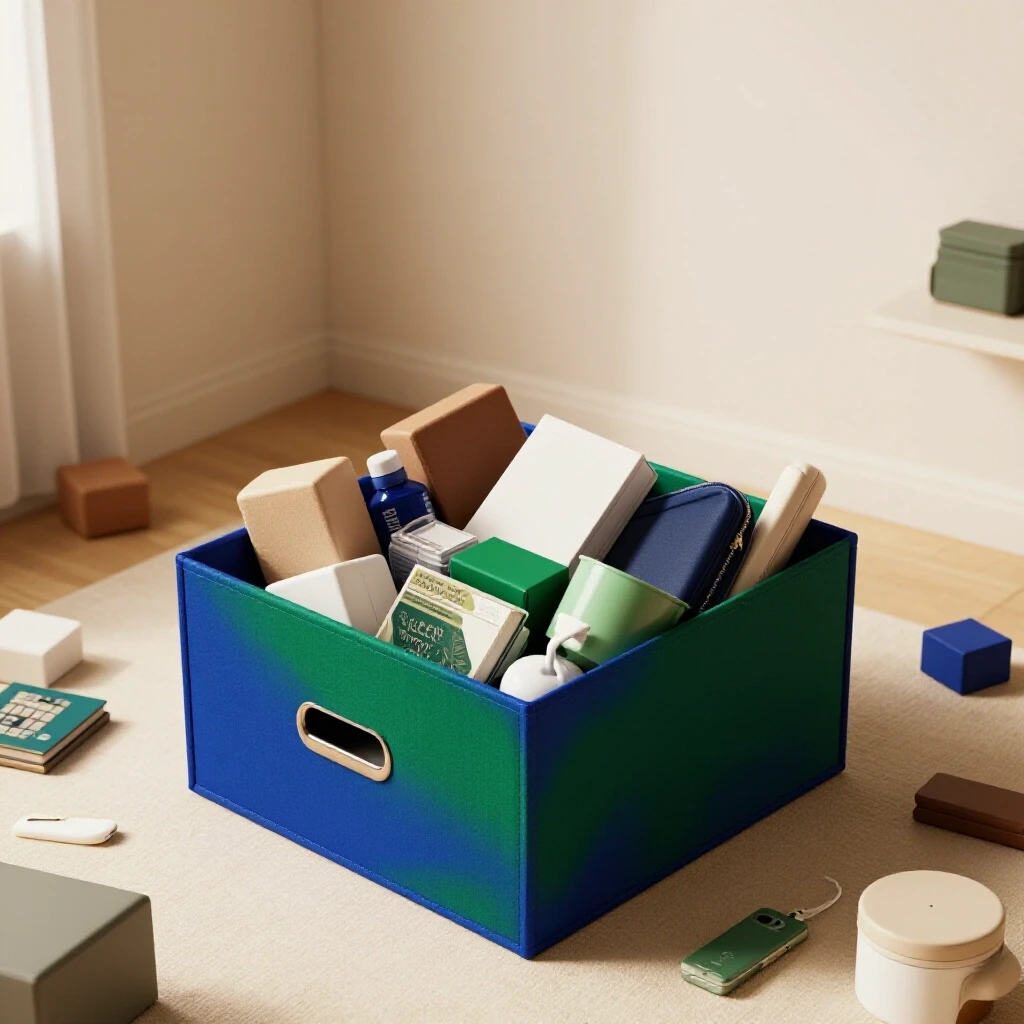
A decision engine is a tool that simplifies complex choices. A single, small container acts as a physical boundary for items you aren’t ready to discard. When the box is full, you must make a choice before adding anything new, effectively managing household inflow.
This approach works because it creates a natural feedback loop. In operations, a feedback loop tells us when a system is out of balance. If your “undecided” container is overflowing, it is a signal that your “inflow” (items coming in) is higher than your “outflow” (items being discarded or assigned a permanent home).
Storage Friction Index by Bin Type
To understand why some systems fail, we can look at the “Friction Index.” This measures how many steps or how much effort it takes to use a storage solution.
| Bin Type | Retrieval Steps | Sorting Speed | Maintenance Level |
|---|---|---|---|
| Open Top Bin | 1 Step | Fast | Low |
| Lidded Tote | 2-3 Steps | Moderate | Medium |
| Stacked Boxes | 5+ Steps | Slow | High |
| Fixed Boundary Box | 1-2 Steps | Fast | Very Low |
As the table shows, the more steps required to interact with a system, the more likely it is to fail. A single, accessible container for undecided items keeps the friction low while maintaining a hard boundary on volume.
Designing Low-Friction Home Organization Systems
Low-friction systems minimize the number of steps required to put an item away or retrieve it. For families, a system with more than two steps often fails. Reducing the “retrieval step count” ensures that the home stays functional even during busy work weeks.
When I redesigned our family’s entryway, I measured the “step count” for putting away a coat and bag. The old system involved opening a closet, finding a free hanger, and sliding it onto a crowded rod. That is a 4-step process. Most kids (and busy adults) will just drop the coat on a chair. We switched to heavy-duty wall hooks. This reduced the process to 1 step.
The same logic applies to your “maybe” items. If the process for dealing with an undecided item is too complex, it will end up on the kitchen counter. A single, designated box in a central location provides a 1-step solution for temporary storage.
- Keep the box in a high-traffic area like the laundry room or office.
- Choose a size that fits on a standard shelf (roughly 15-20 liters).
- Avoid using a lid if you want to see when it is reaching capacity.
Implementing the One-Box Rule in Daily Life
The one-box rule limits the accumulation of “maybe” items to a single, predefined space. This practice forces immediate evaluation of new clutter. It turns a vague “I’ll deal with this later” into a concrete “I must deal with this now because the boundary is met.”
In my home, we use a specific 12×12 inch box for my daughter’s school papers and “treasures.” Before we set this limit, her drawings were taped to every wall and piled on every surface. Now, she knows that if the box is full, she has to pick her favorites to keep and recycle the rest. This teaches her spatial awareness and prioritization from a young age.
Daily Maintenance Timelines by Family Size
Managing a home is about “dwell time”—how long an item stays in a temporary spot before moving to its permanent home.
| Family Size | Daily Reset Time | Weekly Deep Sort | Box Clearance Frequency |
|---|---|---|---|
| 2 Adults | 10 Minutes | 30 Minutes | Once a Month |
| 2 Adults, 1 Child | 15 Minutes | 45 Minutes | Every 2 Weeks |
| 2 Adults, 2+ Children | 20 Minutes | 60 Minutes | Weekly |
Spatial Psychology and the Weight of Too Many Choices
Spatial psychology examines how our physical surroundings affect our mental state. When every surface is a potential storage spot, the brain experiences “choice overload.” Using a single container for undecided items limits these choices, reducing mental fatigue and making the home feel more manageable.
When we have “infinite” storage—like a basement or a large attic—we tend to defer decisions indefinitely. This is known as “expansion bias.” We fill the space available to us. By creating a small, artificial boundary, we counteract this bias. We force our brains to categorize items as either “valuable enough to find a home for” or “not worth the space.”
- Visual Overload: Too many items in view can increase cortisol levels.
- Decision Fatigue: Making hundreds of small choices about clutter saps energy for work and parenting.
- Zoning Principles: Assigning specific functions to areas (e.g., “The Sorting Zone”) creates mental clarity.
Building Sustainable Habit Loops for the Whole Family
A habit loop consists of a cue, a routine, and a reward. In a family setting, the “cue” is an item out of place. The “routine” is placing it in its designated zone or the limited sorting box. The “reward” is a clear, functional living space.
For this to work, the system must be “low-barrier.” If the “keep box” is hidden in the back of a dark closet, the habit loop will break. I found that placing our sorting container on the bottom shelf of the pantry—an area we visit multiple times a day—made the routine effortless.
- Identify the Cue: You find an item (a toy, a gadget, a piece of mail) and don’t know where it goes.
- Execute the Routine: Place it in the designated “boundary box.”
- Check the Limit: If the box is full, take 5 minutes to sort it.
- Enjoy the Reward: The counters remain clear, and you don’t feel the “clutter guilt.”
The Metrics of a Functional Home
Measuring success in home organization requires looking at time and volume. Tracking how long it takes to reset a room or the volume of items entering the house provides data for improvement. These metrics help move from emotional reactions to logical, logistical solutions.
In logistics, we use “throughput” to measure how many units pass through a system. If 50 items enter your home each week (mail, groceries, toys) but only 10 leave, you have a throughput problem. The “boundary box” acts as a pressure valve. It highlights exactly how much “undecided” volume you are carrying.
Decluttering Sorting Log
If you find yourself stuck, try tracking your decisions for one week.
| Item Description | Reason for “Maybe” | Final Decision | Time Taken |
|---|---|---|---|
| Old Kitchen Gadget | Might use for hosting | Donated | 30 Seconds |
| Kid’s Art Project | Sentimental value | Filed in Archive | 1 Minute |
| Extra Charging Cable | Backup for phone | Kept in Tech Bin | 10 Seconds |
| Mystery Hardware | Might fit a shelf | Recycled | 1 Minute |
Selecting the Right Tools for Spatial Management
While the focus should be on the boundary rather than the bin, choosing the right “decision container” can reduce system friction. You want something durable, easy to clean, and sized appropriately for your specific storage area.
I prefer modular units that can be easily accessed. Modern smart-label systems, like QR code stickers, can even help you track what is inside a box without opening it, though for a “maybe” box, visual access is usually better.
- Size Matters: A box that is too large (like a 50-gallon tote) becomes a “clutter coffin” where things go to be forgotten.
- Visibility: Clear plastic or open-top baskets allow you to see the volume levels at a glance.
- Portability: Choose a container with handles so you can take it to the room where the items belong during your weekly sort.
Overcoming the “What If” Trap
The biggest hurdle to letting go is the fear of future need. We keep things “just in case.” However, the logistical cost of storing an item—the space it takes, the time spent cleaning around it, and the mental energy spent remembering you have it—often outweighs the cost of replacing it if needed.
I use the “20/20 Rule” from the minimalist community: If I can replace it for less than $20 and in less than 20 minutes from my house, I don’t need to keep it in my “maybe” box. This simple logistical rule has eliminated about 40% of the small-item clutter in our home.
Practical Steps for a Sustainable Reset
To start implementing this boundary system today, you don’t need a professional organizer. You need a logical plan and about 30 minutes of focused time.
- Audit Your Surfaces: Identify the “hot spots” where clutter naturally accumulates (entryway table, kitchen island, nightstand).
- Assign One Box: Find a single container you already own. Designate this as the only place for undecided items.
- Communicate the Boundary: Tell your family, “If you don’t know where it goes, put it here, but once this is full, we sort it together.”
- Schedule the “Empty”: Set a recurring calendar invite for 15 minutes on Sunday evenings to process the box.
Conclusion: The Freedom of a Finite Space
Managing a busy home is an ongoing logistical challenge, not a one-time project. By shifting our focus from “perfect neatness” to “sustainable flow,” we can reduce the daily stress that clutter creates. The simple act of setting a physical limit on our indecision allows us to reclaim our living spaces. It transforms our homes from overwhelming warehouses into functional, peaceful environments where we can focus on what truly matters: spending time with our families.
Frequently Asked Questions
How big should my “undecided” box actually be? For most families, a container between 15 and 25 liters is ideal. This is roughly the size of a standard milk crate or a medium storage bin. If it is larger, it becomes too heavy and holds too much clutter to sort quickly. If it is smaller, it will fill up daily, which might feel discouraging.
Where is the best place to keep this container? Place it in a “transition zone.” This is an area where you naturally transition from one activity to another, such as the laundry room, the mudroom, or near the primary entrance. Keeping it central ensures that items are put away immediately rather than being left on high-value surfaces like the kitchen counter.
What should I do if my spouse or partner won’t follow the system? Start by managing your own items first. Logistics is about demonstrating efficiency. When they see that your areas are clear and that you aren’t stressed by “lost” items, they are more likely to adopt the habit. Make it as easy as possible for them—place the box where they usually drop their things.
How often should I empty the box? The frequency depends on your “inflow rate.” For a family with young children, a weekly sort is usually necessary. For a two-person household, once every two weeks might be enough. The key is to empty it before it overflows, as an overflowing box creates the very visual clutter you are trying to avoid.
What if I find it too hard to throw things away during the sort? Use the “One-In, One-Out” rule. If you want to keep something from the box but don’t have a permanent home for it, you must remove something else from your house to make room. This forces you to weigh the value of the new item against the items you already own.
Does this system work for digital clutter too? Yes. You can create a “To Sort” folder on your desktop or in your email. Set a limit—for example, no more than 20 files in that folder. Once you hit 20, you must file or delete them before adding more. The principle of a fixed-volume boundary applies to any space, physical or digital.
What if an item is too big for the box? Large items (like a chair or a large toy) require an immediate decision. Because they consume so much “spatial capital,” they cannot be allowed to sit in a “maybe” state. If it doesn’t fit in the boundary box, it must be assigned a home or removed from the house within 24 hours.
How do I handle sentimental items in this system? Sentimental items should have their own separate, very small “memory box.” The “undecided” box is for functional household items—tools, gadgets, papers, and decor. Mixing sentiment with logic makes sorting much slower and more emotionally taxing.
What is the “Sorting Time-Box” interval? I recommend a 15-minute interval. Most people can maintain high focus and quick decision-making for 15 minutes. If the sorting takes longer, you are likely overthinking the decisions. Set a timer, work fast, and trust your first instinct.
Can I have more than one box? Ideally, no. Having multiple “maybe” boxes is just another way of expanding your storage capacity and avoiding decisions. One box for the whole house (or one per person in a large family) is the most effective way to maintain a hard boundary.
(This article was written by one of our staff writers, Christopher Bennett. Visit our Meet the Team page to learn more about the author and their expertise.)