How to Organize Kitchen Essentials for High-Use Zones (Guide)

Imagine a Tuesday evening at 6:15 PM. You are standing in a kitchen where every drawer you open feels like a game of Tetris. To find the vegetable peeler, you move three mismatched lids and a heavy grater. By the time the meal is served, the counters are buried under a mountain of displaced items. Now, shift that image to a kitchen where your hand moves instinctively to the right drawer for a spatula, and the olive oil sits exactly where you need it near the stove. There is no searching, no digging, and no mental exhaustion. This shift is not about a total renovation; it is about the logical placement of the tools you touch every single day.
In my eleven years managing logistics and operations, I have learned that systems fail when they ignore the way people actually move. My own family struggled with a kitchen that looked organized on the surface but fell apart within forty-eight hours. We realized that our storage solutions were too complex. We were storing the things we used most in places that were hard to reach. By applying spatial management principles, we transformed our kitchen from a source of friction into a high-efficiency workspace that stays tidy because the layout supports our natural habits.
The Logistics of Spatial Efficiency in Family Kitchens
Spatial efficiency refers to the strategic arrangement of items to minimize the time and physical effort required to complete a task. In a household setting, this means prioritizing the “prime real estate” of your counters and eye-level cabinets for items used daily. When we ignore these principles, we experience cognitive load, which is the mental effort used to process information and make decisions while performing a task.
The primary reason most home organization systems fail is that they prioritize aesthetics over flow. If you have to move a stack of three heavy bowls to get to the one you use for breakfast every morning, you are creating “retrieval friction.” Over time, this friction leads to clutter because it is easier to leave the bowl on the counter than to navigate a difficult storage setup. By reducing the number of steps and movements required to access your core tools, you lower the barrier to keeping the space clean.
- Spatial Capacity: The physical limit of a designated area to hold items without compromising accessibility.
- Flow Rate: The speed at which items move from their storage spot to their point of use and back again.
- System Friction: Any physical or mental obstacle that makes it harder to return an item to its proper home.
Identifying the Core Workflow Zones for Daily Use
Workflow zoning is the practice of grouping tools and supplies according to the specific activities performed in a given area. Instead of organizing by item type, such as “all plastic containers,” you organize by activity, such as “food preparation” or “cleanup.” This reduces the need to walk across the kitchen multiple times during a single task.
Research in environmental psychology suggests that “visual noise” from disorganized surfaces can increase cortisol levels, particularly in parents. When your kitchen is zoned correctly, your brain can focus on the task at hand—like cooking a healthy meal—rather than scanning the room for missing supplies. In my home, we mapped out three primary stations: the Prep Station, the Cooking Station, and the Cleanup Station.
The Prep Station
This area should be located near your primary cutting surface and the sink. It holds the essentials for getting ingredients ready for heat. * Chef’s knives and cutting boards. * Measuring cups and spoons. * Mixing bowls and colanders. * Trash or compost bins for scraps.
The Cooking Station
Centered around the stove or oven, this zone houses everything needed once the heat is turned on. * Spatulas, tongs, and wooden spoons. * Frequently used oils, salt, and pepper. * Potholders and trivets. * Lids for pans currently in use.
The Cleanup Station
This zone surrounds the dishwasher and sink, focusing on the transition from eating back to a clean kitchen. * Dish soap and sponges. * Drying racks or mats. * Daily-use glassware and plates. * Storage for leftovers (containers and wraps).
Measuring Retrieval Friction to Prevent Clutter Reversion
Retrieval friction is a metric used to determine how much effort is required to get an item out of storage and put it back. A low-friction system allows you to access an item with one hand and in one motion. A high-friction system involves moving other objects, opening multiple doors, or using a step stool.
In logistics, we use a “touch count” to measure efficiency. If it takes five touches to get a pan—opening a cabinet, moving a lid, lifting a smaller pot, grabbing the pan, and closing the cabinet—the system is likely to fail. We want to aim for a one-touch or two-touch system for anything used more than four times a week.
| Storage Type | Friction Level | Steps Required | Sustainability Rating |
|---|---|---|---|
| Open Shelving/Hooks | Low | 1 (Grab and go) | High |
| Single-Layer Drawers | Medium-Low | 2 (Open, grab) | High |
| Stacked Bins with Lids | High | 4+ (Move bin, open lid, grab, replace) | Low |
| Deep Corner Cabinets | Very High | 5+ (Reach, move items, dig, retrieve) | Very Low |
Mapping Your High-Traffic Stations for Maximum Flow
Mapping involves physically observing your movements during a standard meal to see where “bottlenecks” occur. A bottleneck is a point where the flow of work stops because you are searching for a tool or navigating a cluttered surface. By documenting these moments, you can identify which items need to be moved closer to your “Zone 0.”
Zone 0 is the area within immediate arm’s reach of where you stand most often. In my family’s kitchen audit, we discovered that we were storing our daily coffee mugs in a cabinet across the room from the coffee maker. By moving them to the shelf directly above the machine, we saved approximately thirty seconds every morning. While thirty seconds seems small, multiplying that by 365 days and adding other similar adjustments significantly reduces the daily mental fatigue of managing a household.
- Step 1: Track your movements for three days. Note every time you have to walk more than three steps to get a tool.
- Step 2: Identify “hot spots” where clutter naturally builds up. This usually indicates a lack of a convenient “home” for those items.
- Step 3: Relocate the top five items you use most frequently to your Zone 0.
- Step 4: Remove any items from your primary drawers that you have not used in the last month.
Aligning Household Behaviors with Low-Maintenance Systems
A system is only as good as the people using it. For a kitchen to remain functional, every family member—including children—must be able to follow the logic. This is why complex labeling or color-coding often fails in busy homes. Instead, use “intuitive placement,” where the location of an object suggests its purpose.
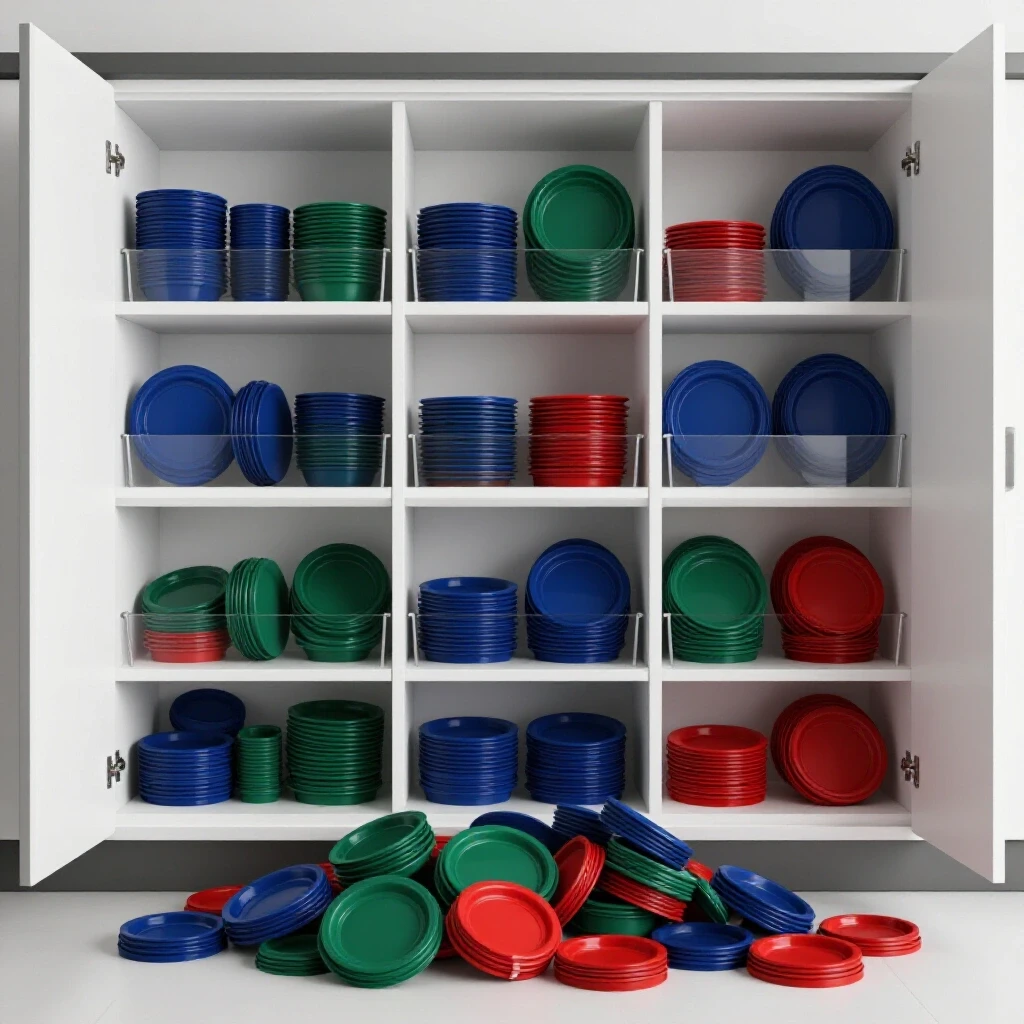
In our home, we found that my children would leave their water bottles on the counter because the cabinet where we stored them was too crowded. We switched to a simple, un-lidded bin on a lower shelf. This reduced the friction for them, and the counter clutter vanished. We moved from a visual-focused system (how it looks) to a behavioral-focused system (how we act).
- Lower the entry barrier: Use open bins for high-use items like snacks or kids’ dishes.
- Visual cues: Use clear containers or simple, large-font labels if necessary, but rely primarily on logical grouping.
- The “One-In, One-Out” Rule: If you bring a new small appliance into the high-use zone, an older one must move to long-term storage.
- Feedback loops: If a certain drawer is always messy, it is a sign the system is too complex. Simplify it immediately.
Establishing Sustainable Maintenance Habits for Busy Parents
Maintenance is the process of returning the system to its baseline state. In a high-efficiency kitchen, this should take no more than ten to fifteen minutes at the end of the day. If cleanup takes longer, it is often because items do not have a clear, low-friction home, leading to “decision fatigue” during the sorting process.
We utilize a “Daily Reset” rather than a “Weekly Clean.” By spending five minutes after dinner ensuring that the Prep and Cook stations are clear, we prevent the accumulation of clutter that leads to the “burnout” phase where the system collapses. This is about maintaining the flow rate of the kitchen so that tomorrow morning starts with a neutral workspace.
- Morning Reset (2 mins): Empty the dishwasher to prepare for the day’s “inflow” of dirty dishes.
- After-School Sweep (3 mins): Clear the Prep Station of lunchboxes and mail.
- Evening Reset (10 mins): Return all Zone 0 items to their designated spots and wipe down prime surfaces.
Practical Strategies for Reducing Household Clutter
To maintain a functional home storage environment, you must treat your kitchen like a professional workshop. This means prioritizing utility over “just in case” items. Every square inch of your high-use zones must earn its place. If an item is not helping you prepare a meal today or tomorrow, it is likely a source of clutter.
- Standard Item Density: Aim for 70% capacity in drawers. This allows you to see and grab items without digging.
- Sorting Time-Box: Spend 15 minutes once a month auditing your high-use drawers to remove items that have migrated there but don’t belong.
- Daily Habit Tracking: For the first 21 days of a new layout, check in every evening to see if the new “homes” for your tools are working.
By focusing on the logistics of how your family actually uses the kitchen, you can create a space that supports your life rather than draining your energy. Sustainable decluttering is not about a one-time purge; it is about building a functional home storage system that respects your time and your mental well-being.
Frequently Asked Questions
What is the most common mistake people make when organizing their kitchen? The most frequent error is organizing by category rather than by frequency of use. People often put all their “baking supplies” together in one cabinet, even if they only bake once a month, while their daily-use spatula is buried in a cluttered drawer. Prioritizing “Prime Real Estate” for daily essentials is key to preventing clutter reversion.
How do I know if a storage system is too complex for my family? If you find that items are consistently left on the counter or shoved into the wrong drawers, the system has too much friction. High-maintenance systems usually involve too many steps—like opening a decorative box inside a cabinet. If it takes more than two motions to put an item away, it is likely too complex for a busy household.
Should I use labels for everything in the kitchen? Labels are helpful for items that look similar (like flour and sugar) or for helping children know where things go. However, over-labeling can become a burden. A better approach is “intuitive zoning,” where the location of the item makes sense based on the task you are doing nearby.
How can I reduce mental fatigue when cooking? Mental fatigue often comes from “decision friction”—having to search for tools or move clutter to find a workspace. By mapping your high-use zones so that every necessary tool is within arm’s reach of its station, you eliminate the need for constant searching and decision-making during meal prep.
What is “Zone 0” and why is it important? Zone 0 is the area you can reach without taking a step. In a kitchen, this is usually the space directly in front of your main prep counter and the stove. Keeping your most-used items here reduces physical strain and speeds up the cooking process, making it easier to maintain the system.
How often should I audit my kitchen zones? A quick “reset” should happen daily, but a deeper spatial audit is beneficial every three to six months. This allows you to adjust the layout based on changing family needs, such as a child starting to pack their own lunch or a shift in your typical cooking style.
Can I organize a small kitchen without buying new containers? Absolutely. Sustainable decluttering is about the placement and quantity of items rather than the containers themselves. The most effective change you can make is removing items you don’t use and repositioning your daily essentials into the most accessible drawers and shelves you already have.
Why does my kitchen get messy again so quickly after I organize it? This usually happens because the “outflow” (taking things out) is easier than the “inflow” (putting things away). If your storage spots are hard to reach or overcrowded, your brain will choose the path of least resistance, which is leaving the item on the counter. Reducing retrieval friction is the only way to stop this cycle.
What should I do with items I use only once a week? Items used weekly should be in “Zone 1″—accessible with one or two steps, perhaps in a lower cabinet or a higher shelf. They shouldn’t occupy the “Prime Real Estate” of your top drawers, but they shouldn’t be buried in the back of a deep pantry either.
How do I handle “multi-purpose” items that fit in two different zones? Store the item in the zone where you use it first or most often. For example, if you use a specific knife for both prep and at the stove, keep it at the prep station, as that is where the “flow” of the meal begins. If you use it equally in both, consider if you have the space to keep it in a central spot between the two zones.
(This article was written by one of our staff writers, Christopher Bennett. Visit our Meet the Team page to learn more about the author and their expertise.)