How to Balance Shelf Organization Without Overcrowding (Guide)

Imagine walking into your living room after a ten-hour workday. You spent your morning managing spreadsheets and your afternoon navigating school pick-ups. You want to sit down and relax, but your eyes keep jumping to the built-in bookshelves. They aren’t messy in the traditional sense—nothing is falling over—but they feel heavy. Every square inch is packed with books, baskets, and framed photos. This visual noise creates a subtle, nagging pressure in your chest. It is the weight of a home that feels full but not functional. You find yourself wanting to clear it all off, yet you know that leaving the shelves empty would make the room feel cold and unfinished. Finding that middle ground is the key to a calm home.
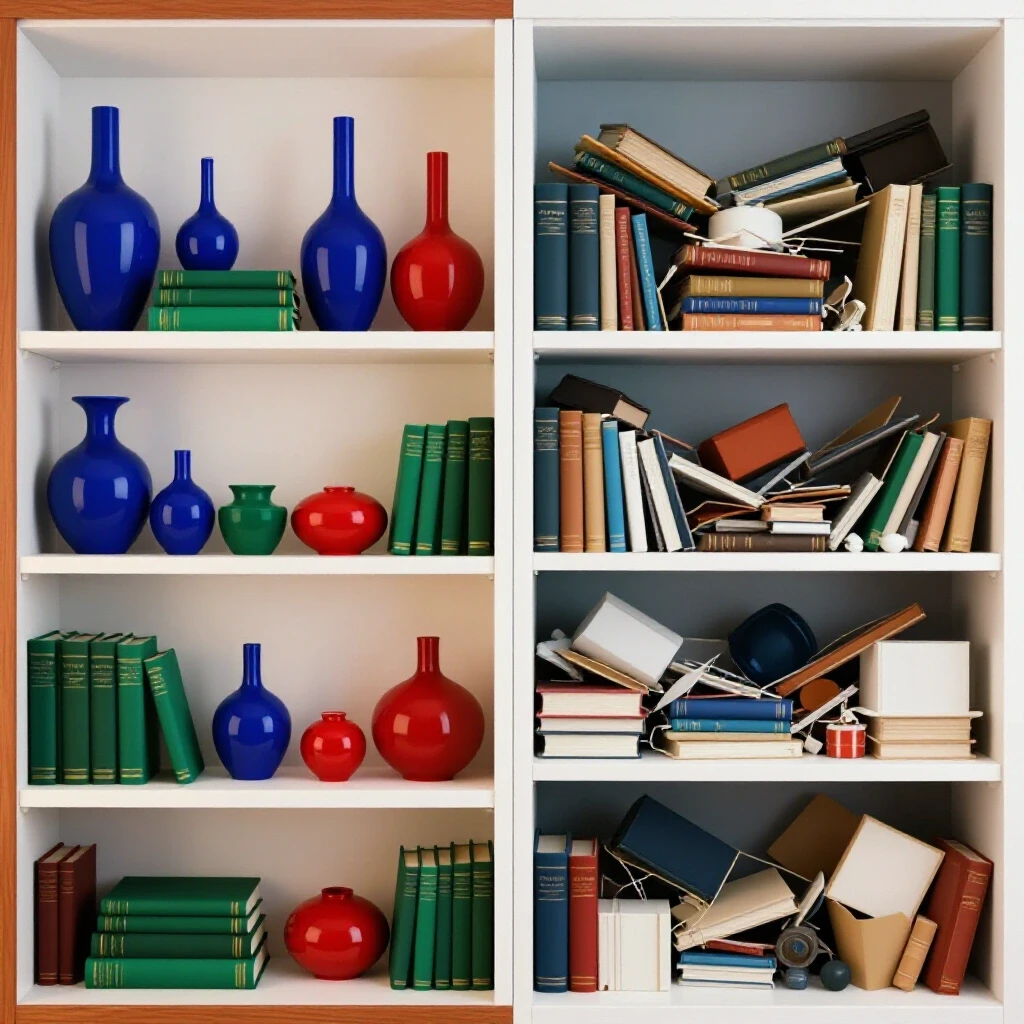
In my eleven years working in operations and logistics, I have learned that residential spaces operate much like a warehouse. If a warehouse is overstuffed, the flow of goods stops. If it is too empty, it is an inefficient use of expensive real estate. My own family struggled with this for years. We would spend entire Saturdays “resetting” our home, only for the shelves to look cluttered again by Tuesday. The problem was not our lack of discipline. It was our failure to understand spatial equilibrium. We were focusing on how much we could fit rather than how much the space could breathe. By applying logistical principles to our shelving, we created a system that stays organized because it is physically easier to maintain.
The Psychology of Visual Weight and Spatial Capacity
Visual weight is the perceived heaviness of an object based on its size, color, and density. Spatial capacity is the physical limit of a shelf, defined by how many items it can hold before retrieval becomes difficult or the eye becomes overwhelmed.
Environmental psychology research suggests that our brains are constantly scanning our surroundings for patterns and “breaks.” When a shelf is packed from edge to edge, the brain perceives it as a single, massive obstacle rather than a collection of items. A study published in The Journal of Environmental Psychology found that high-density environments can lead to increased cortisol levels, especially in women. This is why a “full” shelf can make you feel tired even if you aren’t doing any physical labor. By creating gaps—often called “white space”—you give your brain a place to rest. This reduces the cognitive load required to process the room, making the space feel more restorative.
Calculating Spatial Density for Family Life
Spatial density is the ratio of occupied space to empty space on a given surface. In a family home, this ratio determines how quickly a room reverts to clutter and how much effort is needed to keep it tidy.
In logistics, we rarely fill a shelf to 100% capacity because it makes picking items too slow. The same rule applies to your home organization systems. I recommend a “70/30 Rule” for most family shelving units. This means 70% of the shelf is used for storage or decor, while 30% remains empty. This 30% isn’t “wasted” space; it is a buffer that prevents the shelf from looking crowded. It also allows you to put something back quickly without having to shift three other items out of the way.
| Metric | Goal | Impact on Maintenance |
|---|---|---|
| Occupancy Rate | 70% | High ease of retrieval; low visual stress. |
| Item Grouping | 3-5 items per cluster | Prevents “item creep” across the shelf. |
| Retrieval Steps | 2 steps or fewer | Reduces the likelihood of items being left out. |
| Vertical Clearance | 2-3 inches | Allows for easy grasping without hitting the shelf above. |
Reducing Retrieval Friction in Shared Storage
Retrieval friction is the total amount of physical and mental effort required to get an item out and put it back. High friction is the primary reason why even the most beautiful storage solutions for families often fail within a week.
When my family redesigned our main living area, we realized our shelves were high-friction zones. We had beautiful, deep baskets, but they were stacked on top of each other. To get a toy out, my kids had to move one basket, open a lid, and then dig. To put it away, they had to do the reverse. Naturally, the toys stayed on the floor. We switched to a “low-friction” model where items are visible and accessible in a single motion. By leaving space around items, you eliminate the need to “shuffle” things. This makes the “put-away” process nearly instantaneous, which is essential for busy parents.
- Low Friction: Open bins, items spaced 2 inches apart, single-layer storage.
- Medium Friction: Lidded bins, items tucked behind decor, double-stacked books.
- High Friction: Stacking bins, items stored behind glass doors with locks, overstuffed rows.
Structural Zoning for Balanced Displays
Structural zoning involves dividing a shelf into specific functional areas. This technique uses proportion and layering to create a sense of order that looks intentional rather than accidental or messy.
To achieve a balanced look, think of your shelf as a grid. Instead of lining books up like a grocery store aisle, create “zones.” Place a small stack of books horizontally in one zone, a single decorative object in another, and a small group of vertical books in a third. This creates a rhythmic pattern that the eye can follow easily. Interestingly, using odd numbers—like groups of three or five—is a principle of spatial ergonomics that feels more natural to the human eye. This prevents the “heavy” look of a solid wall of objects while ensuring the shelf doesn’t look neglected or bare.
The Sorting Framework: Inflow vs. Outflow
Inflow and outflow management is the process of controlling how many items enter your home versus how many are removed. Without this balance, any storage system will eventually exceed its spatial capacity.
Sustainable decluttering is not a one-time event; it is a flow-rate problem. If you bring in five new books a month but only remove one, your shelves will eventually become crowded. I use a “One-In, One-Out” policy for our primary display areas. This keeps our item density consistent. When my daughter gets a new trophy or my wife buys a new art piece, we look at the shelf and decide which item has finished its “tenure” in that spot. This prevents the slow accumulation of “visual debris” that leads to mental fatigue.
- Audit: Count the items currently on the shelf.
- Purge: Remove anything that is broken, unused, or lacks meaning.
- Measure: Ensure the remaining items occupy no more than 70% of the surface.
- Zone: Group items by height and weight to distribute the visual load.
Lessons from the Hallway Bottleneck
A few years ago, our hallway shelving unit became a major bottleneck. It was the first thing we saw when we walked in, and it was always crammed. We had mail, keys, kids’ art, and books all competing for space. It felt like a physical wall of “to-do” lists. I realized we were treating the shelf as a “catch-all” rather than a curated space.
We applied a logistics “sorting logic” to the unit. We designated the middle shelf for high-frequency items (keys/wallets) and left the surrounding area completely empty. The top and bottom shelves were used for low-frequency items, spaced out with clear gaps between them. By intentionally leaving 40% of that unit empty, the entire hallway felt wider. We reduced the “sorting time” from ten minutes a day to less than sixty seconds because every item had a clearly defined home with no surrounding clutter to navigate.
Actionable Metrics for Maintaining Equilibrium
To keep your home organization systems functioning, you need measurable standards. These metrics help you identify when a system is starting to fail before it becomes an overwhelming project.
- The Two-Finger Rule: You should be able to slide two fingers between any two items on a shelf. If you can’t, the density is too high.
- The 5-Second Scan: Look at a shelf for five seconds. If your eye doesn’t find a place to “rest” (empty space), remove one item.
- Sorting Time-Box: Dedicate 15 minutes every Sunday to “resetting” the visual gaps on your shelves.
- Item-to-Space Ratio: For every 12 inches of shelf space, aim for no more than 8 inches of “stuff.”
Selecting Functional Home Storage Gear
The hardware you choose dictates the longevity of your system. Modular storage units are often better than fixed ones because they allow you to adjust the vertical clearance as your family’s needs change.
When selecting bins or containers, look for “transparency of purpose.” This doesn’t mean the bins must be clear plastic, but their purpose should be obvious. In our house, we use heavy-duty canvas bins for bulky items and low-profile wooden trays for smaller objects. The trays are particularly effective at “grounding” items. A group of three small objects might look cluttered on a bare shelf, but if you place them on a tray, they become a single “unit” of visual weight. This is a simple way to maintain a tidy look without having to get rid of items you love.
Building Systematic Habit Loops
A habit loop is a three-part process: a cue, a routine, and a reward. For home organization, the cue is seeing an item out of place, the routine is the two-second “put-away,” and the reward is the immediate reduction in visual stress.
The reason most systems fail is that they require too much “activation energy.” If you have to open a heavy door and move a vase to put away a book, you won’t do it. By designing shelves with built-in “breathing room,” you lower the activation energy. You can simply slide the book into its slot. Over time, this becomes a subconscious habit. My children now put their things away not because they are exceptionally tidy, but because the system we built makes it the path of least resistance.
Sustainable Storage Comparison
| System Type | Visual Density | Maintenance Level | Best For |
|---|---|---|---|
| Library Style | High (90%+) | High | Dedicated offices or book collections. |
| Gallery Style | Low (40-50%) | Low | Formal living rooms or entryways. |
| Functional Balance | Medium (70%) | Medium-Low | Active family rooms and play areas. |
| Minimalist | Very Low (<30%) | Very Low | High-stress zones like bedrooms. |
Practical Next Steps for Your Decluttering Journey
Reducing household clutter is a marathon, not a sprint. Start with one single shelf in your most-used room. Remove everything. Clean the surface. Then, put back only 70% of what was there. Group the items into three clusters, leaving clear gaps between them. Observe how that single shelf feels for the next three days. You will likely find that you don’t miss the items you removed, and the “breathing room” makes the whole room feel lighter.
Once you have mastered one shelf, move to the next. Do not try to reorganize the whole house in a weekend. That leads to “decision fatigue,” which is why many people quit halfway through. By focusing on spatial equilibrium one zone at a time, you build the “spatial muscles” needed to maintain a functional home storage system for the long term.
Frequently Asked Questions
Why does my shelf look “messy” even when the items are lined up?
This usually happens because of high visual density. If there are no gaps between items, your brain sees a “solid wall” of objects, which creates a sense of clutter. Try removing 20% of the items and creating small clusters with empty space in between to give the eye a place to rest.
How do I handle items of different heights without it looking chaotic?
Use the “Staircase Method” or “Pyramid Method.” Group items so they create a gentle slope in height, or place the tallest item in the center with shorter items on the sides. This creates a sense of intentional proportion that looks organized rather than random.
What is the best way to store small “knick-knacks” without them looking like clutter?
Use “containment.” Place small items on a tray or inside a shallow decorative bowl. This “corrals” the items into a single visual unit. Instead of five small things for your eye to track, there is now just one “tray” to see.
Is it better to group by color or by size?
For a busy family home, grouping by size or function is usually more sustainable. Color-coding looks great but is high-maintenance. Grouping by size (placing similar heights together) is much easier to maintain when you are in a rush to put things away.
How much “empty space” is too much?
If a shelf is more than 60% empty, it can start to look “bare” or unfinished. The goal for a lived-in family home is usually around 30% empty space. This provides the psychological benefits of order without making the house feel like a museum.
How do I keep my kids from ruining the “visual balance” of the shelves?
Lower the “retrieval friction.” Use open bins on lower shelves for their items. If it is easier to throw a toy into a bin than to leave it on the floor, they are more likely to do it. Don’t put “display-only” items on shelves within their reach.
What should I do with the items I remove from the shelves?
If you haven’t touched or looked at an item in six months, consider if it truly needs to be on display. You can rotate decor items in and out of storage (the “outflow” principle) or donate things that no longer serve your family’s current lifestyle.
Does the depth of the shelf matter?
Yes. Deep shelves often lead to “hidden clutter” where items get pushed to the back. If you have deep shelves, try to keep items toward the front edge to maintain a consistent visual line, and use the back space only for items you rarely need to access.
How can I make my bookshelves look less heavy?
Try alternating the orientation of your books. Place some vertically and stack others horizontally. This breaks up the long line of vertical spines and creates “pockets” of space where you can place a small object or leave a gap, reducing the overall visual weight.
What is “visual noise” in a home?
Visual noise is the accumulation of too many different colors, shapes, and textures in a small area. It forces the brain to work harder to “sort” the environment. By simplifying your shelves and adding space, you turn down the volume of that noise.
(This article was written by one of our staff writers, Christopher Bennett. Visit our Meet the Team page to learn more about the author and their expertise.)