How to Avoid Buying Duplicates When Organizing Your Home (Guide)

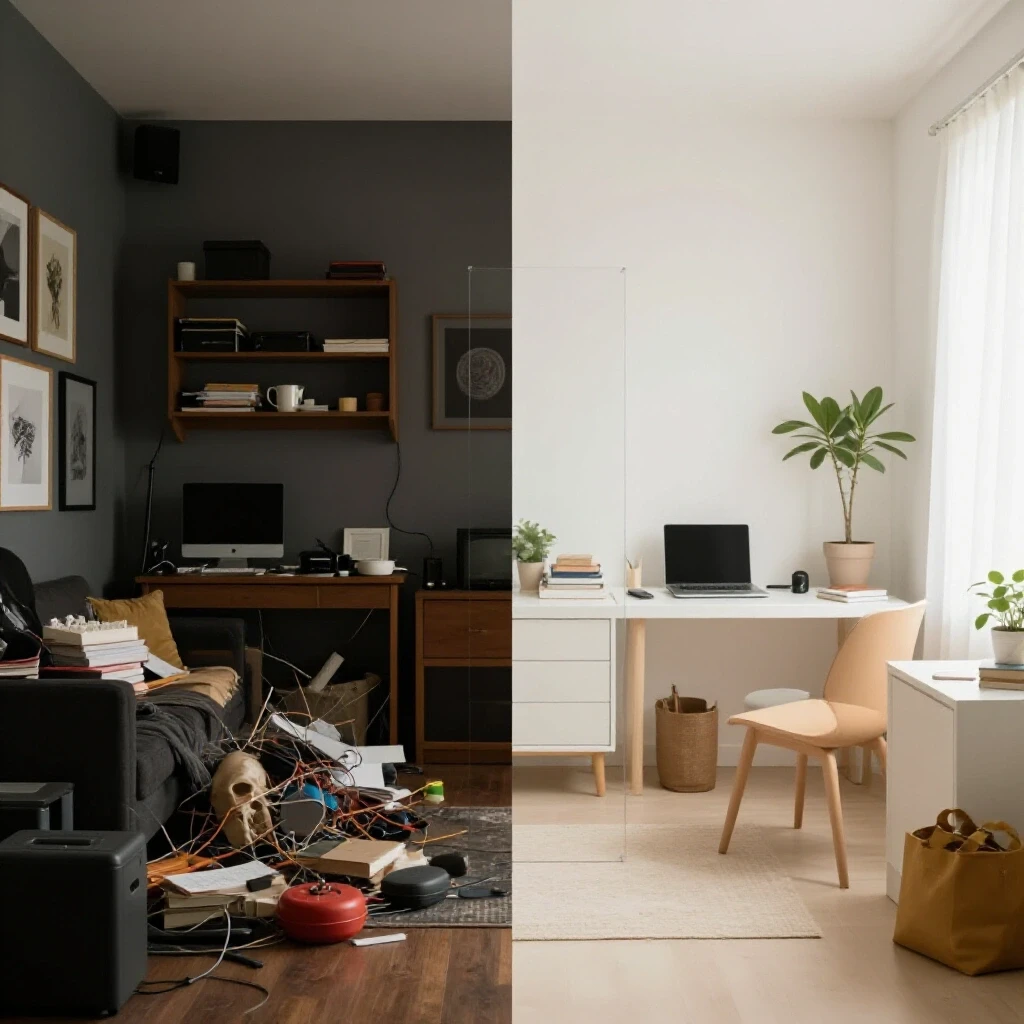
Coming home should feel like a deep breath, a moment where the physical environment supports your rest rather than adding to your to-do list. For many of us, however, the visual weight of too many vases, stacks of unused fabric, and bins of craft supplies creates a sense of “unpaid labor.” We spend our weekends moving items from one shelf to another, only to find that the order we worked so hard to create vanishes within forty-eight hours. My own journey into professional logistics taught me that this cycle isn’t a failure of willpower; it is a failure of the systems we use to manage our household inventory.
The Logistics of Redundant Home Inventory
Managing home décor and DIY supplies requires a basic understanding of inventory visibility and flow rates. When we cannot see what we own, we naturally assume we lack the resource, leading to the accidental purchase of a second or third identical item. This section explores how to treat your home like a high-functioning warehouse where every textile and tool is accounted for.
In my eleven years of managing supply chains, I have seen how “dark inventory”—items tucked away in opaque bins—leads to wasted money. At home, this happens when you buy a new set of brass curtain rings because you forgot the ones you bought last year are at the bottom of a generic plastic tub. To fix this, we must look at our inflow and outflow. If the rate of new décor entering the home exceeds the rate at which we use or remove it, the system will eventually clog.
Logistics professionals use a concept called “Stock Keeping Units” (SKUs). While you don’t need barcodes for your throw pillows, you do need to categorize your items. When my family and I audited our craft room, we discovered we had three separate sets of watercolor brushes simply because the first two sets were stored in different rooms. By centralizing these “like-with-like” items, we reduced our search time from ten minutes to under thirty seconds.
Understanding Retrieval Friction in the Home
Retrieval friction is the number of physical and mental steps required to find and put away an item. High friction—such as a bin buried under four other bins—is the primary reason why we buy things twice; it is easier to go to the store than to dig through the garage.
- Low Friction: An open basket on a shelf containing frequently used ribbons.
- Medium Friction: A labeled, clear bin with a lid located at eye level.
- High Friction: A heavy, unlabeled tote at the bottom of a stack in a dark attic.
Research in spatial ergonomics suggests that if an item requires more than three steps to retrieve, a person is 40% more likely to abandon the search and eventually buy a replacement. In our home, we moved our DIY furniture paint from the back of the shed to a dedicated cabinet in the laundry room. This simple shift in “spatial proximity” stopped us from buying “emergency” cans of primer we already owned.
Why Home Storage Systems Fail to Prevent Accidental Repurchasing
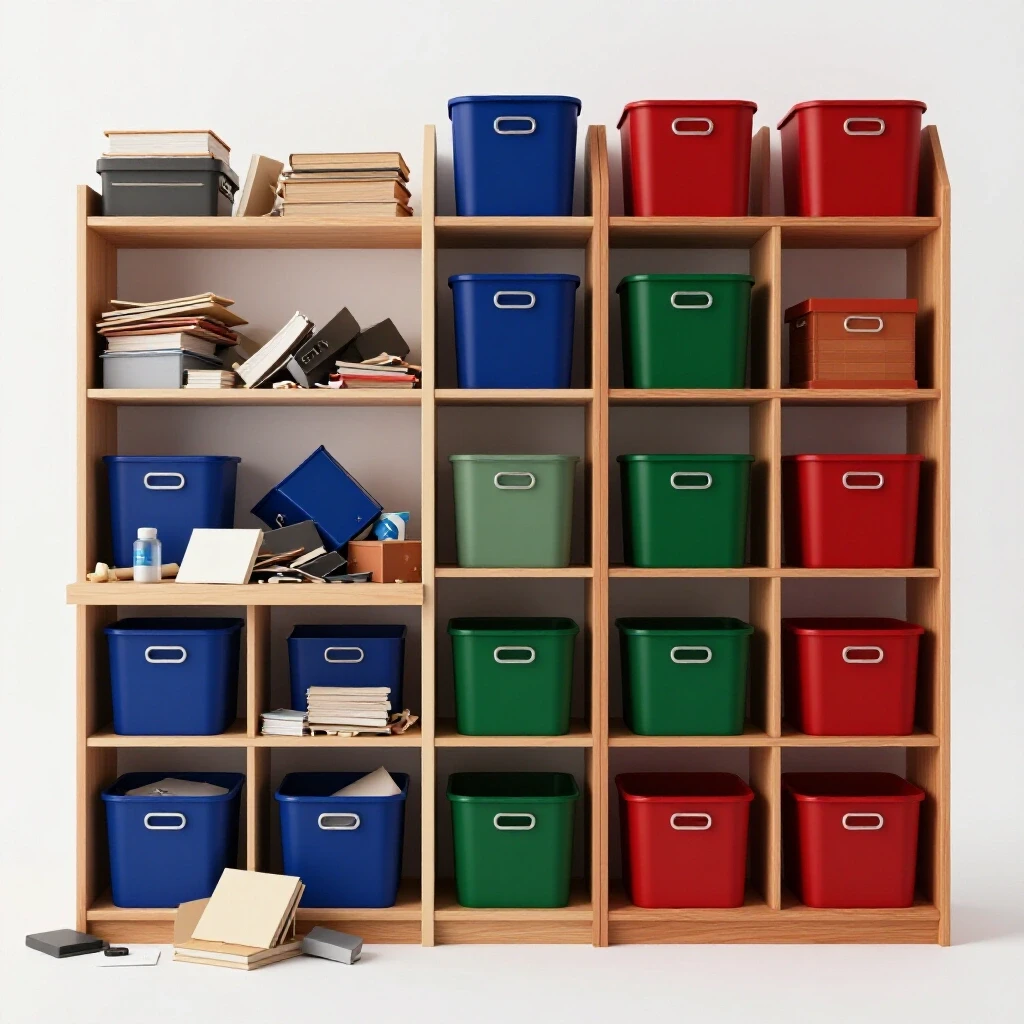
Many families invest in beautiful, matching bins only to find their home is still messy a week later. This happens because the system was designed for aesthetics rather than the reality of a busy household. A truly sustainable system prioritizes the “return path”—how easy it is to put the item back where it belongs.
Most “Pinterest-style” organization relies on high-maintenance habits that busy parents cannot sustain. If a storage system requires you to color-code your fabric scraps or perfectly fold every textile every time, it will fail during a busy work week. Instead, we need functional home storage that accounts for human fatigue. When we are tired, we take the path of least resistance. If that path doesn’t lead to the correct bin, clutter builds up.
| Storage Type | Friction Level | Maintenance Requirement | Best For |
|---|---|---|---|
| Open Baskets | Low | Minimal | Daily use DIY tools, craft paper |
| Clear Labeled Totes | Medium | Moderate | Seasonal décor, extra textiles |
| Opaque Deep Bins | High | High | Long-term archives, rarely used accents |
| Drawer Dividers | Low | Minimal | Small hardware, paintbrushes |
Interestingly, studies in organizational behavior show that “visual transparency” is key to reducing stress. When we can see the edges of our items, our brains don’t have to work as hard to catalog them. This is why clear containers are almost always superior to opaque ones for preventing the purchase of doubles.
The Psychology of Visual Processing Overload
Visual processing overload occurs when our brains are forced to scan too many items to find a specific one. This leads to “decision fatigue,” making us feel exhausted before we even start a home project. By reducing the number of visible items through better zoning, we clear mental space.
When my family redesigned our storage, we measured our space utilization percentage. We found that 30% of our shelving was occupied by “just-in-case” items—décor we didn’t actually like but kept because we felt we might use it. By purging these, we increased the visibility of the items we actually use, effectively ending the cycle of buying “more” to feel “better.”
Mapping Your Home: Zoning for Décor and DIY Supplies
Zoning is the practice of assigning specific “homes” to categories of items based on where they are used. By creating a geographic map of your household goods, you eliminate the guesswork that leads to redundant buying. If the “blue painters tape” only lives in the “Painting Zone,” you will never wonder if there is a roll in the kitchen drawer.
To start, walk through your home and identify where “inventory clusters” form. These are the spots where items naturally pile up. For us, it was the dining room table, which became a graveyard for half-finished craft projects. We established a “Project Zone” in a nearby cupboard.
- Zone A (High Frequency): Items used weekly, like basic DIY tools.
- Zone B (Medium Frequency): Items used monthly, like rotating table linens.
- Zone C (Low Frequency): Items used annually, like holiday-specific textiles.
By following this map, we reduced our sorting time from hours to just 15 minutes a week. We no longer had to search the whole house for a specific furniture wax; we knew it was in Zone A. This level of predictability is the foundation of sustainable decluttering.
Creating a Sustainable Sorting Framework
A sorting framework is a set of rules your family follows to decide what stays and what goes. Without a framework, decluttering becomes an emotional battle rather than a logical process. I recommend a “Logistics Audit” every six months.
- Gather: Bring every item in a category (e.g., all throw blankets) into one central space.
- Compare: Look for “functional duplicates.” Do you need four beige blankets, or will two suffice?
- Evaluate: Check the condition. If a DIY tool is rusted or a textile is stained, it is no longer an asset; it is a liability.
- Assign: Place the remaining items into their designated zones.
During our last audit, we realized we had 12 identical picture frames scattered across three rooms. We only needed six for our current gallery wall. By donating the extras, we freed up an entire shelf in the linen closet.
Low-Friction Storage Solutions for Families
The best storage solutions are those that require the fewest number of hand movements. For a busy parent, a lid is often a barrier. If you have to unstack three bins to get to the one you need, you will likely buy a replacement item rather than deal with the hassle.
In logistics, we call this “pick-path optimization.” We want the path from your hand to the storage bin to be as short and unobstructed as possible. For my children’s craft supplies, we switched from lidded boxes to open-top cubbies. This reduced the daily cleanup duration by nearly 10 minutes because the “cost” of putting things away was lowered.
- Use vertical space: Install wall-mounted racks for DIY tools to keep them at eye level.
- Label everything: Use large, clear text. Labels are not for when you are organized; they are for when you are stressed and can’t remember where things go.
- Avoid “Over-Categorizing”: Don’t have a bin for “Red Ribbons” and “Blue Ribbons.” Just have a bin for “Ribbons.” Too much detail increases friction.
Selecting the Right Gear for Your Space
When choosing containers, focus on durability and modularity. Modular units allow you to reconfigure your storage as your family’s needs change. We use heavy-duty shelving in the garage for furniture accents, ensuring that even heavy items are easy to see and reach.
| Metric | Ideal Target | Why It Matters |
|---|---|---|
| Retrieval Steps | Under 3 | Reduces the urge to buy “easier” replacements. |
| Item Density | 70% Capacity | Allows for easy “browsing” without knocking things over. |
| Label Readability | 5 Feet Away | Ensures all family members can identify the bin quickly. |
| Sorting Interval | 10 Minutes/Day | Prevents the “clutter creep” that leads to lost items. |
Establishing Pre-Purchase Checklists and Habit Loops
The most effective way to stop buying what you already own is to change the way you shop. A pre-purchase checklist acts as a “buffer” between the impulse to buy and the act of bringing an item home. This is the “gatekeeper” of your home’s inventory.
Before I buy a new piece of home décor or a DIY supply, I ask myself three questions: 1. Do I have a specific “Zone” for this? 2. Does a functional version of this already exist in my home? 3. Will this require a new storage solution, or does it fit in an existing bin?
This simple habit has saved our family hundreds of dollars. It forces us to visualize our current inventory before adding to it. We also implemented a “One-In, One-Out” rule for decorative items like vases and pillows. If a new one comes in, an old one must be donated or sold.
Building a Systematic Maintenance Loop
Maintenance is the “oil” in your household machine. Without it, the gears will eventually grind to a halt. We use a Daily Maintenance Timeline to keep our systems running. This isn’t about deep cleaning; it’s about “resetting” the zones.
- Morning (2 mins): Check the “In-Box” for any new décor or supplies delivered.
- Afternoon (5 mins): Ensure DIY tools used during the day are returned to their zones.
- Evening (5 mins): A quick visual sweep of the Project Zone to clear surfaces.
By spending just 12 minutes a day on these small tasks, we prevent the “clutter explosion” that usually happens by Wednesday. This consistency is what makes home organization systems truly sustainable.
Case Study: The “Six Tape Measures” Incident
Early in my career, I applied my logistics knowledge to our messy garage. I was frustrated because I could never find a tape measure when I needed to measure a furniture accent. Over two years, I had purchased six of them.
When we finally did a “category sweep,” we found all six. Two were in the kitchen junk drawer, one was in the glove box of the car, one was under the sofa, and two were buried in a box of “random tools.” This was a classic case of spatial disorganization.
We created a “Measuring Station” right next to the tool chest. We labeled it clearly. Now, when any family member finishes using a tape measure, they know exactly where it goes. We haven’t bought a new one in four years. This experience proved that the problem wasn’t that I was forgetful—it was that my home lacked a logical “return path.”
Actionable Inventory Density Guidelines
To keep your home functional, you must respect the physical limits of your shelves. Overcrowding is the enemy of visibility.
- The 70% Rule: Never fill a shelf or bin more than 70% full. This leaves “finger room” to move items around without causing a landslide.
- The Depth Limit: Avoid storing small décor items more than two rows deep. If you can’t see the back row, you will forget it exists.
- The “Weight-to-Height” Ratio: Store heavy furniture accents or large textile bins on lower shelves to make retrieval safer and easier.
By following these guidelines, you ensure that your functional home storage remains easy to navigate, even on your busiest days.
Conclusion: Sustainable Steps Toward an Orderly Home
Creating a home that stays organized isn’t about finding the “perfect” bin or having a minimalist aesthetic. It is about building a logical system that respects your time and energy. By focusing on inventory visibility, reducing retrieval friction, and establishing clear zones, you can stop the cycle of accidental repurchasing and reclaim your living space.
Start small. Choose one category—perhaps your DIY craft supplies or your extra throw pillow covers. Bring them all together, purge the duplicates, and assign them a permanent, low-friction home. Once you experience the relief of knowing exactly what you own, you will find it much easier to maintain that order across the rest of your home. Your home should be a place of recovery, not a warehouse of forgotten purchases.
Frequently Asked Questions
Why do I keep buying the same home décor items even when I try to stay organized?
This usually happens due to a lack of “inventory visibility.” If your items are stored in opaque bins or scattered across different rooms, your brain cannot easily recall what you own. When you see a beautiful vase or a set of napkins at the store, you lack the mental “map” to confirm you already have something similar. Centralizing categories and using clear storage containers are the best ways to solve this.
How can I get my kids and spouse to follow a new organization system?
The key is to reduce “system friction.” If a system is too complex—like requiring specific folding techniques or multi-step labeling—family members will naturally avoid it. Use open baskets, clear labels with pictures for younger children, and place bins at the height where the items are actually used. When a system is easier to use than the floor, people will naturally follow it.
What is the best way to start a “category sweep” if I’m overwhelmed?
Start with the smallest, most contained category that causes the most frustration. For many, this is DIY craft supplies or small hardware like picture-hanging kits. Spend 30 minutes gathering every single item in that category from across the house. Once you see the “mountain” of duplicates, the motivation to purge and organize usually follows.
Do I really need to label everything?
Labels aren’t just for finding things; they are for putting things away. A label acts as a “spatial contract” for the family. It clearly defines what belongs in a space, which prevents “random” items from creeping in. For a busy household, labels reduce the mental effort required to maintain order, especially during high-stress times.
How often should I audit my home inventory?
A full-home audit can be overwhelming, so I recommend a “rolling audit.” Every time you change your décor for a new season, do a quick check of that specific category. If you are bringing out the autumn textiles, take five minutes to look at your spring/summer ones. If you haven’t used an item in two seasons, it may be time to let it go.
What should I do with the “accidental doubles” I find?
If the items are in good condition, consider donating them to a local charity or selling them. If they are DIY supplies, see if a local school or community center can use them. The goal is to remove the “inventory weight” from your home so you can manage what remains more effectively.
How do I stop the “clutter creep” from returning after I organize?
Clutter creep is usually a sign of a “logistics bottleneck.” If a certain area always gets messy, look at the friction level. Is the bin too hard to reach? Is the category too broad? Adjust the system to match your actual behavior, not your “ideal” behavior. Consistency comes from low-effort systems.
Are expensive professional storage bins worth the investment?
Not necessarily. The most important features of a storage container are its size, visibility (clear is usually better), and how well it stacks. You can often achieve great results with simple, budget-friendly clear totes and a basic label maker. The “system” is the logic of where things go, not the price of the plastic.
How does reducing clutter help with mental fatigue?
Our brains are constantly scanning our environment. Every “unplaced” item represents a tiny “micro-task” your brain thinks it needs to complete. When your home is filled with redundant items and disorganized piles, your brain is in a state of constant low-level stress. By clearing the visual noise, you allow your nervous system to truly rest.
What is “functional home storage”?
Functional home storage is a system designed around the “user experience” of the people living in the home. It prioritizes ease of access and ease of return over perfect visual symmetry. It uses logistics principles like zoning and pick-paths to ensure that the home remains tidy with minimal daily effort.
(This article was written by one of our staff writers, Christopher Bennett. Visit our Meet the Team page to learn more about the author and their expertise.)