How to Use a Maybe Pile for Decluttering (Step-by-Step Guide)

Warning: If your current approach to tidying involves moving items from one room to another without a clear exit strategy, you are not organizing; you are merely rearranging the backlog. Most home organization systems fail because they do not account for the “logistics of hesitation,” leading to a cycle where surfaces are cleared only to be buried again within forty-eight hours.
The Logistics of Indecision in Residential Systems
Logistical bottlenecks occur when the rate of incoming items exceeds the speed of final decision-making. In a professional warehouse, an item without a designated slot is a liability; in a family home, it becomes a permanent resident on the kitchen island or the dining table.

I have spent eleven years managing complex supply chains and applying those same principles to my own home. My family’s breakthrough didn’t come from buying more containers. It came from understanding “throughput”—the speed at which an object moves from your hand to its final destination. When we hesitate on an item, we create a “logistical stall.” These stalls are the primary cause of mental fatigue because every time you see that undecided item, your brain performs a micro-calculation about what to do with it.
Why High-Friction Sorting Leads to System Failure
System friction refers to the number of physical and mental steps required to complete a task. If your method for handling undecided items requires complex categorization or multiple steps, the system will collapse during a busy work week.
In my early years of managing a household with young children, I tried to implement detailed sorting bins for every possible outcome. We had bins for “donate,” “sell,” “repair,” and “think about it.” Within three days, the “think about it” bin was overflowing, and the “repair” bin became a dust magnet. The friction was too high. Research in organizational behavior suggests that as the number of choices increases, the likelihood of making no choice at all—and thus leaving the item on the counter—skyrockets. This is known as decision paralysis, and it is the enemy of sustainable decluttering.
Comparison of Storage Friction by Method
| Sorting Method | Physical Steps | Mental Load | Maintenance Level |
|---|---|---|---|
| Multi-Category Bins | 5-7 steps | High (Categorization) | Difficult |
| Open Surface Piling | 1 step | Very High (Visual Noise) | Impossible |
| Single-Rule Buffer | 2 steps | Low (Binary Choice) | Sustainable |
| Digital Tracking | 4+ steps | High (Data Entry) | Low Sustainability |
The Single-Rule Framework for Temporary Sorting
The most effective way to handle items you aren’t ready to discard is to apply a strict spatial and temporal boundary. This rule states that undecided items may only exist within one physical container and must be re-evaluated on a fixed, short-term schedule.
This framework works because it limits the “volume of indecision.” In my home, we use a single, medium-sized box kept in a high-traffic transition zone, like the mudroom or a utility closet. The rule is simple: if the box is full, nothing else goes in until something comes out. This forces a “one-in, one-out” flow. By capping the spatial capacity, you prevent the “maybe” category from expanding into a new source of household clutter. This is a fundamental principle of inventory management: you cannot manage what you cannot contain.
Managing Spatial Capacity and Flow Rates
Spatial capacity is the maximum amount of material a room or container can hold before its primary function is compromised. Flow rate is the speed at which items enter and leave your home, and balancing these two is the key to reducing daily stress.
When I analyzed our family’s “clutter reversion” patterns, I found that our surfaces were being reclaimed by items that didn’t have a clear “home” but weren’t quite trash. We were exceeding our spatial capacity every Tuesday after the mail arrived and the kids brought home school projects. To fix this, we established a “sorting time-box interval” of fifteen minutes every Sunday evening. During this time, we process the single buffer box. Because the volume is limited by the size of the box, the task never feels overwhelming.
Decluttering Sorting Log: A Typical 15-Minute Session
- Total Items Processed: 22
- Average Time Per Item: 40 seconds
- Final Outcomes: 12 to trash/recycle, 6 to permanent homes, 4 remain in buffer.
- Success Metric: Surface clearance maintained for 6+ days.
Reducing Retrieval Friction for Busy Families
Retrieval friction is the effort required to get an item out of storage or find it when needed. If your temporary storage is too hidden, you will forget the items exist; if it is too visible, it contributes to visual overwhelm.
Environmental psychology journals highlight that “visual noise” significantly increases cortisol levels, especially in primary caregivers. To combat this, your temporary sorting zone should be opaque but accessible. In our home, we moved from open wire baskets to solid-colored bins. This small change reduced the “cognitive load of spaces” by hiding the visual chaos of the undecided items while keeping them within a two-step reach. We also found that placing the bin at waist height (between 30 and 45 inches) reduced the physical effort of sorting, making it more likely that family members would actually use it.
The Science of Visual Processing and Decision Fatigue
Decision fatigue is the decline in the quality of decisions made by an individual after a long session of decision-making. For a professional returning from a nine-hour workday, choosing what to do with a stack of mail or a broken toy feels like a monumental task.
By using a single-rule buffer, you bypass the need for complex thinking. You aren’t deciding “Is this a keepsake?” or “Can I sell this for five dollars?” You are simply asking, “Does this go in the box or in the trash?” This binary choice is much easier for the brain to process. Studies in spatial ergonomics show that reducing the number of “active” items in a person’s field of vision can improve focus and reduce the feeling of being “visually overwhelmed.” This is why clearing a kitchen counter has such a profound impact on your mental state.
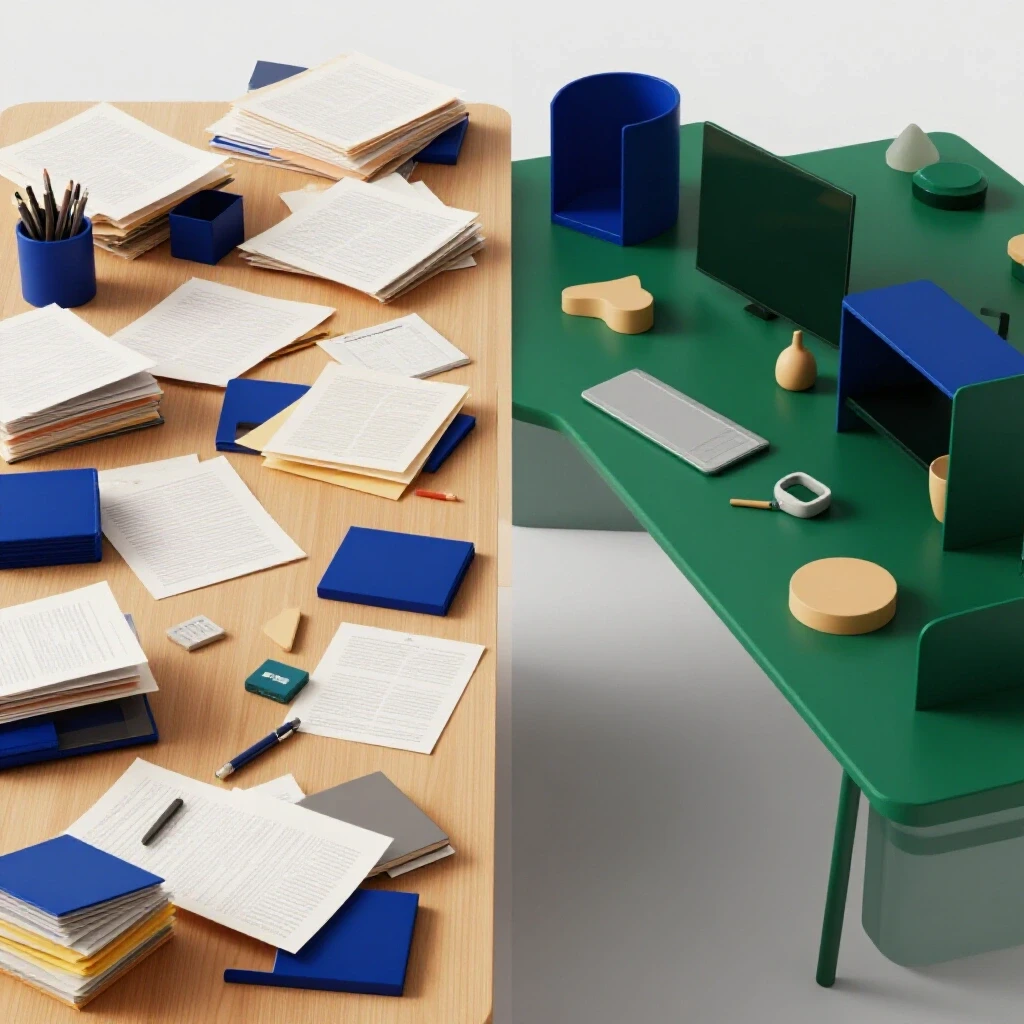
Visual vs. Functional Organization Systems
- Visual Systems: Focus on how things look (e.g., color-coded books). Often fail because they are hard to maintain during busy weeks.
- Functional Systems: Focus on how things move (e.g., the single-rule buffer). These endure because they prioritize the ease of “putting away” over the “look” of the shelf.
Building Systematic Habit Loops for Maintenance
A habit loop consists of a cue, a routine, and a reward. For home organization systems to last, they must be integrated into your existing daily flow without requiring extra willpower.
In my household, the “cue” is the act of walking through the door after work. The “routine” is placing any undecided items into the designated transition bin. The “reward” is a clear kitchen counter where we can prepare dinner without moving piles of paper. We track this using a simple “daily maintenance timeline.” For a family of four, it takes approximately seven minutes of daily “reset” time to keep the flow moving. If you skip three days, that time jumps to thirty minutes, which is where frustration and system abandonment begin.
Daily Maintenance Timelines by Family Size
- Single/Couple: 4 minutes daily reset; 10-minute weekly buffer clear.
- Family of 3-4: 8 minutes daily reset; 20-minute weekly buffer clear.
- Family of 5+: 12 minutes daily reset; 30-minute weekly buffer clear.
Implementation Steps for a Low-Maintenance System
- Select Your Boundary: Choose one container no larger than 15 gallons. This is your only “undecided” zone.
- Define the Location: Place it in a “Zoning Map” area—a place where items naturally accumulate, like near the entry or the end of a hallway.
- Set the Expiry: Decide on a “purge day.” For most busy professionals, Saturday morning works best.
- Apply the Binary Rule: Items either go in the box or are disposed of immediately. No “piling near the box.”
- Empty to Zero: On your purge day, the box must be emptied. Items are either assigned a permanent home or discarded.
Why “Maybe” Zones Fail Without Strict Limits
Most people fail because their “maybe” pile has no “spatial capacity limit.” It starts as a small stack and grows into a room-sized problem. In logistics, this is called “inventory bloat.”
By following the single-rule method, you are creating a “functional home storage” solution that acknowledges human psychology. We aren’t always ready to make a final choice. That is okay. What is not okay—for your mental health or your home’s functionality—is letting those unmade choices occupy your living space. When you limit the undecided items to one box with one deadline, you reclaim your home from the “clutter reversion” cycle.
Common Mistakes to Avoid in Family Households
- Using multiple boxes: This leads to “category drift” where items are hidden and forgotten.
- Choosing a box that is too large: If it’s too heavy to move, you won’t empty it.
- Neglecting the “exit” phase: The system only works if items actually leave the house.
- Over-labeling: Don’t spend time making fancy labels for a temporary bin. A simple “In-Process” label is enough.
- Ignoring the family: Ensure everyone knows that the box is a “transit station,” not a permanent storage unit.
Final Logistics Check: Is Your System Sustainable?
A system is sustainable if it can be maintained during your most stressful week of the year. If you find yourself avoiding the “maybe” box, it is likely too far away or too full. Reduce the friction by moving the box closer to where you naturally drop items.
We found that by reducing the “retrieval step count”—the number of doors you have to open or stairs you have to climb to put something away—our home stayed significantly tidier. In our mudroom, the “undecided” bin is at arm’s length from the door. This ensures that the flow of items stops at the threshold rather than migrating to the living room couch. Sustainable decluttering is about managing these small movements consistently over time.
Frequently Asked Questions
What happens if the box gets full before my scheduled purge day? This is a clear indicator that your “inflow” of items is too high or your “outflow” is too slow. You must perform an immediate 5-minute sort. Do not start a second box. The physical limit of the box is your “red alert” that the system is reaching capacity.
Where is the best place to keep the temporary sorting container? Place it in a “high-friction” transition zone. This is usually near the primary entrance or in a utility area. It should be easy to reach but not in the middle of a relaxation area like the living room.
How do I get my children to use the “maybe” bin instead of leaving things on the floor? Keep the bin at their height and remove any lids. Lids are a form of “mechanical friction” that often prevents children from completing a task. If they can drop an item in one motion, they are 70% more likely to do it.
Is it okay to have a “maybe” bin in every room? No. This decentralizes your indecision and makes it harder to manage. Stick to one central bin to start. If your home is very large (over 3,000 square feet), you might have one per floor, but a single location is much easier to maintain.
What if I find something in the bin later that I actually needed? That is the purpose of the buffer! It gives you a “cooling off” period. However, if you find you are frequently “rescuing” items from the bin, you may need to adjust your initial sorting criteria.
How do I handle large items that don’t fit in the box? Large items should follow the “24-hour rule.” Because they consume significant spatial capacity, they cannot stay in the buffer. They must be decided upon and moved to their destination within one day.
What is the ideal size for a temporary sorting bin? For a family of four, a 15-gallon (approximately 57-liter) container is usually the “sweet spot.” It is large enough to hold a week’s worth of mail and small toys but small enough to be easily carried to the trash or donation center.
Should I use this system for paperwork? Yes, but paperwork should have its own dedicated “action folder” within the box. Paper creates a different type of visual noise and is often the biggest source of mental fatigue for busy professionals.
How do I stop the “reversion” once the house is tidy? Reversion happens when the “habit loop” breaks. Use a visual trigger, like a specific time on your phone or a “reset” song, to remind the family to clear the surfaces and check the buffer bin daily.
Can I use a trash bag instead of a box? A box is better because it has a fixed volume. A bag can stretch and expand, which defeats the purpose of a “spatial boundary.” A rigid container provides a clear visual signal of when you have reached your limit.
(This article was written by one of our staff writers, Christopher Bennett. Visit our Meet the Team page to learn more about the author and their expertise.)