How to Improve Kitchen Work Triangle Flow (Renovation Tips)

In many regions, the way we use our homes is dictated by the era in which they were built. In the Pacific Northwest, where I have spent the better part of two decades managing renovations, older homes often feature closed-off kitchens that prioritize storage over movement. These layouts frequently force the person cooking into a cramped corner, far from the refrigerator or the sink. When you begin a residential renovation planning process, you quickly realize that the success of the project depends less on the brand of your appliances and more on the physical distance between them.
My 18 years as a construction project coordinator have taught me that a kitchen is essentially a high-traffic workspace. During my own two full-home renovations, I learned that even a two-foot deviation from an efficient path can lead to years of daily frustration. Whether you are in the middle of gathering cost estimates or researching construction sequencing, the goal remains the same: creating a flow that works with your body, not against it.
Mastering the Three-Point Efficiency Standard
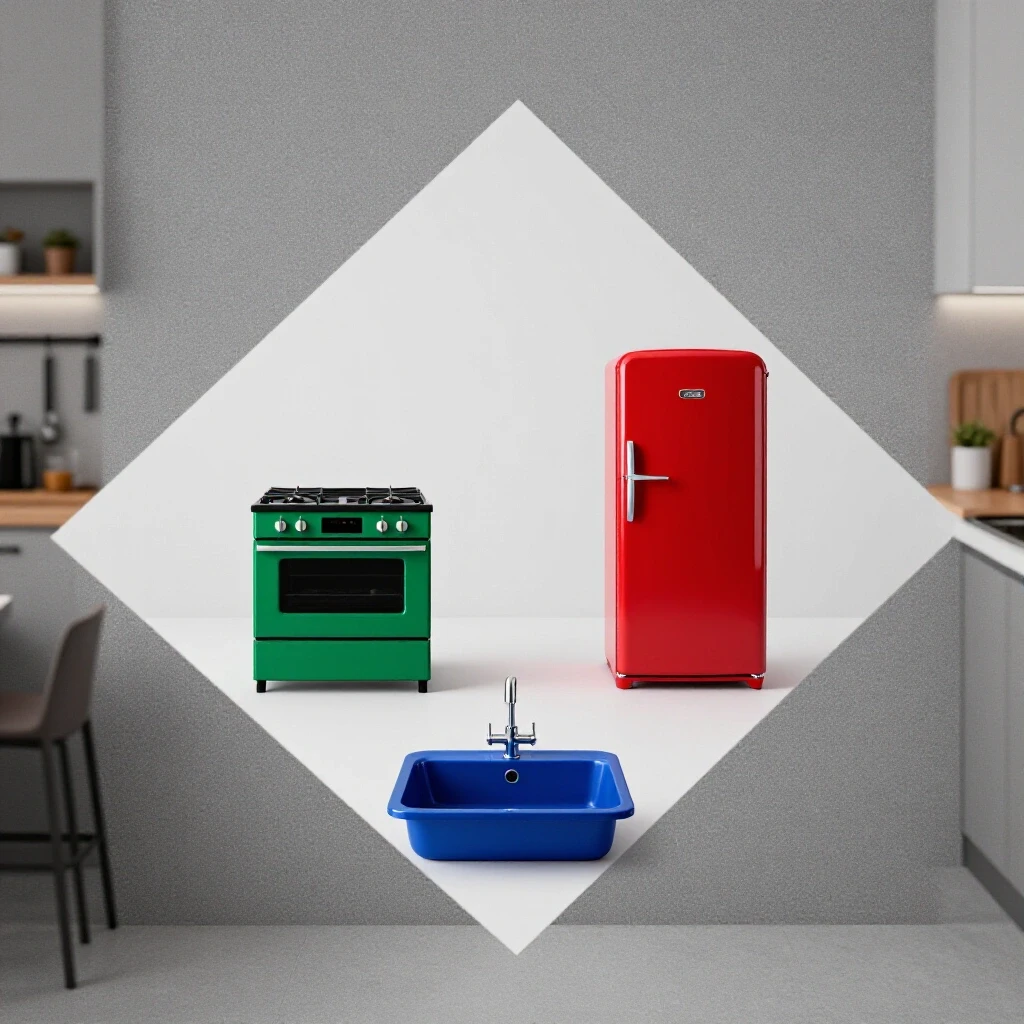
The three-point efficiency standard is a design logic that links the three main work centers: the sink, the cooktop, and the refrigerator. By treating these three points as the corners of an imaginary shape, you can minimize the number of steps taken during meal preparation.
This concept was developed to ensure that the primary path of movement is not blocked by furniture, islands, or other household traffic. In a standard home, the sum of the three legs of this triangle should typically be between 12 and 26 feet. If the distance is too short, the kitchen feels cramped; if it is too long, cooking becomes a tiring chore.
During a project I managed in a 1950s ranch, the homeowner wanted to move the refrigerator to a far wall to make room for a massive pantry. We mapped out the path and found the total distance would have reached 32 feet. By showing them the physical toll of that distance, we adjusted the design to keep the refrigerator within a nine-foot reach of the sink. This saved them from a design error that would have been nearly impossible to fix after the cabinetry was installed.
Why Hidden Structural Surprises Blow Budgets and Impact Layouts
Structural surprises are the unexpected issues found behind walls, such as rotted studs, outdated knob-and-tube wiring, or leaking pipes. These discoveries often force a change in where appliances can be placed, directly impacting the efficiency of your planned layout.
When you are formulating a home remodeling tips checklist, the first item should always be a structural inspection. In my experience, moving a sink to improve flow often reveals plumbing that was never up to code. If you find mold or structural rot, your kitchen remodel budget must be flexible enough to cover these repairs before you can focus on the layout.
- Plumbing Rough-in: This is the phase where pipes are installed but not yet connected to fixtures.
- Load-Bearing Wall: A wall that supports the weight of the floor or roof above it.
- Scope of Work: A detailed document describing all the tasks to be performed in a project.
I once worked on a project where we planned to move the stove to a center island. Once we opened the floor, we found a main support beam exactly where the gas line needed to go. Because we had a 20% contingency fund, we were able to pay for the structural modifications without halting the project. Without that financial buffer, the homeowner would have been stuck with a broken layout and a half-finished floor.
| Property Age | Recommended Contingency Buffer | Common Layout Obstacles |
|---|---|---|
| 0-10 Years | 10-12% | Minor electrical routing |
| 11-30 Years | 15% | Outdated venting, subfloor wear |
| 31-50 Years | 20% | Galvanized pipes, narrow framing |
| 50+ Years | 25%+ | Mold, rot, load-bearing surprises |
Contractor Management Guide for Layout Precision
A contractor management guide focuses on how to communicate your design needs to the people swinging the hammers. It involves setting clear expectations for how the three-point layout will be measured and executed on-site.
Vetting a contractor requires more than checking their price; you need to see if they understand the nuances of culinary workflow. A common mistake is hiring a pro who focuses only on the “look” rather than the “function.” During the interview, ask them how they handle “float time”—the extra time built into a schedule to account for delays—and how they ensure the sink and stove are perfectly aligned for the user.
- Request a Detailed Schedule: Ask for a Gantt chart that shows when each phase of the layout will be completed.
- Verify Licensing and Insurance: Never skip this step, as it protects you from liability if a worker is injured.
- Check References for Layout Accuracy: Ask past clients if their kitchen feels easy to move around in.
- Discuss Change Order Thresholds: Agree on a dollar amount that requires a formal written change order before work proceeds.
Construction Sequencing and the Critical Path
Construction sequencing is the specific order in which tasks must be completed to ensure the project moves forward logically. The critical path is the sequence of stages that determines the minimum time needed to finish the remodel.
In a kitchen project, the sequence is vital because you cannot install cabinets until the plumbing and electrical “rough-ins” are finished. If you change your mind about where the refrigerator goes after the drywall is up, you are looking at a massive budget overrun. I always tell my clients to “freeze” the layout once the framing starts.
- Demolition: Removing the old layout and exposing the “bones” of the room.
- Structural Repair: Fixing any rot or mold found during demolition.
- Rough-In: Installing the hidden systems (pipes, wires, vents) that support the three-point layout.
- Inspections: City officials must approve the rough-in work before walls are closed.
- Finishes: Installing cabinets, counters, and finally, the appliances.
Financial Risk and the Real Cost of Moving Utilities
Managing financial risk in a remodel involves understanding that the most expensive part of a layout change is moving the “wet” and “hot” points. Moving a sink or a gas stove requires professional labor that can quickly exceed initial estimates.
Based on RSMeans construction data, moving a sink more than three feet from its original location can add thousands to your bill. This is because it often involves cutting into the slab or floor joists to reroute drain lines. When I renovated my second home, I kept the sink in its original spot but moved the refrigerator and stove to create a better triangle. This saved me nearly $4,000 in plumbing costs while still achieving the flow I wanted.
| Task | Estimated Cost (RSMeans Base) | Potential Real-World Bid | Why the Gap? |
|---|---|---|---|
| Move Gas Line (5ft) | $600 – $900 | $1,200 – $1,800 | Access issues, permit fees |
| Relocate Sink Drain | $1,500 – $2,200 | $3,000+ | Concrete cutting, venting needs |
| Add 20-Amp Circuit | $300 – $500 | $800 – $1,200 | Panel upgrades, long wire runs |
| Cabinet Installation | $100 – $150 per box | $200 – $350 per box | Custom leveling, crown molding |
Avoiding Design Errors with Post-Occupancy Evaluations
A post-occupancy evaluation is a review conducted after you have lived in the space for several months. It helps you understand what worked and what didn’t, which is invaluable if you ever remodel another property.
Many design errors are only visible once you start cooking a real meal. For example, you might find that the dishwasher door, when open, blocks the path between the sink and the fridge. This is a “broken leg” in your triangle. To avoid this, use blue painter’s tape on the floor to mark the exact footprint of your appliances and cabinets before any work begins. Walk the paths. Pretend to take a pot from the sink to the stove. If you feel blocked, change the plan now.
- Clearance Check: Ensure there is at least 42 inches of space in work aisles.
- Landing Space: Every appliance needs at least 15 inches of counter space next to it.
- Traffic Flow: Ensure the main path through the house doesn’t cut directly through the cooking triangle.
Tools for Planning and Oversight
Modern technology has made it much easier for homeowners to manage their own projects and keep contractors accountable. Using digital tools allows you to track the progress of your three-point layout in real-time.
- Chief Architect or Home Designer Software: Great for visualizing the triangle in 3D.
- Buildertrend or CoConstruct: These are often used by contractors, but some allow homeowner access to track schedules.
- Magicplan App: Uses your phone’s camera to create floor plans and measure distances between appliances.
- RSMeans Data Online: Provides localized cost data to help you verify if a contractor’s bid is fair.
Resolving Punch-List Disputes and Final Quality Control
A punch list is a document created at the end of a project that lists all the small tasks or repairs that must be finished before final payment is made. This is your last chance to ensure the layout was executed exactly as planned.
If the stove was installed two inches off-center, or if the refrigerator door hits the counter, these are items for the punch list. Do not sign off on the final payment until every item is corrected. In my 18 years of experience, I have seen many homeowners rush this phase because they are tired of the construction. However, a small error in appliance positioning can ruin the ergonomic flow you worked so hard to design.
- Check Leveling: Ensure the stove is perfectly level for even cooking.
- Test Clearances: Open every door and drawer simultaneously to check for interference.
- Verify Utilities: Ensure the water shut-off for the sink is easily accessible.
Strategic Steps for Your Next Move
Planning an efficient kitchen layout is a marathon, not a sprint. It requires a balance of design theory, financial reality, and strict project management. By focusing on the physical paths between your main work centers, you can create a space that feels natural to use.
Start by measuring your current kitchen and identifying the bottlenecks. Use the data and sequencing strategies discussed here to build a plan that accounts for structural surprises and keeps your budget under control. Remember, the goal is not just a beautiful kitchen, but a functional one that serves your daily life without friction.
FAQ
How do I calculate the total distance of my work triangle?
To calculate the distance, measure the straight-line path from the center of the sink to the center of the cooktop, then to the center of the refrigerator, and back to the sink. Add these three measurements together. For the best efficiency, the total should be between 12 and 26 feet, with no single leg being shorter than 4 feet or longer than 9 feet.
What happens to the flow if I add a kitchen island?
An island can either enhance or destroy your workflow. If the island sits directly on the path between the sink and the fridge, it creates an “obstacle” rather than a workspace. To avoid this, ensure the island provides extra counter space (landing area) for one of the three points without blocking the direct walking path between them.
Can a kitchen have more than one work triangle?
Yes, modern kitchens often have multiple “zones.” If you have two people who cook frequently, you might design two overlapping triangles. For example, one triangle might focus on the main stove and sink, while a second “snack” triangle links the microwave, a prep sink, and the refrigerator.
Why is the sink usually considered the center of the layout?
Statistically, people spend more time at the sink than at the stove or refrigerator. It is the hub for prep work and cleanup. Because of this, placing the sink between the other two points usually creates the most fluid movement, as you are constantly moving back and forth from the sink to the other stations.
How do I handle a “galley” kitchen where all appliances are on one wall?
In a galley or one-wall kitchen, a true triangle is impossible. In these cases, focus on the “work line.” The goal is to place the sink in the middle, with the refrigerator on one end and the stove on the other. This prevents you from having to walk past a hot stove to get a cold item from the fridge.
Is the three-point rule still relevant with modern open-concept homes?
Absolutely. While the walls may be gone, the physical distance your body must travel remains the same. In an open-concept home, the triangle is even more important because there are fewer boundaries to define the workspace, making it easy for the kitchen to “sprawl” and become inefficient.
What is the biggest mistake people make when planning their layout?
The most common error is prioritizing aesthetics over the “landing space.” People often want a massive refrigerator but forget to leave enough counter space next to it to set down groceries. Every point of the triangle needs at least 15 to 18 inches of clear counter space immediately adjacent to it.
How much should I expect to pay to move a kitchen sink?
Moving a sink involves both supply lines and a drain line. If you are moving it across the room, expect to pay between $2,500 and $5,000 depending on your home’s foundation. If you have a crawlspace, it is cheaper; if you have a concrete slab, the cost increases significantly due to the need for jackhammering and trenching.
Can I use the work triangle logic in a small apartment kitchen?
Yes, in small spaces, the challenge is usually that the points are too close together. If the legs of the triangle are less than 4 feet, you will feel cramped and won’t have enough counter space to work. In these cases, the goal is to maximize the distance as much as the small footprint allows.
Does a dishwasher count as one of the three points?
Technically, no. The three points are the sink, stove, and fridge. However, since the dishwasher is almost always next to the sink, it is considered part of the “clean-up zone.” When planning, make sure the open dishwasher door doesn’t block the path to the refrigerator or the trash bin.
(This article was written by one of our staff writers, David Langford. Visit our Meet the Team page to learn more about the author and their expertise.)