How to Organize a Linen Closet and What to Keep (Simple Guide)

I stood in our narrow hallway, looking at a pile of towels that had just cascaded out of the cupboard. My wife and I had spent three weekends in a row “fixing” this space, yet here we were again. As someone who manages logistics and operations for a living, I felt a familiar frustration. I realized I was treating our home like a warehouse with a broken inventory system. The problem wasn’t a lack of effort; it was a lack of sustainable logic.
In a professional setting, we look at “flow rates” and “retrieval friction.” If a worker has to move three boxes to get to one item, the system is failing. Our home was no different. We had beautiful bins, but they were too deep. We had folded things neatly, but the stacks were too high. By applying spatial management principles to our essential household textiles, we finally created a system that stayed tidy for more than forty-eight hours.
The Logistics of Shared Textile Storage
Spatial logistics in the home involves managing the flow of items from use to laundry to storage and back again. It focuses on reducing the physical and mental effort required to maintain a system. By understanding the volume of items and the frequency of their use, you can design a layout that prevents bottlenecks.
In my eleven years of managing operations, I have learned that the most common reason home organization systems fail is “retrieval friction.” This is the number of steps or physical movements required to get an item out or put it away. In our home, we found that if a child had to lift a heavy lid to put a washcloth away, they simply wouldn’t do it. The washcloth would end up on the floor, starting a chain reaction of clutter.
Environmental psychology research suggests that visual complexity in a small space can increase cortisol levels, the body’s primary stress hormone. When you open a door and see a jumble of mismatched fabrics, your brain registers it as an unfinished task. By focusing on the items we chose to retain and organizing them by use-case, we reduced that mental load significantly.
Understanding Spatial Capacity Limits
Spatial capacity is the maximum amount of inventory a storage area can hold without losing functionality. In logistics, we aim for about 80% utilization. If a shelf is 100% full, you cannot easily remove one item without disturbing the others, leading to a rapid collapse of the entire system.
When we evaluated our shelving, we looked at the “footprint” of each stack. We measured the depth of the shelves and compared it to the size of our bath towels. Most standard shelves are 12 to 16 inches deep. A standard bath towel, when folded into thirds, fits perfectly within this range. By aligning the fold with the front edge of the shelf, we created a uniform visual line that reduced “visual noise.”
- Current Utilization: 85% (Optimal for easy access)
- Retrieval Step Count: 1 (Open door, grab item)
- Sorting Time: 4 minutes per laundry load
- Visual Complexity Score: Low (Uniform folding and color blocking)
Why High-Friction Bins Lead to Rapid Clutter Reversion
High-friction storage refers to containers or systems that require multiple steps to access, such as lidded boxes or stacked bins. While these may look tidy in a photo, they are the primary cause of system failure in busy households. Reducing friction means making the right choice the easiest choice for every family member.
I once made the mistake of buying beautiful, dark wicker baskets for our hand towels. They looked great, but they were opaque. No one could see what was inside without pulling the basket out. Because the baskets were scratchy, my children avoided touching them. Within a week, the towels were piled on top of the baskets instead of inside them. This is a classic example of a “visual-first” system failing a “function-first” family.
In logistics, we use “open-pick” bins for high-velocity items. We applied this to our textile storage by switching to low-lip, open-front containers for smaller items like washcloths and hand towels. This allowed us to see our inventory at a glance and grab what we needed with one hand.
| Bin Type | Friction Level | Visibility | Best Use Case |
|---|---|---|---|
| Lidded Plastic Box | High | Moderate | Long-term storage of extra quilts |
| Open Wire Basket | Low | High | Daily use bath towels |
| Opaque Wicker Bin | Moderate | Low | Bulky items like beach towels |
| Clear Acrylic Tray | Very Low | Very High | Small items like pillowcases |
The Psychological Cost of Visual Overload
Visual overload occurs when the brain is forced to process too many competing shapes, colors, and textures at once. In a storage closet, this happens when stacks are uneven or items are shoved into corners. Reducing this overload creates a sense of calm and makes the space feel more functional.
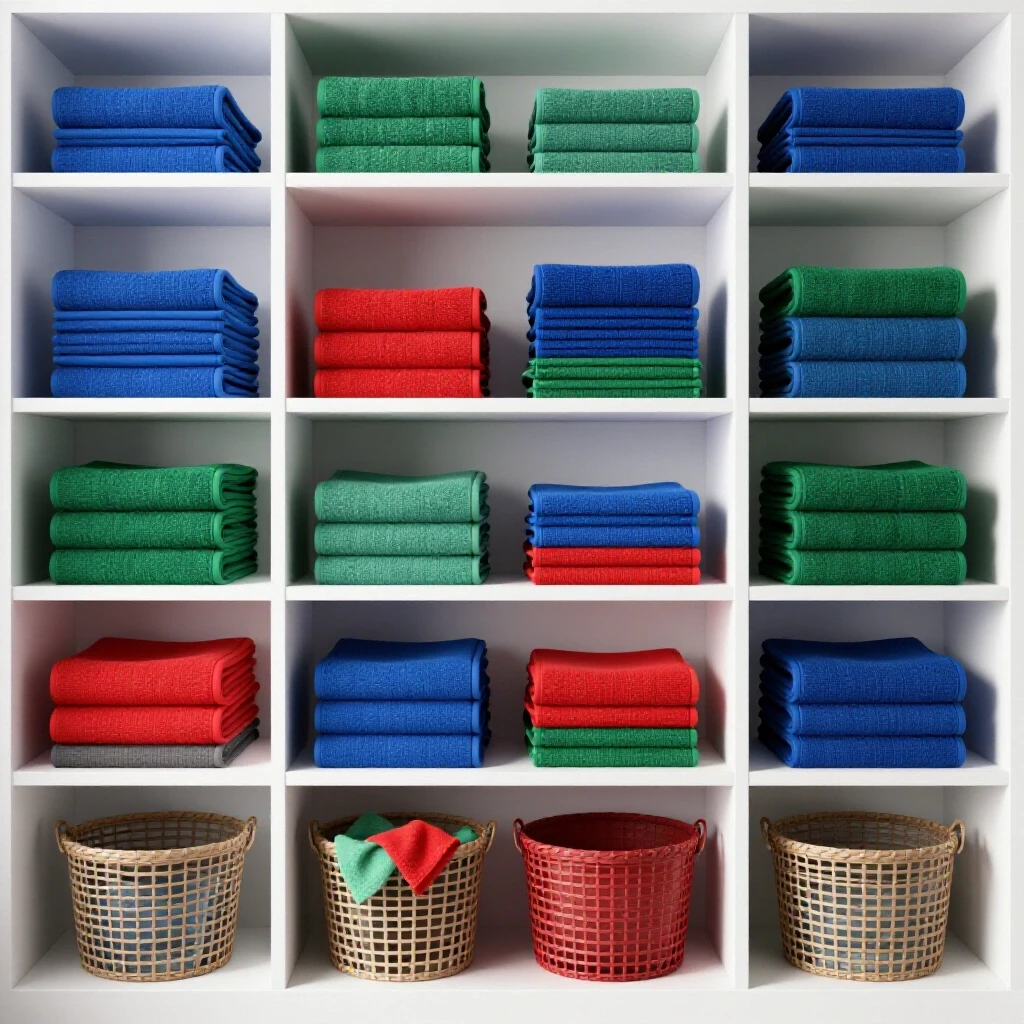
We addressed this by using a “color-blocking” strategy for the items we kept. We grouped all white towels together, followed by blue, then grey. This doesn’t just look nice; it acts as a functional map. When I am looking for a specific set of guest linens, my brain doesn’t have to scan every item. It only scans the section where that color lives. This reduces “search time,” which is a key metric in warehouse efficiency.
High-Efficiency Zoning for Family Homes
Zoning is the practice of dividing a storage space into specific areas based on the frequency of use and the physical height of the users. Prime real estate is the area between the waist and eye level, where the most frequently used items should live. Lower and higher zones are reserved for occasional items.
In our home, we mapped out our shelving based on “reach zones.” My children can reach the bottom two shelves easily. Therefore, we placed their hooded towels and washcloths there. My wife and I use the middle shelves for our daily bath towels. The very top shelf, which requires a step stool to reach, holds the items we only need occasionally, like extra duvet covers or heavy winter blankets.
- Zone A (Eye Level): Daily bath towels and hand towels.
- Zone B (Waist Level): Bed sheets and pillowcase sets.
- Zone C (Floor Level): Heavy quilts and bulky floor mats.
- Zone D (Above Head): Spare pillows and seasonal linens.
Implementing a “One-Touch” Folding System
A one-touch system is a process where an item is handled as few times as possible before reaching its final destination. For our linens, this meant developing a uniform fold that worked for every shelf in the house. This consistency allows any family member to participate in putting laundry away without ruining the system.
We adopted the “hotel fold” for our retained towels. It involves folding the towel in half lengthwise, then into thirds. This creates a sturdy, rectangular shape that stands up on its own. Because the “spine” of the fold faces outward, the shelf looks organized even if the towels aren’t perfectly aligned. This small change reduced our sorting and stacking time by nearly 30%.
Reducing Daily Sorting Friction for Children and Adults
Reducing friction involves removing the physical barriers that make a task feel like a chore. This includes using labels that everyone can understand and ensuring that items are stored near where they are used. A successful system is one that requires the least amount of willpower to maintain.
One of our biggest bottlenecks was the “sheet set scramble.” We used to store flat sheets, fitted sheets, and pillowcases in separate stacks. Finding a matching set was a nightmare. We shifted to the “bundle method,” where the entire set is folded together and tucked inside one of the pillowcases. This turned a three-item retrieval process into a one-item grab.
- Uniformity: Use the same folding style for all items in a category.
- Accessibility: Keep everyday items in the “strike zone” (waist to chest height).
- Labeling: Use clear, large-font labels or icons for younger children.
- Visibility: Ensure you can see at least 90% of your inventory without moving anything.
The Role of Smart Labeling in Inventory Management
Labeling serves as a “visual anchor” for the brain. It tells the user exactly where an item belongs, removing the need for decision-making. In logistics, we call this “point-of-use” labeling. It prevents the “I’ll just put this here for now” habit that leads to clutter.
We used a simple label maker to mark the edge of each shelf. Instead of just saying “Towels,” we were specific: “Master Bath,” “Guest Bath,” and “Kids’ Bath.” This level of detail helps guests find what they need without asking, and it ensures that the right towels go back to the right spot after they are laundered.
Sustainable Maintenance and Habit Loops
A habit loop consists of a cue, a routine, and a reward. To maintain a tidy storage space, the “cue” should be the act of folding laundry, the “routine” is the organized placement of items, and the “reward” is the ease of finding a clean towel the next morning. Sustainability comes from the system’s ability to handle the chaos of daily life.
We implemented a “First-In, First-Out” (FIFO) rotation. When clean towels are put away, they go to the bottom of the stack. This ensures that all our linens get equal wear and that nothing sits at the bottom of a pile for years. It’s a simple movement that takes two extra seconds but keeps the inventory fresh.
- Daily Check: 30 seconds to straighten any leaning stacks.
- Weekly Reset: 5 minutes to rotate stock after laundry day.
- Monthly Audit: 10 minutes to ensure items haven’t migrated to the wrong zones.
Measuring Success Through Retrieval Time
In a professional warehouse, we measure the “pick rate”—how fast someone can find and retrieve an item. You can use this same metric at home. If it takes you more than ten seconds to find a matching set of pillowcases, your system has too much friction.
When we finished our redesign, our average retrieval time dropped from nearly a minute (searching through piles) to under five seconds. This saved time adds up, but more importantly, it removes the micro-frustrations that contribute to parental burnout. We no longer feel a sense of dread when we open the cupboard door.
Practical Logistics for Long-Term Order
Maintaining a functional home requires viewing your space as a living system rather than a static one. As your family grows or your needs change, your storage zones should adapt. A rigid system is a fragile system. By using modular bins and adjustable shelving, we created a layout that can evolve.
We also focused on “visual styling” for our open shelving. By keeping the colors consistent and the folds uniform, the space feels intentional. This aesthetic choice has a functional benefit: when a space looks “designed,” family members are more likely to respect the boundaries of that space. It creates a psychological barrier against clutter.
| Task | Previous Time | New Time | Efficiency Gain |
|---|---|---|---|
| Finding a sheet set | 45 seconds | 5 seconds | 88% |
| Putting away laundry | 10 minutes | 6 minutes | 40% |
| Morning towel grab | 15 seconds | 3 seconds | 80% |
| Monthly tidying | 60 minutes | 10 minutes | 83% |
Creating a Family-Friendly Feedback Loop
A feedback loop is a process where the output of a system is used as an input for future operations. In our home, if we notice that the washcloth bin is always overflowing, that is “feedback” that the bin is too small or we have too many washcloths. Instead of getting frustrated, we adjust the system.
This logical approach removes the emotion from cleaning. It isn’t about being “messy” or “neat”; it’s about whether the system is sized correctly for the inventory. By involving the whole family in these small adjustments, everyone feels a sense of ownership over the space.
Frequently Asked Questions
How do I keep stacks of towels from toppling over? The key is the “depth-to-height” ratio. A stack should never be taller than the depth of the shelf. If your shelves are 12 inches deep, keep your towel stacks under 12 inches high. You can also use shelf dividers to provide lateral support, which keeps the “spine” of the towels vertical and stable.
What is the best way to store bulky items like comforters? Bulky items should be stored in the “lowest-value” real estate, such as the very top or very bottom shelves. We use breathable fabric bags for our retained quilts. This keeps them compressed and tidy without the high friction of vacuum-sealed bags, which are often too difficult to use for regular rotation.
How many towel sets should a family of four actually keep? From a logistics perspective, we recommend the “Rule of Three”: one in use, one in the laundry, and one in the closet. For a family of four, this means 12 bath towels. Keeping more than this often leads to “inventory bloat,” where items are pushed to the back and forgotten, creating unnecessary clutter.
Why do my shelves look messy even after I fold everything? This is usually due to “visual noise” caused by uneven edges. Ensure all the folded “spines” face outward toward the door. Also, try to group items by height. If you have a tall stack next to a short one, it creates a jagged visual line that the brain perceives as disorder.
How can I get my kids to put things back in the right spot? Lower the friction. Use open-top bins at their height so they can “drop” items in rather than having to place them perfectly. Labels with pictures are also very effective for younger children who are still developing their spatial reasoning skills.
Is it better to roll or fold linens? Rolling is excellent for saving space in drawers or for small washcloths. However, for standard shelving, folding is usually more stable. Rolled towels tend to shift and move when you grab one, whereas a properly folded stack stays put due to the weight and friction of the fabric.
What should I do if my storage space is very shallow? If you have shallow shelves (less than 10 inches), use the “narrow fold.” Fold your towels into quarters lengthwise before rolling or folding them into squares. This allows the items to sit sideways on the shelf, maximizing the available horizontal space without overhanging the edge.
How do I manage different sized pillowcases so they don’t get mixed up? We use the “nesting” technique. We keep King-sized pillowcases in one clear bin and Standard-sized in another. By separating them by size at the point of folding, we eliminate the need to unfold and measure them when we are changing the beds.
How often should I audit my textile storage? A quick “visual audit” can be done every time you put laundry away. A deeper dive into the system’s functionality should happen about once every six months. This allows you to adjust for seasonal changes, such as moving heavy blankets to the top shelf during the summer months.
Can I use this system if I have open shelving instead of a closet? Yes, and in fact, these principles are even more important for open shelving. Because the items are always visible, reducing visual complexity is vital. Using uniform baskets and a consistent color palette will turn your storage into a design feature rather than a source of stress.
(This article was written by one of our staff writers, Christopher Bennett. Visit our Meet the Team page to learn more about the author and their expertise.)