Quartz vs Granite Countertops: Pros, Cons & Cost Comparison (Guide)

Have you ever wondered if the most expensive countertop in the showroom is actually the one that will survive your morning coffee spills and heavy cast-iron pans for the next decade? After 13 years of evaluating home materials for multiple properties, I have learned that the “best” surface depends less on the price tag and more on the technical reality of your daily habits. Choosing between natural stone and engineered composites is one of the most significant financial decisions a homeowner makes during a renovation.
In my professional work as a supply chain analyst, I look at materials through the lens of performance data and life-cycle costs. I have lived with both natural granite and engineered quartz in busy kitchens. I have seen where each material excels and, more importantly, where they eventually show their age. This guide breaks down the technical specifications and real-world trade-offs to help you avoid the common pitfalls of high-end surface selection.
Understanding Technical Material Specifications for Countertops
Technical specifications are the measurable data points that define how a surface reacts to physical stress. These metrics help you look past aesthetic marketing to see how a material actually performs under heat, pressure, and chemical exposure in a residential kitchen or bathroom.
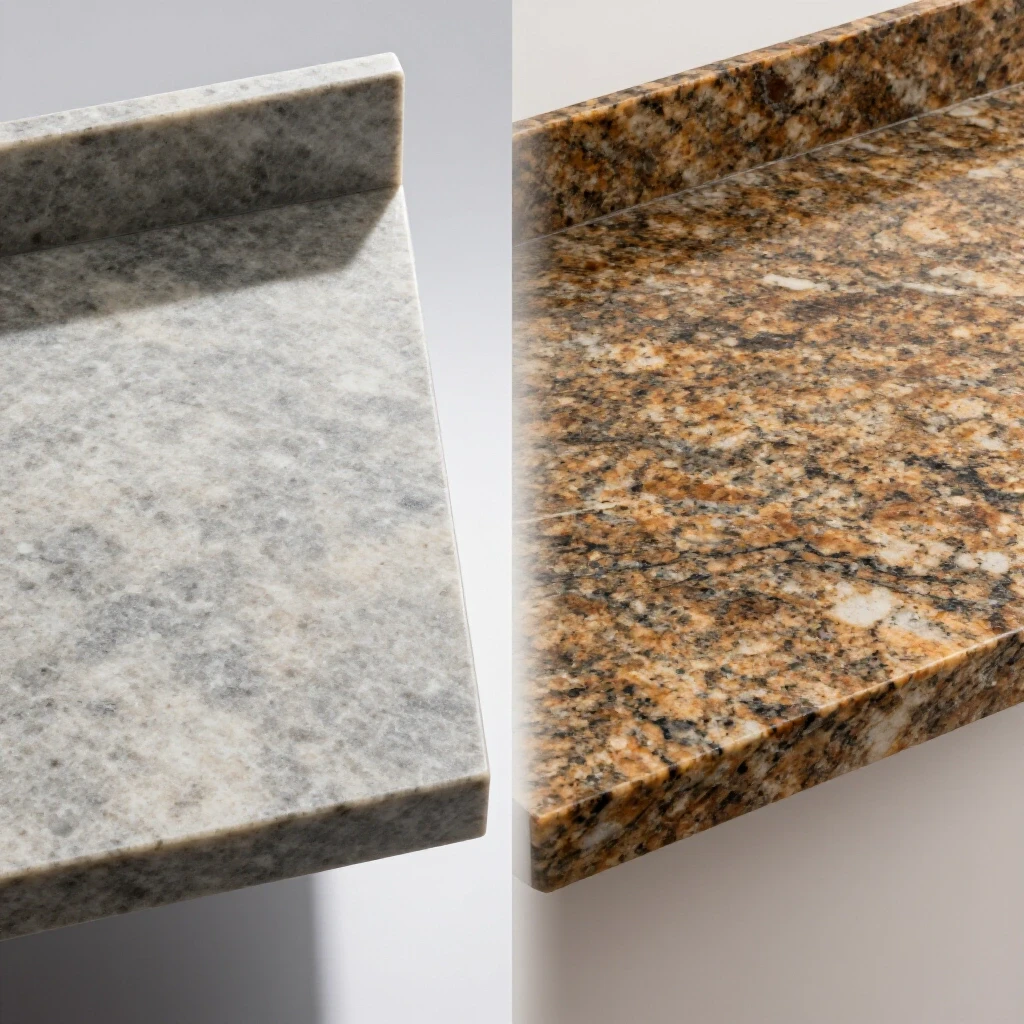
When I evaluate a material, I start with its composition. Granite is a natural igneous rock composed mainly of quartz, feldspar, and mica. Its performance is dictated by its geological formation. Engineered quartz, on the other hand, is a man-made composite. It typically consists of 90% to 93% crushed natural quartz crystals bound together by 7% to 10% polyester resins and pigments.
The “why” behind these materials is found in their structural integrity. Granite’s crystalline structure makes it incredibly hard but also naturally porous. Engineered stone was specifically designed to solve that porosity problem by filling the gaps between stone particles with resin. However, that resin introduces a different set of vulnerabilities, particularly regarding thermal stability.
Decoding the Mohs Scale of Hardness
The Mohs scale measures a mineral’s resistance to being scratched by another material, ranging from 1 (talc) to 10 (diamond). For home surfaces, a higher Mohs rating means the material can better withstand the sliding of ceramic plates or the occasional slip of a kitchen knife.
Most granite varieties fall between a 6 and 7 on the Mohs scale. Engineered quartz usually sits firmly at a 7. While this difference seems small, it means both materials are harder than stainless steel (which is about a 5). In my experience, neither material is likely to scratch from standard kitchen utensils. However, the resin in engineered surfaces can sometimes be scuffed by abrasive pads, which is a detail many homeowners overlook until it is too late.
Porosity and Water Absorption Rates
Porosity refers to the volume of open spaces within a material where liquids can seep in. In the industry, we use ASTM C97 testing to measure the absorption rate of a material by weight, which directly correlates to its stain resistance.
Granite is naturally porous, with absorption rates typically ranging from 0.01% to 0.40%. This means it requires a chemical sealer to plug those microscopic holes. Engineered quartz is considered non-porous, with an absorption rate of nearly 0.00%. This technical difference is the primary reason many people choose engineered stone, as it theoretically removes the risk of deep-set stains from wine or oil.
The Real-World Durability of Natural Granite vs. Engineered Quartz
Durability is the measure of a material’s resistance to wear and tear over time. For countertops, this involves comparing the hardness of natural stone against the resin-bound strength of engineered slabs to determine which survives daily kitchen activities without cracking or scorching.
In my first property, I installed a beautiful slab of Absolute Black granite. I assumed its “natural” status meant it was indestructible. Three years later, I noticed a dulling of the finish around the sink. This wasn’t a failure of the stone itself, but a failure of the sealer. In my second property, I opted for a white engineered quartz. I loved the consistency, but I quickly learned that the resin binder has a “glass transition temperature.” This is the point where the resin begins to soften or discolor.
Thermal Shock and Heat Resistance
Thermal shock resistance is the ability of a material to withstand rapid changes in temperature without cracking. This is a critical factor if you tend to move pots directly from the stove to the counter.
- Granite Performance: Granite is formed under intense heat and pressure in the earth’s crust. It can typically withstand temperatures up to 1,200 degrees Fahrenheit. While I never recommend putting a red-hot pan on any surface, granite handles it far better than its engineered counterpart.
- Engineered Quartz Performance: Because it contains plastic resins, engineered stone is sensitive to heat. Most manufacturers warn that their products can only handle temperatures up to 300 degrees Fahrenheit. If you place a hot cast-iron skillet on it, the resin can burn or turn yellow permanently. This is a technical limitation that I personally found frustrating during busy holiday cooking.
Compressive Strength and Impact Resistance
Compressive strength, measured in pounds per square inch (PSI), tells us how much weight or impact a surface can handle before it fractures. According to ASTM C170 standards, high-quality granite usually tests between 19,000 and 25,000 PSI.
Engineered quartz often tests even higher, sometimes exceeding 30,000 PSI. The resin acts as a shock absorber, making the slab slightly more flexible and less likely to chip on the edges compared to the more brittle natural stone. In my own home, I’ve noticed that dropping a heavy canned good on the edge of a granite counter is more likely to cause a small “star crack” than on an engineered surface.
Material Performance Specifications: Side-by-Side
| Feature | Natural Granite | Engineered Quartz |
|---|---|---|
| Mohs Hardness | 6 – 7 | 7 |
| Porosity (ASTM C97) | 0.01% – 0.40% | ~0.00% |
| Heat Resistance | Up to 1,200°F | Up to 300°F |
| Chemical Resistance | Sensitive to Acids | Sensitive to Solvents/Heat |
| Sealing Required | Yes (Every 1-5 years) | No |
| Standard Thickness | 2cm or 3cm | 1.2cm, 2cm, or 3cm |
Maintenance Cycles and Long-Term Performance Trade-offs
Maintenance refers to the recurring effort and cost required to keep a surface looking new. This involves evaluating the necessity of sealing natural stone versus the chemical sensitivities of engineered surfaces over a 15-year period.
The biggest trade-off in the home material comparison is between “active” and “passive” maintenance. Granite requires active maintenance (sealing), while quartz requires passive maintenance (caution with heat and chemicals). If you are the type of person who wants to “set it and forget it,” the lack of a sealing schedule for engineered stone is a major selling point. However, if you are a heavy cook who uses high heat, the restrictions of engineered stone might feel like a burden.
The Reality of Sealing Natural Stone
Many homeowners fear the sealing process, but it is technically quite simple. A sealer is a liquid polymer that penetrates the stone and clogs the pores. In my 13 years of property management, I have found that a high-quality solvent-based sealer only needs to be applied every three to five years, not every six months as some retailers claim.
To test if your granite needs sealing, perform the “water drop test.” Place a few drops of water on the surface. If the water beads up, the sealer is intact. If it soaks in and darkens the stone within 10 minutes, it is time to reapply. This 15-minute task is the price you pay for the superior heat resistance of natural stone.
Chemical Sensitivities and Surface Etching
Etching is a chemical reaction that eats away at the surface of a material, leaving a dull, matte spot. While this is a major issue for materials like marble, granite is generally resistant to weak acids like lemon juice or vinegar.
Interestingly, engineered quartz can be sensitive to high-pH cleaners. Using heavy-duty degreasers or bleach can break down the bond between the resin and the quartz crystals over time, leading to a loss of sheen. I once made the mistake of using a harsh oven cleaner near my quartz backsplash, and it left a permanent “ghost” mark where the chemicals splashed.
15-Year Maintenance Outlay Comparison
| Expense Category | Natural Granite | Engineered Quartz |
|---|---|---|
| Initial Sealing | $0 (Usually included) | $0 |
| Annual Cleaning Supplies | $30 (Stone soap) | $30 (Mild detergent) |
| Periodic Resealing (3x) | $150 (DIY Kits) | $0 |
| Professional Buffing | $300 (Optional) | N/A (Hard to repair) |
| Total 15-Year Cost | $750 | $450 |
Analyzing the Upfront Cost vs. Long-Term Value
Cost analysis in supply chain management involves looking at the Total Cost of Ownership (TCO). This includes the purchase price, installation labor, and the cost of maintaining the product over its expected lifespan.
In the current market, the price gap between these two materials has narrowed significantly. Ten years ago, engineered stone was a premium luxury item. Today, due to increased manufacturing capacity, it is often priced competitively with mid-range granite. However, the complexity of the installation can still impact your final invoice.
Sourcing and Labor Impact on Pricing
The cost of granite is largely determined by rarity and logistics. A common “Level 1” granite from a local quarry will be much cheaper than an exotic “Level 5” slab imported from Brazil. Engineered stone pricing is more predictable because it is a manufactured product with set wholesale prices.
When I look at my procurement logs, I see that labor costs for both are nearly identical because they require the same specialized cutting tools. However, because engineered stone is more uniform, there is often less waste during the templating process. With natural stone, you may have to buy an entire second slab just to avoid a large fissure or an ugly mineral deposit in a prominent area.
Durability vs. Maintenance Cost: The Trade-off Matrix
To make a confident decision, you must weigh the upfront cost against your lifestyle. If you have young children who might leave a puddle of grape juice on the counter overnight, the “insurance” of a non-porous engineered surface is worth the higher price. If you are a professional baker who frequently moves hot trays, the heat-proof nature of granite is a technical necessity.
- Low Initial Cost / High Maintenance: Entry-level granite. Affordable but requires diligent sealing.
- High Initial Cost / Low Maintenance: Premium engineered quartz. Expensive but stain-proof.
- Variable Cost / High Performance: High-end granite. Offers the best heat resistance and unique aesthetics but requires professional care.
Practical Steps for Evaluating Samples at Home
Before you commit thousands of dollars to a slab, you should run your own technical performance tests. Showroom samples are designed to look perfect under bright lights, but they don’t tell the whole story of how the material will behave in your kitchen.
I recommend creating a “torture test” kit for any material you are seriously considering. This allows you to verify the manufacturer’s claims against your specific lifestyle factors.
- The Oil and Acid Test: Place a teaspoon of olive oil and a slice of lemon on the samples overnight. Wipe them away in the morning to check for darkening or etching.
- The Heat Stress Test: (For granite only) Place a hot mug of boiling water on the surface to see if it affects the sealer. Do not do this with quartz samples unless you want to see the resin fail.
- The Scratch Test: Take a copper penny and try to scratch the surface. Then try a stainless steel butter knife. If the material shows a mark, it is likely lower on the Mohs scale than advertised.
- The “Ghosting” Test: Use a permanent marker on a small corner, then try to clean it with 70% isopropyl alcohol. This tests the density of the material’s surface.
Installation Demands and Structural Requirements
The weight of these materials is a technical specification that impacts your cabinetry. Both granite and engineered quartz are incredibly heavy, weighing between 15 and 20 pounds per square foot for a standard 3cm thickness.
Before installation, I always check the levelness of the base cabinets. Because these materials are rigid, they have zero “flex.” If your cabinets are not perfectly level, the stone can bridge a gap, creating a stress point. Over time, the weight of the slab combined with this stress can cause a crack, especially near narrow cutouts like the sink or cooktop.
Understanding Manufacturer Tolerances
When reviewing a quote, ask about the manufacturer’s tolerances. For engineered stone, the color and pattern are usually very consistent. For granite, the slab you see in the yard might look different than the small sample you took home.
Industry standards from the Marble Institute of America suggest that natural stone can have variations in thickness of up to 1/8 inch. Engineered stone is much more precise, often with tolerances within 1/16 inch. This precision makes engineered stone easier to seam together, resulting in less visible joins in large L-shaped kitchens.
Final Recommendations for Confident Purchasing
After 13 years of trade-off analysis, my conclusion is that neither material is objectively “better.” Instead, one is usually a better fit for a specific set of constraints.
If you value a unique, “one-of-a-kind” look and you don’t mind a 15-minute maintenance task every few years, granite is a superior choice. Its ability to handle heat makes it a more functional “workhorse” for serious cooks. I regret the times I chose a delicate natural stone for a rental property, but I never regret it in my own home where I can control the maintenance.
If you want a modern, consistent aesthetic and the peace of mind that comes with a stain-proof surface, engineered quartz is the winner. It is the best choice for high-traffic family homes where spills are inevitable and coasters are rarely used. Just remember to keep a trivet handy for your hot pans.
Actionable Buying Worksheet
- Step 1: Define your “Heat Zone.” Do you have space for trivets, or do you naturally set pans down next to the stove? (If no trivets, choose Granite).
- Step 2: Assess your “Stain Tolerance.” Does a small shadow on the counter ruin your day? (If yes, choose Engineered Quartz).
- Step 3: Measure your “Maintenance Budget.” Are you willing to spend $50 and an hour of time every 3 years? (If no, choose Engineered Quartz).
- Step 4: Check Cabinet Integrity. Ensure your cabinets can support 20 lbs/sq ft.
- Step 5: Verify Warranty Limits. Read the fine print. Most quartz warranties are voided by heat damage, and most granite warranties don’t cover staining if not sealed properly.
Frequently Asked Questions
Does engineered stone stain?
Technically, engineered stone is non-porous and highly resistant to staining. However, it is not “stain-proof.” Certain chemicals, such as permanent markers, hair dye, or heavy solvents, can react with the resin binder and leave a permanent mark. Most common household spills like coffee or wine will wipe away without issue.
Why did my granite turn dark around the sink?
This is usually a sign that the sealer has worn away and water is being absorbed into the stone. Because the area around the sink is constantly wet, the stone remains saturated. To fix this, you must let the stone dry completely (which may take 24 hours) and then apply a high-quality impregnating sealer.
Can I cut directly on my countertops?
While both materials are harder than steel and unlikely to scratch, I never recommend cutting directly on them. Cutting on stone will dull your expensive knives almost instantly. Furthermore, some engineered surfaces can show “metal transfer,” where the soft metal of the knife leaves a grey mark on the harder stone surface.
How do I identify a “high-quality” quartz?
Look at the technical spec sheet for the percentage of quartz versus resin. Reputable brands like Silestone, Caesarstone, or Cambria use the Bretonstone process, which ensures a high density of stone and a vacuum-sealed resin bond. Cheaper “off-brand” quartz may have higher resin content, making it more prone to scratching and heat damage.
Is granite more expensive than quartz?
Not necessarily. While exotic granites can cost $200 per square foot, standard varieties are often cheaper than mid-range engineered stone. On average, expect to pay between $50 and $150 per square foot for either material, including installation.
Can engineered quartz be repaired if it chips?
Yes, but it is difficult. A professional can fill a chip with a color-matched epoxy resin and buff it flat. However, because engineered stone has a specific sheen, the repaired spot may look slightly different when viewed at an angle. Granite chips are often easier to hide because of the natural variation in the stone’s pattern.
Do I really need to seal granite every year?
No. This is a common myth. Most modern sealers last 3 to 5 years. If your granite is a dark, dense variety like Uba Tuba or Absolute Black, it may never need to be sealed at all because its natural absorption rate is so low. Always use the water drop test to check.
Does white quartz turn yellow over time?
Engineered quartz can yellow if it is exposed to direct sunlight (UV rays) for many hours a day, as the resin is not UV-stable. It can also yellow from chemical reactions with improper cleaners or from heat damage. In a standard kitchen with normal lighting, it should maintain its color for decades.
Which material is more hygienic?
Engineered quartz is technically more hygienic because it is non-porous, meaning it does not harbor bacteria or mold in microscopic cracks. This is why it is often used in healthcare settings. However, a properly sealed granite countertop is also considered safe and hygienic for food preparation by the NAHB.
Can I install these materials myself?
I strongly advise against it. Due to the weight and the specialized equipment needed to cut and polish the edges, countertop installation is a professional job. A single mistake in measurement or a slight drop during transport can result in a total loss of the slab.
(This article was written by one of our staff writers, Andrew Morrison. Visit our Meet the Team page to learn more about the author and their expertise.)