How to Organize a Tool Drawer That Stays Tidy (Expert Guide)

During our first major home renovation, I found myself standing in a sea of sawdust and scattered hardware. As a logistics professional, I was embarrassed. I had every tool imaginable, but I could never find the 1/8-inch drill bit when I needed it. My family was living out of boxes, and the stress of the clutter was impacting our daily rhythm. I realized then that my professional experience in supply chain management wasn’t just for the office; it was the missing link in our household. I began applying flow rates and friction analysis to our utility spaces, transforming our chaotic junk piles into systems that actually lasted through three more renovations and a decade of busy family life.
The Logistics of Household Hardware Storage
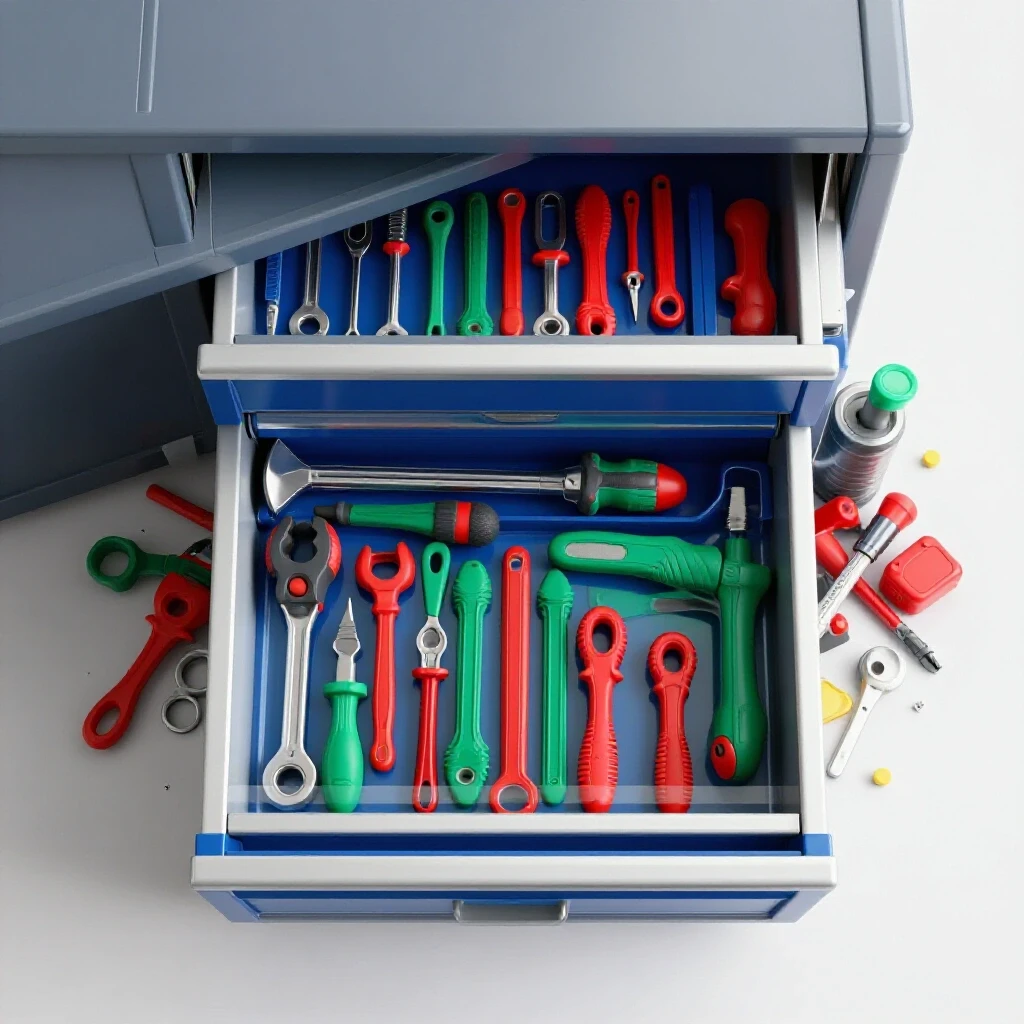
Effective management of home tools involves the systematic control of how physical items enter, move through, and exit a workspace. It focuses on reducing the energy required to find a specific item by optimizing the layout based on frequency of use. This approach ensures that every screwdriver and hex key has a logical, accessible home.
When we look at why most home organization projects fail, we have to talk about “retrieval friction.” This is the amount of physical and mental effort it takes to get a tool out and, more importantly, put it back. In my experience, if it takes more than two steps to put a hammer away, it will likely end up on the counter instead. We need to aim for a “one-touch” system where the drawer opens and the item is immediately visible and accessible.
Environmental psychology suggests that visual clutter increases cortisol levels. When you open a drawer and see a tangled mess of pliers and loose nails, your brain has to work harder to filter out the “noise.” By using clear zones and dedicated spaces, we reduce this cognitive load. This makes the act of finishing a household repair feel less like a chore and more like a streamlined process.
- Retrieval Step Count: The number of physical movements (opening, lifting, moving) to reach an item.
- Visual Processing Time: The seconds it takes for the eye to locate a specific tool in a drawer.
- Spatial Capacity Limit: The maximum number of items a drawer can hold before items begin to overlap.
Why Traditional Utility Drawers Revert to Chaos
Rapid clutter occurs when the mental energy required to maintain a system exceeds the user’s immediate capacity. Without clear boundaries, items migrate into open spaces, creating a “junk drawer” effect. This leads to a cycle where visibility is lost and the time spent searching for tools increases with every use.
In my own home, I noticed that our “everything drawer” failed because it had no internal structure. We would buy a set of organizers, fill them up, and within a week, the batteries were mixed with the tape. This happened because the containers were too deep or too small for the items we actually used. We were trying to fit our lives into the bins rather than choosing bins that fit our lives.
The following table illustrates why certain storage methods fail over time based on the “Friction Index,” which measures the resistance to maintaining order.
| Storage Type | Friction Level | Primary Failure Point | Sustainability Rating |
|---|---|---|---|
| Deep Unlabeled Bins | High | Items get buried at the bottom | Low |
| Stackable Trays | High | Must move top tray to reach bottom | Low |
| Shallow Divided Inserts | Low | Everything is visible at a glance | High |
| Pegboards (Wall) | Medium | Requires vertical reach and precision | Medium |
| Custom Foam Cutouts | Very Low | Immediate visual feedback if missing | High |
The Sorting Framework: Industrial Efficiency for the Home Shop
This method adapts industrial “5S” principles—Sort, Set in order, Shine, Standardize, Sustain—to a residential setting. It involves removing non-essential items and creating a permanent “home” for every wrench, hammer, and screw. This framework ensures that the system remains functional even during high-stress projects or busy weekends.
The first step in any sustainable decluttering journey is a “spatial audit.” I recommend emptying the entire drawer onto a flat surface. This allows you to see the “inventory” you actually have versus what you think you have. Most families find they own four identical tape measures but zero working flashlights.
Once the items are out, we categorize them by “frequency of access.” Items used weekly belong in the front of the drawer. Items used once a year, like a specialized plumbing wrench, should be moved to a secondary storage area like a garage shelf or a high cabinet. This reduces the “noise” in your primary workspace.
- Categorize by function: Group all cutting tools, all fastening tools, and all measuring tools together.
- Purge duplicates: Keep the best two of any common item and donate the rest.
- Measure the volume: Calculate the square inches each category requires before buying any containers.
- Test the flow: Mimic the action of reaching for a tool to ensure the placement feels natural.
Designing Low-Friction Systems for Fastener and Tool Storage
Low-friction systems prioritize one-handed access and clear visual confirmation of an item’s location. By reducing the number of movements needed to grab or stow an item, these configurations stay organized. This is especially important for busy parents who may only have five minutes to tighten a cabinet hinge.
In my professional work, we look at “pick paths.” In a home drawer, the pick path should be a straight line. If you have to move a box of nails to get to the screwdriver, the system is flawed. I found that using modular, shallow bins that lock together prevents them from sliding around when the drawer is opened and closed. This keeps the layout consistent over months of use.
- Item-Density Guideline: Aim for no more than 75% coverage of the drawer floor to allow for easy grasping.
- Sorting Time-Box: Dedicate 15 minutes every three months to a “system reset.”
- Standard Retrieval Time: A well-organized tool should be in your hand within 3 seconds of opening the drawer.
Sustainable Labeling and Visual Cues for Family Success
Visual cues are non-verbal signals that guide the user toward the correct storage location without needing to think. Effective labeling uses high-contrast text or simple icons to minimize mental search time. This makes it easier for children and busy adults to maintain the system without constant reminders or supervision.
Interestingly, research in organizational behavior shows that people are more likely to return items to a labeled spot than an unlabeled one, even if the label is simple. In our house, I used a basic label maker for the edge of each bin. For my kids, I used small icons. When the “hammer” spot is empty and clearly labeled, the “missing tooth” effect prompts the brain to find the tool and put it back.
- Use high-contrast labels (black on white or white on black).
- Place labels on the top edge of bins so they are visible even when the bin is full.
- Color-code categories if you have a large volume of small parts like screws and anchors.
- Ensure the font size is readable from a standing position.
Measuring Long-Term Success in Spatial Management
Success is measured by the “reversion rate,” which is the time a space stays organized before it needs a complete overhaul. By tracking how often items are misplaced, families can identify which parts of their storage system are failing. This allows for small, data-driven adjustments rather than repeated, frustrating “deep cleans.”
I track our home systems using a simple “maintenance timeline.” If a drawer stays tidy for six months without me touching it, the system is a success. If it fails in two weeks, I look at the “friction points.” Usually, the failure is because the bin was too small or the drawer was too hard to open.
| Family Size | Daily Cleanup Duration | Weekly Maintenance | Major System Audit |
|---|---|---|---|
| 2 Adults | 2 Minutes | 5 Minutes | Every 12 Months |
| 2 Adults + 1 Child | 5 Minutes | 10 Minutes | Every 6 Months |
| 2 Adults + 3 Children | 10 Minutes | 20 Minutes | Every 3 Months |
| Multi-Generational | 15 Minutes | 30 Minutes | Every 3 Months |
Avoiding Common Mistakes in Tool Management
Many people focus on the aesthetic of a drawer rather than its function. They buy matching wooden dividers that look beautiful but don’t actually fit their tools. This is a “visual-first” mistake. A functional-first approach might not look like a magazine cover, but it will work when you are in a rush to fix a leaking pipe.
Another common error is “over-compartmentalization.” If you have a separate tiny bin for every single size of screw, you will eventually get tired of sorting them. It is often better to have one larger bin for “common wood screws” and another for “drywall anchors.” This balances the need for order with the reality of a busy schedule.
- Avoid deep stacks: Never place one tool on top of another.
- Don’t ignore the “last 10%”: Loose items like bits and washers cause the most chaos; give them micro-bins.
- Stop buying “sets”: Only keep the tools you actually use, not the 50-piece kit where you only use three items.
- Check drawer slides: A heavy tool drawer needs high-quality, full-extension slides to remain functional.
Building Systematic Habit Loops
A habit loop consists of a cue, a routine, and a reward. In the context of home maintenance, the cue is finishing a repair. The routine is placing the tool back in its labeled spot. The reward is the lack of visual stress and the knowledge that the tool will be there next time you need it.
To make this work for a family, the “routine” part must be as easy as possible. This is why I advocate for open-top bins rather than containers with lids. Removing a lid is an extra step that adds friction. In my experience, containers with lids are where tools go to die, or more accurately, where they never return.
- The “One-In, One-Out” Rule: When you buy a new tool, an old or broken one must leave the drawer.
- The End-of-Project Sweep: Spend 60 seconds at the end of every task returning tools to their zones.
- The Visual Check: Before closing the drawer, scan for any “out of place” items.
- The Family Walkthrough: Show every family member where the most common tools live so they don’t have to ask.
Practical Next Steps for a Tidy Workspace
Start with your most frustrated space. For most, this is the kitchen utility drawer or the workbench drawer. Don’t try to organize the whole house in one weekend. Instead, focus on one single drawer and apply the principles of low friction and high visibility.
Once that drawer is finished, observe how your family interacts with it for a week. If you notice items are still being left on the counter, ask why. Is the bin too hard to reach? Is the label unclear? Use these observations to tweak the system. Sustainable organization is an iterative process, not a one-time event. By focusing on the logistics of how you live, you can create a home that supports you rather than one that demands constant cleaning.
Frequently Asked Questions
How do I prevent small screws and nails from mixing in the drawer? The best way to manage small fasteners is to use modular bins with tight-fitting dividers or individual micro-containers. Avoid large, open bins for mixed hardware. If you frequently use specific sizes, give them their own dedicated, labeled bin to prevent the “sorting fatigue” that leads to mixing.
What is the best way to organize heavy tools like hammers and wrenches? Heavy tools should be placed in the bottom drawers of a unit to maintain stability. Use non-slip drawer liners to keep them from sliding when the drawer moves. For wrenches, “organizer rails” that hold them at an angle can save significant space while keeping every size visible.
How can I get my spouse and children to follow the system? Involve them in the “zoning” process. If they help decide where the tape or the screwdriver goes, they are more likely to remember its home. Keep labels simple and use icons for younger children. Most importantly, make sure the “put back” process is as easy as dropping the item into an open bin.
Is it worth buying expensive drawer organizer systems? Not necessarily. The effectiveness of a system depends on its logic, not its price. You can use inexpensive plastic bins or even sturdy cardboard boxes to test a layout before investing in permanent dividers. The key is that the containers must fit the drawer dimensions perfectly to prevent shifting.
How do I handle tools that don’t fit in standard drawers? For oversized items like saws or large levels, consider vertical storage on the side of a cabinet or a dedicated “deep bin” in a closet. The goal is to keep the high-frequency drawers clear of “spatial hogs” that block access to smaller, more commonly used tools.
How often should I re-evaluate my tool storage? I recommend a quick “spatial audit” every six months. As your DIY skills grow or your family’s needs change, you may find you are using different tools more often. Moving these “new favorites” to the front of the drawer keeps the system efficient.
What should I do with “mystery” tools I don’t recognize? Place them in a “purgatory bin” for six months. If you don’t reach for them or identify them in that time, you likely don’t need them. This prevents unknown items from taking up valuable “prime real estate” in your primary drawers.
How do I manage tools that come in their own plastic cases? If you use the tool frequently, remove it from the bulky case and place it in a drawer for faster access. If it is a specialty tool used only once a year, keep it in the case and store it in a less accessible area like a high shelf or the basement.
Why do my drawers always end up messy again after a few days? This is usually due to “high friction.” If it’s hard to put an item back, people won’t do it. Look for obstacles like lids, stacked bins, or overcrowded spaces. Simplifying the “put away” motion is the best way to stop the reversion to chaos.
What is the “3-second rule” in organization? The 3-second rule states that you should be able to locate and retrieve any commonly used tool within three seconds of opening a drawer. If it takes longer, you likely have too much visual clutter or poor zoning. Reducing the time spent searching is the primary goal of a functional system.
(This article was written by one of our staff writers, Christopher Bennett. Visit our Meet the Team page to learn more about the author and their expertise.)