How to Declutter Your Bathroom Counter for Lasting Organization (Guide)

The bathroom vanity is one of the most demanding zones in a family home because it serves as a high-traffic transition point. Every morning and evening, multiple people cycle through this small space, often in a rush. In my eleven years managing logistics for both warehouses and my own household, I have seen how easily these surfaces become a catch-all for daily essentials. When the counter stays crowded, it is rarely a lack of cleaning that is the problem. Instead, it is usually a breakdown in the flow of items.
Early in my journey, my own family struggled with a vanity that seemed to attract clutter like a magnet. We would spend Sunday afternoons clearing every bottle and tube, only for the surface to be buried again by Tuesday. I realized we were focusing on the visual result rather than the behavioral cause. By applying spatial management principles, we shifted our focus from “cleaning up” to reducing the friction of putting things away. This guide focuses on how you can change your daily habits and system logic to keep your surfaces clear without buying a single new container.
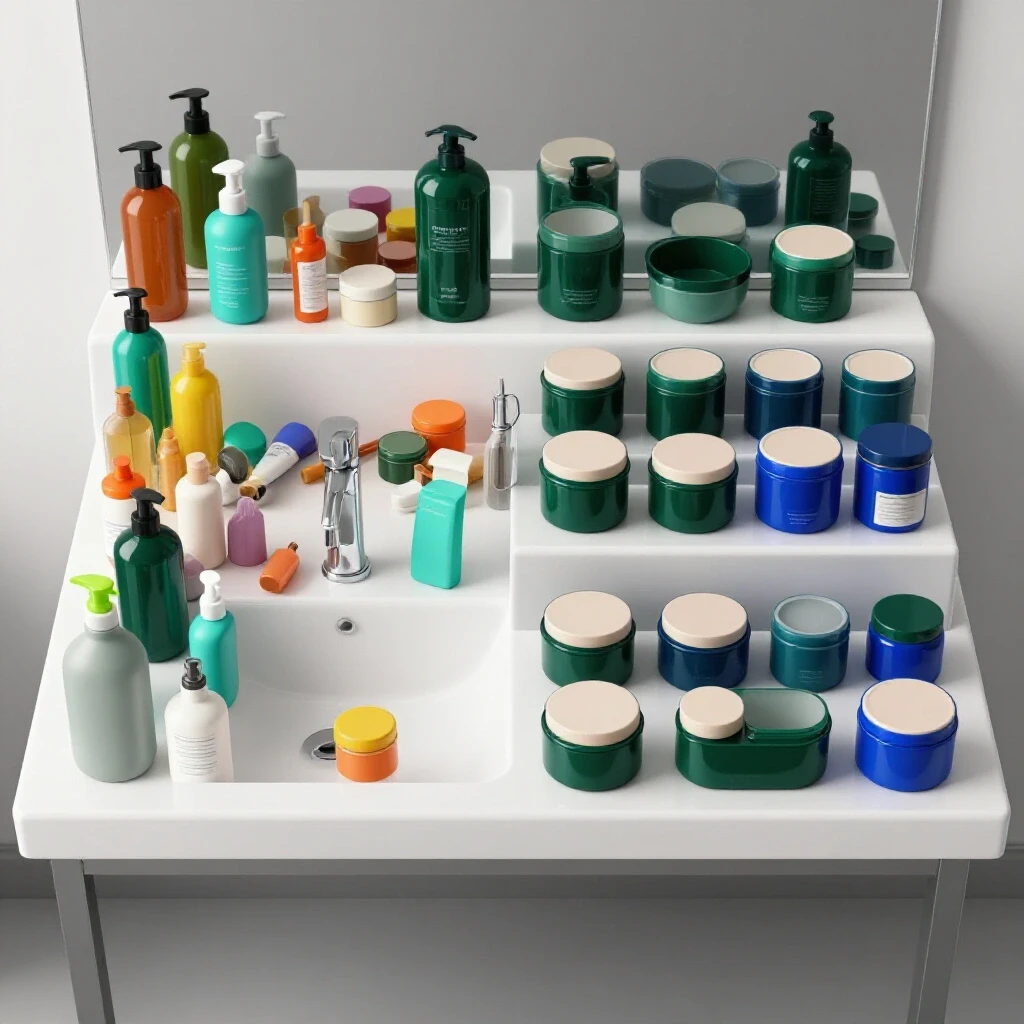
Why Bathroom Surfaces Revert to Chaos
The tendency for flat surfaces to collect items is a result of high retrieval friction and a lack of defined spatial boundaries for daily activities.
In environmental psychology, researchers often discuss the “broken windows theory” in a domestic setting. When one item is left on a counter, it signals to our brain that the surface is a storage zone rather than a workspace. This leads to a rapid accumulation of objects. For a busy parent, this visual noise contributes to “decision fatigue.” Every item you see on the counter represents a tiny unfinished task that your brain has to process. Over time, this constant processing drains your mental energy before you even leave the house.
From a logistics perspective, the bathroom counter fails because it has an “infinite capacity” in our minds, even though its physical space is limited. We treat it as a staging area for everything from medicine to hair ties. To fix this, we must view the counter as a high-value “active zone” where nothing lives permanently.
The Logistics of Daily Flow and Retrieval Friction
Retrieval friction is the amount of physical and mental effort required to put an item back in its designated home after use.
In my professional work, we measure “touches.” Every time you touch an item to move it, you are spending time and energy. If putting your hairbrush away requires opening a drawer, moving a bag, and then tucking it into a corner, that is “high friction.” You are more likely to leave it on the counter to save those three seconds. To maintain a clear surface, we need to aim for a “One-Touch” or “Two-Touch” system.
| Action Type | Steps Involved | Friction Level | Likelihood of Clutter |
|---|---|---|---|
| Leaving on Counter | 0 steps | Very Low | 95% |
| Open Drawer / Drop Item | 1-2 steps | Low | 20% |
| Open Cabinet / Move Bin / Place Item | 4+ steps | High | 75% |
| Walking to another room | 10+ steps | Extreme | 99% |
By analyzing these steps, we can see that the goal is not to have a “perfect” spot, but a “fast” spot. If you can return an item to its home in under three seconds, the habit is much more likely to stick for both adults and children.
Redesigning Daily Routines through Habit Stacking
Habit stacking involves anchoring a new, small behavior to an existing routine to ensure consistency without relying on willpower.
One of the most effective ways to manage household clutter is to tie the “reset” of your bathroom surface to an action you already do, like drying your hands or turning off the light. In my house, we implemented the “Post-Brush Reset.” The rule is simple: before you leave the bathroom after brushing your teeth, the counter must be clear. Because you are already standing at the sink, the physical cost of moving three items back into a drawer is almost zero.
- The 30-Second Rule: If a task takes less than 30 seconds, do it immediately. Putting the toothpaste cap back on and placing the tube in the drawer fits this metric.
- The “Clear Path” Principle: Ensure that the path to the item’s home is never blocked. If you have to move a towel to get to your skincare, you will eventually stop putting the skincare away.
- Visual Cues: Use the clear surface itself as a cue. Once you experience the mental calm of a clear vanity, the sight of a single stray item becomes a signal to act rather than something you ignore.
Zoning Strategies for Shared Family Spaces
Zoning is the practice of allocating specific regions of a storage area to a single user or activity to prevent the mixing of unrelated items.
When multiple people share a bathroom, clutter often happens because items “drift” into other people’s territory. To prevent this, we use spatial capacity limits. This means each family member has a dedicated “in-drawer” zone. If their zone is full, they cannot overflow onto the counter; they must instead remove something they no longer use. This creates a natural “inflow and outflow” system.
- Primary Zone (Drawers): For items used twice a day (toothbrush, face wash).
- Secondary Zone (Under Sink): For items used twice a week (hair masks, extra soap).
- Dead Zone (High Shelves): For items used once a month or less (first aid, backup supplies).
By strictly categorizing items by their “use frequency,” you ensure that the most important tools are the easiest to put away. My family found that by moving “sometimes” items away from the immediate sink area, we reduced the time it took to clear the counter by nearly 60%.
Managing Inflow and Outflow of Personal Care Items
Inflow control is the process of vetting new items before they reach your surfaces, while outflow is the systematic removal of items that are no longer needed.
Most bathroom clutter is actually “inventory” that has expired or been forgotten. In logistics, we use a “First-In, First-Out” (FIFO) method. When you bring home a new bottle of lotion, the old one should be moved to the front to be finished. If you find you have three half-full bottles of the same product, that is an “inventory bloat” that causes surface overflow.
- The One-In, One-Out Rule: For every new personal care product that enters the bathroom, one must leave. This prevents the “volume” of your belongings from exceeding the “capacity” of your storage.
- Monthly Expiry Audit: Spend five minutes on the first of every month checking for items that are dried up or unused. Removing these creates “breathing room” in your drawers, making it easier to put daily items away.
- Sample Management: Small sample packets are a major source of “micro-clutter.” Decide immediately: use it tonight or discard it. Do not let it sit on the counter.
Measuring Success through Sorting Speed and Density
To understand if your new habits are working, you can look at measurable data within your own home. Sustainable decluttering is about efficiency, not just appearance.
Standard Item-Density Guidelines: For a standard 36-inch vanity, having more than three items on the surface at any time significantly increases the “sorting time” required to clear it. In my observations, once a counter hits a density of ten items, the “mental fatigue” factor kicks in, and family members are 40% more likely to give up on maintaining the space.
Sorting Time-Box Intervals: * Daily Reset: Should take 45 to 60 seconds. * Weekly Deep Sort: Should take 5 minutes. * Monthly Inventory Audit: Should take 10 minutes.
If your daily reset is taking longer than a minute, your “retrieval friction” is too high. This usually means the “homes” for your items are too hard to reach or too crowded. You don’t need more bins; you need fewer items in the “Active Zone.”
Overcoming the “Busy Parent” Bottleneck
The biggest challenge in a family home is getting everyone to follow the same system. In my experience, children (and some adults) fail to maintain order not because they are “messy,” but because the system is too complex.
We often make the mistake of creating systems that require too many decisions. If a child has to think about where the comb goes every morning, they will leave it on the sink. To fix this, we use “Logical Grouping.” All “hair stuff” goes in one spot, regardless of what it is. This reduces the “cognitive load” of cleaning up.
Interestingly, studies in organizational behavior show that people are more likely to maintain a system they helped create. Ask your partner or children: “Where is the easiest place for you to put this when you’re done?” Their answer might surprise you, and it will likely be the most sustainable spot for that item.
Key Takeaways for Sustainable Surface Management
Maintaining a clear bathroom counter is a matter of managing flow and reducing the effort required to be tidy.
- Reduce Touches: Make it easier to put things away than to leave them out.
- Anchor Habits: Tie the counter reset to your existing morning and evening rituals.
- Respect Capacity: Treat your drawers and cabinets as finite spaces. When they are full, stop adding items.
- Focus on Function: A clear counter is a tool for a faster, less stressful morning, not just a visual goal.
By shifting your perspective from “organizing” to “logistics,” you create a home that works with your family’s natural behaviors rather than against them. This approach reduces the daily friction of living and allows you to start your day with a sense of calm and control.
Frequently Asked Questions
How do I stop my kids from leaving their toothbrushes on the counter?
The best way to change this behavior is to lower the “physical barrier” to putting the item away. If they have to open a heavy cabinet or reach a high shelf, they won’t do it. Assign them a drawer that is at their height and ensure it isn’t crowded. Use the “Post-Brush Reset” habit, where they aren’t finished with the task until the brush is in its “home.”
What should I do with items I use every single day?
It is tempting to leave “daily” items out, but this is how clutter starts. If an item is used daily, it should have the “lowest friction” spot in your drawer—right at the front. If you must leave something out, limit it to the absolute essentials, such as a single soap dispenser, and keep everything else behind a drawer face.
How can I manage the counter if I have very little storage space?
In small spaces, “inflow and outflow” are your best tools. You must be more aggressive about removing items you don’t use daily. If you have no drawers, use the space under the sink for everything and only bring items up when you are actively using them. The “One-In, One-Out” rule is mandatory in small bathrooms.
Why does my bathroom get cluttered again so fast after I organize it?
This usually happens because the “homes” you chose for your items are too hard to access during a busy morning. If you have to move three things to put one thing away, the system will fail. Re-evaluate your “retrieval friction” and simplify the storage so that items can be put away with one hand in under three seconds.
How do I handle “shared” items like toothpaste?
Shared items often become “homeless” because no one person feels responsible for them. Assign a specific “neutral zone” in a shared drawer for these items. Ensure everyone knows exactly where that zone is, so there is no “decision fatigue” when it comes time to put the item back.
What is the “One-Touch Rule” in a bathroom context?
The One-Touch Rule means you should only touch an item once to put it away. For example, you pick up your deodorant and put it directly into its drawer spot. If you have to pick it up, move a basket, and then put it away, that’s three touches. Minimizing touches is the key to a sustainable system.
How do I deal with my partner’s clutter on the vanity?
Instead of nagging, try “zoning.” Give them a specific half of the drawer or a specific area that is “theirs.” If their items are on the counter, gently remind them of the “Post-Brush Reset” or the “30-Second Rule.” Often, people leave things out because they don’t have a clear, low-friction “home” for their specific items.
Is it okay to have some items on the counter for “aesthetic” reasons?
While some people like the look of certain bottles, for a “cluttered home seeker,” these often become “clutter magnets.” In the beginning, aim for a 100% clear surface. Once you have mastered the habit of putting things away, you can slowly reintroduce one or two functional items, but be wary of the “broken windows” effect.
(This article was written by one of our staff writers, Christopher Bennett. Visit our Meet the Team page to learn more about the author and their expertise.)