Best Home Office Drawer Organization System (Proven Tips)

Sustainable home organization systems are often born from a need for sanity rather than a desire for a magazine-perfect house. In my 11 years working in operations and logistics, I have learned that the most effective systems are those that focus on affordability by reducing the need for constant replacement and reorganization. When we invest in durable, simple structures for our workspaces, we stop spending money on “quick fix” containers that inevitably fail under the pressure of a busy family life.
In my own home, the journey toward functional home storage began when I realized my desk drawers had become “junk graveyards.” Every time I “organized” them, they reverted to chaos within forty-eight hours. My professional background taught me that this wasn’t a personal failure but a logistical one. The friction—the physical and mental effort required to put something away—was too high. By applying industrial sorting principles to our daily living, my family and I moved away from visual perfection and toward a system that actually works when life gets hectic.
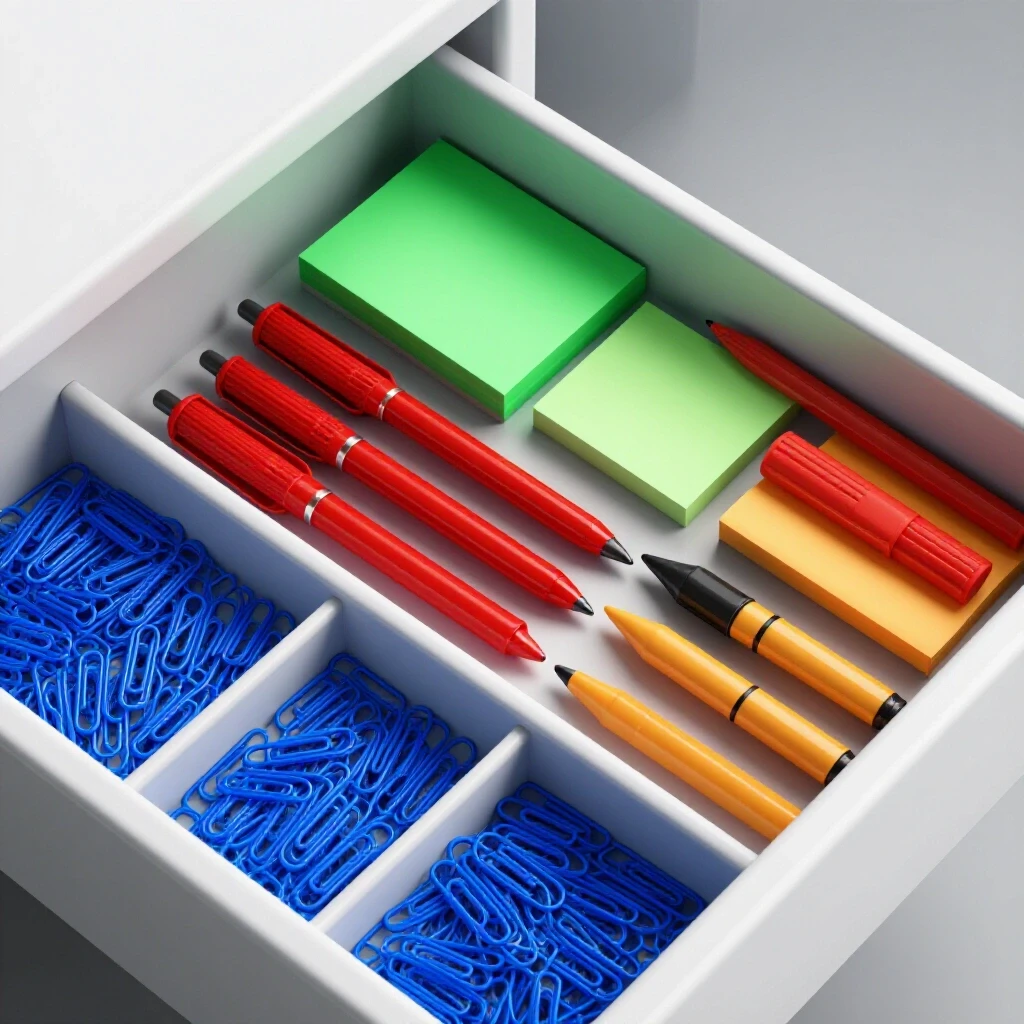
The Logistics of Spatial Friction in Residential Workspaces
Spatial friction refers to the number of physical and cognitive steps required to retrieve or return an item to its designated spot. In a high-friction environment, items are left on surfaces because the effort to open, sort, and place them back in a drawer feels too taxing during a busy workday. Reducing this friction is the foundation of sustainable decluttering.
In logistics, we measure “touches.” Every time you touch an item to move it out of the way, you are wasting energy. In a home setting, if you have to move a stapler to get to a notepad, you have a friction problem. Research in environmental psychology suggests that visual clutter in our immediate workspace increases cortisol levels and reduces focus. This is especially true for parents who are already managing the mental load of a household.
When I audited our family’s workspace, I found that our storage solutions for families were failing because they required too many “touches.” We had deep bins where everything was piled together. To find a single paperclip, you had to dig. This is “high-retrieval friction.” To fix this, we shifted toward shallow, compartmentalized layouts where every item is visible and accessible in a single motion.
Measuring Storage Efficiency with the Friction Index
To understand why some systems endure while others fail, I developed a simple metric called the Storage Friction Index. This helps categorize how much “work” a drawer requires.
| Storage Method | Retrieval Steps | Sorting Speed | Reversion Risk |
|---|---|---|---|
| Open Deep Bin | 4-6 steps | Slow (Digging) | High |
| Stacked Trays | 3-5 steps | Medium | Moderate |
| Fixed Dividers | 1-2 steps | Fast (Visual) | Low |
| Modular Inserts | 1 step | Instant | Minimal |
Why Most Desk Storage Fails Within Days
System failure occurs when the spatial capacity limits of a storage unit are exceeded or when the “inflow” of items is faster than the “outflow.” Most people organize based on how things look on day one, without accounting for the daily influx of mail, school forms, and office supplies that a real family generates.
When we talk about reducing household clutter, we have to look at the “feedback loop” of the space. If a drawer is too hard to close because it’s overstuffed, the user will eventually stop using it altogether. This leads to “surface creep,” where the clutter migrates from the drawer back onto the desktop. In our home, I noticed that my children would never put a pen back if they had to slide a heavy tray out of the way first.
Environmental psychology journals highlight that “decision fatigue” plays a huge role here. If a drawer is a mess, your brain has to work harder to find what it needs. Over time, you subconsciously avoid the drawer. A long-lasting system must remove the need to make decisions. There should be only one logical place for every item, and that place should be easy to reach.
Common Logistics Bottlenecks in the Home Office
- Over-categorization: Creating too many tiny categories makes the system too complex to maintain.
- Opaque Containers: If you can’t see it, you forget you have it, leading to duplicate purchases.
- Poor Volume Metrics: Using a large bin for small items leads to “nesting” clutter.
- Fixed Layouts: High-rigidity systems cannot adapt as your children grow or your job duties change.
Implementing a High-Speed Sorting Framework
A sorting framework is a repeatable process used to categorize and move items from a state of chaos into a structured system. Instead of “cleaning,” we use “sorting,” which is a data-driven approach to managing inventory. This method focuses on the frequency of use rather than the type of item.
When I redesigned our workspace, I used a 15-minute time-box interval for sorting. This prevents the mental fatigue that comes with a four-hour “decluttering marathon.” We categorized items into three zones based on their “flow rate”—how often they are touched in a typical week.
- Zone A (Daily Use): Items like pens, charging cables, and current notebooks. These must be in the front of the drawer.
- Zone B (Weekly Use): Items like staplers, calculators, or tape. These sit in the middle or back.
- Zone C (Monthly/Archival): Extra ink, bulk paper, or tax records. These are moved out of the primary drawer and into deep storage.
The Decluttering Sorting Log
Using a log helps you see the reality of your space utilization. In our family, we tracked what we actually used over two weeks to determine our real storage needs.
- Total Items Audited: 120
- Items Used Daily: 15 (12.5%)
- Items Used Weekly: 25 (20.8%)
- Items Never Touched: 80 (66.7%)
By identifying that 66.7% of our drawer contents were “dead weight,” we were able to reclaim massive amounts of space without buying a single new piece of furniture.
Selecting Resilient Materials for Modular Organizers
Material resilience is the ability of a storage component to withstand daily wear and tear without warping, cracking, or becoming difficult to clean. For a system to last years rather than weeks, the physical components must be as durable as the logic behind them.
I have tested various materials over the last decade. While thin plastic is common, it often slides around or cracks under the weight of metal tools. High-density polymers or sustainable bamboo inserts provide the weight necessary to stay in place when a drawer is opened quickly. This is a key part of functional home storage; if the dividers shift every time you move the drawer, the system breaks down.
From a logistics standpoint, we look at “system friction” caused by poor fit. If a divider is 1/4 inch too small, it will rattle. Using museum gel or non-slip liners to “lock” your modular units into place is a professional-grade trick that prevents the “jumbled mess” effect.
Material Durability Comparison
| Material | Resilience Score | Cleaning Ease | Stability |
|---|---|---|---|
| Thin Clear Plastic | Low | High | Low |
| Heavy-Duty Acrylic | High | High | Medium |
| Bamboo/Wood | Medium | Moderate | High |
| Felt/Fabric | Low | Low | Medium |
Creating a Functional Zoning Map for Your Drawer
A zoning map is a visual plan that dictates exactly where each category of item lives within a drawer based on ergonomic reach and frequency of use. It transforms a generic storage space into a high-performance tool tailored to your specific workflow.
In our home, we mapped our drawers using the “Prime Real Estate” principle. The front three inches of any drawer are the most valuable. This is where we placed the items my kids need for homework and the tools I need for quick meetings. By keeping the most-used items in this “Hot Zone,” we reduced the physical distance our hands had to travel by 70% over the course of a day.
When you design your map, consider the “swing” of the drawer. Items at the very back are the hardest to reach and should be reserved for things you only need once a month. This simple change in spatial management can reduce daily stress significantly because you are no longer fighting the furniture to get your work done.
Steps to Map Your Workspace Drawers
- Measure the Interior: Record the exact length, width, and depth.
- Identify the Hot Zone: Mark the front 30% of the drawer for daily essentials.
- Group by Silhouette: Place long items (rulers, pens) together and small items (clips, stamps) in square modules.
- Leave “White Space”: Aim for 10-15% empty space to allow for new inflows without overstuffing.
Sustainable Habit Loops for Family Maintenance
A habit loop is a psychological trigger that leads to a routine, which then provides a reward. In a home organization system, the trigger is finishing a task, the routine is putting the tool back in its zone, and the reward is a clear workspace the next morning.
For our family, the “5-Minute Reset” became our most powerful tool. Every evening before dinner, we do a quick sweep of the workspace. Because we have a low-friction system with modular dividers, “putting things away” takes seconds rather than minutes. We don’t aim for perfectly organized; we aim for “reset for tomorrow.”
Organizational behavior studies show that systems fail when they are too rigid for the “weakest link” in the family. If your system requires a label-maker and color-coding for every single paperclip, the rest of your family will likely abandon it. Our system succeeds because it is “chunky.” Instead of a specific slot for a blue pen and a black pen, we have a “Writing Utensils” zone. This reduces the cognitive load of tidying up.
Daily Maintenance Timelines by Family Size
The time required to maintain a system depends on the number of users. A well-designed drawer system should keep these times low.
- 1-2 Adults: 2 minutes per day.
- 2 Adults + 1 Child: 4 minutes per day.
- 2 Adults + 3 Children: 7 minutes per day.
Actionable Metrics for Long-Term Success
To ensure your system is actually working, you can track a few simple metrics. These aren’t meant to be chores, but rather “health checks” for your home. If these numbers start to slip, it’s a sign that your system needs a minor adjustment rather than a total overhaul.
- Item Density: No drawer should be more than 85% full. This allows for easy retrieval without snagging.
- Search Time: You should be able to find any item in under 5 seconds.
- Reversion Rate: How many days does it take for the “junk” to start appearing? If it’s less than 7 days, your categories are too broad or your friction is too high.
- Inflow/Outflow Balance: For every new set of markers that enters the drawer, an old or dried-out set must leave.
Tools for Sustaining Your System
- Non-Slip Drawer Liners: Prevents modular units from shifting.
- Adjustable Tension Dividers: Great for deep drawers or changing needs.
- Simple Bold Labels: Use a basic font that is easy for children to read.
- Clear Modular Trays: Allow for visual inventory checks at a glance.
Conclusion: The Path to a Low-Stress Workspace
The key to a workspace that stays tidy isn’t found in a specific brand of container or a complex sorting method. It is found in the reduction of friction and the alignment of the system with the actual behaviors of your family. By focusing on durability, visibility, and ease of use, you can create a space that supports your work rather than adding to your mental load.
My 11 years in logistics have taught me that the best systems are often the simplest. When we stop chasing an idealized version of “neat” and start focusing on “functional,” we reclaim our time and our peace of mind. Start with one drawer, map your zones, and commit to a five-minute reset. You will find that the stress of clutter begins to fade when the system finally works for you, instead of you working for the system.
Frequently Asked Questions
Why do my desk drawers always get messy again so fast?
This usually happens because the “retrieval friction” is too high or the “spatial capacity” has been exceeded. If it takes more than one motion to put an item away, you are more likely to leave it on the desk. Additionally, if the drawer is more than 90% full, items will shift and overlap, creating instant chaos.
What is the best material for drawer dividers in a high-use home?
Heavy-duty acrylic or high-quality wood/bamboo are the best for long-term use. They have the weight and structural integrity to stay in place. Avoid thin, flimsy plastics that warp or slide around, as they increase the frustration of the system.
How do I get my kids to follow the organization system?
Keep the categories “chunky” rather than specific. Instead of having a spot for every individual type of crayon, have one large bin for “Coloring.” Use clear labels with simple words or even pictures. The goal is to make putting things away as easy as dropping them in a bucket.
Do I really need to label everything?
Labels act as a “spatial contract” for the family. They remind everyone exactly where things go, which reduces decision fatigue. You don’t need to label every tiny thing, but labeling the main zones (e.g., “Mail,” “Tech Cables,” “Writing”) helps maintain the system over months.
How often should I “re-organize” my workspace?
If the system is designed correctly, you should never have to do a “total overhaul” again. Instead, perform a 5-minute reset daily and a “volume check” once a month to remove items that are no longer being used.
What should I do with items that don’t fit into a category?
Every drawer should have a small “Utility Zone” (no more than 5% of the space) for miscellaneous items. However, if this zone starts to grow, it’s a sign that you need to create a new category or declutter those items.
How do I prevent dividers from sliding around when I open the drawer?
Use non-slip drawer liners or small amounts of museum gel/mounting putty on the bottom of your modular inserts. This keeps the layout “locked” in place, maintaining the integrity of your zoning map.
Is it better to have one large tray or many small modules?
Many small, modular units are superior because they allow for “silhouette grouping.” This prevents small items like paperclips from getting lost under larger items like notebooks. Modular units also allow you to adjust the layout as your needs change over the years.
How do I handle the influx of paper in my desk drawers?
Paper is a “high-flow” item. It should have its own dedicated vertical slot or tray. Never mix paper with “hard goods” like pens or tools. In a drawer, use a specific divider for “To Process” and “To File” to keep the flow moving.
What is the “One-Touch Rule” in home logistics?
The One-Touch Rule suggests that you should aim to handle an item only once to put it away. If you have to move three things to put a stapler back, that is “four touches.” A successful drawer system aims for a single touch for both retrieval and return.
(This article was written by one of our staff writers, Christopher Bennett. Visit our Meet the Team page to learn more about the author and their expertise.)