How to Organize a Shared Closet for Two People (Step-by-Step Guide)

“I feel like I spend every Sunday afternoon folding clothes, but by Tuesday, I can’t even see the floor of our shared closet. We just keep shoving things in until it explodes. My spouse and I are both working full-time, and we simply don’t have the energy to fight the clutter every single morning.”
The Science of Spatial Constraints in Shared Storage
Spatial constraints refer to the fixed physical boundaries of a storage area that limit the volume of items it can hold. Understanding these limits is essential for two people sharing one area because it prevents the over-saturation of the space, which leads to visual clutter and increased daily stress.
In my eleven years working in operations and logistics, I have seen how industrial warehouses fail when they exceed 85% capacity. Residential spaces operate under the same laws of physics. When a shared wardrobe reaches its maximum volume, the “flow” of items—taking things out and putting them back—stalls. Environmental psychology research suggests that visual clutter in high-traffic areas like a bedroom can spike cortisol levels. This is particularly true for busy parents who already face high cognitive loads.
When two people share a single footprint, the complexity of the system doubles. We aren’t just managing clothes; we are managing the intersection of two different sets of habits. In my own home, my wife and I realized that our “decluttering journey” failed because we ignored the physical reality of our closet’s square footage. We were trying to fit 120% of our belongings into 100% of the space. To build sustainable decluttering habits, you must first acknowledge that the walls will not move.
Defining Retrieval Friction and System Failures
Retrieval friction is the measurable amount of effort, time, and number of physical steps required to access or put away an item. High friction occurs when you have to move three things to get to one, leading to “clutter reversion” where items are left on the floor instead of being properly stored.
In logistics, we measure “touches.” Every time you touch an item to get to another item, you add friction. For a busy professional, a system with more than two “touches” will likely fail within a week. If you have to move a stack of sweaters to reach a pair of jeans, you are experiencing high friction.
- Low Friction: One-handed access, no moving other items.
- Medium Friction: Moving one item or opening a lid.
- High Friction: Moving multiple items, unstacking bins, or using step ladders.
Conducting a Residential Logistics Audit for Two Users
A residential logistics audit is a data-driven assessment of how much clothing you own versus the actual cubic feet available for storage. By measuring the volume of garments and comparing it to the linear feet of hanging rods and shelf space, you can identify the exact “bottlenecks” causing your daily frustration.
To start, you need to know your numbers. Most people guess how much space they need, but logistics professionals measure. Use a standard measuring tape to find the total linear inches of your hanging rods and the square footage of your shelves. This is your “Available Capacity.”
Calculating Item Density and Flow Rates
Item density is the number of garments stored within a specific unit of measurement, such as “items per foot” of rod space. Flow rate refers to how quickly items move from the laundry basket back into the closet. High density often slows down the flow rate, causing laundry backlogs.
In a shared environment, density must be managed carefully. If one person uses 70% of the rod, the other is left with 30%, creating a spatial imbalance that leads to friction.
| Storage Method | Items Per Linear Foot (Avg) | Retrieval Step Count (1-5) | Friction Level |
|---|---|---|---|
| Hanging (Standard) | 10-12 | 1 | Low |
| Hanging (High-Density) | 20-25 | 3 | High |
| Open Shelving (Folded) | 8-10 | 1 | Low |
| Lidded Bins | 15-20 | 4 | Very High |
| Vertical Stacking | 12-15 | 2 | Medium |
Designing Low-Friction Zoning Systems for Couples
Zoning is the practice of dividing a shared space into dedicated “territories” based on frequency of use and individual ownership. By establishing clear boundaries and “prime real estate” zones, you reduce the decision fatigue associated with searching for items in a mixed-use environment.
When my family redesigned our shared storage, we applied the “Golden Zone” principle used in retail ergonomics. The Golden Zone is the area between your shoulders and knees. This is where your most-used items should live. Items used less than once a week go high or low.
Vertical Stacking vs. Horizontal Hanging Efficiency
Vertical stacking involves storing items in upright rows (often seen in drawer filing), while horizontal hanging uses the traditional rod system. Choosing between these depends on your specific spatial limits; hanging is faster for retrieval, while vertical stacking often fits more volume into a smaller footprint.
For home organization systems to be sustainable, they must account for the “sorting speed” of the slowest user. If one partner is naturally less organized, the system must be extremely simple.
- Hanging Zone: Best for professional attire, dresses, and coats.
- Shelf Zone: Best for bulky items like sweaters or denim.
- Vertical Zone: Best for t-shirts and activewear to maximize depth.
Reducing Operational Friction in Wardrobe Maintenance
Operational friction reduction is the process of simplifying storage hardware and routines to make “putting away” as easy as “taking out.” This involves removing lids, using open-front bins, and ensuring that every item has a specific, reachable home that requires minimal effort to maintain.
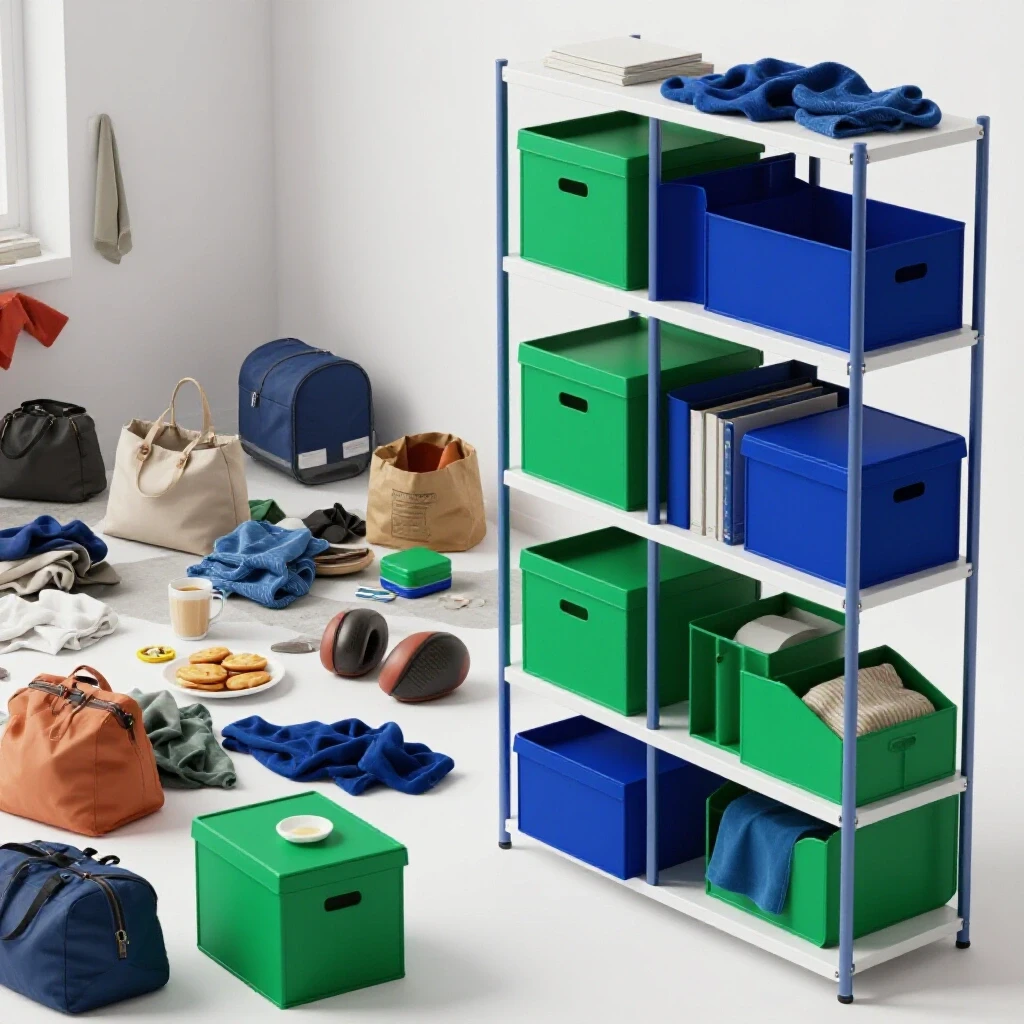
Many functional home storage solutions fail because they look good in photos but are hard to use. A clear bin with a tight lid looks “clean,” but if you have to unstack three bins to put away one shirt, you will eventually stop doing it. This is why many households revert to clutter within days.
Why High-Friction Bins Lead to Rapid Clutter Reversion
High-friction bins are containers that require multiple physical actions to open, close, or access. When a system requires too much effort, the human brain seeks the path of least resistance, which usually results in “the chair” or the floor becoming the default storage spot.
- The Lid Problem: Lids are the primary enemy of sustainable decluttering. They add a step to every interaction.
- The Stacking Trap: Stacking bins makes the bottom items “dead stock.” You will forget they exist, or you will be too tired to reach them.
- Visual Processing Overload: If you can’t see what is inside a bin, your brain treats it as a “clutter box,” leading to mental fatigue.
Implementing Modular Frameworks for Fixed Dimensions
Modular frameworks are adjustable storage components that can be reconfigured as your needs change without requiring structural renovations. These systems allow two people to customize their respective “zones” within the same closet shell, ensuring that the physical space is used to its maximum efficiency.
For families with limited time, modularity is a lifesaver. As seasons change or jobs change, your wardrobe needs change. A fixed rod might work today, but adjustable shelving might be better next year.
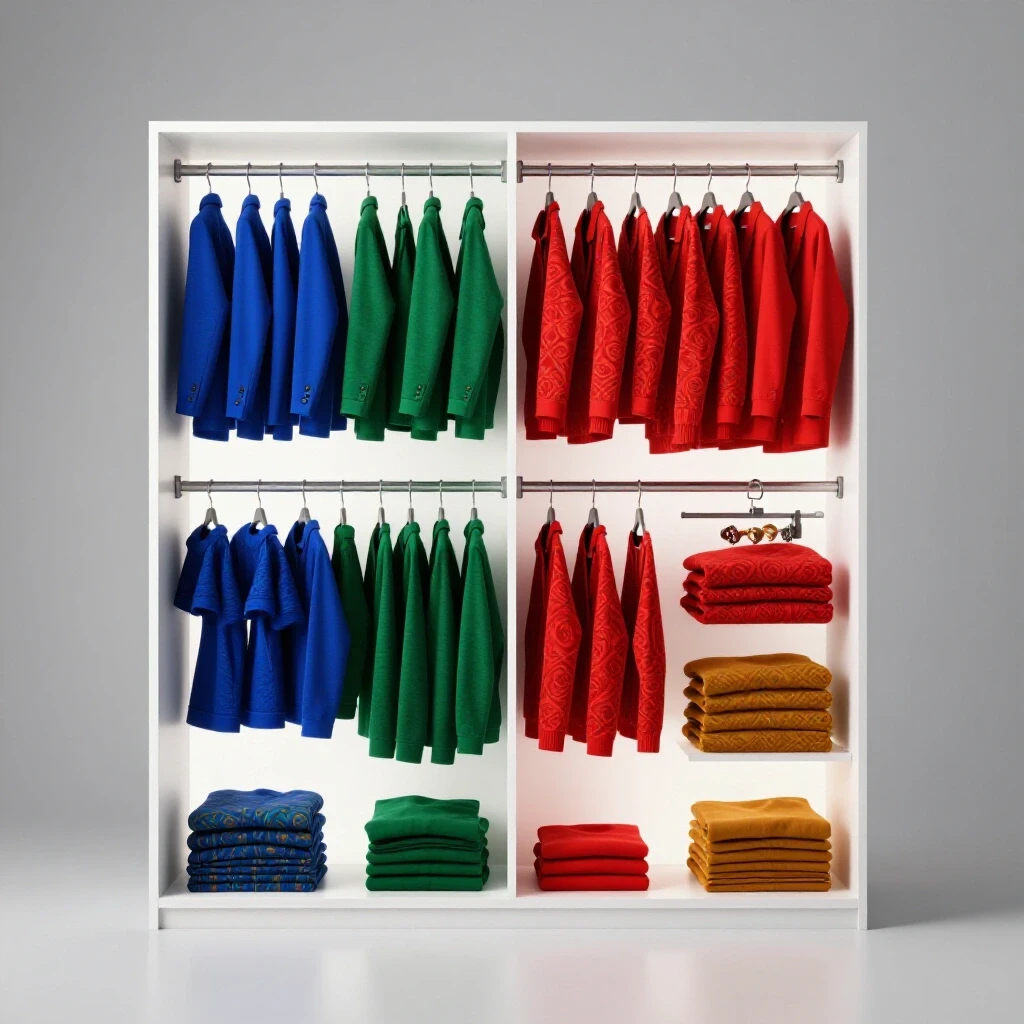
- Adjustable Rods: Allow for “double hanging” (one rod above another) to double the capacity for shorter items like shirts and folded pants.
- Shelf Dividers: Keep stacks of clothes from toppling over into each other’s territory.
- Pull-out Components: Increase visibility for deep shelves where items often get lost in the back.
The Psychology of Visual Overload in Small Spaces
Visual overload occurs when the brain is forced to process too many competing stimuli in a single field of vision, leading to decreased focus and increased anxiety. In a small, shared closet, reducing visual “noise” through uniform hangers and consistent folding patterns can significantly lower daily stress.
Research in the journal Environment and Behavior highlights that “visual complexity” in the home is directly linked to how we perceive our ability to manage our lives. When you open a closet and see a chaotic mix of colors, textures, and falling piles, your brain enters a state of “high alert.”
Reducing Household Clutter Through Uniformity
Uniformity in storage tools—such as using only one type of hanger—is not just about aesthetics. It is about reducing the “visual weight” of the space. When all hangers are the same height and width, your eyes can more easily scan the garments themselves rather than the hardware.
- Metric: Standardizing hangers can reclaim up to 20% of horizontal rod space compared to a mix of plastic, wood, and wire hangers.
- Metric: Using open bins for “sub-sorting” (like socks or belts) reduces search time by an average of 30 seconds per outfit.
Sustaining Order Through System Feedback Loops
A system feedback loop is a regular check-in or “maintenance sprint” designed to catch small misalignments before they turn into full-scale clutter. For two people, this means a five-minute weekly reset to ensure items haven’t crossed “territory lines” and that the density remains manageable.
In my home, we use a “One In, One Out” rule. Because our physical space is a fixed variable, we cannot add a new item without removing an old one. This keeps our volume at that critical 85% capacity mark.
Daily Maintenance Timelines by Family Size
The amount of time required to maintain a system is directly proportional to the number of users and the complexity of the storage. For two adults, a low-friction system should take no more than 3-5 minutes of “reset” time per day.
| Family Member | Daily Reset Time | Weekly Audit Time | Monthly Purge Time |
|---|---|---|---|
| Adult 1 | 2 Minutes | 10 Minutes | 15 Minutes |
| Adult 2 | 2 Minutes | 10 Minutes | 15 Minutes |
| Total | 4 Minutes | 20 Minutes | 30 Minutes |
Practical Next Steps for Shared Spatial Success
Transitioning to a functional, low-stress shared environment doesn’t happen in a single afternoon. It requires a shift from “cleaning” to “systems design.” Start by identifying your highest-friction point—is it the pile of shoes on the floor or the overstuffed hanging rod?
- Measure your capacity: Spend 10 minutes today measuring your linear rod space and shelf depth.
- Define the territories: Use a piece of masking tape to mark exactly where one person’s space ends and the other’s begins.
- Audit your “touches”: For the next three days, count how many things you have to move to get your morning outfit.
- Eliminate lids: Remove the lids from any bins you use daily to immediately lower the retrieval friction.
- Standardize your hardware: Replace mismatched hangers with a single style to reduce visual noise and gain horizontal space.
By focusing on the logistics of the space rather than just the “neatness,” you create a system that can survive a busy work week. You aren’t looking for a “perfect” closet; you are looking for a system that works as hard as you do.
Frequently Asked Questions
How do we decide who gets more space in a shared closet?
Space should be allocated based on the actual volume of clothing each person owns, rather than a 50/50 split. Conduct a “linear inch” audit of both wardrobes. If one person has 60 inches of hanging clothes and the other has 40, the rod should be divided 60/40 to prevent one side from becoming over-compressed and high-friction.
What is the best way to handle seasonal clothing in a small shared space?
If the closet has reached its physical limit, seasonal rotation is necessary. Store off-season items on the highest shelves (the “Cold Zone”) in breathable, labeled bags. This keeps the “Golden Zone” (eye-to-waist level) dedicated to current-season items, reducing the daily time spent digging through heavy coats in the summer.
How can we prevent “clutter creep” from one person’s side to the other?
Clear physical boundaries are essential. Use shelf dividers or a distinct gap on the hanging rod to create a “no-man’s land” of about two inches. This visual and physical break acts as a stop-gap, making it immediately obvious when one person’s wardrobe is exceeding its allocated spatial limit.
Why does my closet get messy again just days after I organize it?
This usually happens because the “put-away friction” is too high. If your system requires you to perfectly fold items into deep stacks or use complex bin systems, you will likely abandon it when you are tired. Switch to “low-touch” solutions like open bins or hooks for items you use daily.
Are “space-saving” hangers actually effective for two people?
Slim-profile velvet hangers are effective because they reduce the “hardware volume” of the closet. They allow you to fit more garments in the same linear footage without the bulk of plastic or wood. However, they do not solve the problem of owning more clothes than the closet can physically hold; they only buy you about 15-20% more room.
How do we manage shoes without taking up all the floor space?
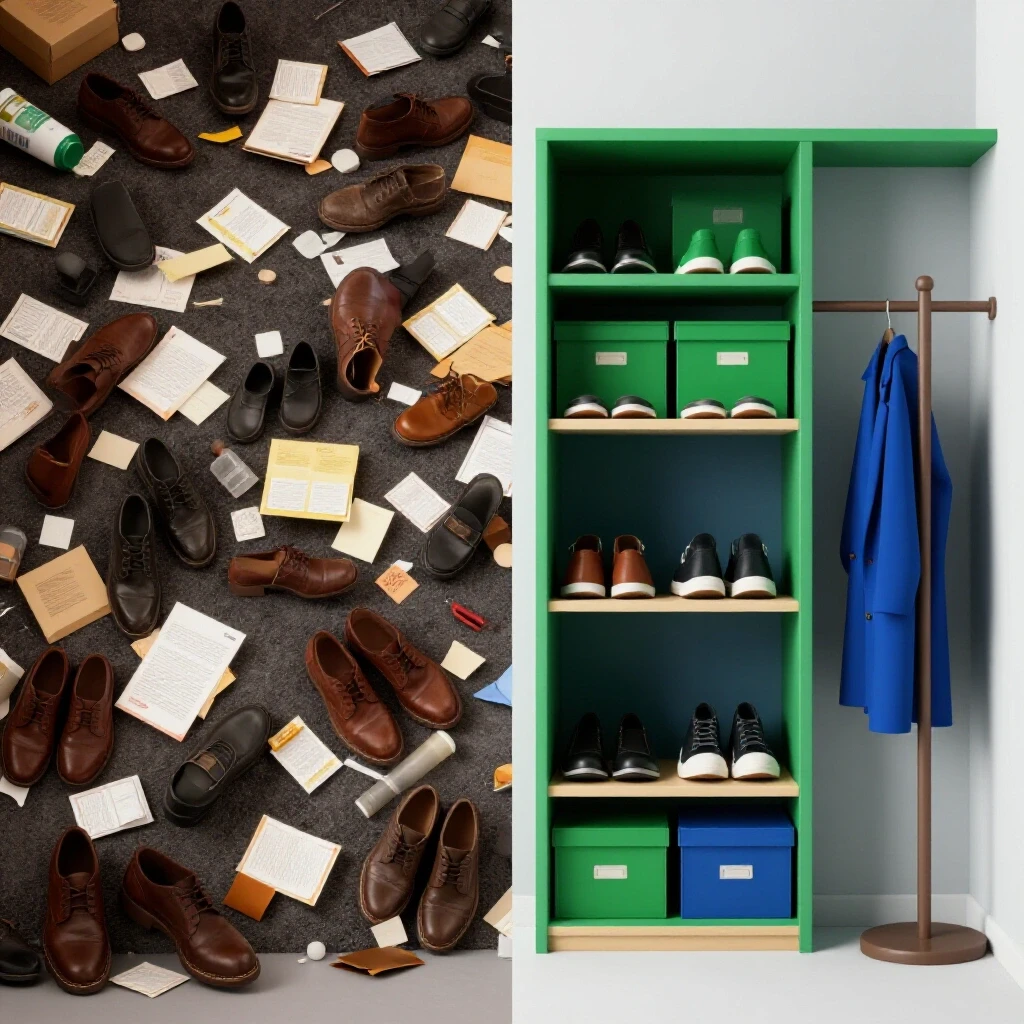
Move shoes off the floor and onto vertical shelving or over-the-door organizers. Floor space is “high-friction” because you have to bend down and search. Vertical shoe storage at waist or eye level makes retrieval faster and keeps the floor clear, which significantly reduces the visual perception of clutter.
What should we do if our closet has no shelves, only a single rod?
You can “manufacture” vertical space by adding hanging shelf units or a second “tension rod” below the main one. This creates a double-hang system, which is the most efficient way to use vertical space for shorter items like shirts, skirts, and folded trousers.
How often should a shared closet be “audited” for space?
A quick 10-minute “reset” should happen weekly, usually on laundry day. A deeper audit should occur every six months during seasonal shifts. This ensures that items no longer being worn are removed, keeping the total volume below the 85% capacity threshold where the system begins to fail.
Can labels really help two adults stay organized?
Yes, but not for the reasons you think. Labels aren’t just for finding things; they define the “purpose” of a space. When a shelf is labeled “Activewear,” it creates a psychological barrier against putting a sweater there. For couples, labels prevent the “I didn’t know where it went” excuse that leads to clutter.
What is the most common mistake couples make when sharing a closet?
The most common mistake is prioritizing aesthetics over ergonomics. Many couples buy matching bins with lids and hidden storage because it looks “clean.” In reality, these systems are too hard to maintain during a busy work week, leading to clothes being piled on top of the bins rather than inside them.
(This article was written by one of our staff writers, Christopher Bennett. Visit our Meet the Team page to learn more about the author and their expertise.)